
Conjoint analysis beats direct price questions because it removes the guesswork from a stated number. Ask someone what they would pay and you get an opinion pulled out of thin air, one that drifts upward and carries no information about trade-offs. Put that person in repeated choices between priced alternatives instead, and the money value of every feature falls out of the model.
The mechanism matters as much as the result. A direct question asks for a valuation of a product that has no alternative attached to it, so the respondent is effectively guessing what a market would pay. Conjoint analysis instead observes a sequence of real decisions and works backwards, which is why its estimates of willingness to pay, price elasticity and demand behave like market data rather than opinions. In 2026, most serious pricing teams treat that difference as settled and budget sample size accordingly.
What follows is a practical comparison: what each method actually measures, where conjoint earns its keep, where a direct question is still the smarter tool, and how to design a conjoint study that survives a finance review.
Table of Contents
- Why Conjoint Analysis Beats Direct Price Questions at a Glance
- How Direct Price Questions Work
- How Conjoint Analysis Measures Trade-Offs
- Why Conjoint Analysis Beats Direct Price Questions for Price Decisions
- Where Direct Price Questions Can Be Better
- Choosing the Right Conjoint Design
- How to Reduce the Limitations of Conjoint Analysis
- Which Should You Choose?
- Frequently Asked Questions
- Is conjoint analysis always better than asking the target price directly?
- What sample size does a useful conjoint analysis need?
- Can conjoint analysis measure willingness to pay accurately?
- How many attributes and levels should a conjoint survey include?
- Should direct price questions be used alongside conjoint analysis?
- What is the main disadvantage of conjoint analysis?
- Conclusion
Why Conjoint Analysis Beats Direct Price Questions at a Glance
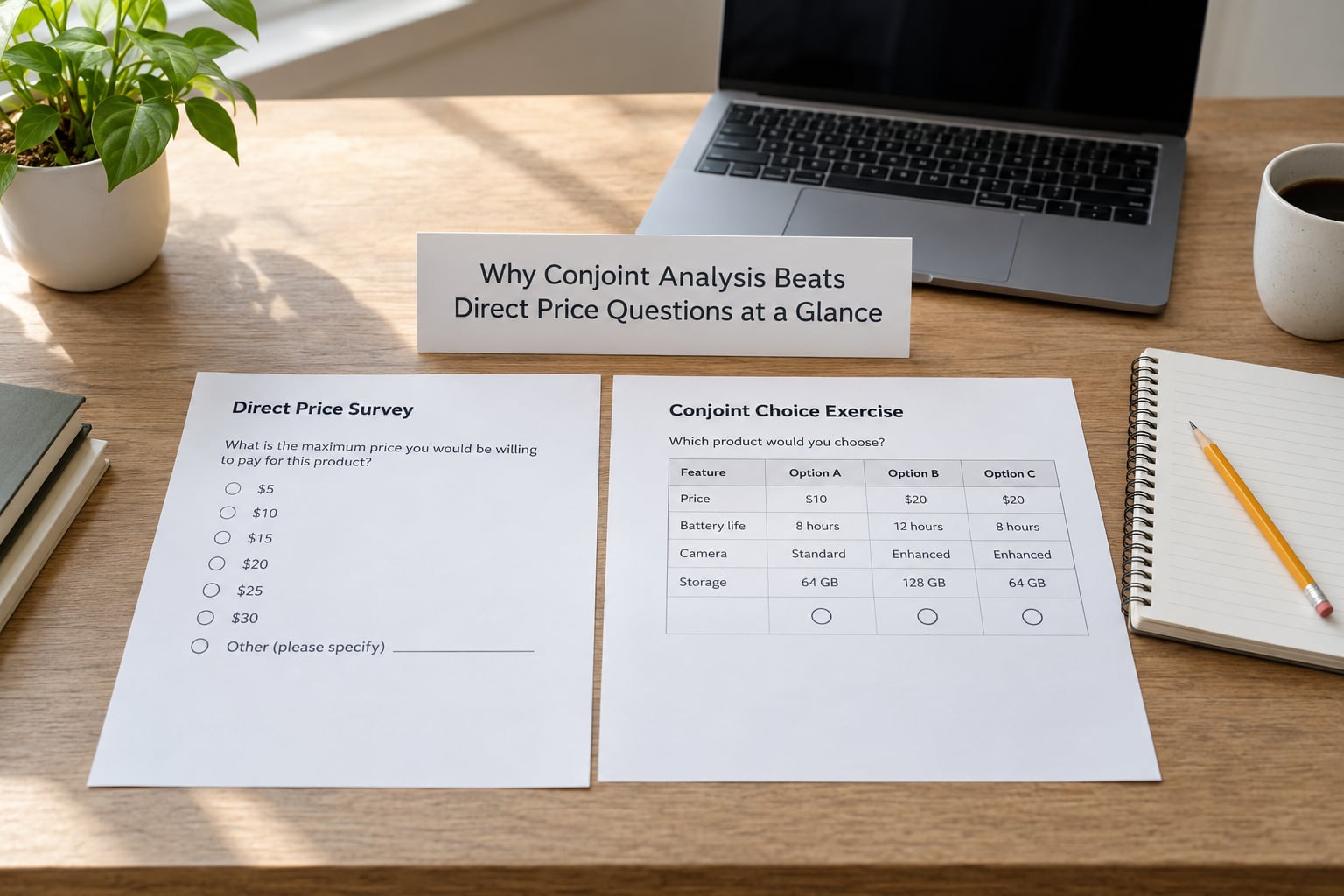
| Criterion | Direct price questions | Conjoint analysis |
|---|---|---|
| Research question | Would you buy this at one price? | Which of these alternatives do you choose, and what is each attribute worth? |
| Respondent effort | A few seconds per question | Eight to twelve deliberate choice tasks |
| Trade-offs | None, features are judged in isolation | Forced on every single task |
| Willingness to pay | One stated number, wide and inflated | Derived per attribute from part-worths, then simulated |
| Response bias | Strategic answering, social desirability, anchoring, hypothetical bias | Hypothetical bias, fatigue, unrealistic bundles |
| Output | A price range per respondent | Part-worths, demand curve, share simulation, segments |
| Cost and timing | Minutes, small sample | Weeks, several hundred to a thousand completes |
| Best used for | Screening an idea, one simple price question, early reactions | Setting or changing a price, tier design, feature prioritisation |
Read the bias row and the cost row together, because they trade against each other. Direct questioning is cheap and therefore tempting, but the number it produces is the one most likely to be wrong in a way nobody can detect. The table is not an argument that conjoint is always the right answer. It is an argument about which number you can defend in a pricing meeting six months later.
How Direct Price Questions Work
A direct price question is simple. The researcher shows a product, a description or a picture, and asks what the respondent would pay for it, or whether they would buy it at a given figure. Sometimes the price is open-ended, sometimes the respondent picks from a ladder. It feels intuitive to everyone in the room, which is part of why it survives.
That intuitiveness hides four distinct failure mechanisms, and they are worth separating because each one needs a different fix:
- Strategic answering. People infer what you want. A customer who suspects you are about to launch a product prices it generously, and a buyer who wants a discount prices it low.
- Social desirability. Some respondents refuse to name a figure they read as unreasonable, others want to look like careful buyers.
- Hypothetical bias. The product was never on a shelf, so the buyer never had to weigh the price against an alternative use of the money.
- Anchoring and rounding. In a sequential price ladder such as the Gabor-Granger method, the first price shown pulls every later answer toward it, and most respondents settle on round numbers rather than real budgets.
The scale of the hypothetical problem is documented rather than anecdotal. Schmidt and Bijmolt’s meta-analysis pooled 77 studies and 115 effect sizes and found stated willingness to pay running about 21 percent above real willingness to pay for consumer goods. Murphy and colleagues reported a median ratio of 1.35 between hypothetical and real willingness to pay across 28 studies, and List and Gallet found overstatement running well past two times in a review of 29 studies.
The direction of the error is the problem for a pricing team. Inflated willingness to pay pushes a list price upward, and a list price set from opinions reliably overshoots what the market will absorb.
How Conjoint Analysis Measures Trade-Offs
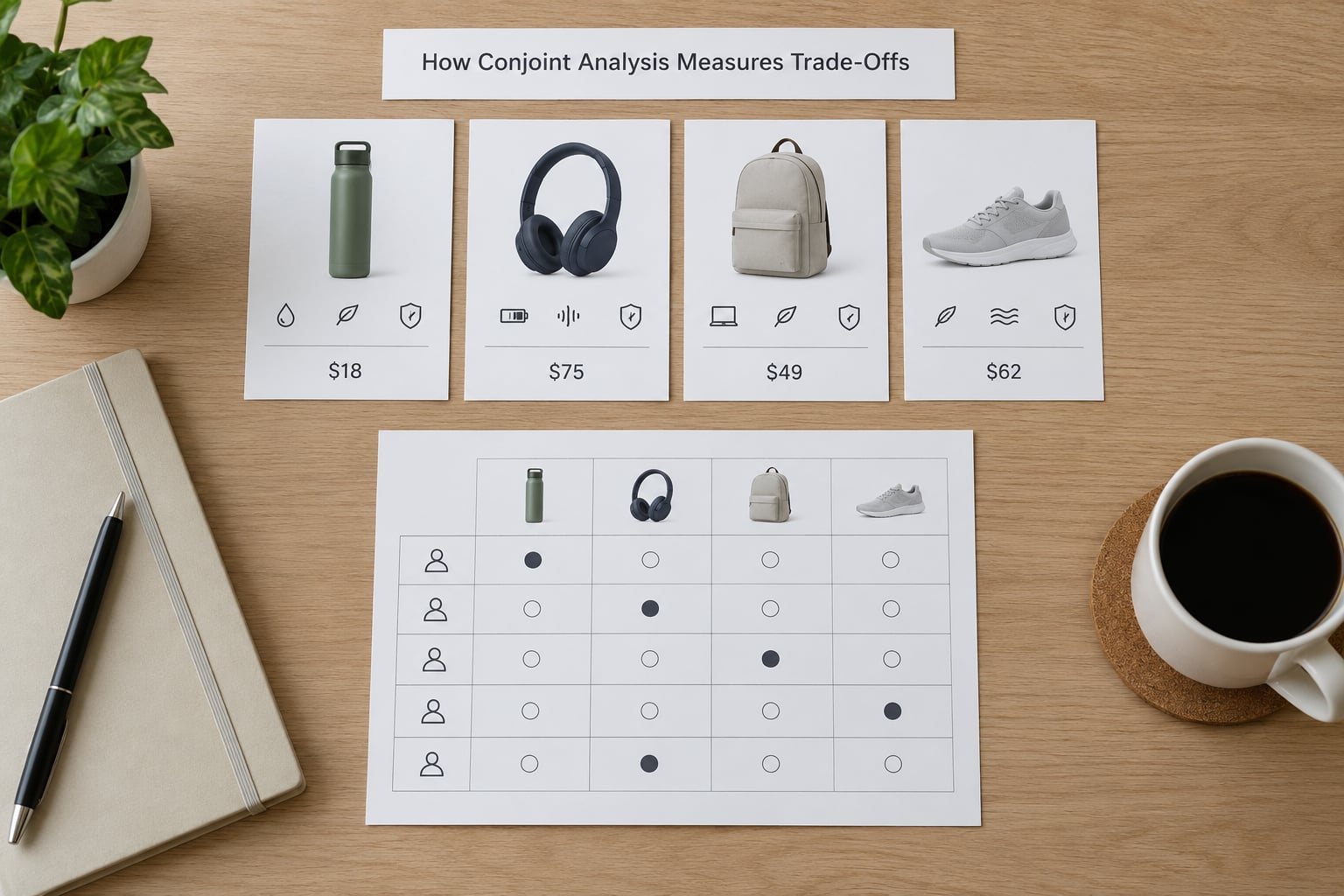
Conjoint analysis inverts the problem. Instead of asking for a value, it builds a set of hypothetical offers that differ on several attributes at once, including price, and asks respondents to pick one. Choice-based conjoint, usually shortened to CBC, is the standard format. Adaptive designs adjust the offers shown to each respondent, and MaxDiff is a related technique for ranking features rather than choosing bundles.
Each task looks trivial. Across twenty of them the pattern is not trivial at all. A mixed logit or conditional logit model estimates a part-worth utility for every attribute level, and the spread between levels is the money value of that feature. Because the price attribute sits in the same design as the features, the model produces a demand curve rather than a single number.
That output is what direct questioning cannot reach. Part-worths let you simulate what happens to revenue and share when a price moves, when a feature is added to a tier, or when a competitor raises their price. You can build a price ladder, test good-better-best packaging, and cut the results by segment rather than averaging away the difference between a small business buyer and an enterprise one.
Why Conjoint Analysis Beats Direct Price Questions for Price Decisions
Put plainly: for a consequential pricing decision, conjoint gives a more reliable number, and it gives a number you can model with. It forces respondents to choose among realistic alternatives instead of inventing an isolated figure, which removes strategic answering from the price attribute for most of the sample. It converts the same effort into multiple outputs, so a single study can price a product, design three tiers and rank the roadmap, instead of answering one question three times.
It also produces the kind of estimate that can be checked against reality. A holdout set of choice tasks that the model never saw gives a predictive error figure, so you can say how well the study reproduces observed behaviour rather than asserting that it will. For calibration, Bijmolt, van Heerde and Pieters pooled 1,851 price elasticities from 76 studies and found an average of about -2.62, which is the benchmark a new estimate should be sanity-checked against.
Where Direct Price Questions Can Be Better
Direct questioning is not a failed experiment. It wins on cost, speed and comprehension, and there are jobs it does better than any choice design.
- Cheap and fast. A price ladder across two hundred people takes an afternoon. A CBC study with a sound design takes weeks and a real sample budget.
- Easy to explain. Executives and customers understand the question immediately, which matters when the result has to survive a meeting without a primer on utility scores.
- Good at screening. Before a concept exists, a direct question is an honest test of whether the idea is even in the running.
- Rich open-ended reactions. Follow an open price question with a why, and you get the reasoning behind the number, which a choice task deliberately does not collect.
The honest version of the verdict is that direct questions narrow a range and conjoint narrows it further. If you need one simple figure for one simple decision, the cheap method is the right tool. Pricing a launch, a tier change or an increase is not that.
Choosing the Right Conjoint Design
Conjoint fails more often at the design stage than at the analysis stage. The decisions that matter most are the ones below.
- Choice tasks over ratings. Ask respondents to choose rather than to rate. Ratings invite everyone to call a 7 out of 10 acceptable and collapse the differences you are trying to measure.
- Attribute selection. Pick four to six attributes a buyer would actually weigh. Include price as one attribute among several, never as the only variable.
- Level ranges. Set price levels around your realistic market, not an absurdly wide sweep. A test that nobody ever chooses teaches you nothing. In a cordless kitchen machine category, prices pitched far above the category ceiling simply produce non-choices.
- Task and sample size. Eight to twelve choice tasks per respondent, with a sample in the few hundreds to around a thousand completes, is the usual working range for pricing decisions. The sample has to cover the segments you plan to cut by.
- Screen and motivate. Qualify for category usage before the tasks, then include a none option so that people who want none of the offers are allowed to say so. Without it, part-worths are inflated by respondents who were never in the market.
- Randomise and blind. Randomise the order of levels and options, keep brand names off the profiles, and hold a set of tasks back for the predictive check.
A minimal design sheet for a subscription product might list storage, seat count, support level and price as attributes, with three or four levels each, which is enough structure to start a pilot. Pilot it first. A short run with twenty respondents exposes confusing bundles and unbalanced designs long before the fieldwork bill arrives.
How to Reduce the Limitations of Conjoint Analysis
Conjoint has its own biases, and pretending otherwise costs credibility. Indirect methods such as conjoint can overstate willingness to pay more than direct questions do, because the format still relies on a hypothetical decision. Beyond that, respondents tire, bundles end up unrealistic, attributes get dropped, and analysts read more into a preference share than it can carry.
Several habits reduce the damage:
- Randomise level combinations so no respondent keeps seeing the same pairing, and keep the design balanced so every level appears equally often.
- Trim the task count once you see dropoff, because answers collected after fatigue add noise rather than signal.
- Check predictive validity against the holdout tasks and report the error, rather than presenting part-worths as if they were direct measurements.
- Validate externally with win-loss interviews, transaction data or a real price test. Miller and colleagues compared CBC, BDM and incentive-compatible formats with genuine purchases and found the binding formats tracked purchase behaviour more closely.
- Add a binding mechanism when the stakes are high. BDM auctions, incentive-compatible designs and live price tests in a limited market give respondents a reason to tell the truth.
What you can never fix is the fact that respondents are choosing from products you wrote. Conjoint measures preferences inside a modelled world, and the modelling choices, not the statistics, decide how close that world sits to yours.
Which Should You Choose?
Start from the decision, not the method. The pricing decision you have to defend determines the research design.
| Situation | Use |
|---|---|
| Testing whether a concept is worth further work | Direct price questions |
| Finding the rough acceptable range for one product | Van Westendorp, then confirm with conjoint |
| Setting a launch price for a new offer | Choice-based conjoint |
| Planning a price increase or a tier redesign | Choice-based conjoint with a none option and holdouts |
| Deciding which features to charge for | Conjoint part-worths, MaxDiff for feature ranking |
| A decision that would be expensive to get wrong | Conjoint plus a live or incentive-compatible price test |
The strongest plans use both, in a defined order. Direct questions or qualitative work define the attribute set and the plausible price range. Conjoint then quantifies the trade-offs and produces the demand curve. A real-world test makes the final call on the one price you are nervous about.
Frequently Asked Questions
Is conjoint analysis always better than asking the target price directly?
No. Direct price questions are faster, cheaper and easier to explain, and they are the right tool for screening a concept or capturing open-ended reasoning about a single figure. Conjoint is better when the decision involves trade-offs, several features, a price ladder or a segment you intend to cut the results by.
What sample size does a useful conjoint analysis need?
For most pricing decisions, a few hundred to around a thousand completed respondents is the practical working range, spread across eight to twelve choice tasks each. The requirement rises when you plan to estimate segment-level part-worths, because each segment you want to report on needs enough observations to estimate its own parameters.
Can conjoint analysis measure willingness to pay accurately?
It estimates willingness to pay as a derived value rather than asking for it, which is why the estimate is far more useful, though it is still a stated preference. Meta-analyses put hypothetical overstatement at roughly 21 percent for consumer goods, and indirect methods can run a little higher. Validate against holdout tasks and real sales data before committing to a price.
How many attributes and levels should a conjoint survey include?
Four to six attributes with three or four levels each is the usual design, with price as one attribute among them. Going wider makes every task harder to read and pushes respondents into fatigue, which shows up as flat or random choices. Fix the attribute set from qualitative work rather than brainstorming it in the survey tool.
Should direct price questions be used alongside conjoint analysis?
Yes, and the order matters. Use direct questions and qualitative interviews first to find the attributes buyers mention and the plausible price range. Use conjoint second to quantify the trade-offs. Reserve a live or incentive-compatible price test for the final price decision, so that one method checks the weakness of the other.
What is the main disadvantage of conjoint analysis?
It is expensive, slow and dependent on design decisions that are easy to get wrong. The bundles you invent, the price levels you pick and the sample you can afford all shape the answer, and the model can only ever measure preferences inside the world you described. Overstating its precision is the real risk.
Conclusion
Why conjoint analysis beats direct price questions comes down to one thing: a choice reveals a trade-off, and an opinion about a single number does not. The stated number carries bias that pushes prices the wrong way, and it cannot be modelled. Define the pricing decision first, build realistic priced alternatives, pilot the design, and only then commit the sample budget.