
Choosing between quantitative and qualitative research comes down to the shape of your research question. If the answer you need is a number, a rate or a comparison, choose quantitative; if the answer is a reason, a meaning or an experience, choose qualitative. Every other decision, from sample size to analysis method, follows from that one test.
The useful part is knowing how to run the test honestly. Most people default to the method they already know, then bend the question to fit it, and that habit causes more bad research than any tooling problem ever has.
Below is a decision framework, the practical constraints that act as tie-breakers, and the mismatch cases worth avoiding. Researchers commissioning a study and students writing a thesis both use the same criteria, just with different weights on budget and timeline.
Last reviewed: October 2026
Table of Contents
- How to Choose Between Quantitative and Qualitative Research at a Glance
- What Each Research Method Is Best At
- How to choose between quantitative and qualitative research by objective
- How Research Objectives Drive the Choice
- How Sampling and Data Collection Differ
- How Analysis and Findings Differ
- How Cost, Speed, and Team Skills Affect the Choice
- When to Use Both Methods Together
- Which Should You Choose?
- Frequently Asked Questions
- Can quantitative and qualitative research be used together?
- Which method requires a larger sample?
- Is qualitative research more reliable than quantitative research?
- How do I choose a research method for a new concept?
- How do I justify choosing one method over the other?
- Conclusion
How to Choose Between Quantitative and Qualitative Research at a Glance
| Dimension | Quantitative research | Qualitative research |
|---|---|---|
| Research question | How many, how often, how much, whether X affects Y | Why, how, what does it mean, what is happening |
| Data you collect | Numbers, scores, counts, coded categories | Words, transcripts, observations, artefacts |
| Collection methods | Structured surveys, questionnaires, experiments, secondary datasets | In-depth interviews, focus groups, ethnography, open-ended diaries |
| Sample size | Typically several hundred to several thousand for stable estimates | Typically 15 to 30 participants until no new themes appear |
| Analysis | Descriptive and inferential statistics in SPSS, R or Excel | Thematic, content and narrative analysis with coding |
| What you get out | Estimates, comparisons, trends, significance tests | Mechanisms, language, context, unexpected issues |
One heuristic covers most cases: if your answer would be a percentage, you want quantitative research. If your answer would be a reason, you want qualitative research.
What Each Research Method Is Best At
Quantitative research measures variables and analyses the numbers to find patterns that hold across a population. It is built around a fixed instrument, a defined sample and a statistical test, and it works deductively: you start with a hypothesis and check it.
Qualitative research collects non-numerical material such as interview transcripts, field notes and open-text survey answers, then analyses it for meaning, motivation and process. It works inductively: you start with a question and let the categories emerge from the data.
Neither approach is more or less restrictive than the other. The standard framing treats the two as addressing different questions rather than sitting at different levels of quality, and that framing matters, because it removes the defensiveness that pushes people into defending a method instead of choosing one.
How to choose between quantitative and qualitative research by objective
Break your objective into verbs. Descriptive, comparative and predictive objectives usually point to quantitative work, because each produces a number that can be checked. Explanatory and exploratory objectives usually point to qualitative work, because each produces an account of process or discovery.
- Describe and measure a population: quantitative. Market sizing, brand health tracking and satisfaction indices all live here.
- Explain or diagnose a result you already have: qualitative. Ad pre- and post-testing drops in response and nobody can say why.
- Predict an outcome from known drivers: quantitative, because the model needs measured inputs.
- Explore unfamiliar territory or an undeveloped concept: qualitative, because you do not yet know which variables matter.
- Define segments before you quantify them: start qualitative, then measure the segments you found.
How Research Objectives Drive the Choice
Choose quantitative research when you need measurement, patterns, comparisons or prevalence. In marketing that means estimating the share of a category willing to switch, tracking brand awareness quarter by quarter, sizing a market from a representative cross-section, or testing whether a new ad outperformed the old one on recall.
Choose qualitative research when you need motivation, meaning or experience. That covers developing message territory before anything is written, diagnosing which part of an ad is confusing, mapping how people move between research online communities and purchase, and finding an unmet need nobody has articulated yet.
A worked example runs through the rest of this guide. A mid-sized coffee subscription business notices that churn climbs two months after signup. The commercial instinct is to survey churned customers about price. The research question underneath is really: which promise at signup fails to hold up once someone has tasted the coffee?
That question asks for a reason, so it points to qualitative interviews with lapsed subscribers. Once the reasons are known and named, a survey can measure how common each one is across the whole base. Running the survey first produces a satisfaction score and leaves the team exactly where it started.
How Sampling and Data Collection Differ
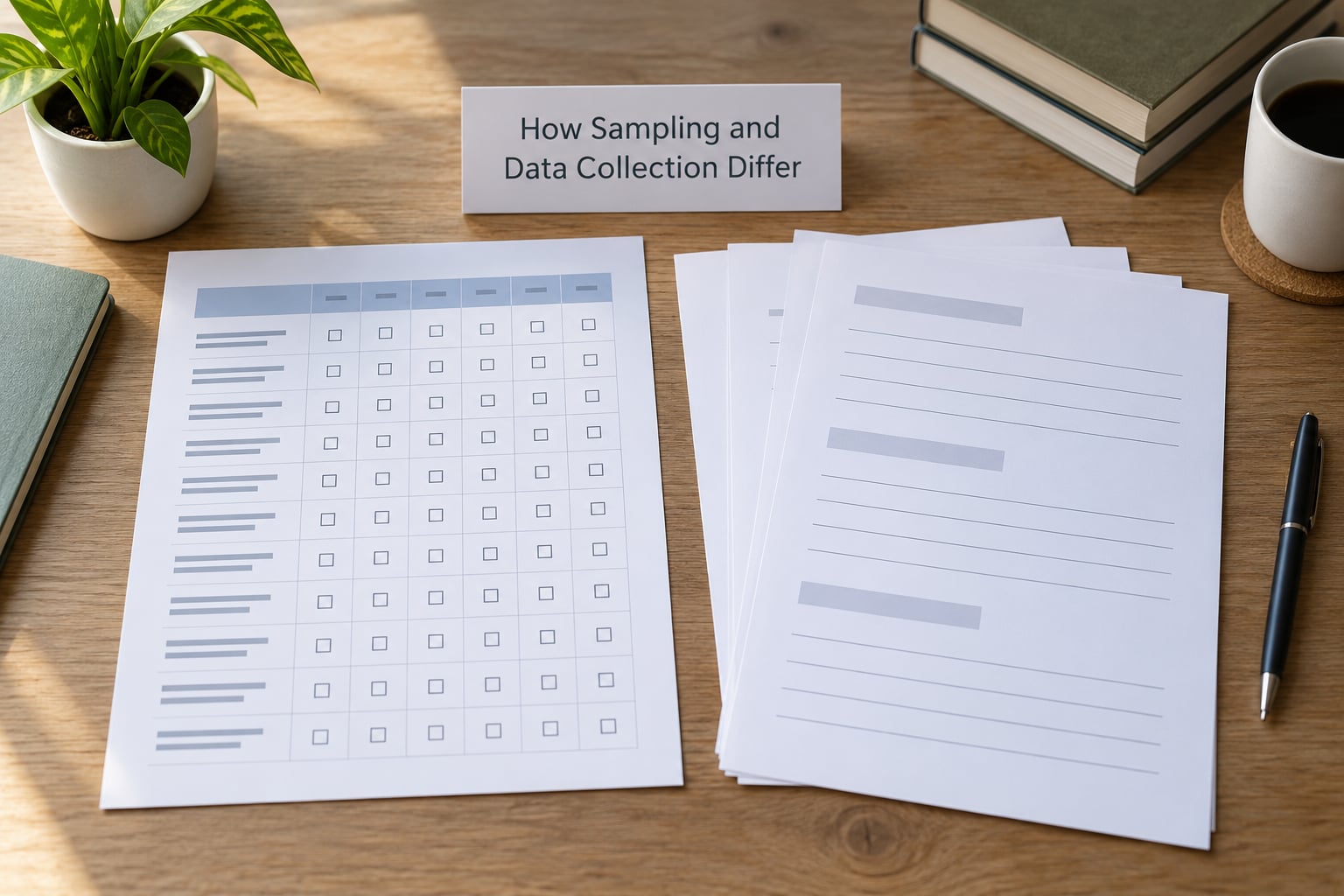
Sampling drives everything else. Quantitative work needs a sample large enough and structured enough to support the estimate you intend to publish. For a large population, roughly 385 respondents gives a margin of error near plus or minus 5 percentage points at 95% confidence, and around 100 gives roughly plus or minus 10. Smaller populations need proportionally more people, and the calculation changes with the population size.
Qualitative work does not chase statistical power. It recruits a small, purposeful group and stops when new interviews stop producing new themes, a stopping rule usually reached somewhere between 15 and 30 participants. Those participants are chosen because they have relevant experience, not because they represent anyone.
Collection formats differ just as sharply. A quantitative survey fixes the wording and the response options before fieldwork, which protects comparability but locks you into what you already thought to ask. An interview guide stays loose on purpose, so a moderator can follow an unexpected thread and get at the language people actually use.
The trade-off is confidence versus flexibility. A representative sample gives you defensible coverage and thin explanation. A dozen thoughtful interviews give you rich explanation and no basis for claiming the wider market agrees.
How Analysis and Findings Differ
Quantitative analysis works on the numbers: distributions, cross-tabulations, correlations, significance tests and confidence intervals, usually in SPSS, R or Excel. You decide the analysis before you collect, then report effect sizes and uncertainty rather than just pass or fail.
Qualitative analysis works on the text: coding transcripts into categories, grouping codes into themes, counting how often a theme appears, and writing the interpretation that gives it meaning. Tools such as NVivo or Atlas.ti help with organisation, but the interpretive step is still human and therefore arguable.
That difference shows up in how you describe findings. Write that 62 percent of respondents rated the packaging as premium and you have a bounded claim. Write that participants consistently described the packaging as premium and you have a claim about meaning, which travels to similar contexts, not to a population. The second property is called transferability rather than generalizability, and using the right word keeps a reviewer from marking you down for overreach.
How Cost, Speed, and Team Skills Affect the Choice
Both approaches vary widely by scope, so treat any figure you see as a starting point rather than a quote. Broadly, a survey of several hundred respondents costs several times what a round of 15 to 30 interviews costs, and the gap widens once you add recruiting, incentive and analysis time. Interviews buy depth per participant; surveys buy coverage per participant.
Timelines follow a similar shape. An exploratory qualitative round usually reaches useful material in two to four weeks of fieldwork, with weeks more for transcription and analysis. A survey needs instrument design, pilot and fielding, then analysis, and the analysis is where schedules usually slip.
Skills matter more than people expect. Quantitative work needs someone who can design a non-leading question, sample properly and read a p-value without over-claiming. Qualitative work needs an interviewer who tolerates silence and an analyst who can show how codes were derived rather than presenting themes as if they appeared fully formed. Whichever method you pick, the person doing the analysis should be the person who shaped the instrument.
When to Use Both Methods Together

Combining the two is legitimate and often the strongest choice, as long as the design explains what each phase contributes. Three patterns cover most real projects.
- Qualitative first, then quantitative. Discovery sets the scope, then a survey measures how widespread the discovered themes are. Use it when you do not yet know which variables matter enough to instrument.
- Quantitative first, then qualitative. A survey identifies segments, outliers or a surprising dip, then interviews explain the mechanism behind it. Use it when you have measurement and lack understanding.
- Convergent. Both run in the same period and are compared at the end. Triangulation raises confidence, but it costs more and takes longer than either phase alone.
Back to the coffee subscription: interviews with 20 lapsed subscribers named three recurring reasons for leaving, weak first-week coffee quality, unclear pause controls and forgotten shipments. A survey of 400 subscribers with one question per reason then told the team that 54 percent of cancellations had the pause-control problem. Only the mixed design produced a fix rather than a statistic.
Which Should You Choose?
Ask these six questions before committing to a design.
- What exactly does your research question need as its answer, and what form does that answer take?
- Do you already know the variables and options involved, or would you be inventing them?
- Do you need a claim about a population, or an account of how something happens?
- How large and reachable is the population you need?
- What will you do with the finding, and does it need to be repeatable over time?
- Which method can you execute well, without bending the question to fit your skills?
If your study has to be repeatable, tracked against a benchmark or defended to a sceptical reader, weight quantitative. If the decision depends on understanding something nobody has named yet, weight qualitative.
| Use case | Start with | Reason |
|---|---|---|
| Market sizing | Quantitative | Needs a representative cross-section and a defensible estimate |
| Brand health tracking | Quantitative | Only numbers repeat over time and show movement |
| Segment discovery | Qualitative, then quantitative | Define segments before you weight them |
| Message development | Qualitative | You are building language, not measuring recall |
| Ad diagnostic after results drop | Qualitative | The number tells you it fell, not why |
| Concept testing | Quantitative, then qualitative | Score the concepts, then find the language behind the scores |
| Satisfaction tracking | Quantitative | Trend movement matters more than individual accounts |
| Usability diagnosis | Qualitative | Watch and listen rather than tally task success alone |
| Niche B2B with a small population | Qualitative | The population may be too small to sample meaningfully |
Two mismatches cause most wasted studies. Running a survey on an exploratory question produces numbers nobody can interpret, because the options were invented before anyone knew what mattered. Running interviews to prove a number produces anecdotes with no reach, because no amount of excellent testimony converts 18 stories into 62 percent.
The subtler trap is skill bias. The most common shortcut is picking the method you already know and then reframing the question until it fits, which reads as efficient until a reviewer asks why the study cannot answer anything else. If your question genuinely supports both approaches, run the small one first and let the evidence settle the choice.
Frequently Asked Questions
Can quantitative and qualitative research be used together?
Yes, and combining them is often stronger than either alone. Qualitative discovery can define the variables a quantitative survey then measures, while quantitative findings can identify the segments or surprises that qualitative interviews explain well. The key is to state in advance what each phase contributes, since mixing methods without a stated design tends to read as indecision.
Which method requires a larger sample?
Quantitative research, usually by a wide margin. Survey work often runs from several hundred respondents upward, and around 385 is the common figure for a large population at a plus or minus 5 point margin of error. Qualitative studies typically run between 15 and 30 participants, stopping when new interviews stop adding themes.
Is qualitative research more reliable than quantitative research?
Neither is more reliable, because they are built to different standards. Quantitative studies are judged on sampling, instrument validity and bias control, while qualitative studies are judged on rigour, reflexivity and saturation. A large biased survey is less trustworthy than twelve carefully conducted interviews, and shallow interviews are less trustworthy than a well-sampled survey.
How do I choose a research method for a new concept?
Start qualitative. A concept that has not been tested has no settled wording, no known variables and no benchmark, so a survey would measure your assumptions rather than audience reaction. Run in-depth interviews or a small focus group to find how people describe the idea and which attributes matter, then instrument a survey from what you learned.
How do I justify choosing one method over the other?
Name the research question first, then state the form its answer must take, then point to the fit. A defensible sentence explains that the question seeks explanation of a dropout process, that qualitative interviews were selected to capture mechanisms and language, and that the findings will be described with limits on transferability. Explicit constraints, sample size rationale and known limitations complete the justification.
Conclusion
Quantitative research earns its place when you need breadth, measurement and a claim that holds across a population. Qualitative research earns its place when you need depth, mechanism and language you did not have before. Start by writing the decision your study must inform in one sentence, then check whether the answer you need is a number or a reason, and let the rest of the design follow from that.