A discussion guide for a focus group is a semi-structured roadmap: an ordered set of open-ended questions, the probes that follow them, and the time each block takes. Writing one well means starting from the decision your research has to inform, not from a list of topics you find interesting. Most guides fail because they were drafted as questions first and an objective second, and you can feel it in the room.
If you are new to this, budget two to three hours for a first draft and a separate hour for testing it. The method is not complicated, but it asks you to hold two things at once: enough structure that four groups produce comparable material, and enough looseness that people talk like people.
Table of Contents
- What You Need
- Step-by-Step: How to Write a Discussion Guide for a Focus Group
- Start With the Research Objective
- Build a Logical Question Flow
- Write Neutral, Open Questions
- Add Probes Without Over-Scripting
- Set Timing and Transitions
- Test and Finalize the Guide
- Common Mistakes
- Frequently Asked Questions
- How many questions should a focus group have?
- How many participants should a focus group have?
- Should participants see the discussion guide in advance?
- How long should a discussion guide be?
- How do I avoid leading questions in a focus group?
- Should the moderator follow the guide strictly?
- Conclusion: Start With the Decision You Need to Make
What You Need
Before a single question gets written, gather seven things. Any one of them missing will show up as a wobbling session.
- The research objective. The decision this work informs, in one sentence. Not “understand customers” but “whether we rebuild the onboarding flow or patch it”.
- Your audience definition. Who is in the room, and what makes someone eligible.
- Participant criteria. Screener thresholds that decide who actually turns up.
- Prior insights. Last year’s survey, support tickets, the report the leadership team keeps quoting. You write different questions when you already know some answers.
- Available time. A hard 60-minute slot with a 10-minute overrun is common, and your guide has to survive it.
- Recording or note-taking method. This determines whether you can ask people to rank things silently, and how much a note-taker can realistically capture.
- The questions the discussion must answer. Three to five. More than that and no guide will survive contact with a clock.
Two of these deserve a hard look. The decision and the prior insights together decide the whole shape of the guide, and skipping prior work is the most common reason a session feels like a re-run of something the client already knows.
Step-by-Step: How to Write a Discussion Guide for a Focus Group
Start With the Research Objective
Write one primary objective and no more than three supporting ones. Then translate each into a specific piece of evidence you need, because a question that does not map to evidence is a question you will regret the extra twenty minutes of.
Try this test: finish the sentence “After this research, we need to decide whether…” The answer is your primary objective. If the sentence comes out vague, the guide will be too. A primary objective like “understand how first-time buyers feel about returns” tells you nothing about what to ask; “decide whether to extend the return window from 30 to 60 days” tells you exactly what a useful answer contains.
Your test for a finished objective: someone outside the project should be able to read it and say what decision it settles.
Build a Logical Question Flow
Order matters more than almost anyone expects. The route runs warm-up and context, then perceptions, then actual behaviours, then the reasons behind those behaviours, then reactions to your idea, then trade-offs, then the close.
The logic underneath is trust. People open up after they’ve said something safe, they describe real behaviour after they’ve felt heard about their opinion, and they critique an idea more honestly once they’ve committed to a viewpoint of their own. Skipping straight to your concept at minute four gets you politeness.
Move general to specific within each block, and only put genuinely sensitive or contestable questions near the end, once rapport exists. If two questions cover the same ground, merge them; a moderator who notices duplication mid-session has already lost four minutes.
Write Neutral, Open Questions
Ask about what happened, not what people would do in the abstract. Recall beats intention, because intentions are forecasts and forecasts from strangers are fiction.
Weak: “How satisfied are you with the current cancellation process?” Strong: “Tell me about the last time you tried to cancel. Walk me through what you did.”
Weak: “Would you pay extra for faster delivery?” Strong: “What have you paid for delivery in the last six months, and what did you get for it?”
The weak pair fails twice. The first asks for a rating dressed as a question, and the second asks about a hypothetical future. Both invite polite guesses.
Three rewrites cover most cases. Leading questions put the answer in the respondent’s mouth, so swap “Wouldn’t you agree…” for “What has your experience been…”. Double-barreled questions ask two things and get half an answer, so split “How was the price and the delivery?” into two separate questions. Jargon does the same damage with accountants, so replace your internal term with what a customer would actually say.
Add Probes Without Over-Scripting
Core questions get you an answer. Probes get you the story underneath it, and they are the single most useful thing on the page. Attach three to five to each core question as sub-bullets.
Probes are short and generic: “Can you tell me more about that?”, “What did you mean by that?”, “Why is that important to you?”, “What happened next?”, “Can you give me an example?” You can memorise a dozen of these and use them all evening.
The mistake is writing probes that decide the answer. “So the fee felt unreasonable, right?” is not a probe, it is a nudge wearing a disguise. Write probes that ask for the mechanism, the instance, and the reason, then stop talking.
A practical rule from group facilitation: wait at least ten seconds of silence before you repeat or rephrase a question. The pause feels unbearable from the moderator’s chair and it is where the actual answer usually arrives.
Set Timing and Transitions
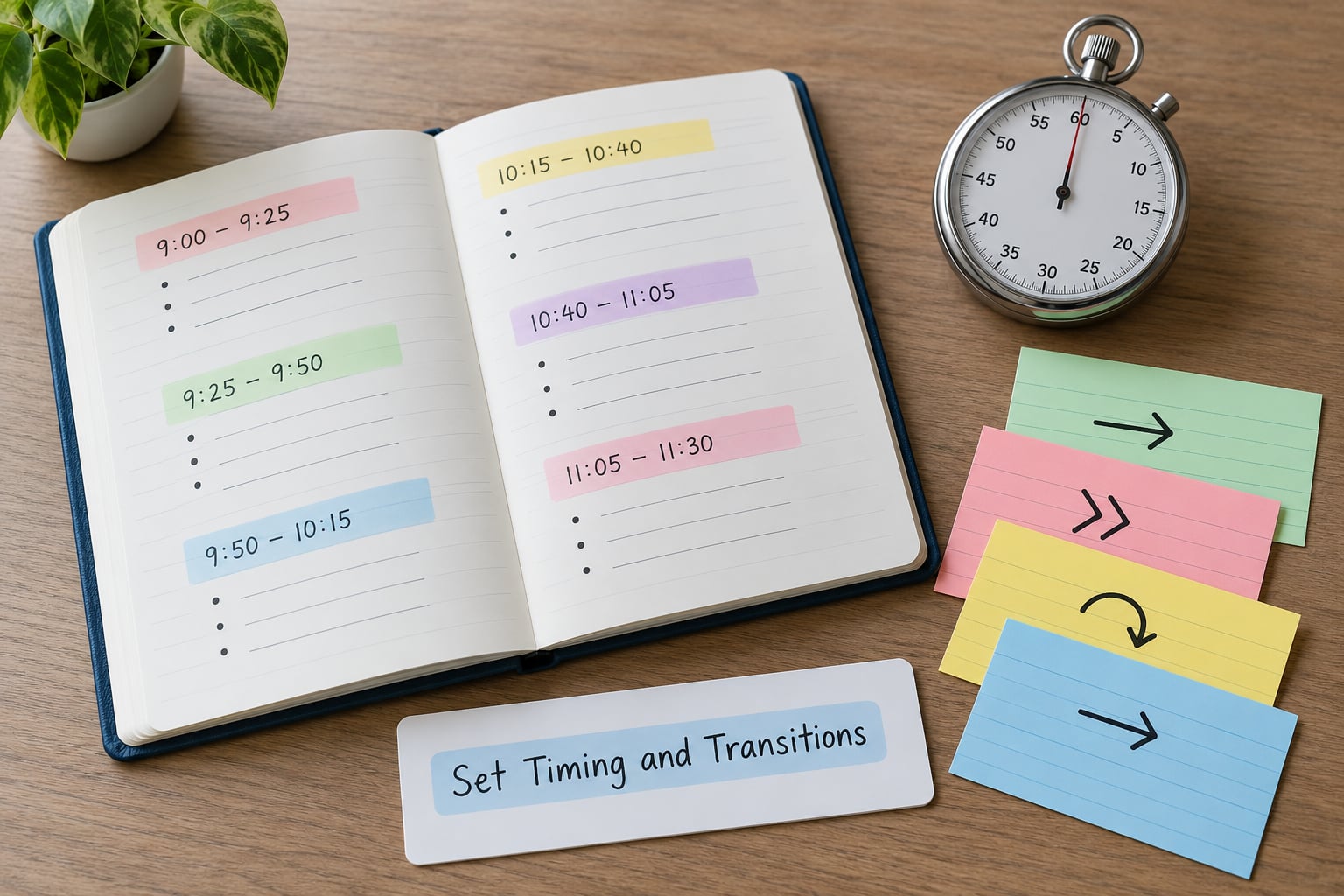
Every block gets a number of minutes, and every core question gets a number. Plan fewer questions than the clock allows, because a productive probe takes three times longer than the question itself.
- 30-minute session: 3 to 4 core questions, 6 to 7 minutes per block, a 3-minute warm-up and a 2-minute close.
- 60-minute session: 5 to 6 core questions, 10 to 12 minutes per block, 5 minutes for the warm-up and 5 for the close.
- 90-minute session: 8 to 12 core questions, 10 to 15 minutes per block, 8 minutes for the warm-up and 8 for the close.
Probes do not count toward the question total. That is why a guide with six core questions and twenty-five probes can fill ninety minutes and still feel unhurried.
Write your transitions as single lines. “Thanks. Thinking about that period, what about the last month?” or “Let’s step back a bit. Taking everything you’ve said, how would you rank these?” A moderator who reads transitions aloud like a script loses the room, so script only the opening, the transitions, and the close, and leave the middle conversational.
Test and Finalize the Guide
Run it past a colleague who has not seen the brief, then run one question or two in a live pilot with someone who matches the participant profile. You are testing three things: whether each question is answerable in plain language, whether the flow makes sense without you filling the gaps, and whether the timing holds.
Expect to cut a third of it. Any question that does not map to an objective goes; any question that repeats another goes; any question you would feel awkward reading out loud gets rewritten until you would not.
Then produce two versions. The full guide carries the rationale, the probes, and the timing, for your records and any client who asks. The moderator version is one page, questions and probes only, sized so nobody has to flip through twelve sheets while eight people are waiting.
Common Mistakes
Most of these are cheap to fix in the draft and expensive to fix in the room.
Writing questions before the objective. Fix: finish the “we need to decide whether” sentence first, then write anything.
Asking for opinions with no context. Fix: add a recall prompt in front of the opinion question, something like “thinking about your last bill…”
Asking what people would do. Fix: replace hypotheticals with the last time it happened.
Packing in too many questions. Fix: count them against the clock and cut until there is 30% slack.
Writing the guide as a verbatim script. Fix: strip every line that is not a question, a probe, or a timing cue, then rehearse the opening and close aloud only.
Ignoring group dynamics in the plan. Fix: build drawing people in and drawing out into the guide itself, as phrases under the relevant questions, not as improvisation.
Skipping probes. Fix: cap core questions so probes have room, then mark three to five per question.
Losing sight of the objective. Fix: put the objective and its evidence need in the header of every page.
Rewarding the fastest voice. Fix: ask every question to the whole room before you take answers, and make sure the person who spoke first is not also the person you return to first.
Ignoring conformity. Fix: ask participants to write down their answer to the two hardest questions before the session starts, and collect the sheets. People who wrote something down will say it out loud; people who have not will go with the room.
Ranking without handling the fallout. Fix: expect disagreement when you ask people to rank, build in a follow-up (“What made that one lower?”), and treat the argument as the interesting part.
Frequently Asked Questions
How many questions should a focus group have?
For a 60-minute session, write five or six core questions. For 90 minutes, eight to twelve works. A 30-minute session takes three or four. Probes do not count in that total, because a single core question with five probes can occupy ten minutes on its own. Plan 30% slack against the clock rather than filling it, since a productive probe always runs longer than the question that triggered it.
How many participants should a focus group have?
Six to eight is the usual range, and it holds because that is where a conversation can start without one voice taking over. For sensitive or technically complex topics, drop to four or five and run more sessions instead. Enlarging a group past about ten buys you less thinking and more silence. If you need more coverage, run a second group, not a bigger one.
Should participants see the discussion guide in advance?
No. Sending the guide in advance lets people prepare an answer instead of recalling one, which produces exactly the kind of polished, unremarkable material the method exists to avoid. Share the logistics instead: time, location or link, whether the session is recorded, and how the incentive works. Participants should arrive ready to talk about their own experience, not ready to recite yours.
How long should a discussion guide be?
Two to four pages for a 60-minute session. One page if the guide is only for the moderator, though keep the full version including rationale and probes for the file. If your draft runs longer, the cause is usually one of three things: too many core questions, too many probes, or a lot of context that belongs in a separate research plan rather than in the moderator’s hands.
How do I avoid leading questions in a focus group?
Read each question aloud and check whether the answer is already inside it. If you can guess the response from the wording, the question is leading. Also strip out double-barreled questions that ask two things at once, and swap internal jargon for the words a customer would use. Ask for a specific past instance rather than a general impression, and never react to an answer, even a small nod.
Should the moderator follow the guide strictly?
No, and the guide is built to be left. It is a route, not a track, and if a thread turns out to be the most valuable thing in the session you should stay on it. What keeps that freedom in check is time-boxing: the pacer role exists to cue the moderator when a block overruns, so the rest of the route still gets covered. Abandon the route when the discussion is producing evidence for your objective, not when it is merely interesting.
Conclusion: Start With the Decision You Need to Make
The craft of how to write a discussion guide for a focus group is mostly restraint. One objective, three to five evidence needs, five or six neutral questions in a broad-to-specific route, probes attached to each, minutes assigned to every block, and only the opening and close written word for word.
So open a blank page and finish this sentence: after this research, we need to decide whether… Everything you write from there is easier, and every question in the guide will trace back to something you can point at afterwards.