
An observation is what you saw, heard or measured. An insight is what that evidence means and why it changes a decision. The difference between an insight and an observation is a matter of interpretation: one records a fact, the other explains the fact.
Most research decks blur the two, which is why a deck can be full of “key insights” and still leave the team arguing about what to do next. Below is a repeatable test you can run on any statement in about a minute, plus worked examples showing the rewrite.
Table of Contents
- How to Tell the Difference Between an Insight and an Observation at a Glance
- What Counts as an Observation?
- What Counts as an Insight?
- 5 Tests for Telling Them Apart
- Test 1: Does It Describe What Happened?
- Test 2: Does It Explain Why It Matters?
- Test 3: Does It Reveal a Pattern or a Surprise?
- Test 4: Could It Change a Decision?
- Test 5: Can You Trace It Back to Evidence?
- Examples: Observation, Insight or Neither?
- 1. “People want clothes delivered fast”
- 2. “The homepage confuses people”
- 3. “Men are less likely to complete the survey”
- 4. “Instagram comments said the new pack looked premium”
- 5. Neither: “The market is ready for a premium subscription”
- 6. The Lego case, done properly
- Which Should You Choose?
- Frequently Asked Questions
- What is the primary distinction between an observation and an insight?
- Is a percentage automatically an insight?
- What are five examples of an observation?
- What are five examples of an insight?
- How do I turn an observation into an insight?
- What is the difference between a finding and an insight?
- Conclusion
How to Tell the Difference Between an Insight and an Observation at a Glance
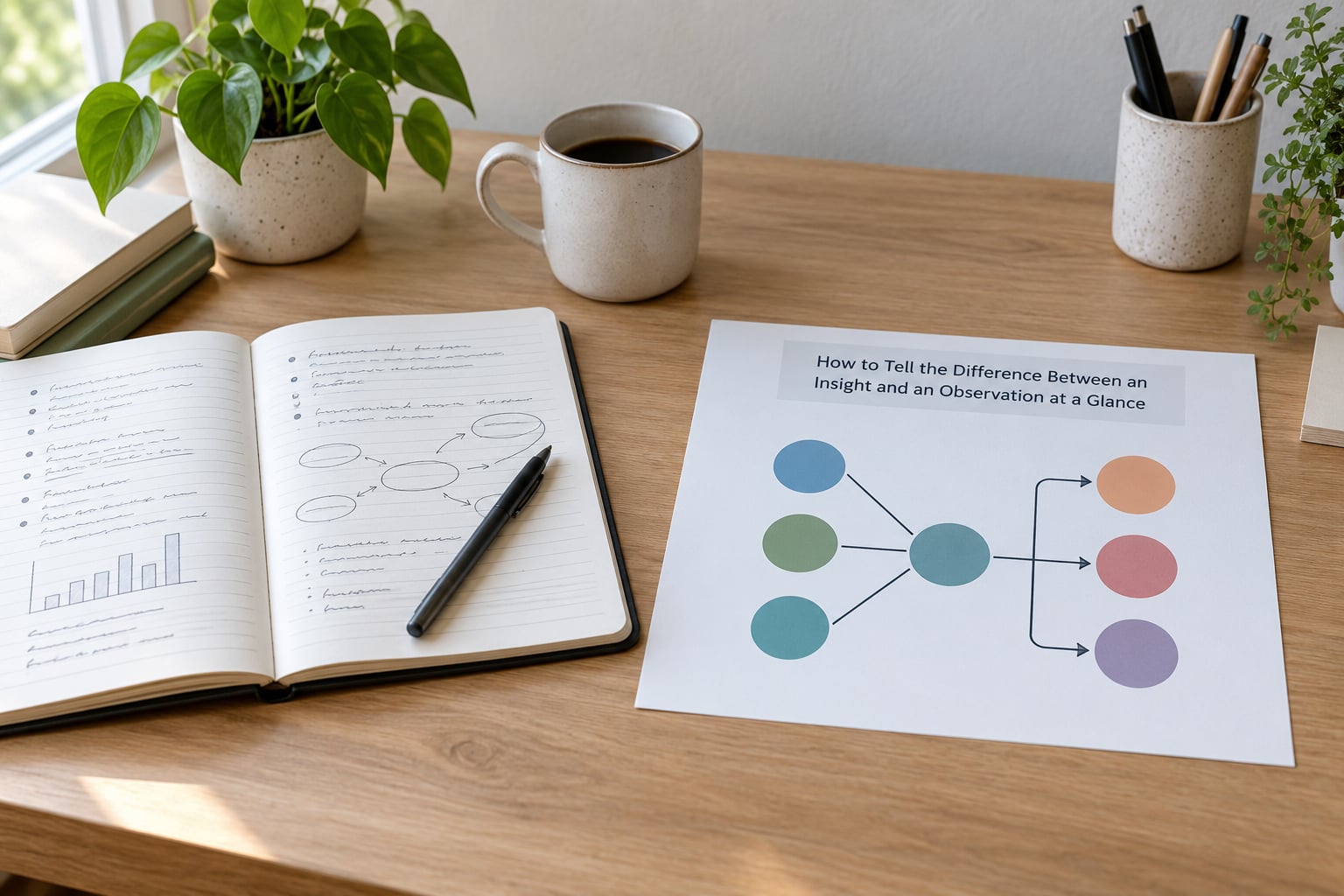
The quick version: an observation stops at the fact, an insight adds meaning, mechanism and consequence. Here is the same evidence set laid out row by row.
| Criterion | Observation | Insight |
|---|---|---|
| Definition | A factual record of what was seen, heard or measured | An interpretation of what that evidence means and why it matters |
| Where it comes from | A study, a transcript, an analytics dashboard, a support log | Synthesis across several observations plus a reasoning step |
| Question it answers | What happened, where, how often, to whom | Why it happened and what follows from it |
| Specificity | Bound to a sample, a date range and a number | General enough to describe a behavior driver across contexts |
| Evidence | Is the evidence, so it either stands up or it does not | Rests on evidence, but is judged by whether the reasoning holds |
| Actionability | Usually none on its own | Should point to a decision, a bet or a reframe |
| Typical example | 42% of shoppers in this survey picked option A | Shoppers treat the first listed option as the safe default, so placement beats description |
One more column helps in practice: the finding. That is the middle layer where a piece of evidence has been compared against a benchmark or a prior study and turned into a statement of fact, such as “returning customers abandon checkout at a higher rate in mobile web than in the app”. A finding is still evidence. It is sorted and framed, but it does not explain a mechanism.
What Counts as an Observation?
An observation is a direct account of something you or someone else recorded, with no interpretation added. Strip the verbs out of it and what remains should still be checkable against a transcript, a recording or a dataset.
Four kinds show up constantly in research work.
- Numerical. “41% of respondents rated delivery speed as the deciding factor in the category.”
- Behavioral. “In six of eight usability sessions, users opened the filter panel and then closed it without changing anything.”
- Descriptive. “Shoppers described the onboarding as “fine, I guess” and moved on quickly.”
- Source-based. “Support tickets mentioning login failures doubled in the week of the release.”
An observation can be surprising, well-designed and hard-won. What it cannot do on its own is tell you why. That is not a flaw in the work; it is the job the observation was hired to do.
What Counts as an Insight?
An insight is a statement about meaning. It takes evidence, connects it to something already known about human behavior, and lands on a consequence someone could act on or be wrong about.
Four things separate a real insight from a dressed-up observation: it names a mechanism, it surfaces a tension, it is not obvious from the evidence alone, and it carries a consequence.
Same evidence, two levels. The observation is that 42% picked option A. The insight is that shoppers read option A as the safe default, so listing it first absorbs the choice and makes the rest of the page feel like a rejection risk. The first is a count; the second explains the count and predicts what happens if you move the option down.
The distinction is not about length. A long sentence with “because” in it can still be an observation with padding on the front.
5 Tests for Telling Them Apart
Run a statement through these five in order. One clear no on tests one or two usually settles the argument; the later tests stop weak insights from passing.
Test 1: Does It Describe What Happened?
Yes means it is an observation, or at best a finding. Look for a number, a quotation, a count of sessions or a reference to a specific artifact you could pull up on screen.
“Most users abandoned the second step of signup” describes what happened. “Users do not trust us enough to give us their email” describes something you inferred about a mental state nobody reported. That is already an interpretation, and it is an unearned one.
The quick check: can you point to the tape, the transcript line or the dashboard cell? If not, the statement is not reporting an observation.
Test 2: Does It Explain Why It Matters?
This is the real divider. An insight answers a why, or a so-what, that the evidence alone does not contain.
Consider checkout abandonment. The finding: 68% of abandonments happen after the shipping-cost reveal. The surface pattern: people are abandoning. The insight: shoppers are not price-sensitive, they are control-sensitive, because they accept a cost they chose and abandon when a cost appears that they did not.
That reframes the problem. Discounts stop being the fix and shipping transparency becomes it, which is a completely different roadmap conversation.
Quick check: finish the sentence “because…” If the clause that follows is just a restatement of the evidence, you are still holding an observation.
Test 3: Does It Reveal a Pattern or a Surprise?
Not every pattern is an insight. A pattern is meaningful when it connects several observations, exposes an exception, challenges an assumption the team was working from, or holds a contradiction that has to be resolved.
The Dove Real Beauty work is the clean example of a pattern that travelled. The insight behind the body-shaped bottles was that women had spent decades hiding their bodies rather than shaping them, so showing the shape was an act of honesty. That connected product research, social listening and cultural reading into one idea.
By the time the same insight was restated a decade later, it had lost its tension and become a slogan. That is the useful warning: a pattern can go stale. If your insight no longer surprises anyone in the room, check whether it is still describing the culture or just describing your last campaign.
Test 4: Could It Change a Decision?
An insight earns its place when it would alter a choice somebody is about to make. This is the falsifiability bar, and it is one line long: would this change what we do, and if we believed it and nothing changed, would we say we were wrong?
Be careful not to confuse a strategic implication with a solution. “We should launch a subscription tier” is a recommendation. “Customers who reach the third delivery treat the service as a subscription in their heads, and retention is 3x higher there, so the churn problem lives before delivery three” is an insight. The first closes the thinking; the second opens it.
A weak insight can often be sharpened by asking what would have to be true. “Shoppers want faster delivery” becomes testable when you can say which decision it changes.
Test 5: Can You Trace It Back to Evidence?
Traceability is what separates an insight from speculation wearing an insight’s clothes. Check the source quality, the sample size, the dates, the alternative explanations and the boundary of the claim.
The strongest insights write their own limit into the sentence: “among returning app users, in markets where delivery is next-day, over a six-week window.” That boundary costs you nothing rhetorically and buys you credibility when a stakeholder pushes back.
If you cannot name the evidence, you may have a hypothesis. That is a perfectly good thing to have, but label it as one so nobody builds a quarter of work on it by accident.
Examples: Observation, Insight or Neither?
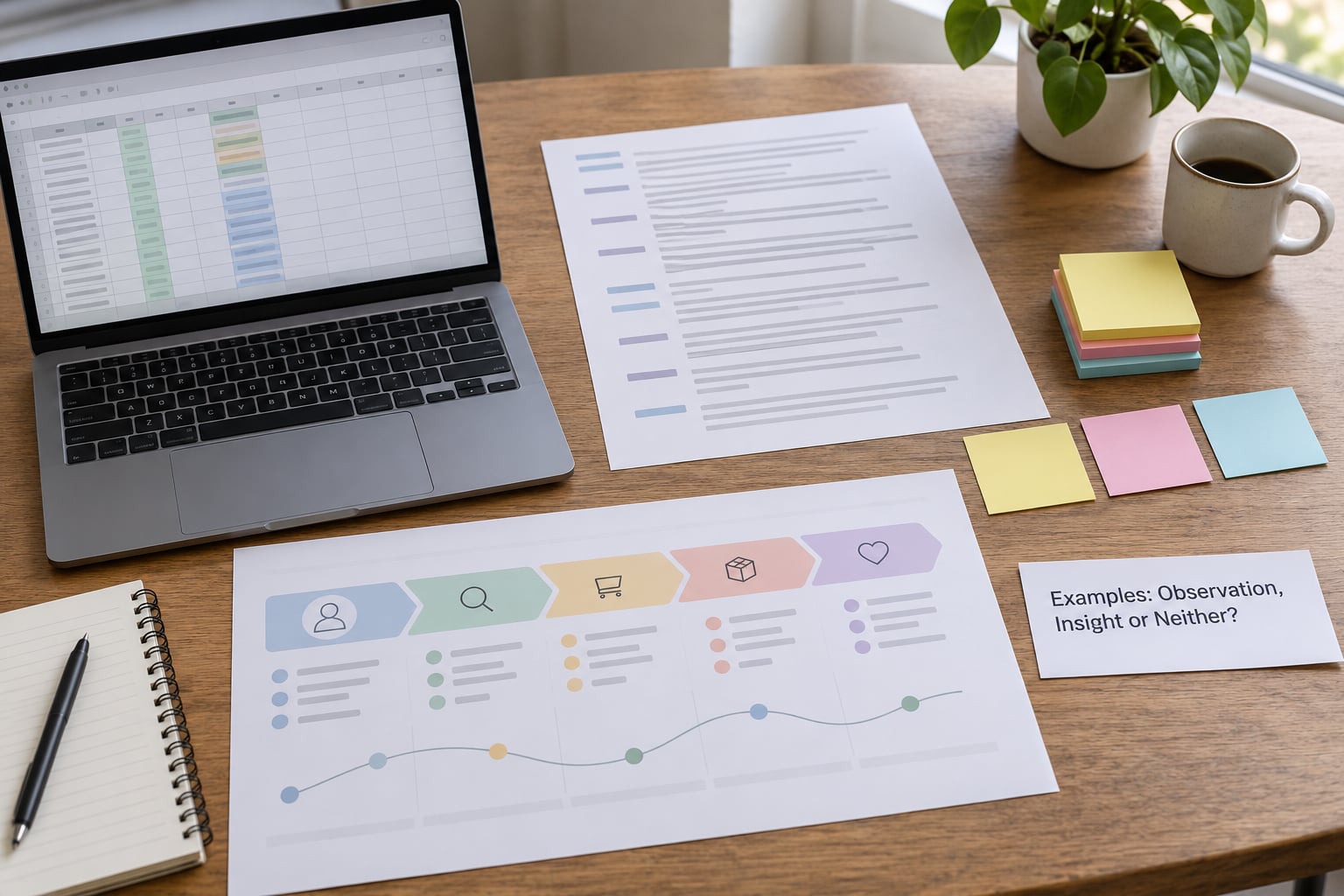
Here are real-shaped statements. Most of these come from the kind of readout where the distinction actually gets argued about.
1. “People want clothes delivered fast”
That is an observation wearing a costume, and a vague one at that. It has no number, no segment and no boundary. Useful version: “Among returning subscribers, standard delivery drives most cancellations within the first week, while next-day delivery barely appears in cancellation reasons.” That is a finding: measurable, bounded, still silent on cause.
2. “The homepage confuses people”
An observation, stated as a conclusion. The rewrite: “First-time visitors cannot tell which of the three plans is the default, so they compare all three and leave; returning visitors never scroll past the first plan.” Same page, two behaviors, and now the fix has a target.
3. “Men are less likely to complete the survey”
An observation with a number attached. Quantifying an observation does not turn it into an insight. The insight sits one step further: “Male respondents drop out at the question about body measurements, so the survey is silently excluding the audience whose experience matters most here.”
4. “Instagram comments said the new pack looked premium”
A source-based observation, and a weak one, because “looked premium” is already an interpretation smuggled into the description. Say what was observed: “Comments used words like clean, expensive and finally, unprompted.” The insight comes from the pattern across posts: people were reacting to restraint in the design, not to the redesign itself.
5. Neither: “The market is ready for a premium subscription”
This one fails on test five. No evidence is offered for “ready,” and it is really a recommendation wearing a market claim. It can be rescued by naming what would make it true: which behavior in the data would signal readiness, and what you would watch to know you were wrong.
6. The Lego case, done properly
Children described building sets as a way of showing off what they had made to other people. The observation is the child’s words and the recorded behavior of leaving builds on the shelf. The insight is that display, not completion, is the motivation, which is why sets designed to be photographed outperform sets designed to be assembled quickly.
Which Should You Choose?
Most readouts need both, in a specific order. Evidence first, interpretation second, implication third, action last. Skipping a step is what produces an insight deck that changes nothing.
- Collect observations. Keep them dull and specific. Dull is a feature at this stage.
- Sort them into findings. Compare against benchmarks and prior waves so each fact has a reference point.
- Cluster. Affinity diagramming or thematic analysis: the point is to find what repeats across sessions rather than what is loud in one.
- Write an interpretation per cluster. Mechanism, tension, consequence. One idea per statement.
- Attach the implication. Name the decision it changes. If you cannot, it is a note, not an insight.
- Decide separately. The recommendation belongs to the team with the budget, not to the researcher.
If your team inflates every observation into an insight, the fix is not a style guide. It is a rule that no statement gets the word “insight” on the slide until it has passed test two and test four in writing, with the evidence line next to it.
One honest exception: an observation can stand alone. In a monitoring dashboard or an experiment readout, the fact is the deliverable and nobody is asking for meaning.
Frequently Asked Questions
What is the primary distinction between an observation and an insight?
An observation records what happened: a number, a behavior, a quotation, a logged event. An insight interprets that evidence to explain why it happened and what it means for a decision. One is evidence you can point at in the data, the other is reasoning built on top of it. If a statement has no mechanism, no tension and no consequence attached, it is an observation no matter how it is labelled.
Is a percentage automatically an insight?
No. A percentage with a benchmark is a finding, which is still evidence. It only becomes an insight once it explains a mechanism, such as why a group is resisting, and points at a consequence. The common error is treating precision as depth: a very accurately measured statistic that nobody has interpreted is still just a fact.
What are five examples of an observation?
Five: 42% of survey respondents chose option A; six of eight users closed the filter panel without changes; support tickets about login failures doubled after the release; shoppers used the word fine more than any other word about onboarding; and returning customers churned faster on mobile web than in the app. Each is checkable against a recording, transcript or dashboard.
What are five examples of an insight?
Five: shoppers read the first listed option as the safe default, so placement beats description; control, not cost, drives checkout abandonment; display rather than completion drives children’s interest in building sets; men abandon body-measurement questions, quietly skewing the survey; and retention triples once customers reach a third delivery, so the churn problem sits earlier in the journey.
How do I turn an observation into an insight?
Ask why until you reach a reason someone could disagree with, then state what follows from it. Cluster observations first so you are explaining a pattern rather than a single session. Write the interpretation with its evidence boundary attached, then name the decision it would change. If no decision changes, you have a pattern worth watching, not yet an insight.
What is the difference between a finding and an insight?
A finding is evidence that has been compared to something: a benchmark, a prior wave, another segment. It is still fact, but it is framed fact rather than raw observation. An insight goes a step further and explains why the finding exists, what tension it reveals and what follows. Observations, findings and insights form a ladder, and most decks stop one rung too low.
Conclusion
Run any statement through the same five checks: does it describe what happened, does it explain why it matters, does it reveal a pattern or a surprise, could it change a decision, and can you trace it to evidence. When the answers get vague, you have not left the difference between an insight and an observation, you have just run out of wording.
Start with your last deck. Underline the factual evidence, then in the margin write what it means for each line. The sentences that only needed the underline are observations. The ones that needed your handwriting are the ones worth arguing about.