Coding interview transcripts for themes means attaching short labels to specific passages of text so that recurring ideas, behaviours and meanings can be grouped, compared across interviews, and turned into themes you can defend with evidence. It takes longer than people expect and the first transcript is genuinely awkward. Here is the process I use, step by step, including the pruning pass that keeps a code set from exploding into thousands of labels.
This is the version I wish someone had handed me before I opened a 6,000-word transcript with no idea where to put the first code. Nothing here needs paid software. A spreadsheet and a decision log will carry a dissertation or a twelve-interview market study just as far as NVivo will.
A working definition before we start. A code is a short label attached to a passage that means something for your research question. A theme is not a topic. A theme makes an interpretive claim about a pattern, has a central organizing concept, and can be wrong.
Table of Contents
- What You Need
- How to Code Interview Transcripts for Themes: Step-by-Step
- 1. Clarify the Research Question and Unit of Analysis
- 2. Prepare and Organize the Transcripts
- 3. Do a First Pass Without Over-Coding
- 4. Build an Initial Codebook
- 5. Code the Transcript in Manageable Segments
- 6. Revise Codes and Compare Across Interviews
- 7. Check Reliability and Freeze the Codebook
- Common Mistakes When Coding Interview Data
- Tips for Reliable and Credible Coding
- Frequently Asked Questions
- Can I use qualitative analysis software to code interview transcripts?
- Should I code interview transcripts inductively or deductively?
- How many themes should I expect in a qualitative study?
- What is inter-coder reliability, and do I need to calculate it?
- How do I prevent my coding from being biased toward the research question?
- Does a frequently mentioned theme automatically become an important theme?
- Conclusion
What You Need
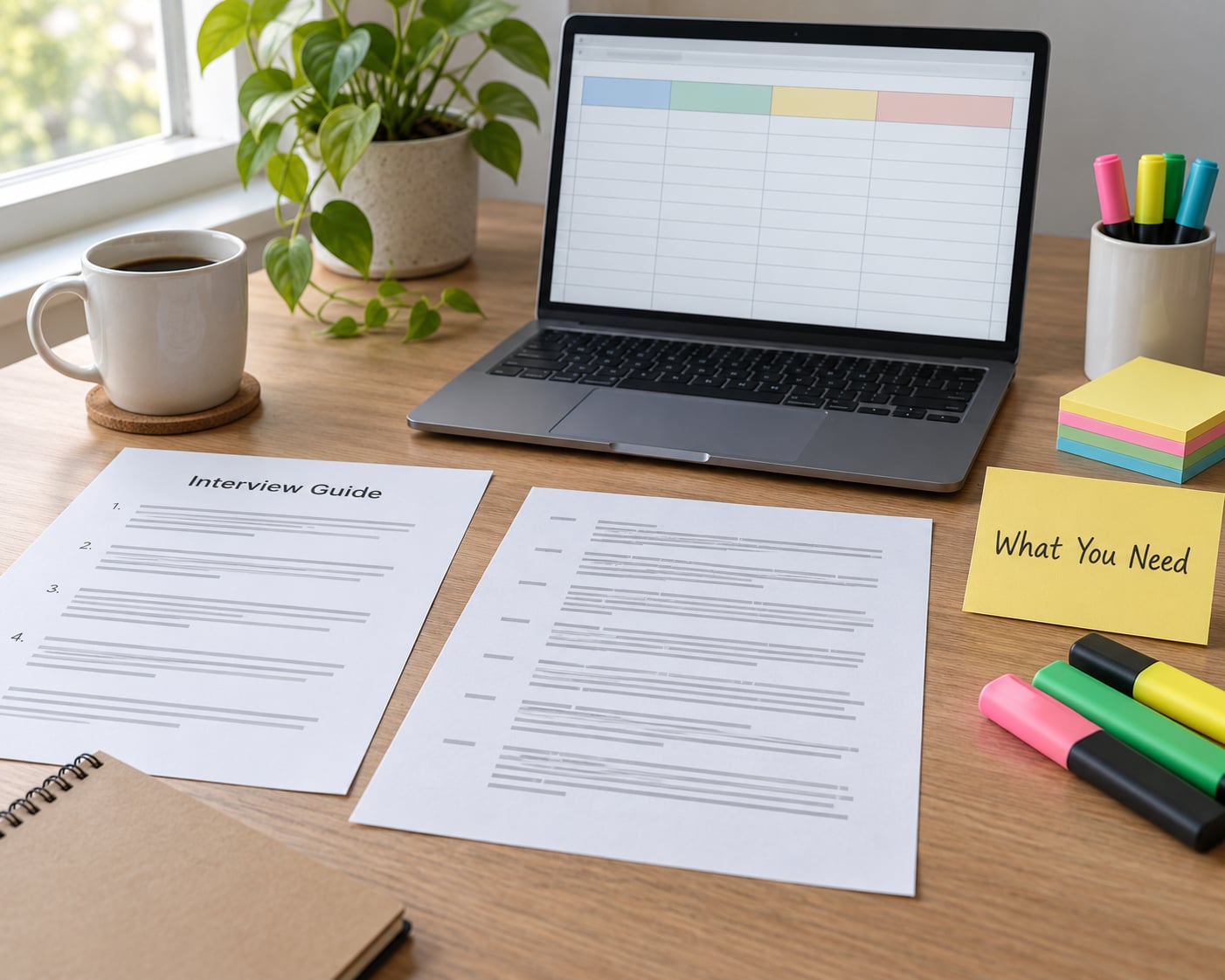
Six things, and most of them you already own:
- A written research question. One sentence, answerable by evidence from talk, not by survey data. If you cannot write it, coding will drift.
- The interview guide. You need to know which questions you asked, because guides shape what participants volunteer.
- Transcripts or recordings. Recordings let you check tone. Transcripts let you quote.
- A coding environment. A spreadsheet, a word processor with a tag feature, or qualitative software. All three work.
- A versioned codebook document. A single file with a row per code that you update as you go, never a stack of notes in your email.
- A decision log. A dated running list of what changed and why. This is the artifact that saves you in a viva or a client review.
One distinction to settle now, because it shapes everything else: deductive coding means you start with codes defined in advance, usually from your research question, literature or existing framework. Inductive coding means you let codes emerge from the data and formalize them afterwards. Most real studies are hybrid. You carry two or three deductive codes in from the start and let the rest develop inductively.
I also want to flag one honest thing from the field. A thread on r/PhD asks what your strategy is for analysis after coding, and the anxiety underneath that question is real: plenty of people finish coding and then sit still. The plan here front-loads enough structure that the post-coding step is already built.
How to Code Interview Transcripts for Themes: Step-by-Step
Coding is iterative, not linear. The same excerpt may get a descriptive code in the first pass and land inside a broader theme after you have read four interviews. What follows is a seven-stage workflow; expect to loop back to stage four more than once.
The method, in one line: read first, code loose. Do not open the file with a codebook and hunt for confirmation.
1. Clarify the Research Question and Unit of Analysis
Write the research question down and mark what a successful answer would look like. “How do first-time buyers decide between two similar products” is a workable question. “What do people think” is not.
Then decide your unit of analysis: are you coding concepts, experiences, behaviours, mechanisms, or cultural patterns? Unit of analysis just means the thing you consistently treat as the coding target. If you are coding concepts, you might mark every mention of a belief. If you are coding behaviours, you might mark only what the participant did rather than what they felt about it.
You know the unit is clear enough when two transcripts can be coded by the same rule without arguments. Test it by writing one paragraph of a rule and asking whether someone else could point at a passage and say yes or no. If both answers are possible, the rule is too vague.
2. Prepare and Organize the Transcripts
Formatting matters more than people expect, because bad formatting quietly corrupts codes later. Before coding anything:
- Anonymize. Replace names with stable labels like P01, P02. Keep a re-identification key stored separately and encrypted.
- Use consistent speaker labels throughout. Interviewer and Participant, not mixed names.
- Add timestamps or line numbers every ten lines or so, so a quotation can be traced back to audio.
- Break paragraphs by topic shift rather than by fixed time intervals.
- Keep filler words. Removing every “um” and “you know” destroys meaning in spoken data.
- Bracket anything inaudible, for example [inaudible] or [laughs], rather than guessing.
- Fix names, numbers, brand names and specialist terms. These errors propagate straight into your codes.
That last point matters more with automated transcription. AI and meeting tools mishear names, drop negatives, and sometimes invent words. A transcript where “the app is not slow” becomes “the app is slow” will produce a negative code you then defend in your write-up. Fix those lines by listening to the audio before coding.
Give each transcript a stable ID and a fixed file format. Assigning P03 twice is the kind of error that surfaces at the worst possible moment, usually when your client asks which participants did not mention price.
3. Do a First Pass Without Over-Coding
Read one transcript straight through with no codes at all. Write a one-sentence summary of what this person’s story is actually about. Call it your North Star sentence. It is not a code and it does not go in the codebook. It exists so that when you are 40 codes deep you still know what the interview was about.
The North Star sentence is the part of my own practice I would keep if I lost everything else. It is also the fastest way to notice that you have coded an entire interview around a side issue.
Then read it a second time and mark, in the margin, five to seven places that matter. Flag recurring ideas, surprising or contradictory passages, emotionally loaded moments where the speaker’s tone shifts, and anything you cannot yet explain. Do not name the codes yet. This pass is about attention, not taxonomy.
Over-coding at this stage is the most common regret in the field. Researchers lock into a structure after two interviews and then spend the rest of the project forcing later data into it. Stay loose; the structure comes later.
4. Build an Initial Codebook
Turn your marginal marks into code definitions. Every code needs five things: a name, a definition, an inclusion rule, an exclusion rule, and one example excerpt. Codebooks built from names alone are the reason people label forever without ever knowing what they have labelled.
Here is what one filled row looks like in a spreadsheet:
| Code | Definition | Include when | Exclude when | Example excerpt |
|---|---|---|---|---|
| Second-guessing the purchase | Participant revisits a decision after making it, describing doubt or checking behaviour | They describe returning to a decision, checking reviews again, or asking a friend after buying | They describe ordinary hesitation before deciding | “I did buy it that night, then I stayed up till one looking at the same review again.” |
| Justifying the price out loud | Participant explains to themselves or another person why the amount was acceptable | They name an amount or a comparison and say it was fair or worth it | They simply state the price was high without reasoning | “It was more than I normally spend, but it replaces the other one, doesn’t it?” |
Two rules make a code usable. Keep sibling codes distinguishable: if you cannot write an exclusion rule that separates them, they are probably one code. And keep codes about as short as the passage they name. A label that needs a sentence to explain is almost always carrying two ideas.
5. Code the Transcript in Manageable Segments
Now work through the transcript in coherent blocks, usually one topic shift at a time. For each block, decide whether it needs a code at all; most blocks do not. Then attach a code, and add a second when a passage genuinely carries two meanings.
Multiple codes on one passage is normal and not a failure. If a participant both jokes about price and admits they checked three competitors, that excerpt may sit under humor about cost and competitor comparison at once.
Move on only when the passage in front of you is adequately labelled by your own standard. Write a short memo whenever you notice something that does not fit the codebook, and keep quotations exact. A paraphrase in a quotation mark will be challenged, correctly, by the first person who reads your data.
Expect the first transcript to take a few hours. Later ones go faster because the codebook exists, and faster still after the fifth because you stop creating new codes and start applying old ones.
6. Revise Codes and Compare Across Interviews
After four or five transcripts, stop and do a second pass across the whole set. Test whether your existing labels still fit. Merge codes that mean the same thing, split codes that hide two ideas, and rename anything that a new participant would not understand.
This is the point where codes become themes. A theme is a cluster of codes with a central organizing concept that makes an interpretive claim. “Talking about price” is a topic. “Price gets defended after the purchase, not before it” is a theme, because it says something you could be wrong about.
You will also need a stopping rule for moving from coding to theming. A usable test is analytic adequacy: do new interviews mostly reproduce existing codes, or occasionally generate one genuinely new one that you can absorb? If the second keeps happening, keep coding. Braun and Clarke’s reflexive thematic analysis treats this as a recursive loop rather than a gate you pass once.
Then hunt for negative cases deliberately. Pull the excerpts that contradict each theme and keep them in the same place as the supporting ones. A theme with no contradicting case in your data usually means you coded the contradicting case into a different code somewhere upstream.
Record every codebook change with a date and a reason. This change log is what makes the analysis auditable rather than a reconstruction you try to remember at the end.
7. Check Reliability and Freeze the Codebook
Pick two or three excerpts per interview, roughly ten percent of the material, and have a second coder label them with your codebook. Discuss every disagreement where the definition did not resolve it, then fix the definition rather than persuading the other person. Repeat on fresh excerpts until the codebook explains itself.
If you want a number, agreement between coders can be expressed as a percentage of matched codes or as a coefficient such as Cohen’s kappa. Do not treat the number as a quality score. Kiger and Varpio’s AMEE Guide No. 131 is blunt about this: agreement statistics do not prove an analysis is correct, and a high score on a vague codebook is not evidence of a rigorous one. Some reflexive approaches skip the calculation and rely on a documented, reflexive decision trail instead. Decide which convention your field expects and state it.
Freeze the codebook when the last interviews add nothing structural, then export the final theme table, the supporting and contradicting quotations, the frequency counts, and your memos. Keep the counts. Just remember they describe how often something appeared, not how much it mattered.
Common Mistakes When Coding Interview Data
- Coding isolated quotations out of context. Pull the surrounding exchange back in. A participant who says “it was fine” after a long pause is not the same as one who says it flatly.
- Inventing a theme from one interview. A vivid story is not a pattern. Require support from at least three participants before a candidate theme survives.
- Using vague or overlapping labels. If two codes could apply to the same passage with no way to choose, they are one code or the boundaries are missing.
- Counting mentions and calling that analysis. Frequency is a retrieval aid. It cannot tell you whether a code is important, only that it is visible.
- Changing definitions with no change log. Rename freely, but write down what moved and when. Otherwise your own past coding becomes unexplainable.
- Claiming saturation too early. Do not report a fixed number of interviews as the threshold. Describe the evidence for adequacy instead.
- Ignoring tone and silence. Hesitation, laughter, a sudden change of register, or an answer that stops mid-sentence often carry more than the content words. Code those moments too.
- Pruning by deletion. Never reduce codes by throwing away excerpts. Merge and rename, keep the underlying quotations attached.
Tips for Reliable and Credible Coding
Prune without losing meaning. When your code count runs away, resist the urge to cut. Sort codes into piles by meaning, merge within each pile, keep the original code names in a retired column so you can trace what went where, and only then remove rows from the active sheet. A ResearchGate poster asked whether 3,000 codes across 12 interviews meant something had gone wrong; the answer is usually that first-cycle coding produced genuinely fine-grained units and nobody did the second-cycle pass. Pruning is the second-cycle pass, so do it deliberately rather than by panic.
Separate descriptive from interpretive codes. A descriptive code names what is happening in the passage. An interpretive code names what it means for your question. Descriptive first, interpretive second, and keep them distinguishable while you work. Mixing them early makes it impossible to tell whether your theme came from the data or from you.
Use in vivo codes sparingly. A participant’s own phrase makes a vivid code, especially around symbols and identity. It also carries their vocabulary, not yours, which is why it does not generalise past that person without a definition.
Keep a running memo. Two sentences after every interview, written while it is fresh, saves hours later. Note what surprised you and what contradicts the codebook so far.
Test alternatives out loud. After you draft a theme, write the strongest competing reading of the same evidence. If you cannot articulate it, you have not tested the theme yet.
Let software do retrieval, not judgement. NVivo, MAXQDA, ATLAS.ti, Delve and Taguette all speed up searching, tagging and visualizing. None of them can decide what a theme means or whether your dataset supports it. Taguette is a reasonable free starting point; a spreadsheet with one row per excerpt is genuinely sufficient for a moderate study.
Use AI in stages, never in one prompt. An assistant can propose candidate codes for a chunk of text, cluster your existing codes, and pull every excerpt attached to a label. It cannot own the interpretation. Ask for staged, reviewable outputs that you edit by hand, and never ask for “the themes” in a single prompt, because you will get a plausible-sounding list with no audit trail behind it.
Frequently Asked Questions
Can I use qualitative analysis software to code interview transcripts?
Yes, and for anything beyond a handful of interviews it makes retrieval much faster. Tools such as NVivo, MAXQDA, ATLAS.ti, Delve and Taguette let you tag passages, run text searches and see every excerpt attached to a code at once. They do not make your decisions for you, and a spreadsheet with one row per excerpt works for a moderate study. Choose software for the retrieval work, not as a substitute for writing code definitions.
Should I code interview transcripts inductively or deductively?
Both, in most studies. Deductive codes come from your research question or existing framework and are defined before you start. Inductive codes emerge from the data and are formalized as you go. A workable hybrid is two or three deductive codes carried in from the start, with everything else developed inductively. Purely deductive coding risks forcing data into your framework; purely inductive coding can drift away from the question you were funded to answer.
How many themes should I expect in a qualitative study?
Any honest answer has to begin with the observation that there is no target number. A small study may produce three to five themes, a larger one ten or more, and both can be sound. What matters is whether each theme makes an interpretive claim, has support and contradicting evidence, and cannot be replaced by a more accurate sibling. If two themes make the same claim, merge them.
What is inter-coder reliability, and do I need to calculate it?
Inter-coder reliability means checking whether a second person applies your codebook to the same material and lands in roughly the same places. You can measure it as a percentage of matched codes or with a coefficient such as Cohen’s kappa. Some fields expect a number for dissertations; reflexive thematic analysis does not, and prefers a documented decision trail instead. Kiger and Varpio’s AMEE Guide No. 131 warns that agreement statistics do not prove an analysis is correct.
How do I prevent my coding from being biased toward the research question?
Code some material before you finalize your codebook, keep at least one interview uncoded until late, and deliberately search each theme for negative cases rather than confirming excerpts. Ask a second coder to label a sample with your definitions and record where the definitions failed. If you can state the strongest competing reading of your evidence, you have tested the bias instead of assuming it away.
Does a frequently mentioned theme automatically become an important theme?
No. Counts tell you what is visible in the data, not what matters for your question. A code mentioned in every interview may be background noise that participants assume everyone shares, while a code mentioned twice may carry the most analytically interesting tension. Treat frequency as a way to locate material and to check coverage, then let the strength of the evidence and the central organizing concept decide importance.
Conclusion
Clarity beats volume in transcript coding. If you take one path from this guide, take this order: write the research question and the unit of analysis, run one read-first, code-loose pass, then draft a provisional codebook with a definition and an example for every code. Everything after that is comparison — across participants, against negative cases, and through a decision log you will be glad to have when someone asks why you coded it that way.
Do not wait until you feel ready to code. Open the transcript, write the North Star sentence, and mark five passages that matter.