
Why ethnographic research reveals what surveys miss is a fair question to ask, because a survey with a thousand responses produces a very different picture than a week in someone’s kitchen. Surveys collect what people say they did, remember and approve of. Ethnographic research watches what people actually do while the television is on, the baby is crying and the delivery is late.
That gap is not a flaw in either method. It is the difference between two kinds of evidence: reported behavior and revealed behavior. Once you can name the specific ways self-reporting goes wrong, the choice between the two methods stops being a matter of taste.
Table of Contents
- What Does Ethnographic Research Reveal About Consumer Behavior?
- Why Ethnographic Research Reveals What Surveys Miss
- Social desirability bias
- Satisficing
- Recall error
- Acquiescence bias
- Question framing and order effects
- The difference is the context
- What Can Surveys Measure That Ethnography May Miss?
- How Do Researchers Capture These Hidden Insights?
- What Kinds of Consumer Insights Does Ethnography Uncover?
- When Should You Use Ethnography Instead of Surveys?
- How Can Ethnography and Surveys Work Together?
- What Are the Limitations of Ethnographic Research?
- Frequently Asked Questions
- What is the main difference between ethnographic research and surveys?
- Is ethnographic research always better than survey research?
- How large does an ethnographic sample need to be?
- Can ethnography and surveys be combined in one study?
- What are the most common biases in ethnographic research?
- Conclusion: Start with the Insight You Need
What Does Ethnographic Research Reveal About Consumer Behavior?
Ethnographic research is a qualitative method in which a researcher observes and interacts with people in their natural environment to understand how they behave, rather than asking them to describe that behavior afterwards.
In practice it means a researcher is physically or remotely present where the product gets used: a kitchen, a car, a hospital ward, a warehouse, a shared office. The researcher watches, takes field notes and asks short, open questions while the activity is happening. The output is rich narrative evidence rather than a chart of percentages.
That evidence covers a specific set of things. Ethnographic research reveals the behaviors that happen between the taps a survey asks about, the workarounds people invent when a product frustrates them, the social influences that change a decision, and the contextual constraints that explain it all. It also surfaces the emotions attached to a routine, which is usually where the commercial opportunity sits.
One clean example: a team shipping a meal-planning app kept hearing in interviews that users planned on Sundays. Field visits showed that fewer than a third actually planned on Sundays. Most opened the app on Thursday evening, standing in the kitchen, deciding between three options that were already in the fridge. Nothing about Thursday evening appears in a survey instrument, because nobody thinks of it as a planning habit.
Why Ethnographic Research Reveals What Surveys Miss
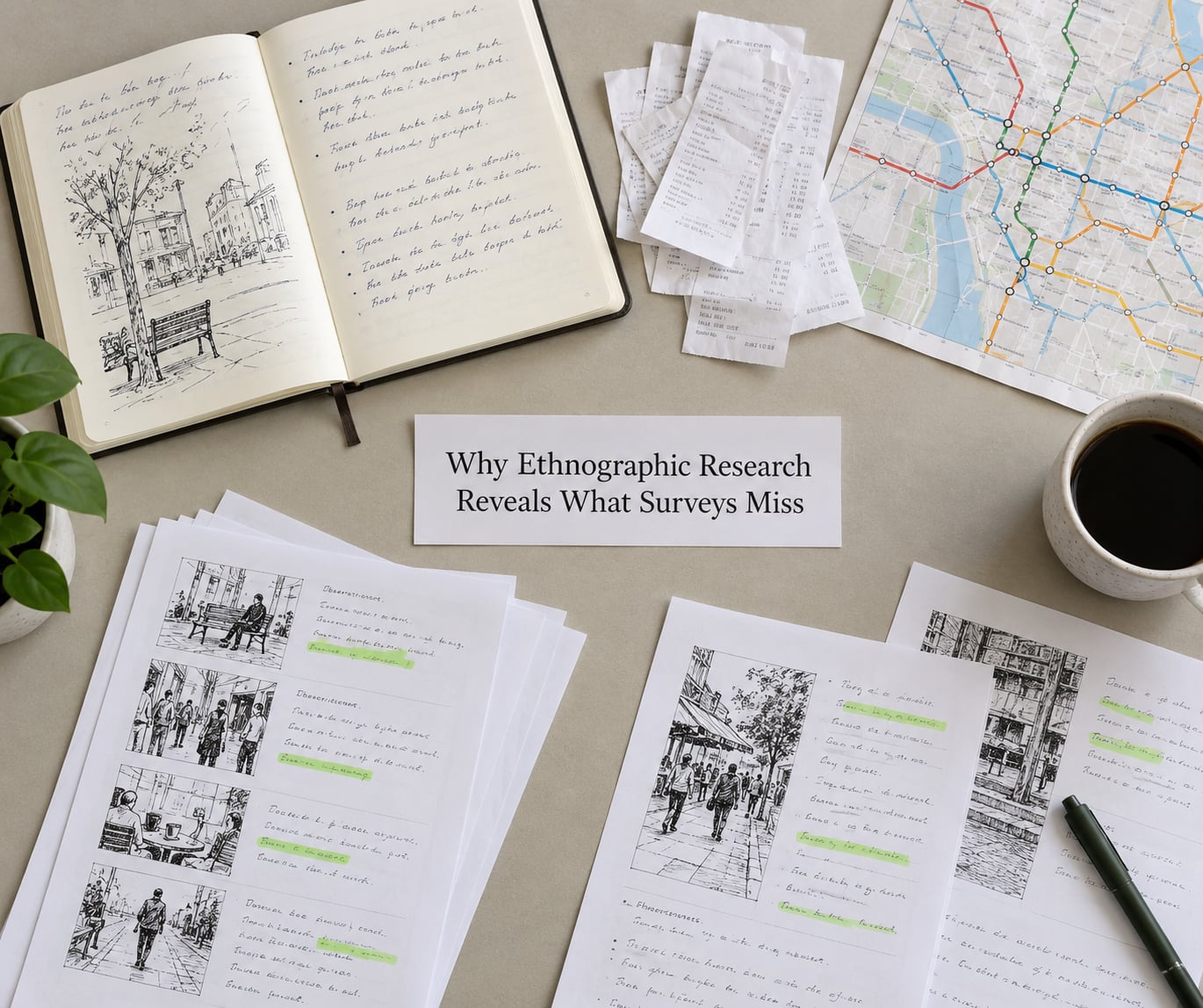
Because a survey asks people to reconstruct their own behavior, and reconstruction is unreliable in five specific, well-documented ways. Naming them is the fastest way to understand why ethnographic research reveals what surveys miss.
Social desirability bias
Respondents give answers that make them look good. Nobody wants to admit they re-bought the same shampoo because the one they liked cost too much, ignored the instructions, or shopped by price alone when asked about quality. The gap between stated preference and revealed preference is not dishonesty, it is self-presentation.
Satisficing
The term, coined by psychologist Tobias Harris, describes what happens when people give a survey enough effort to get through it and no more. They pick the first plausible option, pattern their answers, or stop reading halfway. Satisficing quietly inflates every percentage in the dataset.
Recall error
Asking someone to report the last three purchases, or how often they did something last month, assumes an accuracy memory rarely delivers. Frequency questions drift upward for things people enjoy and downward for things that felt pointless.
Acquiescence bias
People lean toward agreeing with whatever is in front of them, especially with a neutral-sounding statement. A long neutral survey starts producing agreement, and the team reads that as a real preference.
Question framing and order effects
Wording moves results. Asking about satisfaction after asking about effort produces a different answer than the reverse, and both look clean in the data. Field observation has no instrument, so there is nothing for a leading question to contaminate.
The difference is the context
A survey strips the behavior out of its setting. It does not capture the third party in the room, the time pressure, the previous failure, the borrowed tool, or the fact that the real decision was made by someone who never filled in the survey at all. Ethnographic research keeps the setting intact, which is why it reveals cues and influences that respondents cannot recognize or describe, and would not describe even if they could.
Field teams describe this mismatch in practical terms: the person answering the survey is not the person doing the work, and the two talk about the same task in different language. That is structural, not a sample-size problem, and no increase in responses fixes it.
What Can Surveys Measure That Ethnography May Miss?
Surveys win on reach, standardization and change over time. Ethnography wins on explanation and context. Neither replaces the other, and any vendor who tells you otherwise is selling something.
| Dimension | Survey | Ethnographic research |
|---|---|---|
| Typical sample | Several hundred to thousands | Roughly 8 to 20 participants per segment |
| Timeline | Two to four weeks fielding | Three to ten weeks in the field |
| Cost profile | Scales predictably with sample | High fixed cost, low marginal cost |
| Output | Numbers, segments, trends | Narrative, sequences, observed behavior |
| Why | Answers only what was asked | Explains causes and mechanisms |
| Change over time | Easy to repeat on a fixed cadence | Expensive to repeat identically |
| Geographic reach | Broad and cheap | Limited by where the researcher can be |
| Reporting | Dashboard-ready | Needs a skilled reader and editing |
| Main bias | Response and sampling bias | Observer and interpretation bias |
| Good at | How common, how often, how much | How, why, in what situation |
Two limits deserve naming here. A sample of twelve cannot tell you how common a behavior is, and anyone who claims otherwise is over-reading the data. And a narrative report is hard to feed into a dashboard, which is exactly why ethnography alone frustrates leadership teams used to quantified answers.
How Do Researchers Capture These Hidden Insights?
Fieldwork combines observation with conversation. The four classic observation modes differ in how much the researcher joins in, and each produces a different kind of evidence.
- Participatory observation. The researcher joins the activity as a participant, for instance cooking a meal alongside the household. Reveals tacit knowledge and the sequence of the task in detail.
- Nonparticipant observation. The researcher watches without joining, usually in a public or semi-public setting such as a shop aisle or a clinic waiting room. Keeps behavior undisturbed and works at a distance.
- Contextual inquiry. Observation in the workplace, workplace being wherever the work actually happens, including a site manager’s car. Good for B2B and service operations.
- Go-along interviews. A short interview conducted while the participant moves through their real environment, asking questions in the moment. Cues surface from the surroundings rather than from memory.
Shadowing is the business variant: the researcher follows a person through their day and records what they actually do, which frequently contradicts their job description. Diary studies fill the gaps between visits, and cultural probes are small tasks given to participants to reveal how they organize and improvise.
Remote and digital ethnography extends the same logic without the travel. A researcher joins a video call while the participant shares their screen or holds the camera on their hands, then codes the recordings. It reaches distant markets cheaply, and it loses some of the ambient context a physical visit picks up. Practitioners sometimes call this 360-degree ethnography and treat it as the practical answer to multi-site fieldwork, accepting less depth for coverage.
What Kinds of Consumer Insights Does Ethnography Uncover?
The recurring categories are worth knowing, because they show up differently in every project.
- Unstated motives. The reason behind the reason. People report that they bought for durability and reveal that durability was chosen because returning items felt like admitting failure.
- Hidden labor. Steps nobody counts. A grocery app team watched people photograph items, check pantry inventory, and text a partner before confirming a pickup slot, then discovered most cancellations traced back to that text.
- Workarounds. Behavior invented to survive a product’s flaw. Workarounds rarely show up in surveys because participants have stopped noticing them, yet they map exactly where a redesign would pay off.
- Decision points. The real trigger for a purchase or a switch, which is frequently not the moment the team assumed.
- Emotional reactions. Hesitation, embarrassment, small reliefs. These are visible in observation and invisible in a Likert scale, because a five-point scale cannot hold relief.
- Social norms. Who does the task, who is allowed to, and what an acceptable version looks like in a group.
- Physical interaction. Grip, distance, one-handed use, where a device sits in a room. Small details that decide whether a design feels natural.
Named cases still circulate for a reason. Intel’s netbook team watched customers take it on trains and planes before the design settled on a keyboard-first layout, and Miele’s vacuum work led to an allergen sensor because owners were emptying bags in ways the manual never anticipated. Both stories come from the 1990s, which tells you something about how durable the observation principle is.
When Should You Use Ethnography Instead of Surveys?
Choose fieldwork when the question asks why, when the journey is unfamiliar, or when the behavior is sensitive, social, or awkward to describe in writing.
- Unfamiliar categories. Nobody can answer questions about a market that has no language for it yet.
- Complex or emotional decisions. High-consideration purchases rarely reduce cleanly to a rating.
- New product or service design. Watching use beats testing a mock-up in a lab, where nothing is at stake.
- Onboarding and workflow. The first-run experience is where most abandonment happens, and it is easy to study in place.
- Sensitive subjects. Health, money, workplace frustration. People disclose differently in a room than in a survey field.
- Explaining a drop-off. Once analytics shows a cliff, ethnography explains what happens at that step.
Choose a survey when you need a number to defend in a budget meeting, when you are tracking change month over month, when you need to segment a market, or when the question is already well defined and only the magnitude is unknown. Running fieldwork to answer “do people like the color” is an expensive way to learn that color was never the issue.
How Can Ethnography and Surveys Work Together?
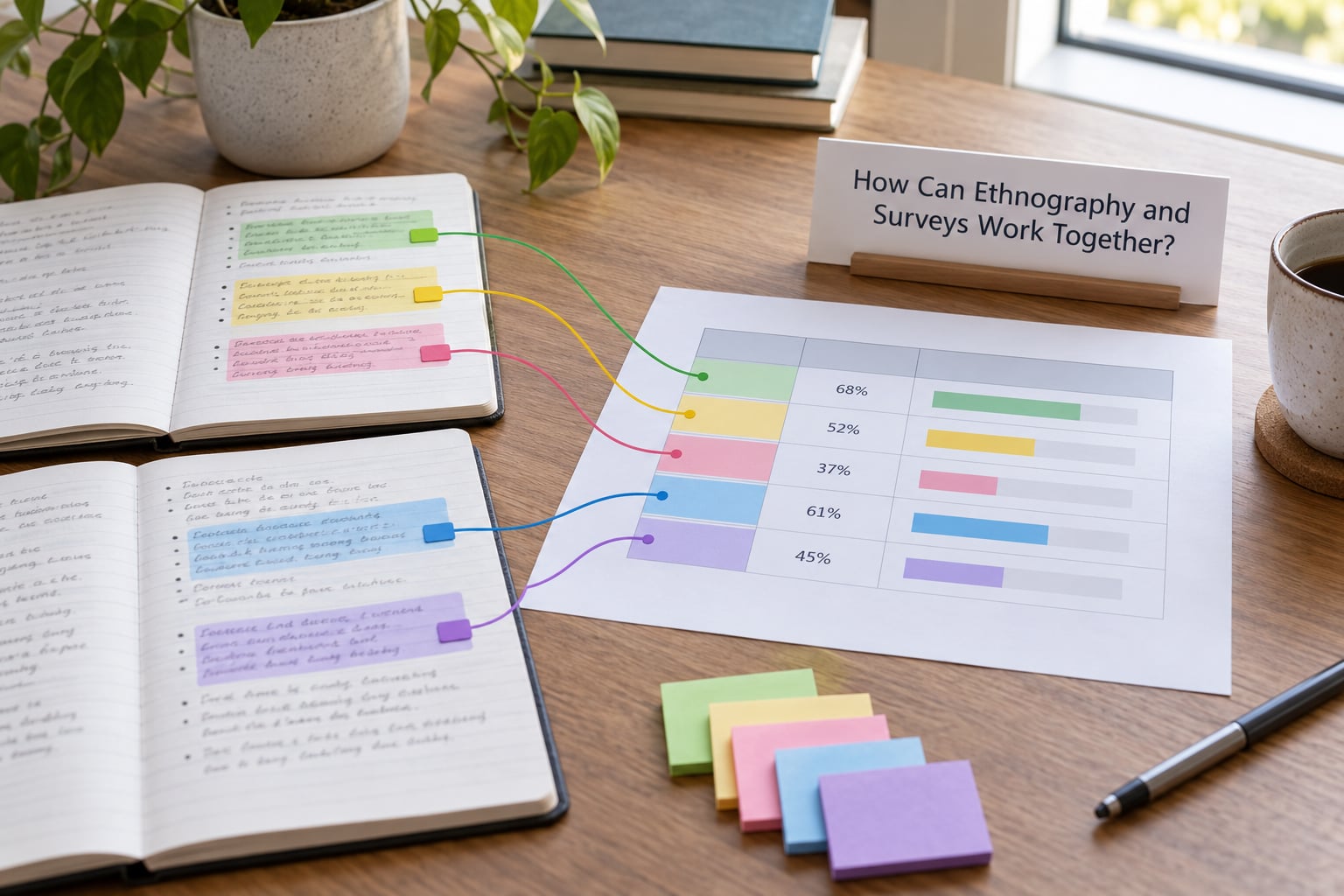
Sequencing works best when fieldwork runs first to discover, then the survey runs at scale to measure. Discovery finds the variable that nobody was measuring; the survey finds out how common it is across a market.
The same sequence repairs survey design, which is the loop most teams miss. If field notes show that people cancel because a household member has to approve the order, then the next survey needs an option for that approval step. Without the fieldwork, the survey will measure intent again and produce another clean, useless chart. Teams that run sustained qualitative research alongside survey work report better question design and better use of the output, which is why the fieldwork has to come first, not after a disappointing result.
A workable sequence looks like this: two weeks in the field with 10 to 12 participants per key segment, a readout that names the observed behaviors precisely, a survey instrument rewritten around those behaviors, then a representative sample large enough to quantify them. Member checking, where researchers read field notes back to participants, and triangulation across observers both tighten the fieldwork stage before the survey exists.
Reporting matters here too. A dashboard-ready summary of what was observed, with a short clip or a described moment, travels much further than a thick narrative deck nobody opens.
What Are the Limitations of Ethnographic Research?
Ethnography trades precision for meaning, and that trade has a price. The honest limitations are these.
- Representativeness. A dozen participants cannot describe a market. Findings describe patterns that held across those cases, not a proportion of a population.
- Researcher influence. People behave differently with a stranger holding a notebook. The observer effect is unavoidable; reflexivity, writing down your own assumptions as you go, is how teams limit it.
- Time and cost. Access is the hardest practical problem, and multi-site fieldwork gets expensive fast. A focused engagement often lands in the low five figures once recruitment and analysis are counted.
- Interpretation. Two analysts reading the same notes can reach different conclusions. Fieldwork supports claims about meaning, where a number would settle the argument, and teams occasionally over-claim.
- Poor fit for shared, group-level questions. When you need prevalence, trend or segment sizes, fieldwork is the wrong instrument.
- Ethics. Observation in private or workplace settings needs explicit informed consent, a clear line on recording, and an answer ready for the question “are you writing down what I am saying.”
The fashion critique is fair too. Ethnography has been oversold for a decade as the source of all true insight, which has made some teams spend months in the field on questions a survey would have answered in three days. Manage the constraint by naming the decision the fieldwork will inform, before recruiting.
Frequently Asked Questions
What is the main difference between ethnographic research and surveys?
Surveys collect self-reported data: what people say they did, remember and approve of, through a fixed instrument applied to a large sample. Ethnographic research observes and interacts with people in their natural environment, recording what they actually do and why context shapes it. Surveys are better at measuring how common something is; ethnography is better at explaining how and why it happens.
Is ethnographic research always better than survey research?
No. Each method answers a different question, so the useful comparison is fit, not quality. Ethnography explains mechanisms, uncovers workarounds and studies behavior that is social or sensitive. Surveys measure prevalence, track change over time, and produce numbers that hold up in a budget meeting. Researchers who claim fieldwork is always superior usually have not had to report a finding to a finance team.
How large does an ethnographic sample need to be?
Most business ethnography studies run 8 to 12 participants per key segment, and 20 is often treated as the practical ceiling for depth and budget reasons. Recruit roughly 20 percent more than your target because some sessions fall through. The number matters less than the segment: adding participants to a homogeneous group adds little, while one participant from a different context can change the read entirely.
Can ethnography and surveys be combined in one study?
Yes, and the combination is usually stronger than either method alone. Run fieldwork first to discover behaviors and variables nobody thought to ask about, then use those findings to rewrite the survey instrument. The survey then measures how widespread the observed pattern is across a representative sample. Researchers also reverse the order, using survey results to spot where a drop-off needs observational follow-up.
What are the most common biases in ethnographic research?
The main risks are the observer effect, where participants change their behavior because they are being watched, and interpretation bias, where the researcher over-reads a small sample. Selection bias enters when participants are recruited only from the easiest groups to reach, and reflexivity matters because researchers routinely notice in their own habits what they cannot see in a client’s. Triangulation across observers and member checking reduce most of these problems.
Conclusion: Start with the Insight You Need
Why ethnographic research reveals what surveys miss comes down to one thing: self-reporting is a reconstruction, and reconstruction drops the context that explains the behavior. Watching people in their natural environment captures the motives, workarounds and social dynamics that no wording of a survey question can reach.
Start with a decision you cannot currently make. Name the behavior you do not understand, put a researcher in the room where it happens, and let the fieldwork tell you which question deserves to be asked at scale next.