
An online community for brand research is a private, invitation-only space where a brand’s real customers gather over months to answer questions, react to concepts and argue about problems. Run it as a research instrument rather than a marketing channel, and it becomes a standing panel of qualitative data that answers your next question the day you ask it.
The honest version: this is a six-to-eight week setup followed by about four hours of work a week from one person. Small and unglamorous. What makes it worth doing is that a community keeps producing between studies, and it shows you the reasons behind a number instead of just the number.
Below is the sequence I use when a team asks me to stand one up: define the decision, define the member, choose the format, recruit and screen, run a structured prompt programme, moderate for depth, protect the data, code the threads, and report against measures that tell you whether to keep going.
Table of Contents
- What You Need Before You Invite Anyone
- Step-by-Step: How to Run an Online Community for Brand Research
- 1. Set the research objective and the decision
- 2. Define the ideal participant profile
- 3. Choose the community format and platform
- 4. Recruit participants and set expectations
- 5. Design a structured discussion program
- 6. Facilitate consistently and moderate carefully
- 7. Protect participant trust and research quality
- 8. Turn discussions into coded insight
- 9. Evaluate the community and report results
- Common Mistakes and How to Fix Them
- Facilitation tips worth keeping
- Frequently Asked Questions
- How many members does an online research community need?
- How do I recruit research participants for an online community?
- How much should I pay research community members?
- How do you moderate a brand community without killing engagement?
- Can a customer community replace customer surveys?
- Can you use ChatGPT for qualitative data analysis?
- Conclusion
What You Need Before You Invite Anyone
Most failed communities fail in the setup week, not the moderation month. You need seven things in place before the first invitation goes out.

A research objective tied to one decision. “Improve customer engagement” is not an objective. “Decide whether to launch the refill subscription in the second quarter” is. If you cannot name the decision, the threads will produce opinion that nobody uses.
A participant profile. Write down the behaviours that matter, not just the demographics. Category experience, purchase frequency, tenure with the brand, role in the buying decision, and the one attitude you want to probe.
A platform with private areas. You need an invite flow, member profiles, threaded replies, polls or concept cards, and the ability to export or search everything later. Public community software often gives you the first four and quietly fails the fifth.
A consent and privacy note. One page, plain language: what is collected, what the research purpose is, who sees member responses, how long data is kept, and how to withdraw. Practitioners say repeatedly that members disengage the moment they suspect the community is a funnel in disguise, so say it out loud.
Community guidelines. Two or three behavioural rules, one enforcement ladder, and a named human who owns it. Anonymity and generic corporate replies kill trust faster than anything else.
An incentive plan. Decide format and rough value before recruitment, not after you see how many replies you get.
An analysis kit. A tagging scheme with ten to fifteen starter codes, a place for verbatim quotes, and a decision log. Decide this now, while you are still planning, because tagging retroactively is miserable work.
Step-by-Step: How to Run an Online Community for Brand Research
1. Set the research objective and the decision
Turn the broad idea into one or more research questions, each attached to a decision someone actually owns. Useful objectives cluster into four types: unmet needs, barriers to purchase, reactions to a concept, and reasons for churn.
A test: write the question, the decision, and the deadline on one card. If the decision has no named owner or no date, you have a topic, not a research question. Two to three questions per quarter keeps a community focused and gives you a reason to bring members back.
2. Define the ideal participant profile
Specify inclusion and exclusion criteria before you invite anyone. Recruit for the behaviour that matters most in your question, since buying frequency or category depth usually predicts far more useful answers than age or location.
Precision improves the insight and does not have to narrow the pool. “Owners of the current model who bought it in the last year and have used two or more features” is still a large group, and it produces usable material. Vague criteria like “interested in our products” produce members who cannot answer anything.
Set soft quotas for segments you must hear from, typically three to five: new versus long-tenure, heavy versus light users, advocates versus detractors, and one B2B segment such as buyers versus end users.
3. Choose the community format and platform
Match the format to the question. Nothing else matters as much, and the wrong format wastes months.
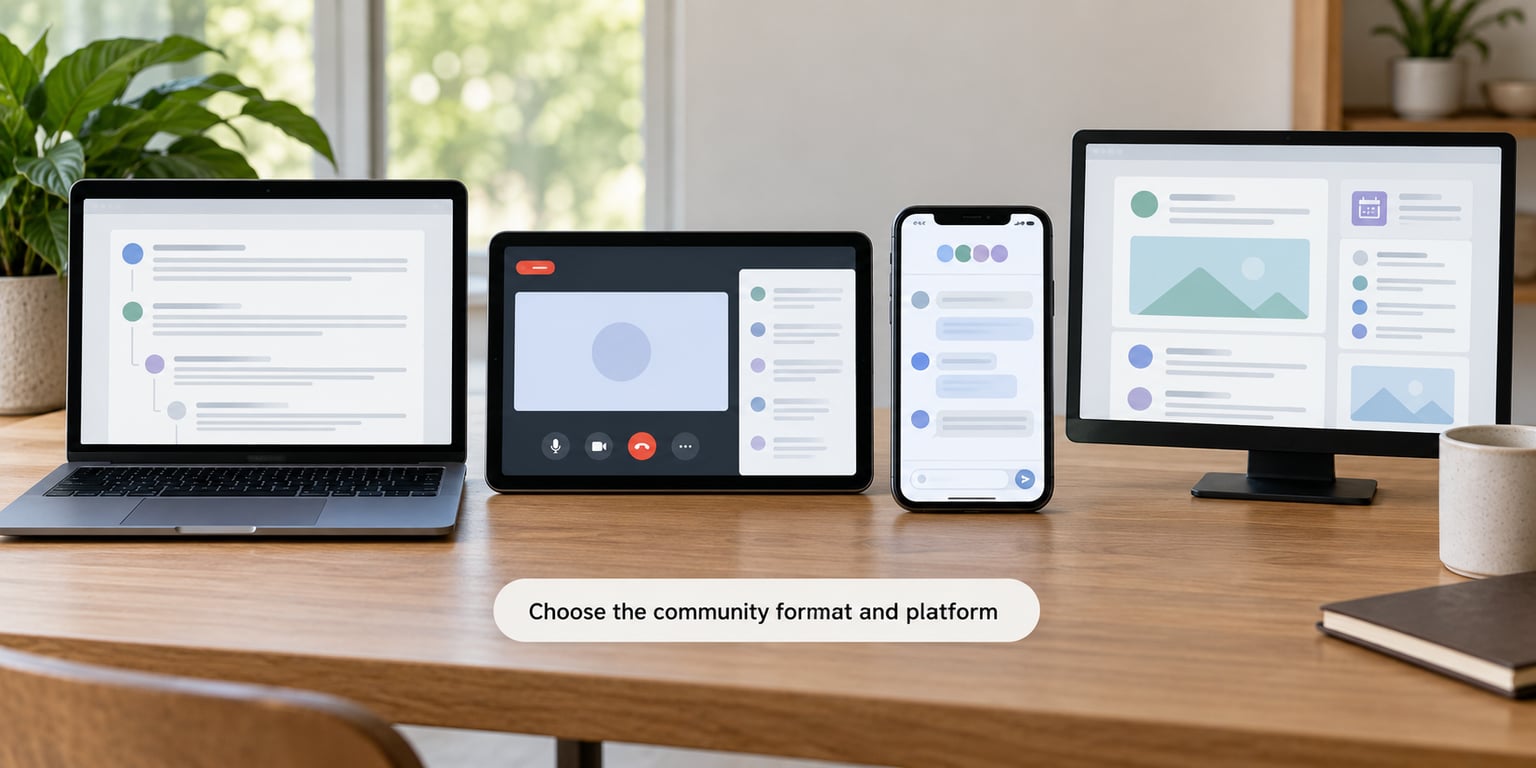
| Format | What it is good for | Weekly commitment from members | Moderation load |
|---|---|---|---|
| Asynchronous forum | Concept testing, message testing, longitudinal tracking, churn diagnosis | 15-30 minutes, in their own time | Moderate |
| Live scheduled session | Complex trade-offs, new concept reveal, group energy and disagreement | 60-90 minutes at a fixed date | High during the session |
| Private group chat | Quick pulse checks, informal reactions, early signal | 5-10 minutes | Constant |
| Hybrid community | Everything above, staged across a week | Varies by week | Highest, needs cover |
On platform choice, there are three realistic routes: repurpose what your audience already uses, buy a research community platform, or build. Repurposing is fastest and cheapest but you inherit the platform’s export limits and its privacy posture. Buying gives you quotas, screening and tagging out of the box. Building rarely pays for itself below a few thousand active members.
For a first community I usually recommend repurpose for speed, with one condition: confirm before launch that you can export full thread history with member identifiers intact. Confidentiality needs three things regardless of platform: a private space, no search-engine indexing, and a rule against members sharing what others said.
4. Recruit participants and set expectations
Recruit from where your customers already are: support tickets, review responses, buyers of adjacent products, event attendees, and existing beta or loyalty groups. Practitioner threads on running a brand community from scratch keep landing on the same tactic, which is to find the five to ten people who already reply everywhere and message them individually before opening the doors.
The invitation does most of the work. It should state the topic, the time required per week, what you will ask and roughly when, what the incentive is and how it is earned, what happens to their responses, and that they can leave at any time. Be explicit that this is research and not a sales channel; members forgive small communities, they do not forgive feeling managed.
Screening questions should filter on behaviour and honesty. Three to five short questions is enough, and one of them should check willingness to engage over months rather than only today. Informed participants give better answers and keep answering, because they understand the deal.
5. Design a structured discussion program
Plan prompts in a deliberate order: familiar experiences first, then attitudes, then motivations, then trade-offs, then future behaviour. Skipping straight to attitudes gets you speculation, which is what you would have got from an internal brainstorm.
A good week has three touchpoints. A warm-up prompt drawing on lived experience, a stimulus such as a concept card, a poll or a sort task, and one closing question that asks what would change someone’s mind. Keep the discussion guide written down and post the same core wording to every member so responses stay comparable.
Avoid three failure shapes. Leading questions smuggle your hypothesis into the data. Repetitive polls train members to click without thinking. Broad prompts such as “what do you think of our brand?” reliably produce nothing usable.
Stimulation techniques worth trying: concept sorts where members rank options and explain the top two, ideation grids that force variation across rows and columns, diary tasks where members log a real experience for a week, and polls used as a warm-up rather than as the finding.
6. Facilitate consistently and moderate carefully
Your job in a research community is elicitation, not enforcement. Ask follow-up questions that push for the mechanism: “what happened just before you decided to switch?” rather than “do you like the new option?”. Acknowledge good contributions by name, because recognition is the cheapest incentive there is.
There are four interventions worth making regularly. Ask one clarifying question per thread so others can build on it. Correct factual errors about the product quietly and briefly. Redirect off-topic threads to a parking area instead of deleting them. And stay silent on threads that are already working, because a moderator jumping into every reply flattens the discussion.
Overmoderation is the more common failure. If you delete every disagreement, you remove the most useful signal in the room. Redirect the conversation, let the contradiction stand, and let members resolve it.
Budget the time honestly. An asynchronous community of around fifty active members takes roughly three to five hours a week: two on facilitation and follow-ups, one on the weekly stimulus, one on tagging, and the rest on admin and reporting. A live session adds three to five hours of prep and follow-up on top.
7. Protect participant trust and research quality
Trust is the whole mechanism. If members stop believing their answers are handled properly, the quality of what you collect collapses faster than any sampling problem.
Keep the consent note visible at onboarding and repeat the data-use promise when you run a sensitive topic. Separate research data from identifiable brand records: give members a research identifier, strip names from any dataset that leaves the research team, and never export member contact details into a CRM without a stated permission. Give people a route out that actually works, and honour withdrawal requests including partial deletion.
Close the loop in public. Post a short “what we heard and what changed” note after each round, including the rounds where the answer was no. In B2B and professional communities, members check whether their employer is identifiable in a post, so write a simple rule about that and enforce it.
Handle bias deliberately rather than hoping it away. A volunteer community over-represents the engaged, the recent, the loyal and the loud. Counter it by tracking which segments are missing, inviting deliberately from quieter segments, running one quantitative tracker alongside to check whether the community’s views drift away from the base, and never reporting a community finding as if it were a representative survey.
8. Turn discussions into coded insight
Organise responses before you interpret them. Tag every contribution against your ten to fifteen starter codes, allow new codes when a theme recurs three times, and keep verbatims attached to the theme rather than floating loose.
Then look for three things: repetition, which is a pattern; contradiction, which is usually a segment boundary; and silence, since a topic nobody raises is evidence too. Compare deliberately by segment when a theme splits by tenure, usage or role, and check whether a claim rests on one loud member or several.
Use AI tools for first-pass coding and summarisation on large thread volumes, but keep human review on anything you will act on. Models are good at clustering similar language and bad at sarcasm, segment nuance and reading what a member chose not to say. Treat generated summaries as a reading aid, never as a finding.
Finally, connect every theme back to the original objective. If it does not help you decide between launch and hold, it is colour, not insight.
9. Evaluate the community and report results
Measure the operation and the output separately. Operation: recruitment conversion from invite to accepted, screening pass rate, activation in the first fortnight, participation rate, return-visit rate and topic coverage against your plan.
Output: response depth rather than raw volume, number of usable verbatims per discussion, number of themes that reached a decision, and proportion of findings that changed a plan. A community that produces lots of posts and no decisions is a support queue, and you should treat the numbers accordingly.
When you report, give the method, the member composition, the known biases, a confidence level per theme, recommended actions and the next research question. Say plainly which findings came from a handful of members, because that credibility survives contact with a sceptical stakeholder.
Common Mistakes and How to Fix Them
Recruiting too broadly. “Anyone interested in our brand” fills the room with people who cannot answer your question. Fix: define behaviour-based criteria, set three to five segment quotas, and check composition at recruitment rather than at analysis.
Asking leading questions. “Would you buy a refill subscription at a lower price?” teaches members to agree with you. Fix: ask about the underlying trade-off and let them name the condition themselves.
Treating discussion as a survey. Volunteers are not a probability sample and a few loud voices will dominate any thread. Fix: label every finding as directional, use a quantitative tracker to sense-check drift, and report the mix.
Rewarding volume over thought. Leaderboards produce fast, shallow replies. Fix: reward completed tasks and usable verbatims, and credit thoughtful contributors by name in the weekly note.
Ignoring the quiet half. Five active members can carry a fifty-member community for months. Fix: check contribution distribution monthly, invite directly from missing segments, and use polls plus live sessions to draw them in.
Changing the topic without warning. A sudden pivot to pricing research after three weeks of product talk reads as extraction. Fix: explain the change and the reason in the community before the new topic lands.
Reporting comments without context. Dropping raw quotes into a deck invites over-reading. Fix: attach the theme, the segment, the count behind the quote and the decision it affects.
Facilitation tips worth keeping
- Post the same stimulus to everyone at the same time; staggered access contaminates comparisons.
- Ask one follow-up per thread and leave the rest alone.
- Let disagreement stand, and moderate tone rather than opinion.
- Name a real person as the community contact, and let non-leadership staff answer questions.
- Close every round publicly with what changed and what did not.
- Keep a parked area for off-topic threads so you do not have to delete anything.
Frequently Asked Questions
How many members does an online research community need?
For qualitative brand research, 30 to 60 active members is usually enough, because depth per participant matters more than headcount. You want three to five people in each segment you care about so that a repeated comment means something. Below roughly 20, you lose the subgroup comparisons that make communities valuable. Above a few hundred active members, the same moderator time produces thinner responses, so segment or recruit a second wave instead of growing one pool.
How do I recruit research participants for an online community?
Recruit from channels where your customers already speak: support ticket follow-ups, review respondents, buyers of adjacent products, event attendees and existing beta groups. Message your most active responders individually before opening registration, because founding members set the tone. Use three to five screening questions that filter on behaviour and willingness to engage over months, set soft quotas for the segments you must hear from, and state the time commitment and incentive in the invitation itself.
How much should I pay research community members?
Cash is not required and often causes trouble. A mix works well: a modest fixed amount or gift card per completed research task, a small quarterly thank-you draw for members who contribute consistently, and visible recognition such as naming contributors in the weekly note or early access to launches. Keep the value proportional to the ask, roughly matching an hour of their time for a substantial task. Whatever you choose, publish the rule so nobody has to guess what earns a reward.
How do you moderate a brand community without killing engagement?
Moderate tone, not opinion. Redirect off-topic threads to a parking area instead of deleting them, correct factual errors about the product quietly, and step back when a thread is already moving. Deleting disagreement removes the most valuable signal in a research community, and constant presence flattens discussion. Name a real moderator, apply a short written rule set with a clear enforcement ladder, and handle bad-faith posts quickly and quietly rather than publicly.
Can a customer community replace customer surveys?
No, and it should not be sold that way. Surveys give you breadth and a defensible sample; communities give you depth, explanation and speed. The strongest pattern is to run both, using a quantitative tracker as a sense-check on whether the community is drifting away from the wider customer base. Community findings are directional insight from engaged volunteers, so they are excellent for diagnosis, concept reaction and reasons, and weak as a substitute for measurement.
Can you use ChatGPT for qualitative data analysis?
Useful as a first pass, not as a finding. Language models are good at clustering similar phrasings, drafting neutral summaries and tagging large thread volumes so a human can start faster. They are unreliable on sarcasm, segment nuance, thin evidence and anything a member chose not to say, and they will state a minority view with the same confidence as a repeated pattern. Use generated output as a reading aid, then verify every theme and quotation against the original thread.
Conclusion
To run an online community for brand research well, define one research decision, recruit a small group of members who actually match it, and run one carefully structured discussion before you scale anything. Name a real moderator, promise transparent data use, code every thread, and report what changed. Get those three things right and the community becomes the cheapest standing panel you will ever have.