When your creation cost is zero, cost-plus pricing has nothing to stand on, so you price from the outcome the buyer gets and from what comparable products charge. How to price digital products with no production cost comes down to four numbers: the value of the result, the market range, your real per-sale cost floor, and the conversion you actually see.
This matters more than it sounds. A product built in a freemium tool, drafted with AI help, or reassembled from content you already owned still costs you something to deliver, and the gap between what it costs and what it earns is the whole decision. Get the price wrong and the work does not matter.
Sellers in printables and template communities keep landing in the same place: they price at a few dollars because the file costs nothing to make, then wonder why volume never turns into income. The assumption underneath that price is the problem. Buyers do not know what it cost you. They only see the number.
Here is the sequence I use when a product’s marginal cost is close to nothing, in the order that stops you from making expensive mistakes early.
Table of Contents
- What You Need
- Step-by-Step: How to Price Digital Products With No Production Cost
- 1. Define the outcome buyers receive
- 2. Choose the pricing objective
- 3. Pick a pricing model, and how to price a digital product over time
- 4. How to price digital products with no production cost: set a starting price from value and evidence
- 5. Test price and packaging without confusing the results
- 6. Review performance and adjust the price
- Common Mistakes
- Frequently Asked Questions
- How do I calculate the price of my digital product?
- How do I set value-based pricing with no sales history?
- How much do digital products typically cost?
- Does the .99 pricing trick actually work?
- What are the 5 C’s of pricing?
- Should I price low to get sales first, then raise the price?
- Conclusion
What You Need
Five inputs, and most of them are things you already have lying around. Gathering them takes an hour and it removes most of the guesswork from the price decision that follows.
- The audience problem in one sentence. Not the topic. The problem. “Freelancers who can’t keep quotes in one place” is a problem; “project templates” is a topic.
- The promised outcome. What is true for the buyer the morning after they use it? Write it as a finished state, since you will reuse this line on the sales page.
- Three to five comparable offers. Real listings in the same market, with their prices and what each one includes. Closeness matters more than fame.
- Your delivery costs. Platform fees, payment processing, refund rate, sales tax or VAT handling, and the minutes of support each buyer consumes.
- A definition of success. A number and a time frame, such as covering tooling costs in 30 sales, or 15 paid orders in the first month. Without this, any result feels like failure.
If the first two are still fuzzy, stop there and fix them. Every later step inherits their vagueness.
Step-by-Step: How to Price Digital Products With No Production Cost
1. Define the outcome buyers receive
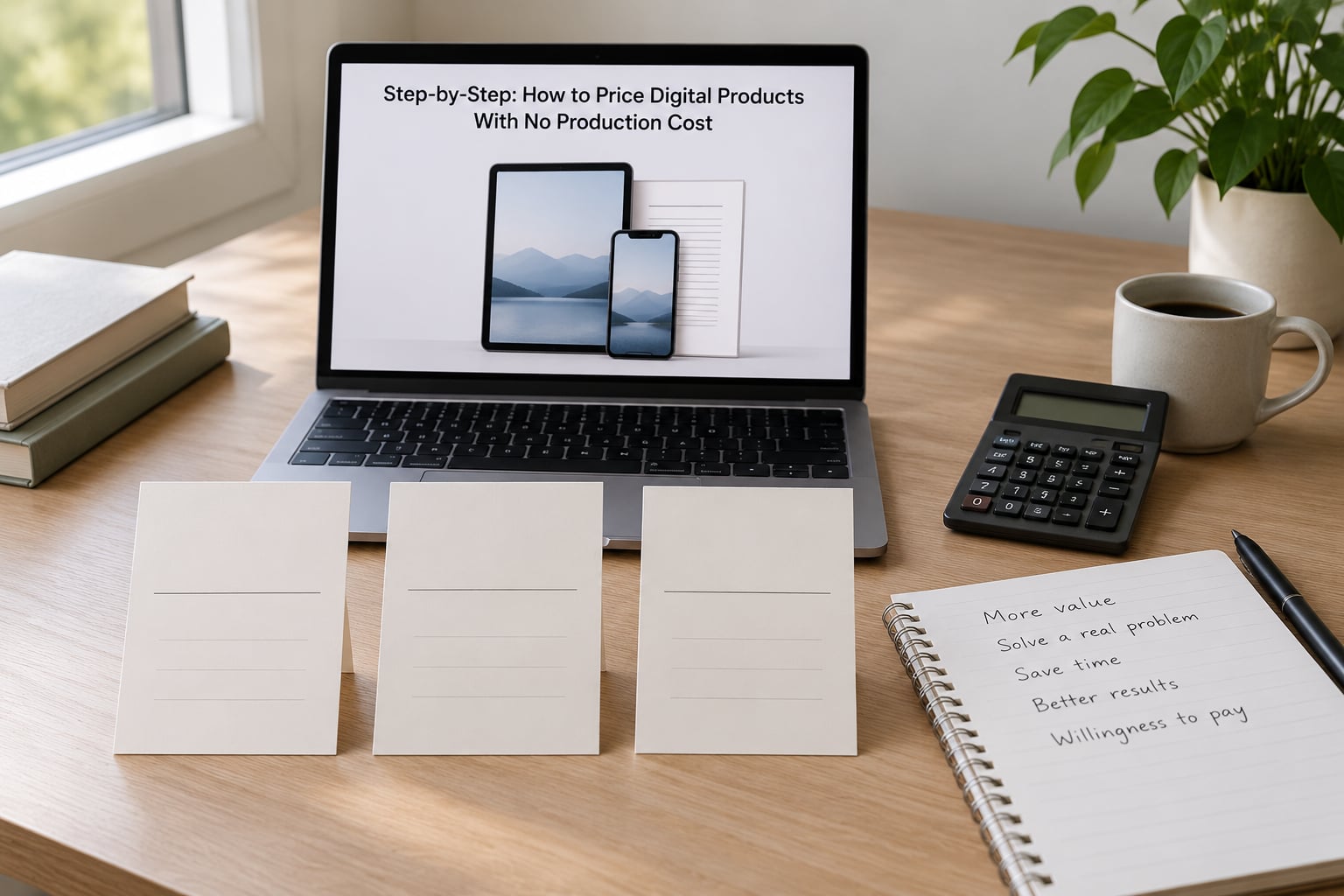
Features describe what is inside the file. Buyers pay for what changes in their week. A 40-page Notion dashboard is a feature; “I stop rebuilding my client tracker every Sunday night” is the outcome, and it is the one worth a higher price.
The quickest way to put a figure on that outcome is the time-saved estimate. Count the hours a buyer would spend without your product, multiply by what their time is worth to them, and take a share of that as your ceiling rather than the whole thing. A template that saves ten hours matters more than a long book nobody finishes, and sellers report that same gap repeatedly in digital product communities.
Write down three outcome levels: the basic one your product delivers, the improved one a busy buyer gets, and the best case. Each level supports a different price point, which is what makes tiers work later.
2. Choose the pricing objective
Most bad prices come from having no objective, so every argument feels like a loss. Pick one before you look at a number.
- Maximise revenue per buyer. Fewer sales, higher price, heavier support load. Works when your audience is small and the outcome is high stakes.
- Maximise volume. Low price, wide audience, thin margin per sale. Works when discovery is cheap and the product is an impulse buy.
- Hold a premium position. You price above the visible market and justify it with proof, updates and support. Works in a niche where buyers already arrive suspicious of cheap clones.
- Acquire customers for something else. The first product is a doorway into a course, membership or service. Here the price matters far less than the list it builds.
Say the objective in one sentence before you continue. If it is volume, a low price is a decision rather than a fear.
3. Pick a pricing model, and how to price a digital product over time
The model decides how the value you defined gets collected, and it matters more at zero production cost than it does anywhere else, because your cost per extra sale is nearly nil. That gives you room most sellers never use.
| Model | Best for | Typical band | Main risk |
|---|---|---|---|
| One-time | Templates, printables, asset packs, ebooks | 9 to 49 dollars | No recurring income; updates become free labour |
| Tiered | Products with a clear basic and improved outcome | Two or three steps from about 19 to 149 dollars | Too many options stall the decision |
| Freemium | Products that need volume and an email list | Free tier, paid tier from 9 to 29 dollars | Support load from users who never intended to buy |
| Subscription | Continuously updated libraries or communities | 5 to 25 dollars a month | Cancellation pressure once novelty fades |
| Pay what you want | Launch weeks and audience research | Whatever they choose | Most people choose the lowest anchor you set |
| Lifetime plus paid updates | Anything with a version history | 2 to 3 times the one-year price | Old buyers ask for updates forever |
Two or three tiers usually beat a menu of six. Sellers who flood a page with options see the sale rate fall because the buyer now has a comparison to make instead of a decision.
4. How to price digital products with no production cost: set a starting price from value and evidence
You now have a value estimate and a market range. The cost floor comes last, and it only tells you where to stop, not where to aim.
| Product type | Band most sellers land in |
|---|---|
| Short ebook or guide | 9 to 19 dollars |
| Printables and templates, single pack | 5 to 19 dollars |
| Template bundle or system | 29 to 79 dollars |
| Short course with templates | 49 to 199 dollars |
| Membership or paid newsletter | 5 to 25 dollars a month |
| One-to-one coaching | Hourly or package, priced on time |
Place your number inside the band where the outcome sits, not where your effort sat. Effort is sunk the moment you publish, and buyers never see it.
Now the arithmetic that keeps a cheap sale from being a loss. Take a product priced at 29 dollars where the card processor takes about 3 percent plus 30 cents, refunds run near 8 percent of sales, and each buyer asks about six minutes of questions that you answer yourself.
- Processing: about 1.17 dollars, leaving 27.83
- Refund reserve at 8 percent: about 2.33, leaving 25.50
- Your own support time at six minutes: about 3 dollars, leaving roughly 22.50 before tax
Run the same three lines at a price point of 9 dollars and support eats a third of the margin. Run them at 3 dollars, which is where a lot of printables sit, and six minutes of support alone can exceed the entire margin. That is the arithmetic behind the usual complaint that cheap digital products feel busy and unprofitable. Fee schedules do shift, so check your own processor’s current rates before committing.
Publish at a deliberate position: one rung above where the cheapest comparable product sits, with tiers above it. Anchor the page at the top tier so the middle reads as sensible.
5. Test price and packaging without confusing the results
Soft launch to a small slice of your audience before you commit to a public price. Offer the product at one price to a group of roughly 50 to 100 qualified visitors and count how many buy. If you are still working out how to price digital products with no production cost, a soft launch buys you evidence faster than another week of theorising.
The rule that keeps the test clean: change one variable at a time. Price this week, packaging next week. If you move both, a good result tells you nothing about which move worked, and you will repeat the wrong one forever.
Watch three numbers during a test rather than one. Conversion rate shows whether the offer persuades. Revenue per visitor is the one that decides whether the month was a good one. Refund rate and support minutes tell you whether the buyers you attracted are the buyers you wanted.
Keep a written log. One row per test with the date, the price, the tier structure, the visitor count and the result. Six months from now this log is the only pricing evidence you will trust, and it takes two minutes per test to build.
6. Review performance and adjust the price
Set a review rhythm. Weekly while you are actively selling, monthly once the volume settles. On that day, look at conversion rate, revenue per visitor, average order value after bundles, refund rate, support minutes per sale, and repeat purchase rate if you have a subscription or a related offer.
Small increases are the easiest move to justify. A ten to twenty percent rise on an existing product usually costs you fewer customers than that percentage, because the buyers who leave are mostly the ones who were going to ask you four questions anyway. Raise in steps, hold each step long enough to see a real number, and stop if revenue per visitor falls.
Tell existing buyers before you move them. A short note that names the price, the date and what improved since they bought keeps most of them, and it creates the update record you will want at the next increase.
Common Mistakes
Pricing to recover the hours you spent. The number nobody sees is not a basis for anything. Fix: price the outcome and treat your time as sunk the day you publish.
Pricing at a few dollars because the file is free to deliver. Marginal cost is real, but it is nearly nil, and a low price signals low quality to buyers who cannot inspect the product first. Sellers in template communities describe exactly this: cheap listings get skipped as if they were junk. Fix: use the cost floor to set your floor, not your price.
Competing on price in a saturated niche. When near-identical AI-made products flood a market, the floor drops toward nothing and price tells you nothing. Fix: ask slightly more than the cheapest option and make the difference obvious in the first screen of the sales page.
Offering six tiers. Buyers compare instead of choosing, and the middle tier you wanted to sell quietly disappears. Fix: two or three options, each tied to a different outcome level.
Discounting immediately. A launch discount teaches buyers to wait, and a permanent sale price becomes the real price. Fix: discount once, keep it short, and spend the discount on gathering proof instead of lowering your ceiling.
Changing price with no record. Without a log you will cycle through the same prices forever. Fix: write down every test and its result.
Two habits help more than the rest. Raise the price on your oldest product first, since it has proof and no recent feedback to protect. And when a free or machine-made clone appears in your niche, compete on updates, support and specificity rather than on being cheaper.
Frequently Asked Questions
How do I calculate the price of my digital product?
Start with value, not cost. Estimate the hours your product saves a buyer, multiply by what that time is worth to them, and treat a share of that total as your ceiling. Then bracket it against comparable offers in the same market. Finally subtract the real per-sale costs: payment processing, a refund reserve, tax handling and your own support time. That last step gives you a floor, not a price.
How do I set value-based pricing with no sales history?
With no sales history, use the value estimate and the market band as your two anchors and pick a deliberate position inside them. Launch at one price to a small slice of your audience, count how many buy, and treat that as your first data point rather than a verdict. Most sellers need three or four such tests before the pattern is clear, and the log they keep matters more than any single result.
How much do digital products typically cost?
Short ebooks and single printables tend to sit between 9 and 19 dollars. Template bundles and small systems usually land between 29 and 79 dollars, and short courses that include templates between 49 and 199 dollars. Memberships and paid newsletters cluster from 5 to 25 dollars a month. These are wide ranges and they move with the niche, the outcome promised and how much support is included.
Does the .99 pricing trick actually work?
The evidence is mixed, and the reason is that a 99 ending only helps when buyers are comparing rounded numbers in the same range. Tested head to head on a clean product page, a round price often wins because it reads as a considered decision. The clearer win is simply using the charm ending as one rung on an anchored ladder, where the real influence comes from the tier above it rather than the two digits at the end.
What are the 5 C’s of pricing?
The five C’s are cost, customer, competition, convenience and company. Cost covers what you actually spend to deliver. Customer covers what the buyer gains. Competition covers what similar offers charge. Convenience covers how easy the purchase and delivery are. Company covers what your reputation and support record justify. When production cost is near zero, cost carries the least weight, and customer, competition and company carry the most.
Should I price low to get sales first, then raise the price?
Starting low works as a way to gather reviews, not as a pricing strategy. Reviews you paid for with margin attract price-sensitive buyers, and those are the buyers who generate the most support. A better route is to launch at a fair price with a genuinely strong launch offer, then raise in steps of ten to twenty percent once you have proof. Existing buyers usually keep buying at the new price when you tell them what improved.
Conclusion
The method is short. Write the outcome the buyer ends up with, pick one pricing objective, bracket the number against the market, and treat the cost floor as a stopping point rather than a starting one.
Do the first three things this week. Write one sentence on what changes for the buyer, choose revenue or volume or premium and stick to it, then test two or three clearly defined offers against a small audience. When you know how to price digital products with no production cost, the cheap price stops being a fallback and becomes a choice you made on purpose.