The Explorer archetype sells adventure products by turning a jacket, a pack or a camera into a pass to an unmediated encounter with something real. The product is the excuse; the purchase is a statement about freedom, discovery and self-reliance. Understanding how that conversion works matters because the mechanism decides which features a brand builds, which claims it can safely make, and where the positioning collapses.
Table of Contents
- What Is the Explorer Archetype?
- How Does the Explorer Archetype Influence Product Choice?
- Freedom and the removal of friction
- Competence and the wish to be capable
- Novelty and the self-directed trip
- Authenticity and identity signalling
- Risk and social belonging
- What Makes an Adventure Product Feel Exploratory?
- How to Use Explorer Archetype Messaging
- Step 1: Name the exploration the customer wants
- Step 2: Choose the one product benefit that makes it possible
- Step 3: Attach the proof
- Step 4: Write in the brand’s voice, then strip the clichés
- Step 5: Design the experience and the community
- Explorer Archetype Brand Examples
- How Explorer Archetype Advertising Builds Trust
- Explorer Archetype vs. Other Adventure Brands
- Common Mistakes When Marketing to Explorers
- Frequently Asked Questions
- What is the Explorer archetype in branding?
- How can an adventure product appeal to Explorer customers without using clichés?
- Should every outdoor brand use the Explorer archetype?
- How do you prove the benefits of an adventure product?
- Is the Explorer archetype suitable for travel and lifestyle products?
- How can marketers measure whether Explorer messaging resonates?
- Conclusion
What Is the Explorer Archetype?
The Explorer brand archetype is the brand persona built on freedom, discovery, independence and authenticity, exemplified by Patagonia, REI, Jeep and The North Face. It comes from Carl Jung’s concept of archetypes as recurring patterns in human experience, adapted for marketing by Margaret Mark and Carol Pearson in The Hero and The Outlaw (2001), one of twelve archetypes in their system.
Jung was not writing about marketing. The useful part is narrower: people recognise certain patterns quickly, without being taught them, and then respond to brands that fit one. The Explorer pattern is the story of leaving the known for the unknown, and readers already know that story before a brand tells it.
Also called the seeker, pilgrim, adventurer or pioneer, the Explorer is easy to confuse with several neighbours in outdoor retail. The distinctions matter, and I cover them further down. For now, the six characteristics that show up most often are:
- Freedom-seeking, expressed as the removal of constraints rather than the addition of features
- Independence, including self-reliance and competence in unfamiliar conditions
- An appetite for novelty, a restlessness that makes familiar routes feel stale
- Comfort with risk, treated as evidence of a life properly lived
- Authenticity, meaning the brand must be what it claims to be, not what it wishes
- Discovery, the belief that better versions of yourself are found outside the routine
The framework is useful precisely because it is a constraint. It tells a strategist which words, colours, product decisions and customer experiences will feel on-brand, and which will feel borrowed.
How Does the Explorer Archetype Influence Product Choice?
Explorer buyers do not shop on specification alone, because specifications in adventure categories are largely commoditised. A waterproof shell from four manufacturers does the same job. What separates them is the story each one tells about the person wearing it, and how confident the buyer is that the brand can back up that story.
Six forces shape the decision, and they rarely pull in the same direction:
Freedom and the removal of friction
Freedom here is practical before it is philosophical. Weight in grams, pocket layout, how long a battery lasts, whether a piece folds into a carry-on: these read as freedom because they are the measurable part of independence. A brand that talks about freedom while adding 400 grams sells a feeling it then undermines.
Competence and the wish to be capable
Buyers are not only escaping routine, they want to be the kind of person who could handle what happens out there. Gear that fails publicly is expensive beyond its cost, which is why construction details and repair policies sell better than slogans in this audience.
Novelty and the self-directed trip
The trip is chosen by the buyer, not assigned. Products that support improvisation get valued: a piece that works in cold rain and warm evenings, a pack that reconfigures for a two-night or two-week trip.
Authenticity and identity signalling
Buying is identity work. The brand tells the room something about the buyer before they say a word, and a recognisable Explorer brand does that more cheaply than any explanation.
Risk and social belonging
Community and shared values arrive last but decide the loyalty. A repair programme, an ambassador group or a conservation commitment converts a one-time buyer into a participant.
Take two hiking backpacks on a shop shelf. One has a 60 litre main compartment, a load-lifter system, a lifetime repair policy and a muted slate colourway; the other has slightly more volume, a bright colour and a discount badge. The technical comparison is close. The emotional one is not: the first is described as equipment for a person who goes places, the second as a purchase that expired.
What Makes an Adventure Product Feel Exploratory?
A product reads as exploratory when its attributes point outward to a place, and as generic when they point back at the object itself. These are the cues that hold up under scrutiny:
- Portability that is measurable. Packed weight, packed dimensions, time to set up. Real numbers, not adjectives.
- Adaptability across conditions. Products that do several jobs remove the need for the buyer to plan as carefully, which reads as competence.
- Durability with a policy behind it. Repairability and warranty length are commitments a company makes in advance, and commitments are harder to fake than material claims.
- Access to a new place. Whether that is a waterproof rating, a traction compound, a range figure or a lens, the feature works when it opens a route that was previously closed.
Anything that cannot be demonstrated gets demoted to decoration. A mountain printed on the panel is not a claim; it is a wallpaper decision. That is the line most often crossed in this category, and readers here are unusually good at spotting it.
How to Use Explorer Archetype Messaging
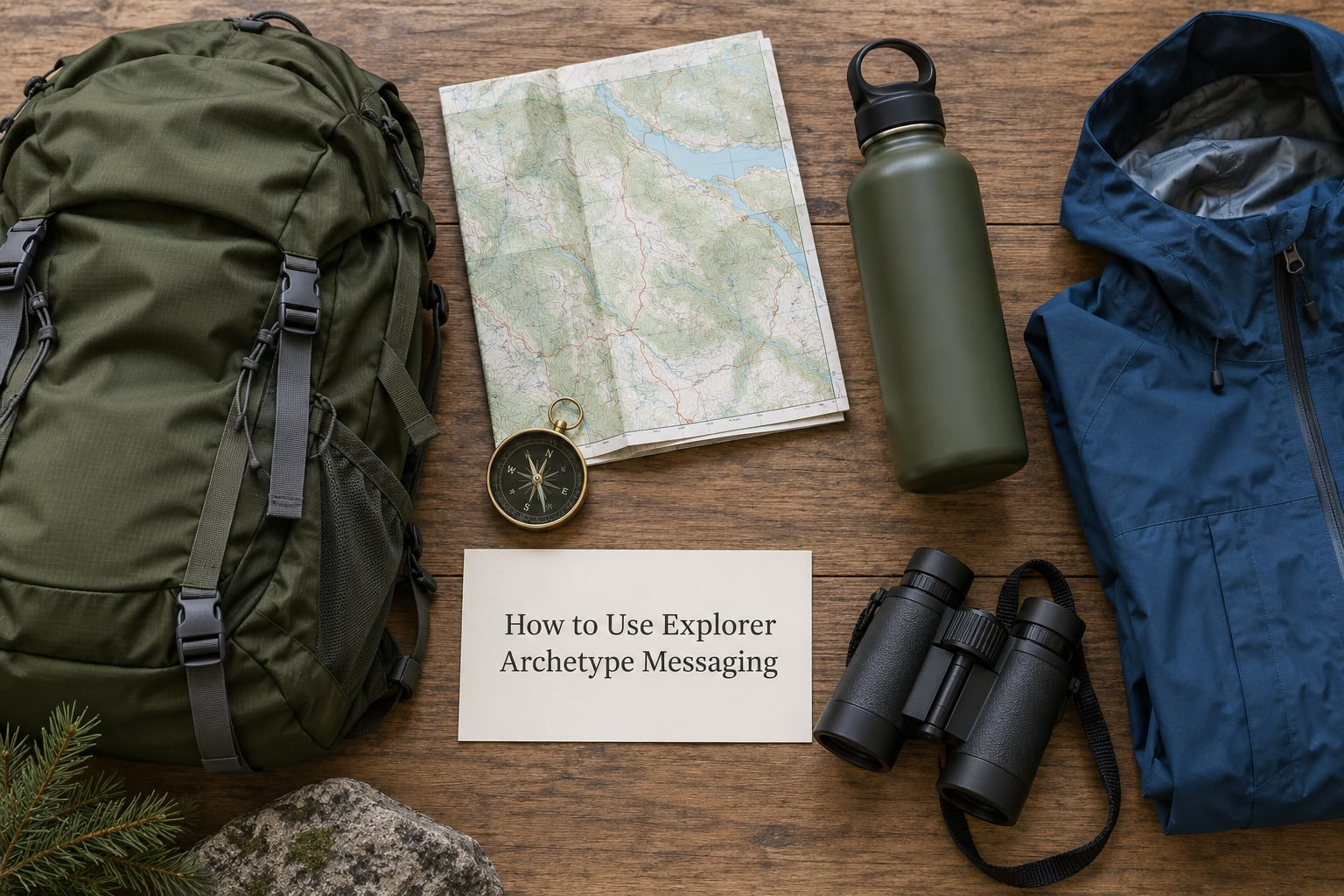
The practical version of how the explorer archetype sells adventure products is a five-step translation. Each step has a failure mode, and the failure usually appears downstream of where it started.
Step 1: Name the exploration the customer wants
Not a feature area, a destination in their head. A weekend of unplanned ground, a first ascent without a guide, a long drive on roads that end. Write it in one sentence and check that it sounds like something a person would admit to a friend.
Step 2: Choose the one product benefit that makes it possible
One. Two claims split attention and both read as weaker. The benefit must be specific enough to be checked, because the next step depends on it.
Step 3: Attach the proof
Field testing, published repair rates, published warranty terms, third-party measurement, manufacturing transparency. If no proof exists yet, that is a product development task, not a copywriting task.
Step 4: Write in the brand’s voice, then strip the clichés
Explorer language gets flatter the more it leans on stock vocabulary. Cut the summit-and-storm imagery and keep the plain verb: it holds, it folds, it drains, it repairs.
Step 5: Design the experience and the community
Trip reports, repair scheduling, group routes, ambassador trips. This is the layer that converts a buyer into a participant, and it is the layer most often skipped after launch.
Explorer Archetype Brand Examples
The brands below all read as Explorer to a typical buyer, and they read it for different reasons. The table separates the reason each one works, because the archetype is a template rather than a costume.
| Brand | Archetype expression | Product signal | Messaging signal |
|---|---|---|---|
| Patagonia | Discovery with a conservation conscience | Durable construction, repair service, clear environmental commitments | Field imagery and user stories rather than product glamour |
| REI | Self-directed travel for ordinary people | Broad gear range plus services that teach you to use it | Member model, classes and trip advice as the core offer |
| The North Face | Accessible wilderness | Approachable outdoor and everyday crossover | Exploration rendered as something any consumer can enter |
| Arc’teryx | Competence under hard conditions | Technical construction and restrained design | Quiet, specification-led, minimal adventure language |
| Jeep | Freedom of movement | Off-road capability as the reason the vehicle exists | Landscapes and named routes with little showroom content |
| GoPro | Documenting the discovery | Durability, mounting options, stabilisation | First-person footage rather than polished commercial sets |
| Yeti | Rough-use equipment as identity | Built for hard use, visibly over-specified | Owners shown working, not posing |
| Salomon | Speed and technical range | Trail and ski systems, precision fit | Short-form athlete and terrain content |
What separates them is the balance between the emotional promise and the physical evidence. Where a brand leans on imagery alone, buyers tend to discount it as decoration.
How Explorer Archetype Advertising Builds Trust
Trust in this category is operational, not emotional. The emotion gets attention; the evidence earns the price. Four formats carry most of that weight.
Demonstration over description. Show the joint, the seam, the fold and the repair bench. A close-up of a manufacturing detail persuades a buyer who has stopped believing in adjectives.
Field testing with stated conditions. Testing is credible when the brand names the temperature, the duration and the failure modes. An unstated test reads as decoration.
Transparent limitations. Stating what a product does not do removes the need for the buyer to suspect the marketing. In outdoor gear, where failure has consequences, this is one of the few moves that buys real confidence.
Real user stories with real conditions. Named people, specific weather, specific outcomes including the awkward ones. Aspirational adventure photography with no operating detail is the fastest route to being classified as a costume.
Explorer Archetype vs. Other Adventure Brands
Adventure categories attract several archetypes at once, and outdoor retail is full of Hero and Outlaw brands being mislabelled as Explorer. The difference shows up in what the buyer is buying.
| Criterion | Explorer | Outlaw | Hero | Everyman |
|---|---|---|---|---|
| Central motivation | Freedom and discovery | Rebellion against convention | Mastery and achievement | Belonging and shared values |
| Desired feeling | Unfettered and self-directed | Unconventional and free-spirited | Capable and respected | Accepted and ordinary |
| Message style | Place, route, horizon | Attitude, edge, defiance | Performance, records, podiums | Everyday people, real life |
| Proof point | Field performance and repair terms | Distinctive design and attitude | Measured performance and endorsements | Broad appeal and trust signals |
A brand that leads on podiums and records has drifted into Hero territory, whatever its product category. One that leads on attitude and anti-establishment imagery has become an Outlaw. Both can sell adventure products; they simply make different promises and demand different evidence.
Common Mistakes When Marketing to Explorers
Leaning on the vocabulary instead of the substance. Words such as journey, wild, untamed and extreme have lost most of their force through repetition. The correction is to remove them from the headline entirely and let one concrete product fact carry the sentence.
Claiming access the product does not deliver. Promising entry to hard terrain with equipment tested in mild conditions is the fastest credibility loss available in this category. Publish the test conditions or drop the claim.
Adventurous imagery without a credible operation behind it. Stock mountains on a product made elsewhere reads as appropriation rather than identity, and this audience notices quickly. The correction takes time, not budget: repairability, material traceability, and a service that answers when something breaks.
Selling to a version of the buyer that does not exist. The Explorer is frequently imagined as a twenty-something adrenaline seeker. In practice the audience is far wider, including parents buying a first pack for a child, mid-life buyers reclaiming time, and gift purchasers choosing on someone else’s behalf. Positioning written only for the first group loses the other three.
Freedom with no responsibility attached. Adventure brands that celebrate leaving no trace of themselves on the places they visit contradict the value the buyer is paying for. Environmentally responsible sourcing and repair programmes are not decoration here; they are part of the promise.
Elitist access. Language that implies only the fit may go creates a smaller audience and more resentment than the positioning was meant to create. REI’s model shows the alternative: the same adventure promise, offered to a much wider group.
Frequently Asked Questions
What is the Explorer archetype in branding?
The Explorer archetype is the brand persona built on freedom, discovery, independence and authenticity. Brands in this category sell access to an experience rather than a specification, which is why Patagonia, REI, Jeep and The North Face are usually placed in it. The pattern comes from Jung’s archetypes as later adapted by Margaret Mark and Carol Pearson for brand strategy.
How can an adventure product appeal to Explorer customers without using clichés?
Replace emotional shorthand with one checkable fact. Rather than claiming a product is untamed or built for wild places, state a weight, a test condition, a repair term or a route the buyer could not previously reach. Specificity reads as confidence, and confident brands are trusted more than enthusiastic ones in this category.
Should every outdoor brand use the Explorer archetype?
No. It works best for products that extend a person into new terrain, distance or duration, and poorly for brands whose advantage is comfort, reliability or price. A comfort-first line or an urban lifestyle label borrowing Explorer imagery tends to read as costume. The archetype should follow the product advantage, not lead it.
How do you prove the benefits of an adventure product?
Publish the conditions rather than the conclusion: temperature, duration, terrain, load and failure modes, plus repair and warranty terms that a customer can check later. Independent measurement and documented field use by named testers add a second layer. Transparent limitations build more trust than a longer list of claims, because they remove the need to verify.
Is the Explorer archetype suitable for travel and lifestyle products?
Yes, with care. Luggage, durable watches and travel accessories carry the same cues of portability, adaptability and durability that outdoor gear does. The risk is overreach: heavy visual adventure language on an item used in ordinary settings makes the promise look borrowed. Keep the product truth central and the exploration in the background.
How can marketers measure whether Explorer messaging resonates?
Watch behaviour rather than sentiment. Useful signals include repeat purchase among customers who bought the same product family, participation in community and repair programmes, user-generated content that shows the product in real conditions, and the share of buyers arriving from referral. Sentiment scores alone tend to flatter emotional campaigns that never convert.
Conclusion
The Explorer archetype sells adventure products by reframing a functional item as the means of reaching somewhere real, and that reframing only works when the product can carry it. Start by writing the exploration your customer actually wants in one sentence, then find the single product benefit that makes it possible and build everything else on that proof.