
How the hero archetype shapes advertising is a question about borrowing: a brand takes the oldest story shape humans know, casts itself as the champion, and lets the viewer’s memory do half the persuading. It works because the viewer recognises the frame before they finish reading the headline. It also breaks in predictable ways, and those breakages are worth studying.
Most pages on this topic stop at a trait list. This one goes further, into the mechanics: which narrative beat lands in which slot of a thirty-second spot, what the promise has to look like in the actual creative, and where the whole approach breaks down.
Last reviewed October 2026.
Table of Contents
- How the Hero Archetype Shapes Advertising Campaigns
- What the archetype decides inside a campaign
- What Is the Hero Archetype in Consumer Psychology?
- The five traits that define a hero-coded brand
- Why a familiar frame lowers resistance
- How Hero Advertising Builds a Clear Brand Promise
- From narrative beat to ad execution
- Hero Archetype Advertising Ideas for Different Products
- Sportswear and athletic brands: the obstacle is the training block
- Financial services: mastery without the swoosh
- Technology: the anti-obstacle narrative
- Food and drink: the effort behind the ingredient
- Education and careers: the outcome made visible
- How to Use Hero Archetype Advertising Without Looking Outdated
- Balance the aspiration with the proof
- Widen who is allowed to be the hero
- Cut the moral high ground
- Ask the diagnostic before you commit
- Hero Archetype Advertising Examples: What Works and Why
- Nike: the shortest possible hero structure
- Gatorade: the obstacle named in public
- Patagonia and mission-led brands: the ethical challenger
- Tesla: the obstacle as a stubborn industry
- Meta: the case where the archetype broke
- Frequently Asked Questions
- What does hero mean in the context of marketing?
- What is a simple definition of an archetype?
- Are there 12 hero archetypes?
- How do I stop a hero brand from sounding arrogant?
- Where did Nike get the slogan Just Do It?
- Is the hero archetype overused in advertising?
- Conclusion
How the Hero Archetype Shapes Advertising Campaigns
The hero archetype shapes advertising by supplying a story frame that is already finished before the brand arrives. The brand takes the hero’s role, the problem in the customer’s life becomes the obstacle, the customer is cast as either the ally or the rescued party, and the ad resolves in triumph.
That structure is not decoration. It decides what the headline is about, whether the product is the sword or the magic lamp, who gets to speak in the spot, and what the call to action asks the viewer to become rather than what it asks them to buy.
What the archetype decides inside a campaign
- Who holds the power. In a hero ad the brand is competent, and the customer is capable once equipped. That is a very different relationship from an ad where the brand is a caring guide and the customer is fragile.
- What the obstacle is. Hero framing needs something to push against: gravity, the clock, doubt, the competitor, the beginner version of the customer.
- How long the story runs. Thirty seconds buys you a call, an ordeal and a return. Ninety buys you a transformation. Six buys you a stance.
- What proof looks like. Hero claims need receipts, because the archetype promises competence and competence is checkable.
- Which emotions are allowed. Determination, pride and relief. Also the dangerous ones: contempt, and the quiet smugness of a brand congratulating its customers for buying.
The emotional need underneath all of it is a wish to be capable. People do not want to be told they are heroic. They want to be shown a version of themselves that has already survived the hard part.
What Is the Hero Archetype in Consumer Psychology?
In its simplest form, an archetype is a recurring pattern of character that recurs across cultures and stories. The word comes from Carl Jung, who argued in analytical psychology that certain figures and situations repeat in myths, dreams and religion because a shared unconscious structure shapes how people tell stories.
The hero is the most worked-out of these patterns. In myth he leaves the ordinary world, faces a trial, dies or is transformed, returns with something, and hands it to everyone else. Joseph Campbell later collected that structure into what he called the monomyth, and it has since been applied to nearly every brand film you have seen with a swelling score.
Mark and Pearson later turned this into a commercial framework of twelve brand archetypes, of which the hero is one. Worth being precise here, because the search query “the 12 hero archetypes” is a common confusion: there are twelve archetypes in total, and the hero is a single member of that set.
The five traits that define a hero-coded brand
- Courage. The willingness to move toward the thing that frightens you.
- Competence. Mastery that has been paid for, not claimed. This is the trait most often faked and most easily caught.
- Resilience. The ability to be knocked down and continue, which is what makes the narrative repeatable.
- Mastery. The pursuit of excellence as an ongoing project rather than a finished state.
- Service. The hero achieves in order to give something back. This is what separates the archetype from plain celebrity.
A brand needs a strong majority of these to read as hero-coded. Two traits plus a mountain silhouette will not do it.
Why a familiar frame lowers resistance
Consumers process a story they already know faster and with less scepticism than a novel claim, because recognition substitutes for evidence. The ad has less work to do, and the viewer spends their attention on feeling rather than on argument. That efficiency is the whole appeal of the archetype, and it is also why the frame feels hollow when the brand has nothing behind it.
How Hero Advertising Builds a Clear Brand Promise
Hero advertising builds a clear brand promise by collapsing many benefits into a single sentence about what the customer will be able to do. One promise, repeated without variation across the headline, the offer, the product page and the experience of contacting support.
The discipline is in the repetition. Most brand failures that get labelled “archetype problem” are actually consistency problems: the ad promises mastery, the pricing page talks about discount, and the customer experience delivers neither.
From narrative beat to ad execution
| Narrative beat | What the viewer is told | How it appears in the ad |
|---|---|---|
| Ordinary world | This is normal, and it is not good enough | Opening hook set in the customer’s actual routine, unstyled |
| Call to adventure | Something has to change | The product or the decision, introduced without hype |
| Resistance and ordeal | The obstacle is real and named | The problem beat, shown rather than described |
| Transformation | You will be different after this | Before and after, or a result stated as an outcome |
| Return with the prize | The gain belongs to you | The product as the takeaway, plus the call to action |
Short formats compress the middle. A six-second bumper can hold the hook and the return, and nothing in between, which is why six-second hero ads so often feel like a promise with no story attached.
Hero Archetype Advertising Ideas for Different Products
The archetype travels across categories, but the execution changes completely. These are starting points rather than finished campaigns.
Sportswear and athletic brands: the obstacle is the training block
The obstacle is the training block, not the rival. Ads that show the four hundredth rep rather than the trophy read as credible to the audience that actually trains. Competitors in this category lean hard on celebrity; the version that works better puts an ordinary body in frame and lets the effort carry the shot.
Financial services: mastery without the swoosh
Mastery without the swoosh, because financial services has a credibility deficit that imagery alone cannot fix. Show a decision made well: a fee avoided, a tax year handled, a household plan that survived an income shock. The hero is the customer who knows what they are doing, and the brand is the tool that got them there.
Technology: the anti-obstacle narrative
The anti-obstacle narrative, where the product removes the grind rather than demanding heroics from the user. That is the inversion worth trying: in most tech advertising the customer must persevere, and here perseverance is the enemy. Speed, reliability and fewer steps do the narrative work.
Food and drink: the effort behind the ingredient
The effort behind the ingredient. This is the oldest hero trade in advertising and the least contrived version of it: the grower, the baker, the person who did the difficult part before the product reached the shelf. It works because the effort is legible in a second and it borrows a virtue the category has no claim to.
Education and careers: the outcome made visible
The outcome made visible. Show the finished thing: the qualification, the first day, the room where the work happens. The obstacle, doubt and long wait, is the real emotional content, and it is almost always left out of the ad. Naming it does more than any testimonial.
How to Use Hero Archetype Advertising Without Looking Outdated
Most of the outdated feeling comes from one register: the brand congratulating itself. The cure is not softer visuals, it is a change in who the ad respects.
Balance the aspiration with the proof
Every hero claim needs a specific, checkable fact attached to it in the same breath. Dates, counts, materials, training hours, the name of the actual person who did the work. If the only evidence is that the brand feels great, the archetype reads as theatre and the audience prices it accordingly.
Widen who is allowed to be the hero
The tired version of this trope casts one narrow type of person as the champion. The current version casts the customer, a beginner, an older body, a parent doing it badly on a weekday morning. That widening is a creative decision with a measurable effect on who recognises themselves in the ad.
Cut the moral high ground
Hero framing sets an unfalsifiable standard of virtue: any brand can claim to be for the good side, and almost no claim can be disproved. That is exactly why audiences have become quicker to punish it. A brand that stays on the competence side of the line, doing a thing well and showing the receipts, is far harder to attack than one claiming moral high ground.
Ask the diagnostic before you commit
- Can you name a real obstacle this product removes, rather than a problem it encourages?
- Do you have proof of competence, and is it the kind of proof a sceptic would accept?
- Would the message still be interesting if you removed every mountain, summit and slow-motion shot?
- Can your customer be cast as the hero rather than the rescued one?
- Are three or four competitors already running the identical heroic register?
If the answer to that last question is yes, the archetype is not unavailable but it is no longer differentiating. Wellness, fintech and AI products are all deep in that fatigue right now, and hero language in those categories now reads as background noise.
Hero Archetype Advertising Examples: What Works and Why
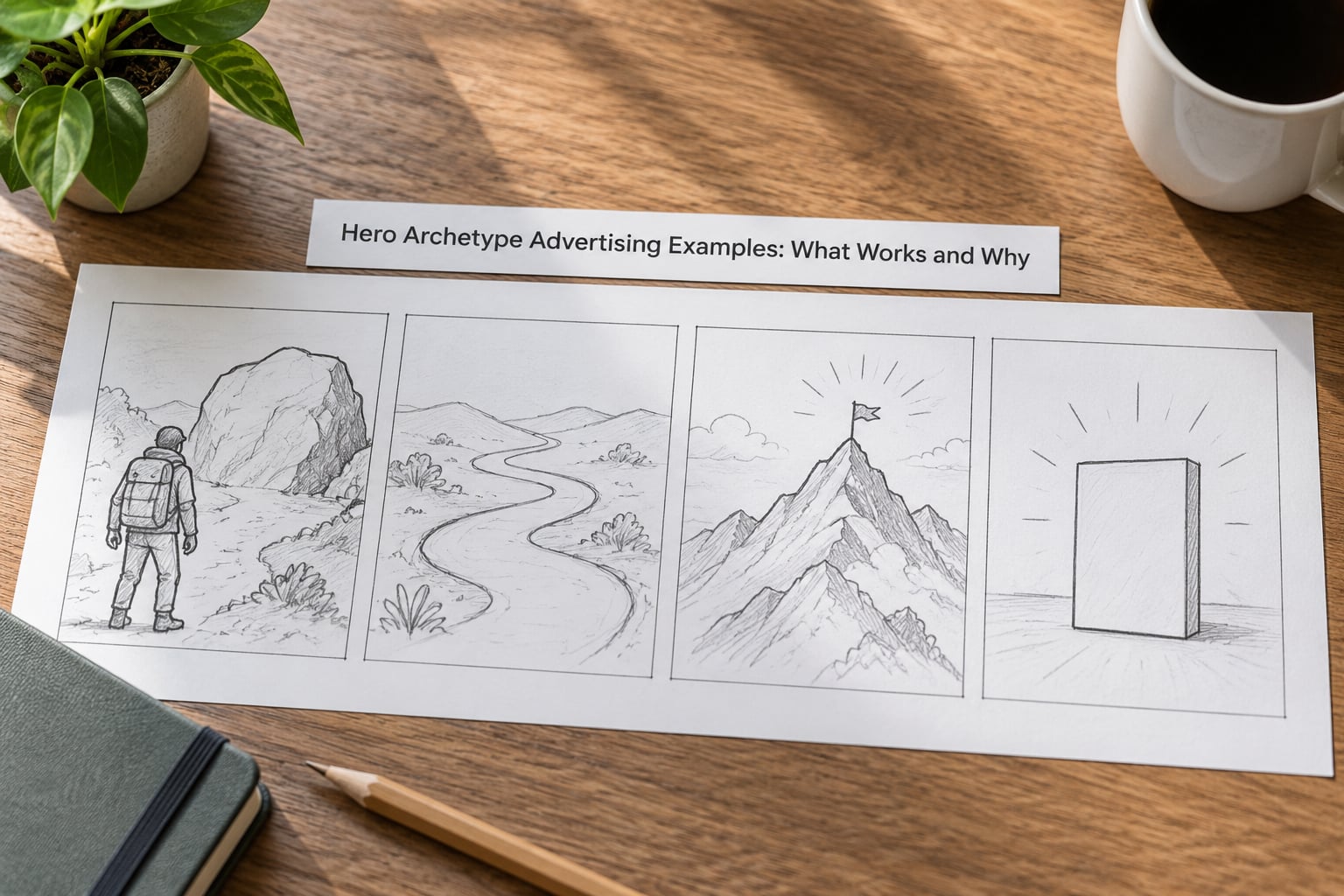
Nike: the shortest possible hero structure
Nike is the reference case because the construction is visible once you look for it. The slogan is three words, and it functions as a call to action rather than a description. Its origin is a story about Gary Gilmore’s last words, told to a copywriter named Dan Wieden in the early nineteen-eighties; the line that survived was the one that worked as an instruction to a body in motion.
Structurally, the ads are ordeal and return with the beginning cut away. You never see the ordinary world or the training. You see resistance, then you see the resolve, and the product is the thing that made it possible. The line has stayed the same through every rewrite of the campaign, including the Dream Crazy era built around Colin Kaepernick, which took the same imperative line and pointed it at a social obstacle instead of a physical one.
What makes it work is that the imperative sits below the argument. It never claims the viewer is special. It gives them an instruction they can act on before breakfast, and the brand takes the credit for the outcome without ever stating the claim.
Gatorade: the obstacle named in public
Gatorade sells the wall. The ad shows an athlete hitting a specific, unglamorous moment, and the product is the thing that gets them past it. The archetype is doing less work here than it looks, because the drama comes from the situation rather than from the brand’s character. That restraint is why the campaign has aged better than most of its era.
Patagonia and mission-led brands: the ethical challenger
Patagonia, Bombas, Ecosia and Who Gives A Crap are frequently described as hero brands, though practitioners more often mean ethical challenger. The pattern is different: the villain is a system, the hero is the customer who chooses better, and the brand’s virtue comes from funding something rather than from surviving something. It borrows the hero’s moral position while skipping the hero’s personal struggle, which is why it travels well into cause marketing.
Tesla: the obstacle as a stubborn industry
Tesla is a useful case because the obstacle is external. The narrative is not beating your own doubt but defying an entrenched industry, and the customer is cast as an early adopter with the taste to see it. It is a clean example of a hero frame built from the antagonist rather than from the mountain.
Meta: the case where the archetype broke
Meta is the limit case everyone cites. The brand was built on the hero promise of connecting people, then spent years being judged on the very obstacle it claimed to have removed. When a hero-coded promise meets evidence pointing the other way, there is no fallback position, because the brand built its whole identity on being for the good side. The lesson is structural rather than moral: the more virtuous the central promise, the worse the failure looks.
Frequently Asked Questions
What does hero mean in the context of marketing?
In marketing, hero means the brand is cast as the courageous, competent champion who faces an obstacle and delivers the triumph. The customer is usually positioned as the ally or the rescued party. It comes from Jung’s collective unconscious rather than from any advertising study, and it is used to compress meaning: the viewer recognises the story shape instantly, so the message lands faster.
What is a simple definition of an archetype?
An archetype is a pattern of character or story that repeats across cultures, myths and dreams. Jung argued that these patterns come from a shared unconscious rather than from individual experience. In branding, the word is used more loosely for a personality a brand borrows, such as the sage or the outlaw, so a brand can sound and look like a familiar kind of character.
Are there 12 hero archetypes?
No. There are twelve brand archetypes in Mark and Pearson’s framework, and the hero is one of them alongside the sage, the innocent, the explorer, the ruler, the creator, the magician, the outlaw, the regular person, the lover, the jester and the caregiver. The hero itself has five defining traits: courage, competence, resilience, mastery and service.
How do I stop a hero brand from sounding arrogant?
Move the spotlight from the brand to the customer, and attach evidence to every capability claim. Arrogance reads through the grammar of superiority: we are better, they were not doing it right. Rewrite those claims as capability the customer gains, name a real obstacle, and attach a checkable fact to the boast. A specific number does more against arrogance than a warmer tone of voice.
Where did Nike get the slogan Just Do It?
Nike’s longtime advertising lead Dan Wieden has said the line was inspired by the last words of convicted murderer Gary Gilmore, who told his executioner to do it just before he died. Wieden was not looking for a slogan but for a phrase that would work as a command to an athlete. The line has stayed in use since the late nineteen-eighties, including the Dream Crazy campaign.
Is the hero archetype overused in advertising?
In some categories, yes. Wellness, fintech and artificial intelligence products all run heavy heroic language, and audiences now read it as category default rather than as a claim. That makes it background noise, not differentiation. The archetype still works, but only where a brand can show real competence and a real obstacle, and where fewer than three competitors are saying the same thing.
Conclusion
Start with the achievement, not the word. Write down what your audience wants to be able to do that they cannot reliably do today, then decide whether your brand can credibly help with that. If it can, the hero archetype gives you a frame that carries thousands of years of story weight in thirty seconds, and the job becomes keeping the promise consistent in the headline, the offer, the product page and the experience.
If it cannot, a different archetype will be cheaper than an apology later.