How to test brand names with consumers, in short: narrow your longlist to two to four finalists, clear each one for trademark and availability, define your scoring criteria before you collect data, then run qualitative interviews followed by a blinded quantitative test against people who actually buy in your category. The name that clears the legal screen and tops your weighted criteria wins, not the one you personally like best.
It takes roughly two to four weeks for a competent do-it-yourself test, and the hardest part is not the survey. It is resisting the moment three people you like say a name is great and you decide to stop looking.
Here is the whole process in compressed form:
- Define the decision you are actually making: broad appeal, memorability, premium perception, or something else.
- Screen a large list down to two to four credible candidates.
- Run a legal and availability screen on each candidate before spending research time on it.
- Explore open-ended reactions in interviews or small groups to surface meanings and misunderstandings.
- Run a controlled test with a blinded, representative sample and randomised order.
- Score the results against criteria you fixed in advance, not criteria you invented afterwards.
- Write up the winner, the runner-up, the trade-offs, and the limitations.
The reason internal opinion fails is structural rather than a matter of taste. The people who built the business already know what the brand does, so they skip the association other people will have. Strategic consensus then piles onto whichever option was presented first, and the group never hears a challenge to it.
Table of Contents
- What You Need Before You Start
- Choosing a Method by What You Need to Know
- Step-by-Step: How to Test Brand Names with Consumers
- 1. Define the Decision Before Testing
- 2. Create an Appropriate Shortlist
- 3. Explore Initial Consumer Reactions
- 4. Run a Controlled Test: How to Test Brand Names With Consumers
- 5. Interpret the Results Without Chasing the Average
- 6. Refine the Leading Options Before You Test Again
- 7. Make and Justify the Final Recommendation
- Common Mistakes That Skew Your Results
- Frequently Asked Questions
- Should I use a survey, focus group, or interviews to test brand names?
- How many consumers do I need to test a brand name?
- Can I test several brand names in the same research study?
- When should I check trademark availability and legal risk?
- Does consumer testing replace a trademark search?
- Conclusion
What You Need Before You Start
Preparation decides whether the results can guide a real decision or just confirm one. Six things need to exist before the first question is written.
A defined audience. Not “customers” in general. Name the people who would buy, the category they buy it in, and how they hear about the category. A name that works with twenty-five to forty-five year-old urban professionals tells you nothing about the buyers you will have in five years.
Two to four name candidates. Testing eight names in one study fragments attention and produces mush. Bring a small shortlist.
Decision criteria written down. These become your scorecard. Write them before the fieldwork, including the thresholds that count as a pass, so you cannot move the goalposts after seeing results.
A target or competitor set. Ask respondents to rate names against two or three names already in the market. Relative judgement is how buyers actually decide.
A research budget and time. Even a low-cost test needs a few dozen respondents recruited from the right group, which takes coordination rather than just money.
The right method. Qualitative work explains why. Quantitative work tells you how much and whether the gap is real. You want both, in that order.
Choosing a Method by What You Need to Know
| Method | What it tells you | Typical sample | Relative cost | When to run it |
|---|---|---|---|---|
| In-depth interviews | The reasoning behind a reaction, in the respondent’s own words | 8 to 15 per priority segment | Low | First, before any survey exists |
| Small focus groups | Language people use, disagreements within a peer group, social reaction | 6 to 8 people, 2 to 4 sessions | Low to moderate | When you need connotation and phrasing detail |
| Online survey with ranking | Preference, appeal, distinctiveness, purchase intent across a wider group | 100 to 400 respondents | Moderate | After the qualitative pass |
| Unaided recall task | Whether a name survives exposure without a prompt | 200 or more, since recall rates run low | Moderate | Once finalists are down to two or three |
| Agency study | Segment-level significance and a defensible written record | 500 and up | High | When the name is public and expensive to change |
If you have no research budget, the first three rows are enough to make a defensible decision. What you lose is statistical confidence on small differences between close names.
Step-by-Step: How to Test Brand Names with Consumers
1. Define the Decision Before Testing
Start by writing down the product, the geography, the target audience, the competitive set, and the intended positioning. Without those five, a survey becomes a popularity contest among strings of letters.
Then state the outcome you are buying with the research. Broad appeal, premium associations, memorability under low attention, easy pronunciation over the phone, and international extensibility are five different objectives, and they produce five different winners from the same shortlist. If you cannot name one primary objective and one secondary one, the study will hand you an average that helps nobody.
One practical test: write the sentence “We are choosing this name because it does ___ better than the alternatives.” If you cannot fill the blank without reaching for a second objective, the brief is not ready.
2. Create an Appropriate Shortlist
Take your long list and apply hard filters before anyone sees it. Check legal availability and rough distinctiveness, say the name out loud to people who do not know English well, and check the meaning in the markets you intend to enter.
Test each candidate for unintended meaning. Names that read innocently in one language often carry something unpleasant in another, and the problem surfaces late and expensively when it surfaces at all. Several companies have discovered after launch that their name translates into an unfortunate phrase in a market worth real revenue.
Now the important part: the shortlist must contain genuine alternatives. One favourite plus three also-rans produces a study that confirms what you already decided. If you cannot construct two or three candidates you would genuinely be willing to launch, go back to generating names rather than running research on a rigged contest.
Check availability here as well. Search the business registry, the domain, the app stores, and social handles for each candidate, so a name that cannot be used never reaches a respondent. Do the legal and availability screen before the fieldwork, because consumer testing is the cheaper half of the process and a trademark opinion is not.
3. Explore Initial Consumer Reactions
This is the qualitative pass, and its purpose is diagnosis rather than decision. You are listening for what people assume, what they ask, and what they mishear.
Recruit eight to fifteen people per priority segment and speak with them individually, or run small groups of six to eight where you specifically want peer-group reaction. Keep groups reasonably homogeneous, because a mixed room splits into factions and the quieter half stops talking. One session rarely reveals enough, and more than four or five per segment adds little once themes repeat, which is the saturation point.
Ask open questions first. “What do you think this is?” “What would you expect from a brand called this?” “How do you say it?” “What does it sound like it does?” Then go deeper. What questions do they ask about the category before they ever get to the name? What does the name make them picture? Does it remind them of an existing brand?
Treat a small exploratory sample as diagnosis, not a verdict. Twelve people telling you they like a name is weak evidence about preference and strong evidence about meaning. Meaning problems show up quickly and predictably; preference differences need bigger samples.
4. Run a Controlled Test: How to Test Brand Names With Consumers
The quantitative round is where you get numbers you can defend. Show names without a logo, without a tagline, and without a colour scheme, because all of those bias meaning. If you must show a design, show one neutral design applied identically to every name. Getting this stage right is where most of the craft sits in how to test brand names with consumers well.
Measure these criteria, in this order:
- Unaided recall. Show each name briefly with the category, remove it, then ask which ones they remember. This is the closest thing to real behaviour you will get, and it is unforgiving.
- Aided awareness. Show the full list and ask which they have heard of, been familiar with, or would recognise.
- Appeal and distinctiveness. Rate each name on standard scales, then force a ranking at the end. Ranking forces trade-offs that rating scales let people dodge.
- Meaning and fit. Use a semantic differential, two opposite adjectives with a slider between them, so you capture direction rather than a vague score.
- Purchase intent. Ask what a person would have to believe before trying the product under this name, and how likely they would be to look it up. The belief question usually reveals more than the likelihood scale.
- Pronunciation and spelling. Ask them to say it and to write it from hearing it once. Mispronunciation clusters by segment and it will not fix itself.
Randomise the order in which names appear. Position effects are real: the first name in a list gets more attention and the last gets a fatigue penalty, and a study without randomisation will reliably hand you a favourite that is really just a position.
Pilot the questionnaire with five to eight people first. Catch confusing wording, broken routing, and any question that hands the answer to the respondent. Then run it.
On sample size, be honest about what each size can detect. Twenty to thirty people from your category will surface meaning problems, pronunciation trouble, and wildly unpopular options. It will not reliably separate two names that score within a few points of each other. One hundred to two hundred gives you workable segment cuts. Three hundred and up lets you claim statistical significance on small gaps. Beyond that, the money is usually better spent on a second test round than on more respondents in the first.
5. Interpret the Results Without Chasing the Average
Compare the top two or three names on each measure separately rather than averaging everything into one composite number first. An average hides the specific failure that matters, such as a name with excellent recall and no appeal.
Look at whether differences are real. With samples this size, a gap of one or two points on a five-point scale is noise. A gap of fifteen points on unaided recall is not. Check confidence intervals or run a significance test before you describe a winner as better.
Then look at segments. A name that wins overall and loses badly in your highest-value segment is not a winner. Your priority audience decides, and the average describes everyone else.
Set the decision rule now, while you are still designing rather than analysing: the name must clear every threshold you set in step one, must not fail badly on any single criterion, and must win or tie on your primary objective among your priority audience. Convergence across methods is a stronger signal than a large margin on one measure. When the qualitative themes and the quantitative ranking point in the same direction, you have a defensible answer.
When they disagree, that is information rather than failure. Often the qual reveals a meaning problem the averages smoothed over, or the quant shows a name people rate highly and cannot recall. Fix the specific problem and retest that name alone against the leader, which is a small, cheap study.
6. Refine the Leading Options Before You Test Again
Now test the details that were constant in round one. Spelling, capitalisation, spacing, singular versus plural, the full name versus the short form, and whether a descriptor changes the meaning.
Keep the discipline of one variable per test. If you change the lockup and the tagline together, you cannot tell whether the name improved or the design did. Test the name with a neutral descriptor first, then test the descriptor, so the contribution of each is legible.
Watch for the trap here. A name that looked weak can look strong simply because the new design is better. If the improvement disappears when you strip the design away, the design is carrying the name, not the name carrying the brand.
Repeat exposures change results too. Preference measured after a single viewing is different from preference after a week of exposure, and real launch momentum is closer to the second. Where you can afford it, re-contact the same respondents a week later and re-measure. Names that hold their score are safer bets than names that climb only because everyone has seen them repeatedly.
7. Make and Justify the Final Recommendation
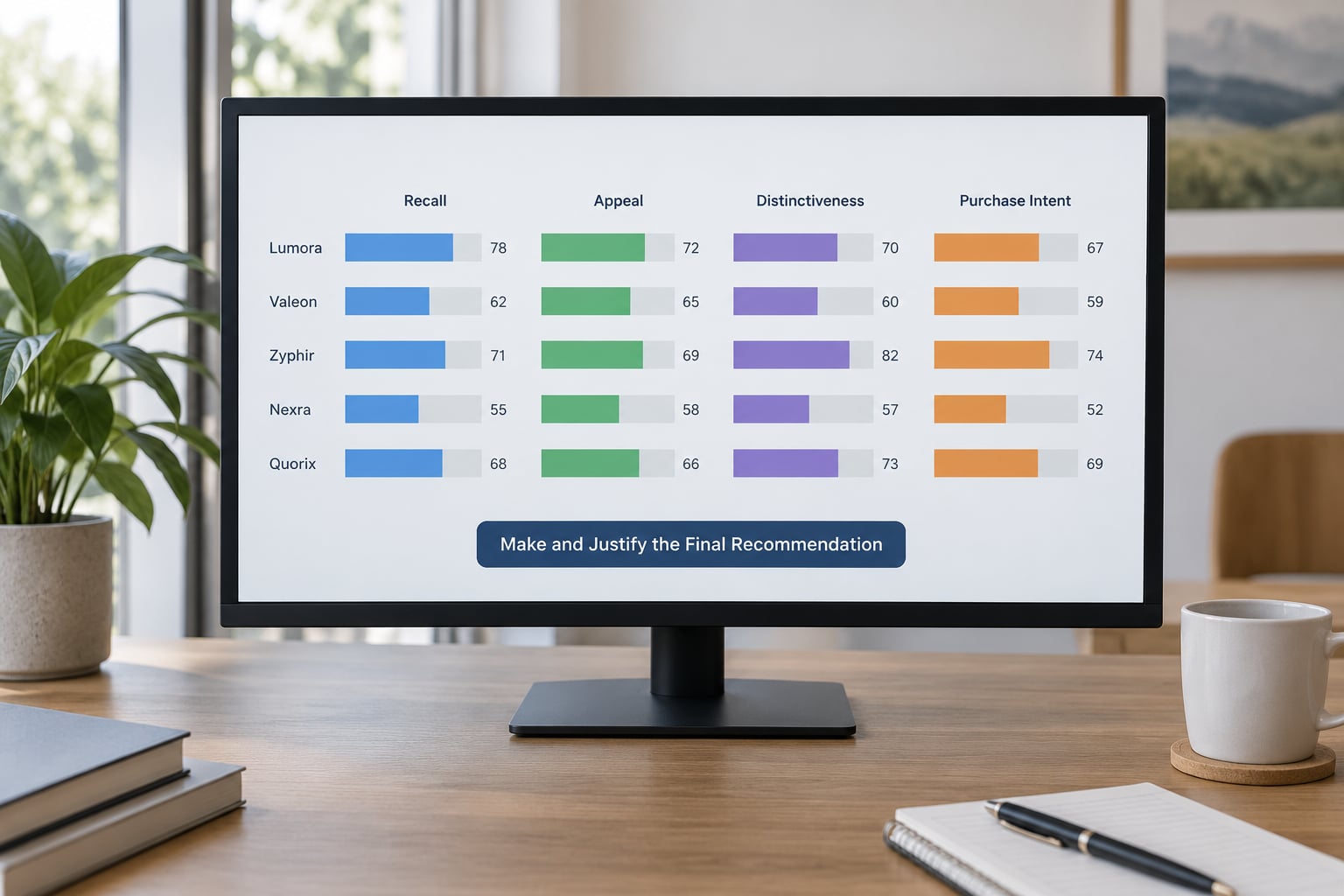
Write the recommendation the way you would defend it in a meeting. Name the winner. Name the runner-up and say what would have had to be true for it to win. Give the rationale in terms of your criteria, with the actual numbers.
Report the limitations honestly. The sample was self-selected. Two segments were overweight. Recall was measured after one exposure. The name scored slightly lower on appeal and much higher on recall. A recommendation that admits its weak spots survives scrutiny; one that claims everything is equally strong invites a question you cannot answer.
Close with next actions and owners: legal clearance, domain and handle acquisition, a second validation round if any threshold was missed, and post-launch tracking of the metrics you used in the test. If you ran the study yourself, keep the raw data and the questionnaire, because you will be asked to reproduce the result when the name is under pressure six months later.
Common Mistakes That Skew Your Results
Most bad naming decisions are not caused by bad names. They come from a small set of avoidable errors in how the test was run.
Leading questions. “Doesn’t Meridian sound sophisticated?” asks for agreement rather than a reaction. Ask what the name sounds like, then let the respondent supply the adjective.
Showing the logo before measuring the name. A designed mark changes perception of the name, and the result no longer transfers to the name alone. Measure the bare name first, always.
Testing in a biased category context. If you tell respondents the product is a mortgage lender, they will rate every name through that frame and a name meaning something else entirely will be penalised for it. Where the name is meant to signal category entry, test it both ways and report both.
A sample that does not match buyers. Ten colleagues, three friends, and a Reddit thread are not a target audience. Recruiting strangers who match the buyer profile is the single biggest jump in reliability available to a small team.
Declaring a winner from a tiny group. Qualitative work explains reasons. It does not measure preference reliably below roughly twenty relevant respondents, and it should never be the only evidence.
Collecting likes instead of measures. “Do you like it?” measures politeness. Recall, forced-choice ranking, and the belief question measure something closer to behaviour.
Fixed presentation order. Randomise it. Position bias is consistent and it is entirely self-generated.
Testing too late. By the time a name is on packaging, a domain, and an invoice, the cost of changing it is no longer a research budget. Run the test while the decision is still cheap.
Ignoring practical constraints. A name that scores beautifully and cannot be registered, domain-matched, or pronounced by your sales team is not usable. Screen for that before fieldwork.
A few execution habits pay for themselves. Brief the moderator with the same script every session. Write down verbatim comments, not summaries. Decide in advance what evidence would make you reject all names, because that decision gets much harder once there is a favourite. And if the shortlist has no alternative you would truly launch, no amount of research will produce a useful answer.
Frequently Asked Questions
Should I use a survey, focus group, or interviews to test brand names?
Interviews first, survey second. One-to-one interviews give you the reasoning behind each reaction, which is what you need to diagnose meaning, pronunciation, and misunderstanding. A survey then measures how widespread those reactions are and whether the difference between two names is real. Focus groups work when you specifically want peer-group language and disagreement, but they are weak on preference and stronger people talk louder.
How many consumers do I need to test a brand name?
Twenty to thirty people from your target category will surface meaning problems, pronunciation trouble, and obviously weak options. One hundred to two hundred lets you cut results by segment and separates close names. Three hundred or more supports significance claims on small gaps. Below twenty, treat the work as diagnosis rather than a decision, and never report a preference number from a handful of colleagues or friends as evidence.
Can I test several brand names in the same research study?
Yes, and it saves time, but keep the list to two to four. More than that fragments attention and respondents start ranking on position rather than meaning. Randomise the order names appear in, and follow the exposure with a ranking task, because ratings alone let people avoid trade-offs. If your shortlist is long, screen it internally and on availability first, then take only the survivors into the study.
When should I check trademark availability and legal risk?
Screen early, before fieldwork, and get a formal clearance opinion after consumers have narrowed your options. The initial screen costs very little and stops you testing names you cannot use. The order matters because consumer testing is the cheaper half of the process, so you should spend research budget on names that survive a basic availability check, then commission legal work on the one or two finalists.
Does consumer testing replace a trademark search?
No, and no amount of good consumer data substitutes for either. A trademark search answers whether you can legally use and register a name in a class and territory. Consumer research answers whether people react well to it. Run both. They fail independently: a name can be perfectly registrable and still be unpronounceable, or score well with respondents and still be blocked in your main market.
Conclusion
How to test brand names with consumers comes down to sequence: define the decision, screen a small shortlist for availability and unintended meaning, explore reactions in person, run a blinded controlled test with a sample that matches your buyers, and choose against criteria you wrote down before you started.
Start with the part most teams skip. Sit down and agree who the audience is and what evidence will decide the winner. Everything after that gets easier, because the study finally has a job to do.