
Repositioning a brand without losing loyal customers means changing what the brand stands for while deliberately protecting the recognition, trust and emotional payoff that existing customers already buy. The order matters more than the idea: measure brand equity first, decide what must survive the change, then build the new promise around those anchors and roll it out in stages with open communication.
Most loyal customers do not leave because a company changed strategy. They leave because they stopped recognizing the brand, or because they quietly realised they were not part of the future being described. Treat the change as a promise that needs evidence, and the customer base tends to come with you.
The process below takes eight steps and usually spans several months, because the research phases cannot be rushed without losing the whole point. Most of the effort sits in the first three steps, which is where you find out what you are actually allowed to change.
Table of Contents
- What You Need
- Step-by-Step
- 1. Diagnose the current brand position
- 2. Identify what loyal customers already value
- 3. Research the market opportunity
- 4. Define a differentiated new position
- 5. Test the position with existing and new customers
- 6. Preserve familiar assets and signals
- 7. Build a transition plan and communicate early
- 8. Roll out in stages and measure loyalty
- Common Mistakes
- Confusing repositioning with rebranding
- Changing too much at once
- Defining existing customers as the wrong audience
- Waiting for the data to tell you it failed
- Treating a trend as a strategy
- Failing to communicate, or communicating too late
- Frequently Asked Questions
- How can a brand reposition while keeping loyal customers?
- How do you know when a brand should be repositioned?
- Should a repositioning change the logo and visual identity?
- How can you test a new brand position with existing customers?
- What should a brand tell customers about a repositioning?
- How long does a brand repositioning process usually take?
- Conclusion
What You Need

Repositioning fails when a team starts with the new message and works backwards. Before you draft anything, you need a baseline, and the baseline only exists if you collect it now, while the current brand is still intact.
- Customer research. Recent interview notes, open-ended survey responses, support and complaint logs, and a read of public reviews and social mentions. Volume matters less than specificity here, since you are hunting for reasons, not averages.
- Performance data. Repeat purchase rate, retention by cohort, share of repeat buyers versus first-time buyers, average order value for repeat customers, and any churn you have seen in the past 24 months.
- A brand equity baseline. Unprompted recall, prompted awareness, purchase intent, perceived quality and Net Promoter Score, each measured with a consistent method so the same survey can be repeated later.
- Written positioning documents. Your current positioning statement, brand promise, audience definition and value proposition. Many teams discover that half of these no longer exist in writing, which is itself a finding.
- Competitive and category context. Where the category is heading, which rivals are gaining ground, and which customer needs are going unmet.
- Internal alignment. A short list of leaders and teams who can block or delay the change, plus the employees who carry the brand in front of customers day to day.
- Communication assets. The channels you can reach customers through directly, the ones you depend on for reach, and the approval process for anything you publish.
- A measurement plan. Named metrics, a baseline reading for each, and a schedule for when you will read them again. Without a pre-change reading, you cannot prove anything improved.
Sequence them in that order and the rest of the process gets much easier. If a line item is missing, the honest move is to fill it before committing to a new position, because the alternative is discovering the gap after launch.
Step-by-Step
Eight steps, and the first five happen before anything customer-facing changes. That is deliberate. Repositioning that skips the diagnostic stages tends to produce a launch that reads as a surprise, and surprise is what loyal customers punish first.
1. Diagnose the current brand position
Write down what the brand promises today, who it promises it to, and the associations customers attach to it. Do it from evidence rather than memory: interview your long-tenured customers, read a sample of reviews by hand, and check what sales and support staff hear when people explain why they buy.
Then name the business problem the repositioning has to solve. Market pressure, a new competitor, a shift in the audience, a reputation event or a move upmarket each call for a different answer, and a change made for vague reasons reads as vagueness to buyers.
You know this step worked when you can state the current promise in one sentence, name at least three associations customers actually use when they justify the purchase, and separate the durable strengths from the assumptions that only ever appeared in internal documents.
2. Identify what loyal customers already value
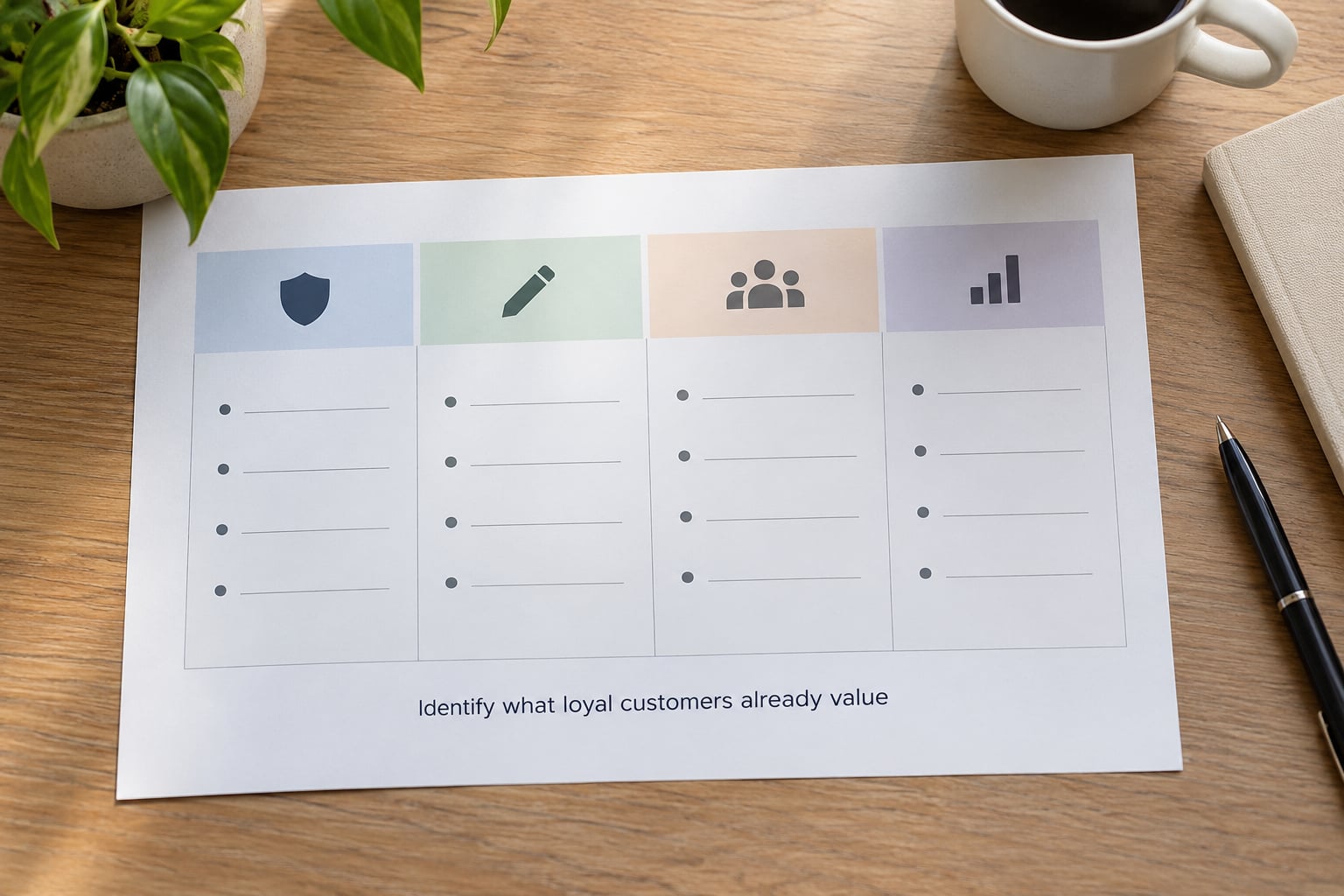
Loyalty has layers, and they do not respond to change in the same way. Map the functional benefit (does it work, is it worth it), the emotional benefit (how does it make me feel), the social benefit (what does buying it say about me) and the identity benefit (which group do I belong to when I choose it).
Sort your loyal base into four segments before you design anything, because each one needs a different message:
| Segment | What they want | How to treat them in a repositioning |
|---|---|---|
| Super fans | Recognition, participation, early access | Give them a role in shaping and testing the new position before you announce it |
| Loyalists | Consistency and the reasons they already buy | Show explicitly that those specific reasons still hold, with evidence rather than reassurance |
| At-risk loyalists | A signal that the brand noticed them drifting | Contact directly, listen to what changed on their side, and fix the specific break |
| Transactional buyers | Price and convenience | Expect less attachment; keep the offer legible so they do not have to re-learn anything |
The output of this step is a written list of equity anchors: the benefits and assets that must survive the change untouched. Everything else is negotiable. If you cannot produce that list, you are not ready to reposition.
3. Research the market opportunity
A new position has to be worth the switching you are asking of customers. Look at where the category is going, which needs are unmet, which rivals are pulling customers away and what cultural shifts are changing how people in your audience now think about the problem you solve.
Test the opportunity against alternatives. If your new position could describe half the competitors in the category, it is not a position, it is a description. Distinction is what gives a reframe a reason to exist in a customer’s head.
You know it worked when you can name the specific unmet problem the new position addresses and explain in one sentence why the current position can no longer reach it. If you cannot, you have a marketing problem, not a positioning one.
4. Define a differentiated new position
Write a positioning statement that names four things: the target customer, the frame of reference or category, the distinctive benefit, and the reason to believe. Keep it to a few sentences, and keep the reason to believe concrete, since that is the part customers actually check.
Run it against four tests. Relevance: does a real customer need this? Comprehension: does an outsider understand it after one reading? Credibility: can you prove it? Fit: does it sit on top of the brand’s strongest existing associations, or does it fight them?
A statement that scores well on relevance and badly on fit is the classic failure case, because the brand ends up asking customers to abandon the very thing that made them stay. Most “we are moving upmarket” positions fail on the fourth test, since they quietly redefine the existing customer as the wrong one.
5. Test the position with existing and new customers
Put the statement and the supporting creative in front of both audiences before you commit. Concept tests and message experiments can run cheaply, and existing customers are the harder audience to please, which makes them the better test.
Measure comprehension, relevance, trust, purchase intent and perceived fit, and break the results out by segment rather than averaging them together. A flat average hides the one reaction that matters most: loyalists who feel excluded.
Set your thresholds before you see the data. For example, comprehension at or above 80 percent of respondents, trust at or within a few points of the current baseline, and no loyalist segment showing a meaningful intent drop. If the numbers miss those thresholds, change the message, not the standard.
6. Preserve familiar assets and signals
Decide element by element what stays recognisable: the name, the logo, the colour palette, the packaging cues, the signature product, the tone of voice, the service behaviour. Most positioning work needs only the message layer to change, and a total visual overhaul on top of a repositioning asks customers to absorb two unfamiliar things at once.
Protect the assets that carry trust signals. A heritage mark, a long-running product or a consistent service standard tells an existing customer that the company they chose is still there, even as the promise around it moves.
Watch brand architecture here. In a branded house structure, a repositioning usually applies across the family and gets diluted quickly. In a house of brands, each name carries its own equity, so you can shift one without touching the others, which is often the safer route.
7. Build a transition plan and communicate early
Sequence the rollout: internal alignment and employee training first, then product or service changes, then customer messaging, then channel updates, then measurement. Employees carry the brand in every customer interaction, so a change they have not heard about first will reach customers as a rumour.
Write the customer message around three things: the reason for the change in plain language, what remains familiar, and what the customer personally gets. Avoid the corporate framing that turns a strategic decision into an announcement about the company’s feelings.
Where both old and new signals have to run at once, say so explicitly. When two positions are live and unexplained, customers assume the worst version. Acknowledging feedback publicly, including the criticism, does more for trust than a polished launch film.
This is where co-creation pays off. Practitioners repeatedly describe transparency and a sense of being heard as the central retention lever, and small business owners in particular say they lack a framework rather than a budget for this stage.
8. Roll out in stages and measure loyalty
Pilot the new position with one segment or one market before committing everywhere. A limited release gives you a real response at real risk, which is far cheaper than finding out nationally.
Track awareness, consideration, conversion, repeat purchase rate, complaints, churn and sentiment through the transition, comparing each against your pre-change baseline. Set thresholds in advance for both rollback and further investment, so the decision is a rule rather than an argument.
Read the leading indicators before the lagging ones. Churn data arrives months late, while a rise in support complaints about the change, a dip in repeat purchase among one cohort, or negative sentiment clustering around one message element shows up within weeks. Watch those weekly during the first quarter.
You know the repositioning worked when repeat purchase among pre-existing loyalists holds within a small tolerance of its baseline, while consideration among the target audience moves up. Growth with a stable base is the signal. Growth with a collapsing base is a different brand, whatever the name on the door.
Common Mistakes
Most of the damage comes from a handful of predictable errors. Each has a straightforward fix, and none of them require a bigger budget than the change you already planned.
Confusing repositioning with rebranding
These are different projects with different risks, and picking the wrong one is the single most destructive mistake available to you.
| Approach | What changes | Equity risk | Use it when |
|---|---|---|---|
| Repositioning | Promise, audience, message | Low to moderate | The brand is still right and the message is behind |
| Brand refresh | Visual identity, tone | Moderate | The identity looks dated but the promise still fits |
| Rebranding | Name, identity and promise | High | The old brand actively blocks the new market |
The fix is to write down the business reason for the change in one sentence and match the method to it. If the reason involves your customer, the promise or the audience, you are repositioning.
Changing too much at once
A new promise, a new logo, a new price architecture and a new product line launched together give customers no anchor at all. Existing buyers cannot tell which part they are being asked to accept.
Fix: change the message first, hold the assets steady, and move the identity later, once the new position has proven it holds. Staged change lets you attribute any customer reaction to the right cause.
Defining existing customers as the wrong audience
This is the quiet killer. The moment a repositioning document implies loyal customers are no longer the target, the advocates read it and quietly stop renewing.
Fix: state explicitly which benefits from the current position carry into the new one, and treat any move that excludes the core base as a separate strategic decision requiring its own evidence and its own announcement.
Waiting for the data to tell you it failed
By the time churn shows up in revenue, the cause is buried under a quarter of other news. Teams also tend to declare victory on awareness growth, which is the easiest metric to move and the least connected to loyalty.
Fix: baseline retention and repeat purchase before launch, watch leading indicators weekly, and put a written rollback threshold in place while judgement is still calm.
Treating a trend as a strategy
A competitor’s move, a cultural moment or an internal ambition can each trigger a repositioning that customers never asked for. Trends shift; the associations customers hold shift slower.
Fix: require a named unmet customer need before the project starts. If the justification is a trend rather than a problem you have heard from buyers, pause and go back to step 3.
Failing to communicate, or communicating too late
Customers experience a repositioning as something that happened to them, not as a strategy you ran. Silence converts an internal decision into an external betrayal, and it is the fastest route to public backlash.
Fix: brief employees before customers, tell customers why before what, and keep answering questions in public for as long as the question keeps coming. Build social listening around the announcement so the reaction arrives as data rather than as a fire.
Frequently Asked Questions
How can a brand reposition while keeping loyal customers?
Keep the elements customers chose you for and change the promise around them. Measure brand equity first, identify the functional and emotional benefits your loyal base relies on, protect those as equity anchors, and change only the message, audience framing and offer that no longer fit the market. Test the new position with existing customers before launch and roll it out in stages with clear reasons.
How do you know when a brand should be repositioned?
Look for sustained pressure rather than a single bad quarter. Common signals include repeat purchase falling while awareness holds, a fast-growing entrant taking your customers, an audience that no longer matches how you sell, distribution or channel changes, or a reputation event. If your brand promise still fits but the message, audience or proof has drifted behind the market, a repositioning is usually the right move.
Should a repositioning change the logo and visual identity?
Usually not at the same time. A repositioning changes what the brand stands for, and most customers can accept a new promise faster if the name, colours and signature products still look familiar. Hold the identity steady through the message change, then consider a visual refresh once the new position has held up in the market. Changing both together doubles the amount customers have to re-learn.
How can you test a new brand position with existing customers?
Run concept tests and message experiments with a sample of loyal customers alongside priority new audiences. Measure comprehension, relevance, trust, purchase intent and perceived fit, then break results out by segment so loyalist reactions do not disappear inside an average. Set pass thresholds before you see the data and revise the message rather than lowering the bar.
What should a brand tell customers about a repositioning?
Say three things: why the change is happening in plain language, what stays familiar about the brand, and what the customer personally gains. Acknowledge the feedback you received while researching, including the criticism, because transparency is the lever customers consistently respond to. Tell employees first, since they carry the brand into every customer conversation.
How long does a brand repositioning process usually take?
Most take six to twelve months from first diagnostic work to a measured rollout, and the research stages account for much of that. A messaging-only repositioning can move faster, often three to four months, while a full rebrand with new identity and packaging runs considerably longer. Rushing the diagnostic phase is the most common reason timelines extend, not the execution itself.
Conclusion
A repositioning that keeps its loyal customers is mostly a matter of order. Diagnose the current position, segment the base, find out what customers actually value, research the opportunity, define and test the new position, protect the familiar assets, communicate the transition early, then roll out in stages and measure against a baseline you captured before anything changed.
Start with one exercise this week. Write down the five benefits existing customers describe when they explain why they stay, and the three assets they would notice immediately if they disappeared. Those become your protected list, and every later decision gets tested against it.