
Recognition beats recall in advertising testing because it asks a far easier question. Showing someone a frame from a commercial and asking “have you seen this?” only needs a weak memory trace to fire, while asking someone to name the brand from nothing requires a strong, well-cued one. That makes recognition the better instrument for confirming an ad was actually seen and encoded, and recall the better test of whether the message was stored deeply enough to come back on its own.
The catch is that recognition is also easy to fool. People say yes to ads they never watched, and the two measures can disagree by a factor of two on the same campaign. Which one you pick depends on the question you are actually asking, so it is worth treating this as a measurement decision rather than a debate with a winner.
Table of Contents
- What Is Recognition and Recall in Advertising Testing?
- Why Recognition Beats Recall in Advertising Testing
- Why recognition scores run so much higher
- How Recognition and Recall Measure Different Effects
- Aided vs. Unaided Recognition and Recall
- How to Test Recognition and Recall Properly
- What Recognition Results Can Mislead
- Which Metric Should You Use for Each Research Question?
- How to Interpret Recognition and Recall Scores Together
- References
- Frequently Asked Questions
- Is recognition always more accurate than recall in advertising testing?
- What is the difference between aided and unaided recognition?
- Does higher brand recognition always lead to higher brand recall?
- Should recognition or recall be the primary metric in ad testing?
- How can researchers reduce familiarity bias when measuring recognition?
- Conclusion
What Is Recognition and Recall in Advertising Testing?
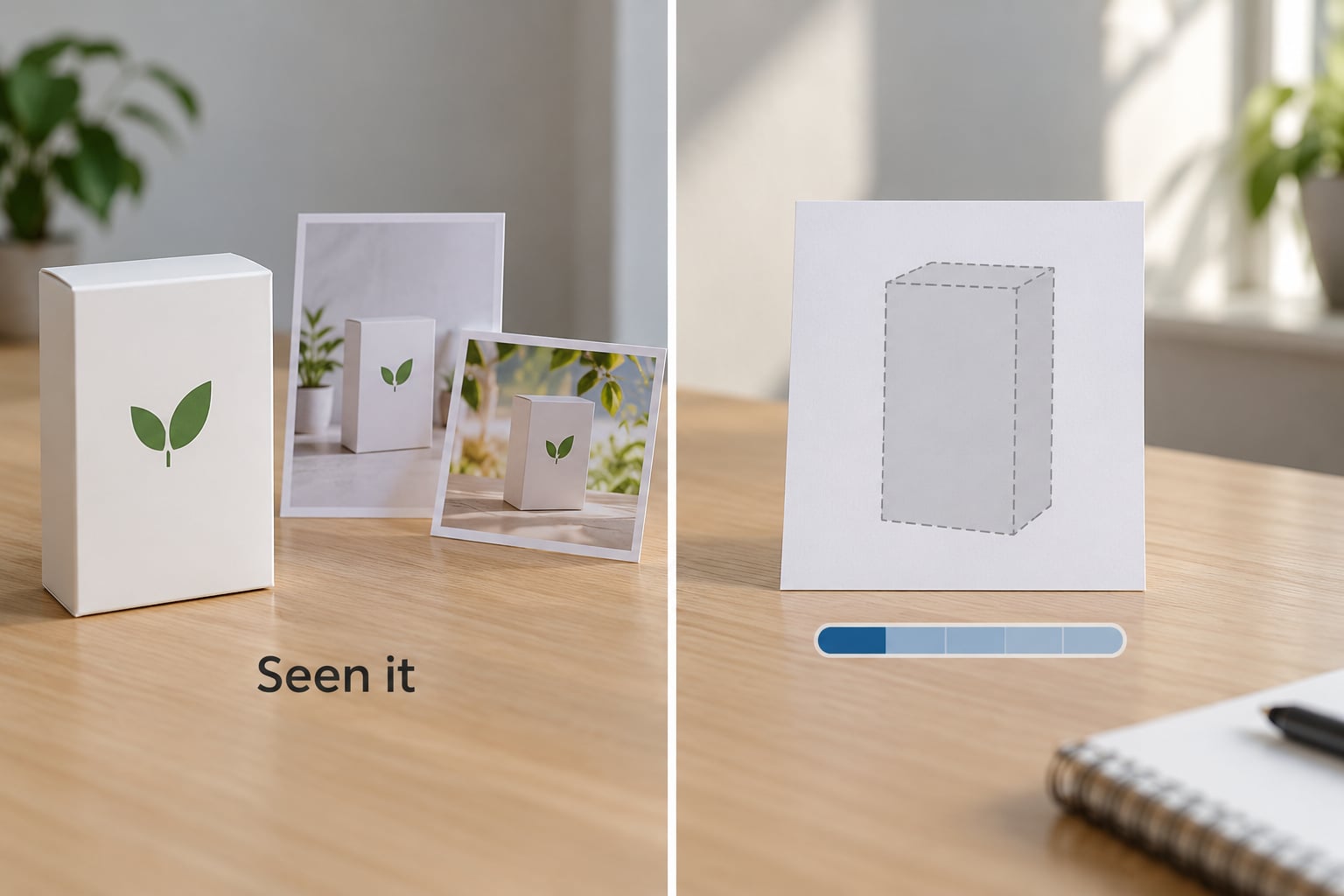
Recognition testing presents a cue and asks the respondent to judge it as familiar. Recall testing removes the cue and asks the respondent to produce the brand, the message or the advertiser unprompted.
In practice a recognition test might flash four to six key frames from a commercial with a short audio snippet and ask which ones the respondent remembers seeing. A recall test asks an open question such as “what advertising do you remember seeing recently?” and codes the answers afterwards.
| Dimension | Recognition | Recall |
|---|---|---|
| Task type | Dichotomous or matching judgement against a cue | Generative search with no prompt |
| Cue | Still frame, video clip, audio snippet or description | Category prompt at most, often nothing |
| Cognitive demand | Low. A familiarity judgement | High. Active retrieval and generation |
| Main bias direction | Overstates exposure through false positives | Understates exposure through confabulation and forgetting |
| Typical score level | Noticeably higher | Noticeably lower |
| Best used for | Confirming an ad was seen and encoded | Measuring how retrievable the message is |
Both are measures of explicit memory. Recall leans on episodic memory, which stores what happened, and on semantic memory, which stores facts and associations. Recognition taps the same store but only asks whether a particular item feels familiar.
Why Recognition Beats Recall in Advertising Testing
Five things account for most of the difference in practice.
Lower retrieval burden. Recall is a search through memory with no external support. Recognition is a comparison against something already on screen. One is a test you can fail by saying nothing; the other all but tells you the answer.
A lower bar for a memory trace. A viewer who glanced at a commercial for a second and encoded only a colour scheme, a face or a logo will fail a recall question but will still recognise that frame when it reappears.
Less room for confabulation. Recalled advertising gets misfiled constantly. People attribute a commercial they half-saw to a familiar-sounding advertiser, or reconstruct a plausible ad from the general look of a category. Recognition makes that harder because the cue is fixed.
It survives emotional creative. The complaint against recall is old and well documented: asking for a verbal brand name systematically penalises emotional and mood-based advertising, which builds feeling rather than a name. Zielski’s 1982 work in the Journal of Advertising Research is the standard reference for that criticism.
It scales to individual ads. A recall tracker usually reports campaign-level numbers because open-ended coding does not decompose neatly. Recognition works frame by frame, which is what you need to spot wear-out or an ad burning budget.
Why recognition scores run so much higher
Recognition-based tracking frequently produces results around twice the level of recall-based tracking on the same campaign. Some of that gap is real, because the two measures ask different questions. Some of it is inflated, because recognition collects false positives that recall would have filtered out. Treating a factor-of-two gap as a meaningful improvement in ad performance is a mistake.
How Recognition and Recall Measure Different Effects
A high recognition score tells you something perceptual: the stimulus left a trace that is strong enough to be reactivated by a matching cue. That is a statement about availability, not about persuasion, and it stays true even for an ad a viewer resented.
A high recall score tells you something generative: the brand or message came back without help. That implies a stronger, more organised memory trace, which usually travels with better future behaviour.
So the two measures answer different questions. Recognition asks whether the ad landed at all. Recall asks whether the ad stayed. A commercial can win the first and lose the second, and campaigns that look equally familiar at the shelf can sit very differently in a recall study.
Aided vs. Unaided Recognition and Recall
Each measure has a prompted and a spontaneous form, and the gap between them is where most of the interpretation problems live.
| Variant | Typical wording | What it measures | Bias direction |
|---|---|---|---|
| Unaided recall | What advertising do you remember seeing? | Top-of-mind availability | Overstates prominence, understates exposure |
| Aided recall | Do you recall any advertising for a soft drink? | Availability within a category | Depends on how specific the prompt is |
| Aided recognition | Have you seen this commercial before? | Familiarity with a specific execution | Overstates exposure through false positives |
| Unaided recognition | Which of these brands have you seen advertising for? | Prompted awareness of a brand | Inflated by category familiarity |
Unaided questions are the honest ones and the noisiest. Aided questions raise scores and can move them by more than the differences you are trying to detect, so wording has to be held identical across waves or across ads.
Order matters too. Ask recall before recognition and the cue has not contaminated the search. Ask recognition first and you have effectively shown the answer, which inflates everything that follows.
How to Test Recognition and Recall Properly
A workable recognition study runs in three steps: expose, delay, then cue and rate.
1. Set the objective first. Decide whether you are testing exposure, message takeout or brand linkage. Each maps to a different instrument, and mixing them produces a number nobody can act on.
2. Build a fair stimulus. Key frames should be selected for what actually enters long-term memory rather than for how they look. Young and Robinson’s 1989 work on video rhythm and recall, and the Flow of Attention method later used for photoboard selection, both address this. A photoboard of four to six frames plus about ten seconds of audio is the standard low-bandwidth version of the cue.
3. Control exposure and delay. Use a randomised design with an exposed group and a control group, keep the exposure period fixed, and hold the retention interval constant. Most copy testing uses a 24-hour delay. If you need to know how long a trace lasts, run separate cells at several intervals rather than guessing.
4. Insert a distractor before the memory question. A short unrelated filler task stops respondents forming a deliberate rehearsal strategy. Without it you are partly measuring how carefully someone tried to memorise.
5. Ask recall first, then recognition. Then add a confidence rating on the recognition response. Confidence separates a genuine trace from a guess, and it costs nothing extra.
6. Audit the false positives. Add a control ad and a decoy stimulus that nobody was exposed to, and ask about those alongside the real ads. The share of respondents who say yes to a stimulus they never saw is a quality check on the whole instrument. Without it a recognition score is not interpretable.
One more thing to disclose in your write-up: telling participants they will later be asked to recognise the ad changes what they encode. Test expectancy effects are well documented, and a study that hides its test type will produce a different memory trace than one that does not.
What Recognition Results Can Mislead
Recognition without exposure. Yes, a consumer can recognise an ad they never saw. Category familiarity, a recognisable layout and a plausible brand cue are enough to trigger a false positive, and heavy media weight makes it worse because the brand is already sitting heavily in memory.
Familiarity from exposure frequency. Recognition scores climb with frequency whether or not the specific ad was watched. A high score on one execution may just be a reading on the campaign.
Simple logos. A clean mark is recognised easily and says almost nothing. Recognition rewards visual distinctiveness, which is not the same as memorability of the message.
Non-attentive processing. People encode from the corner of the eye. Recognition registers that, and may report a viewing that never happened in any meaningful sense.
Wear-out dressed up as strength. After enough repetitions, familiarity keeps rising while liking and responsiveness fall. Recognition alone will not show you that, and neither will recall on its own.
The Singh critique. Singh’s 1988 comparison of recognition and recall as measures of television advertising effectiveness in the Journal of Advertising Research reported that recognition scores failed to decline meaningfully across longer delay intervals. If a measure barely moves as memory fades, it is not tracking memory as closely as its label suggests. That is the strongest published argument for treating recall as the purer memory measure, and it should sit in any honest write-up.
Response bias. Yes answers drift upward when the question is repeated or when respondents infer what the study wants. Long questionnaires and repeated waves both inflate recognition scores over time.
Which Metric Should You Use for Each Research Question?
Five questions settle it.
1. Are you asking whether people saw the ad, or whether they kept something from it?
2. Is your creative emotional or brand-feeling-led?
3. Do you need results per execution, or is a campaign-level number enough?
4. Is your category one where category familiarity is high, which makes false positives likely?
5. Can you afford a control group and a false-positive check?
| Objective | Primary measure | Why |
|---|---|---|
| Brand-link or brand-awareness testing | Recognition, paired with aided brand recall | Confirms the ad carried the brand, then checks the name travelled |
| Message takeout and memorability | Unaided recall | Only free retrieval proves the message was stored |
| Package and logo identification | Recognition | The stimulus is visual and the task is matching |
| Pre-screening a large slate of ads | Recognition | Cheap per execution and decomposes cleanly |
| Purchase-oriented and rational-claim research | Recall, supported by stated intent | Decision arguments need to be retrievable |
| Print, low-involvement categories, new brand building | Recall | Low involvement and rational claims favour verbal retrieval |
| Sponsorship and event activation | Both | Recognition measures exposure, recall measures linkage |
For print and rational-claim work, the older argument still holds: recognition suits broadcast-style creative, recall suits argument-led media. For sponsorship, run both. Linking a sponsor name to an event almost always under-performs sponsor recognition, and the gap is the interesting finding.
How to Interpret Recognition and Recall Scores Together
The two measures are most useful as a pair, because the pattern of agreement or disagreement tells you more than either line on its own.
High recognition and high recall means the ad landed and stuck. High recognition with low recall usually means visual familiarity without a retrievable name, which is common in low-involvement categories and often a fine outcome for a reminder ad. Low recognition with high recall means a narrow but loyal audience who remembers the message without a cue, which is worth knowing before you cut spend on it.
Both low is the weakest of the four patterns. It usually means the ad did not get attention, the exposure was too low to matter, or the delay was too long.
Add two more readings before you conclude anything: the false-positive rate from decoy and control stimuli, and a behavioural or attention-based measure such as eye-tracking or frame-level attention. Where the two self-report metrics disagree, treat that as a finding to explain rather than a number to average.
References
- Singh, S. N. (1988). Recognition Versus Recall as Measures of Television Advertising Effectiveness. Journal of Advertising Research.
- Zielski, H. L. (1982). Day-after recall: the effects of complex versus simple advertising. Journal of Advertising Research.
- Young, G. R., and Robinson, J. (1989). The influence of video rhythm and length on brand recall. Journal of Advertising Research.
- Young, G. R. Quirk’s Marketing Research Review. Tracking ad awareness: recognition vs. recall.
Frequently Asked Questions
Is recognition always more accurate than recall in advertising testing?
No. Recognition is more reliable for confirming that an ad was seen and encoded, but it carries false positives: respondents say yes to ads they never watched. Recall is a purer memory measure and often tracks decay better across delay intervals, as Singh (1988) found. Use recognition for exposure and execution-level screening, recall for message takeout, and both when they disagree.
What is the difference between aided and unaided recognition?
Unaided recognition gives respondents no prompt and asks them to name which brands they have seen advertising for. Aided recognition supplies a cue first, such as a specific commercial frame, a category prompt or a list of brands, then asks whether they recognise it. Aided versions produce higher scores and are easier to administer, so wording must stay identical across ads or waves.
Does higher brand recognition always lead to higher brand recall?
No. Recognition and recall measure different effects. Recognition registers perceptual availability of a stimulus, while recall requires the brand name or message to be generated without a cue. A commercial can be highly familiar and leave no retrievable brand name, which is common with emotional creative and in low-involvement categories. A high recognition score alone is not evidence of a strong memory trace.
Should recognition or recall be the primary metric in ad testing?
Match the metric to the objective. Recognition is the primary measure for brand-link testing, package identification and screening many executions cheaply. Recall is primary for message takeout, rational-claim creative, print, low-involvement categories and new brand building, where retrievability matters more than familiarity. For sponsorship and campaign tracking, report both and explain the gap.
How can researchers reduce familiarity bias when measuring recognition?
Run a randomised exposed-versus-control design and include control and decoy stimuli that respondents never saw. A respondent who says yes to a control ad is a false positive, and the rate tells you how much of the score is noise. Also hold the cue format, question wording and delay interval fixed, ask recall before recognition, add a confidence rating, and report the false-positive rate alongside the headline figure.
Conclusion
Start by writing down the communication outcome you want, then pick the metric that measures it. Recognition is the stronger instrument for confirming an ad was seen and encoded, and recall is the stronger one for proving the message can be retrieved unaided. Running both, with a control group and a false-positive check, tells you far more than either alone.