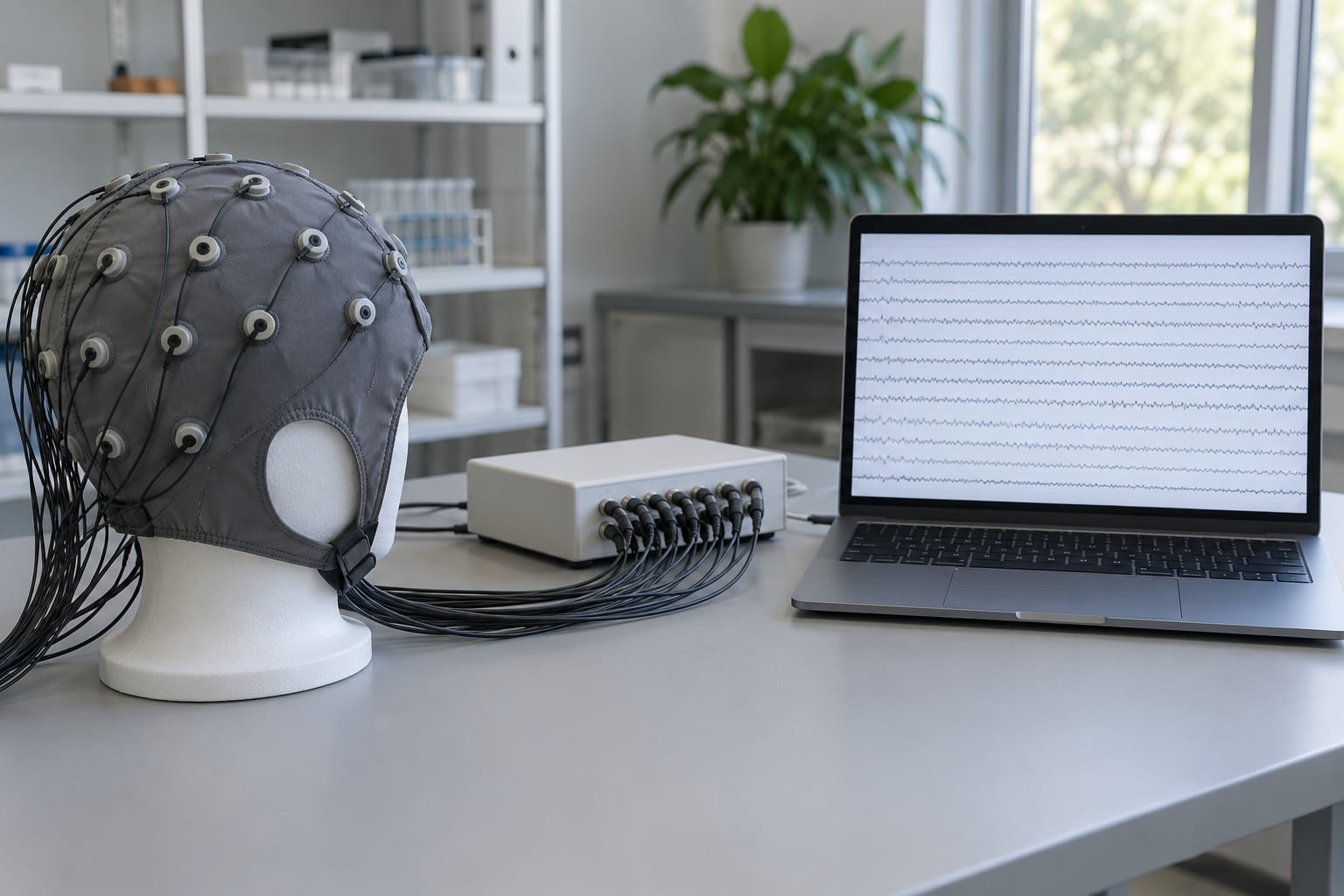
How EEG is used in neuromarketing comes down to timing. Researchers fit scalp electrodes, play a participant an advert, package or page, and record the brain’s electrical response millisecond by millisecond to see when attention lands and when it drops away. Those readings are then compared against a control condition and validated with behaviour before anyone calls a signal a result.
What that buys a marketer is a moment-to-moment read on attention and emotional processing that a survey, which only asks after the fact, cannot deliver. What it does not buy is a view of someone’s inner monologue. The difference matters, and it is where most of the confusion in this field comes from.
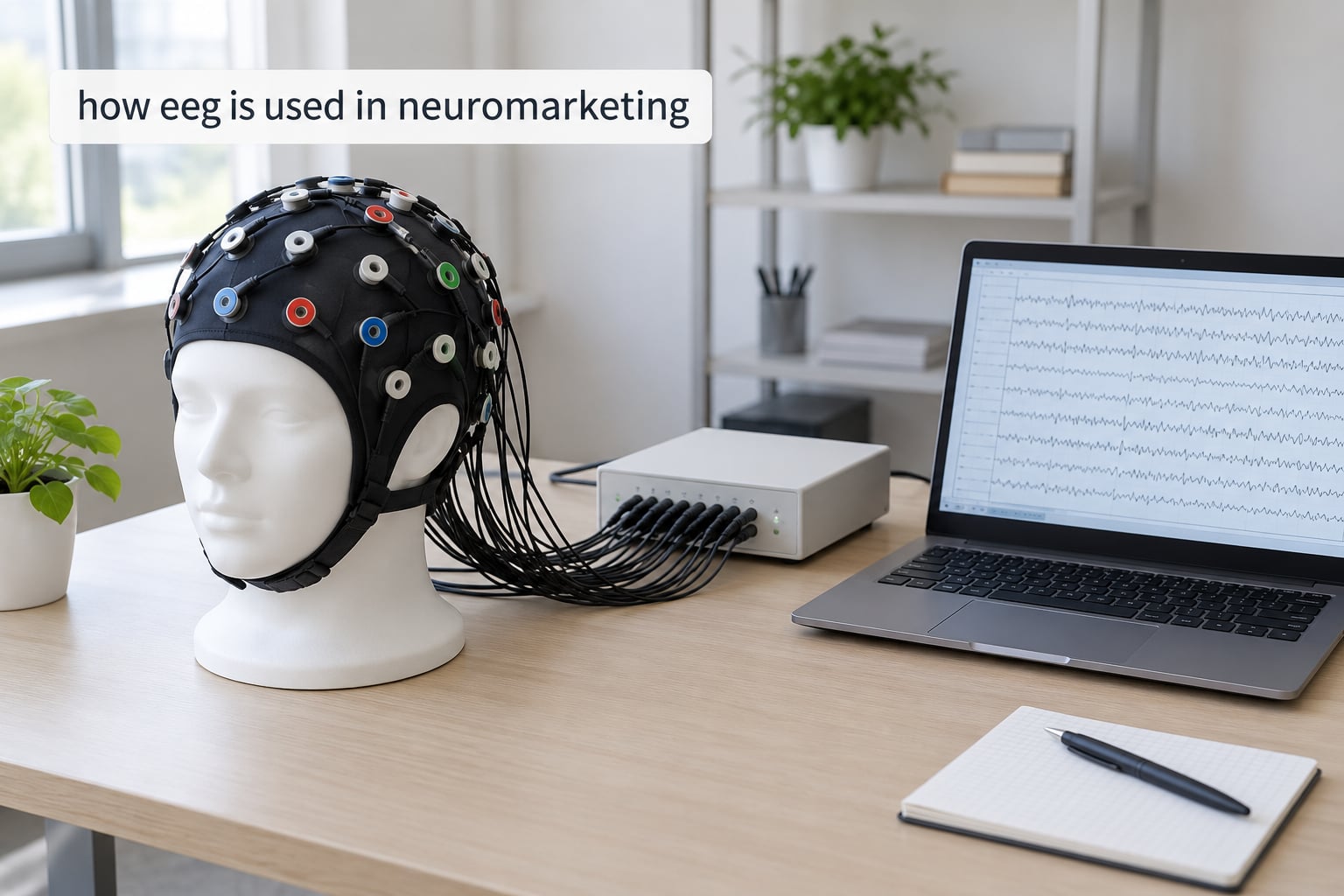
Table of Contents
- How EEG Is Used in Neuromarketing
- What Does EEG Measure in Advertising Research?
- How EEG Is Used in Neuromarketing Research: A Step-by-Step Workflow
- 1. Frame the marketing question
- 2. Design the stimulus and the comparison
- 3. Recruit an appropriate sample
- 4. Prepare participants and electrodes
- 5. Present the stimuli and record
- 6. Clean the signal
- 7. Analyse responses
- 8. Validate and translate
- What Marketing Questions Can EEG Help Answer?
- Comparing ad attention
- Examining emotional engagement
- Testing visual and auditory design elements
- Studying approach and avoidance responses
- Supporting memory and decision-related processing
- Preferring one stimulus over another
- How Do Researchers Interpret EEG Results?
- What Are the Limitations and Risks of EEG Neuromarketing?
- Signal noise and contamination
- Coarse spatial resolution
- Reverse inference
- The gap between the lab and the shelf
- Ethical and regulatory exposure
- What a credible claim includes
- How Does EEG Compare With Other Neuromarketing Methods?
- How Can Marketers Use EEG Responsibly?
- Frequently Asked Questions
- Can EEG tell marketers what consumers are thinking?
- What is the difference between EEG attention and consumer interest?
- How is EEG used to test advertisements and brand stimuli?
- What are the biggest limitations of EEG in neuromarketing?
- Is EEG better than eye tracking or fMRI for marketing research?
- Should marketers use EEG to measure purchase intention?
- Conclusion
How EEG Is Used in Neuromarketing
EEG neuromarketing is the use of scalp-recorded electrical activity to study how people react to marketing stimuli. Electrodes placed on the head detect the summed postsynaptic electrical fields of large groups of neurons, and researchers analyse patterns in that signal alongside designed comparisons to investigate attention, emotional response, approach or avoidance, and advertising effects.
Read that definition twice, because the last clause is doing heavy lifting. A brainwave difference on its own means very little. It becomes evidence when the same participants saw a designed comparison, when the same electrode layout was used throughout, and when the finding holds up against behaviour or self-report.
In practice the method almost always sits inside a larger design rather than running alone. A marketing research agency pairing EEG with eye tracking, facial coding and post-task questionnaires is doing something more defensible than a brain-only read, because each instrument covers a blind spot the others have.
| Common EEG measure | What a researcher looks at | The marketing question it serves |
|---|---|---|
| Event-related potentials (ERPs) | The signal locked to a specific stimulus event, such as a logo appearing on screen | Did the brand mark get processed, and how quickly? |
| Alpha power | Changes in the roughly 8-12 Hz range during a stimulus | Is the person relaxed and open enough to encode what they just saw? |
| Beta power | Changes in the roughly 13-30 Hz range during exposure | How much active engagement and task demand does the stimulus create? |
| Theta power | Changes in the roughly 4-7 Hz range, often frontally weighted | Is there evidence of conflict, internal deliberation or memory encoding? |
| Frontal asymmetry | Left-versus-right balance in frontal theta and alpha | Is the approach-avoidance balance shifting toward or away from the stimulus? |
| Latency | How many milliseconds pass before a component appears | How fast did processing kick in, which varies by design and familiarity? |
What Does EEG Measure in Advertising Research?
What reaches the scalp is not one person’s thinking. Every electrode sums the electrical field of thousands of neurons firing roughly together, so the recording is a blurred portrait of a synchronised slice of cortical activity, filtered through bone and skin on the way out.
That has two consequences marketers should hold onto. First, spatial resolution is coarse: you know roughly that activity over a cortical area changed, not precisely which circuit fired. Second, the signal is time-locked and fast, which is exactly why EEG is useful for stimuli that unfold in a second or two, like a six-second bumper or a shelf block.
Frequency bands are often introduced as if they were emotion detectors, and that framing breaks. Alpha, beta, theta and gamma are descriptions of oscillation ranges, not labels for feelings. A larger frontal theta response is consistent with more demanding processing, but interpreting it as a specific emotion requires an experimental design that isolates that emotion and a comparison condition that rules out the alternatives.
The link from signal to marketing claim runs through design, not through decoding. A study is set up so that one thing varies, usually the stimulus, and everything else is held steady. When the signal changes consistently with that one variation, the researcher has something to test. When the signal moves for a dozen reasons at once, the finding is noise with a p-value attached.
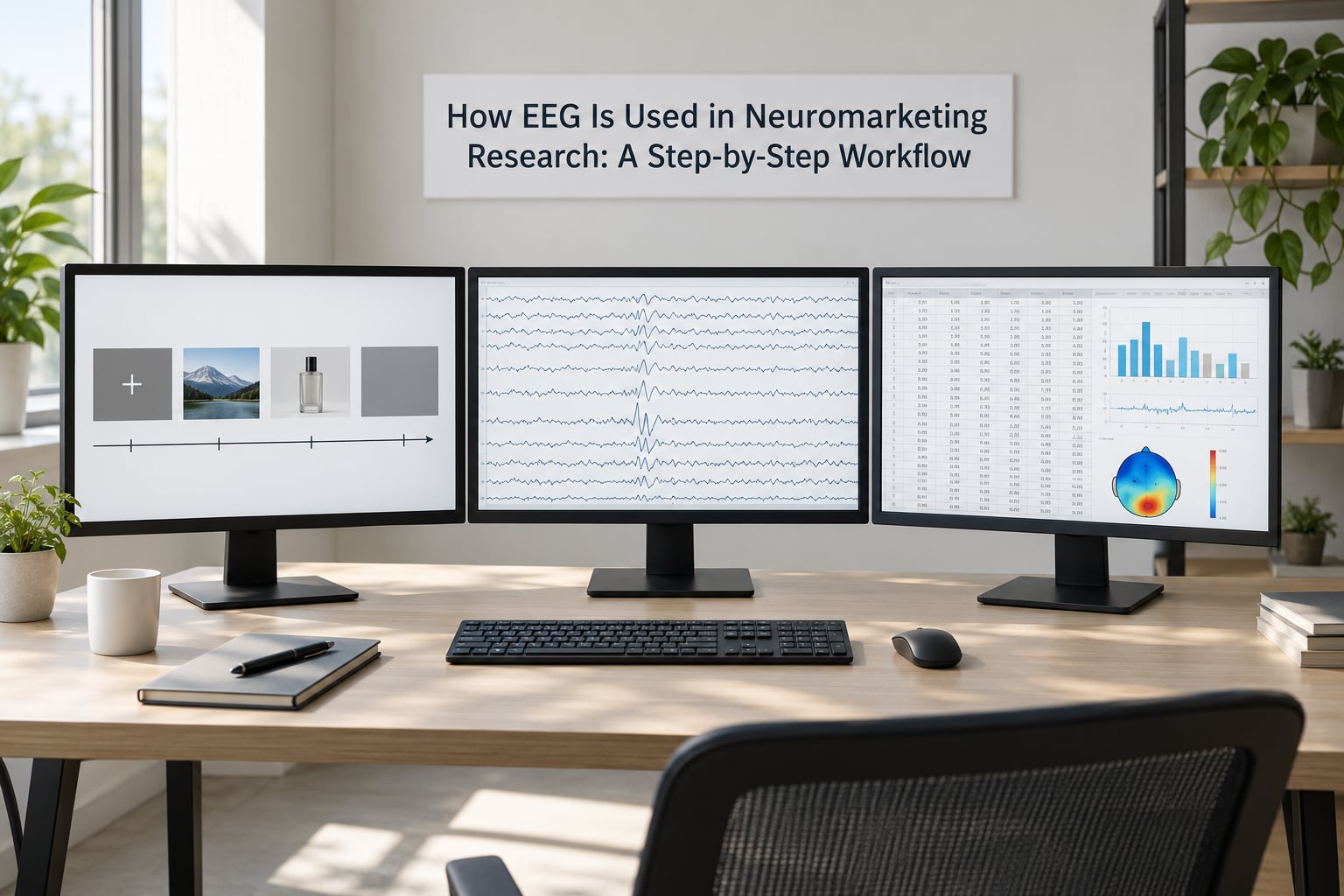
How EEG Is Used in Neuromarketing Research: A Step-by-Step Workflow
The end-to-end process runs roughly as follows, and each stage earns its place or the conclusion is not worth much.
1. Frame the marketing question
Start with a decision, not a curiosity. Which of two pack designs will be noticed on a busy shelf, or which of three edits keeps attention past the first second, are answerable questions. Which one the participant prefers is a different study with a different method.
2. Design the stimulus and the comparison
Choose the assets and build a condition that isolates the variable of interest. A neutral image, a scrambled version or a competing execution gives the baseline without which nothing can be interpreted.
3. Recruit an appropriate sample
Sample size drives statistical power, and small consumer EEG studies often sit uncomfortably close to the edge of underpowered. Consumers are also more variable than laboratory volunteers, which pushes the requirement higher, not lower. A vendor who quotes a fixed headcount without discussing the effect size is not answering the question.
4. Prepare participants and electrodes
A technician fits the cap, applies gel or positions dry electrodes, checks contact quality and runs an impedance check. Skin prep matters because a poor contact produces noise that can be mistaken for a weak or erratic response.
5. Present the stimuli and record
Participants view or hear the assets in a controlled order while the system logs the electrical signal at millisecond resolution. Stimulus timing is recorded precisely so responses can be aligned to the event that caused them.
6. Clean the signal
Movement, blinks, jaw tension and muscle activity contaminate EEG heavily. Analysts reject or correct artifact-contaminated segments, filter the signal and handle eye movements before any interpretation happens, and reporting what was rejected is part of honest work.
7. Analyse responses
Component analysis and band power are computed against the baseline condition, with statistical tests applied across conditions and multiple comparisons corrected. Wrong here and the pipeline manufactures findings from noise.
8. Validate and translate
Results get compared with self-report, recall tests, preference choices or sales-adjacent behaviour. This is the stage that decides whether the finding is marketing evidence or a curiosity in a chart, and it is the one most often skipped.
What Marketing Questions Can EEG Help Answer?
EEG fits best where the timing of a reaction is the interesting part, and fits poorly where the content of a belief is what you need.
Comparing ad attention
Design: same spot, same length, edited or original, shown in randomised order to the same participants. EEG can show whether one execution holds processing through a specific second, and where attention falls away.
Limit: a longer or more arousing advert can produce a stronger signal without being more persuasive. EEG cannot make the commercial argument for you.
Examining emotional engagement
Design: matched stimulus sets with known or pilot-rated emotional character, ordered and counterbalanced to prevent habituation. Arousal and valence get examined as separate dimensions rather than one mood score.
Limit: facial expression, skin conductance and self-report often triangulate emotional readouts better than EEG alone, and practitioners working in the field routinely pair them for that reason.
Testing visual and auditory design elements
Design: isolate one variable per condition, whether a colour, a composition, a logo treatment, a voice or a music bed. The workflow above exists to make this isolation defensible.
Limit: EEG is silent about why something worked. It tells you a change coincided with a processing shift, and the interpretation of that shift stays with you.
Studying approach and avoidance responses
Design: frontal asymmetry is commonly read as a balance between motivational tendencies toward and away from a stimulus, and it is one of the more widely used markers in this applied literature.
Limit: the mapping from asymmetry to motivational state is a debated interpretation, not a direct reading. Treat it as a hypothesis generator that needs behavioural confirmation.
Supporting memory and decision-related processing
Design: recall tests, recognition tasks or choice tasks run alongside recording, so the electrical signature can be tied to whether a stimulus was later remembered or selected.
Limit: this is the area most susceptible to small-sample optimism. Independent replication is thin, and researchers are increasingly careful about how generalisable single-study results are.
Preferring one stimulus over another
Design: two or more options shown in randomised order, with choices collected after recording. Machine-learning classifiers on EEG features are the standard approach.
Limit: published accuracy varies widely with task, preprocessing and sample size, and vendor claims far above the peer-reviewed range circulate regularly. Treat headline accuracy numbers as unverified until you can see the study behind them.
How Do Researchers Interpret EEG Results?
Interpretation always starts with a comparison, because there is no absolute meaning in a raw trace. A response is always something relative to a baseline, a control condition, or the same participants’ response to a different stimulus.
ERPs are read as components locked to a stimulus and identified by their timing, polarity and scalp distribution. Band-power analysis quantifies how much oscillatory power changed in a given window. Time-course analysis shows when that change happened, which for marketing work is often the most useful view, since a difference at 300 milliseconds and a difference at 1,500 milliseconds imply different things about a fifteen-second advert.
Three problems make casual reading dangerous. Multiple comparisons multiply false positives, because testing dozens of bands, windows and electrodes almost guarantees at least one significant result by accident. Artifacts create false effects just as efficiently, and they cluster in the same places that look interesting. Individual differences mean a group average can hide half the sample reacting in the opposite direction.
That is why sample size, power analysis, artifact handling and a stated comparison condition belong in any report a marketer reads. A result without them is an opinion with a waveform attached.
What Are the Limitations and Risks of EEG Neuromarketing?
The method’s main weakness is a signal that is heavily processed before it reaches you, and a set of failure modes that all produce the same symptom: a confident conclusion that a creative did or did not work.
Signal noise and contamination
Muscle, eye movement and sweat all leak into scalp recordings. In low-quality setups the artifact can exceed the signal of interest, and the resulting chart looks exactly like a real effect.
Coarse spatial resolution
EEG cannot localise activity the way fMRI can. You get a broad indication of which region changed, and inferring a specific brain circuit from a scalp trace goes beyond what the measurement supports.
Reverse inference
Noticing a known signature and concluding the person felt the matching emotion runs the logic backwards. A given signal can appear for several processes, and identifying which one happened needs the design, not the label.
The gap between the lab and the shelf
A participant watching a stimulus on a monitor in a quiet room is not a shopper in a noisy aisle. Laboratory responses are a useful input, not a forecast of sales, and the industry earns credibility by saying so plainly rather than quietly implying otherwise.
Ethical and regulatory exposure
Neural data is treated as sensitive personal data in several jurisdictions, including as a special category under UK and EU rules. Participant consent, data minimisation and secure handling are not paperwork details; they are conditions of the study being publishable and defensible. Dark-pattern concerns attach to any attempt to apply insights about vulnerability to consumers who never agreed to the research.
What a credible claim includes
Any finding you are shown should come with the comparison condition, the sample size and a power rationale, the preprocessing and artifact rejection, a reliability estimate, and some form of behavioural or self-report validation. A vendor presentation missing three of those five is a sales deck.
How Does EEG Compare With Other Neuromarketing Methods?
No method covers the whole response. EEG buys timing and accessibility, fMRI buys spatial detail, eye tracking buys gaze, and the behavioural methods buy truth about what people actually did.
| Method | What it measures | Strength | Main limitation | Best suited to |
|---|---|---|---|---|
| EEG | Synchronised cortical electrical activity at the scalp | Millisecond timing, portable, works in realistic settings with moderate cost and equipment demands | Coarse spatial resolution, noise, needs careful controls and validation | Rapid, stimulus-locked response: ads, pack shots, screens |
| fMRI | Blood oxygen changes as a proxy for neural activity | Detailed spatial mapping of which regions respond | Immobile participants, high cost, poor time resolution, artificial viewing conditions | Mechanism questions, reward, decision regions, long-form brand research |
| fNIRS | Blood oxygen in the cortex using near-infrared light | Moderate spatial detail, more naturalistic than fMRI, lower cost | Slower time course, surface-limited, awkward setup | Consumer response in more natural viewing conditions |
| Eye tracking | Gaze position, fixations and pupil behaviour | Direct, interpretable visual attention data; widely accepted | Shows where the eyes went, not why | Shelf and layout, website and creative attention |
| Facial coding | Muscle activity around the eyes and mouth | Captures expression change without requiring conscious reporting | Ambiguity between expressions and interpretations, needs validation | Emotional reaction to video and imagery |
| Skin conductance | Sweat gland activity as an arousal proxy | Cheap, portable, strong with emotion-arousal work | Arousal only, no valence, heavily affected by temperature and activity | Paired physiology for emotional response studies |
| Surveys and self-report | Stated attitudes, preference and recall | Cheap, scalable, reports meaning directly | Susceptible to bias, post-hoc rationalisation, and stated-not-actual behaviour | Defining the question, validating neural findings, market sizing |
| Behavioural analytics | Observed choices, clicks, dwell time, sales | Grounded in real behaviour at scale | Explains what happened, rarely why | Confirming that a decision from research predicts results in market |
Two related questions come up constantly. An ERP is not a different machine from EEG: it is EEG data averaged across trials, aligned to an event, which isolates the time-locked response and suppresses background activity. MEG instead detects the magnetic field produced by neural currents, giving better spatial detail and comparable timing, but the magnets require shielded, expensive facilities, so it stays in research labs rather than agency studios.
How Can Marketers Use EEG Responsibly?
The method is worth commissioning when the decision is about timing and the alternative evidence is weak on timing. Here is the process I would want to see a vendor work through.
Start from a specific question with a decision attached. “Which pack design holds attention on shelf” is workable. “Understand the consumer mind” is not, and any proposal framed that way is selling a concept rather than a study.
Then ask whether EEG is genuinely the right instrument. If the question is what people look at first, eye tracking answers it more directly. If it is which brain region lights up, fMRI or fNIRS serves it better. If it is whether the choice sells, behavioural data is the arbiter.
Require a written methods section before the work starts: conditions, sample size with a power rationale, control condition, preprocessing and artifact handling, planned statistical tests, and the behavioural validation. Treat any provider who cannot produce that as disqualified rather than negotiate it down.
Finally, hold the interpretation loosely. A labelled frontal asymmetry is not a purchase decision, and no reading from thirty seconds of exposure is a reliable purchase predictor. Combine the neural data with recall tests, stated preference and market behaviour, and let the behavioural evidence have the final word when the two disagree.
Frequently Asked Questions
Can EEG tell marketers what consumers are thinking?
No. EEG records the summed electrical activity of large groups of neurons at the scalp, which is a blurred, synchronised signal, not a readable representation of an individual’s thoughts. It can show when a stimulus was processed and how processing changed between conditions. It cannot report a belief, a preference reason or an intention. Any claim that a brainwave reading reveals what someone truly intends should be treated as marketing language until matched with behavioural evidence.
What is the difference between EEG attention and consumer interest?
Attention is a processing event: the brain registered and allocated resources to a stimulus, and EEG can timestamp that with reasonable accuracy. Interest is a state: a persistent evaluation and motivational orientation toward a subject, which no single scalp signal measures directly. A stimulus can be highly attention-grabbing and uninteresting, or quietly interesting without dominating awareness. The gap between the two is exactly why EEG results need behavioural and self-report validation.
How is EEG used to test advertisements and brand stimuli?
Participants wear an electrode cap and view or hear the assets in randomised order while the system records electrical activity at millisecond resolution. Analysts clean artifacts, compare responses against a control condition and a control stimulus, and examine event-related potentials and band power. Results are then checked against recall tests, self-report and stated preference. Studies like the one examining emotional and attentional responses to automobile imagery illustrate this structure, and show how far EEG advertising research can be taken.
What are the biggest limitations of EEG in neuromarketing?
Three dominate. The signal is noisy and easily contaminated by muscle and eye movement, so preprocessing decides what the data shows. Spatial resolution is coarse, so inferring a specific brain circuit from a scalp trace overreaches. And the reverse inference problem means a known signature does not identify a specific emotion or decision. Small samples, uncorrected multiple comparisons and the gap between lab viewing and real shopping add to the risk of confident, unreplicable conclusions.
Is EEG better than eye tracking or fMRI for marketing research?
Better at what, specifically. EEG has the best temporal resolution of the three and works outside a shielded scanner, which suits rapid, stimulus-locked responses to ads, packaging and screens. Eye tracking answers where attention goes with results everyone can interpret. fMRI answers where in the brain activity changes, at higher cost and with participants lying still. The methods are complementary, and serious studies that need both timing and meaning usually combine them rather than choosing.
Should marketers use EEG to measure purchase intention?
Not on its own. A laboratory exposure of a few seconds cannot establish whether someone will buy, and the claim that a brainwave reading predicts intent is a common vendor talking point rather than a peer-reviewed finding. Use EEG for the questions it handles well, such as when attention lands and how processing changes between creative versions, then confirm the commercially meaningful outcome with recall tests, stated preference and real behavioural data.
Conclusion
EEG earns its place in marketing research for one reason: it timestamps how a brain responds in the moment a stimulus appears, which is the part of consumer response that self-report handles worst. Used alongside a designed comparison, careful artefact handling and behavioural validation, it sharpens decisions about attention, creative sequencing and emotional tone.
Used carelessly, it produces confident charts about intentions nobody can verify. So start with the marketing question, name the comparison or validation method before choosing the tool, and require the methods before the conclusions.