p hacking is what happens when analysis decisions get made after you have already seen the results: switching metrics, cutting subgroups, extending the test, or excluding awkward respondents until something crosses 0.05. To avoid p hacking in consumer experiments, you fix the metric, the sample size, the stopping rule and the decision rule before the first respondent answers, write them down, and then run the analysis you wrote. Updated for 2026, that is still the whole method.
The reason it matters commercially is specific. A p-hacked concept test ships a proposition that does not sell, a p-hacked price test anchors a brand to the wrong number for a year, and a p-hacked copy test convinces a team that message A beats message B when the two are identical in truth. Nobody finds out, because nothing about the report looks unusual.
This guide walks the workflow in order, from the documents you need through to reporting a result nobody likes. It assumes you run concept tests, brand lift studies, copy tests, conjoint, or online controlled experiments, either in-house or through an agency.
Table of Contents
- What You Need
- Step-by-Step
- Step 1: Define the Question, Outcomes, and Decisions Before Collecting Data
- Step 2: Preregister the Analysis and Label Exploratory Work
- Step 3: Set Stopping Rules and Protect the Study from Optional Peeking
- Step 4: Run the Planned Analysis and Account for Multiple Testing
- Step 5: Record Deviations and Report the Full Result
- Step 6: Use an Independent Review or Reproducibility Check
- Common Mistakes
- Frequently Asked Questions
- What is the difference between p-hacking and HARKing?
- Is preregistration always necessary to avoid p-hacking?
- What do I do when the experiment fails?
- Can I run unplanned analyses without it counting as p-hacking?
- Can p-hacking happen in qualitative or observational consumer research?
- Conclusion
What You Need
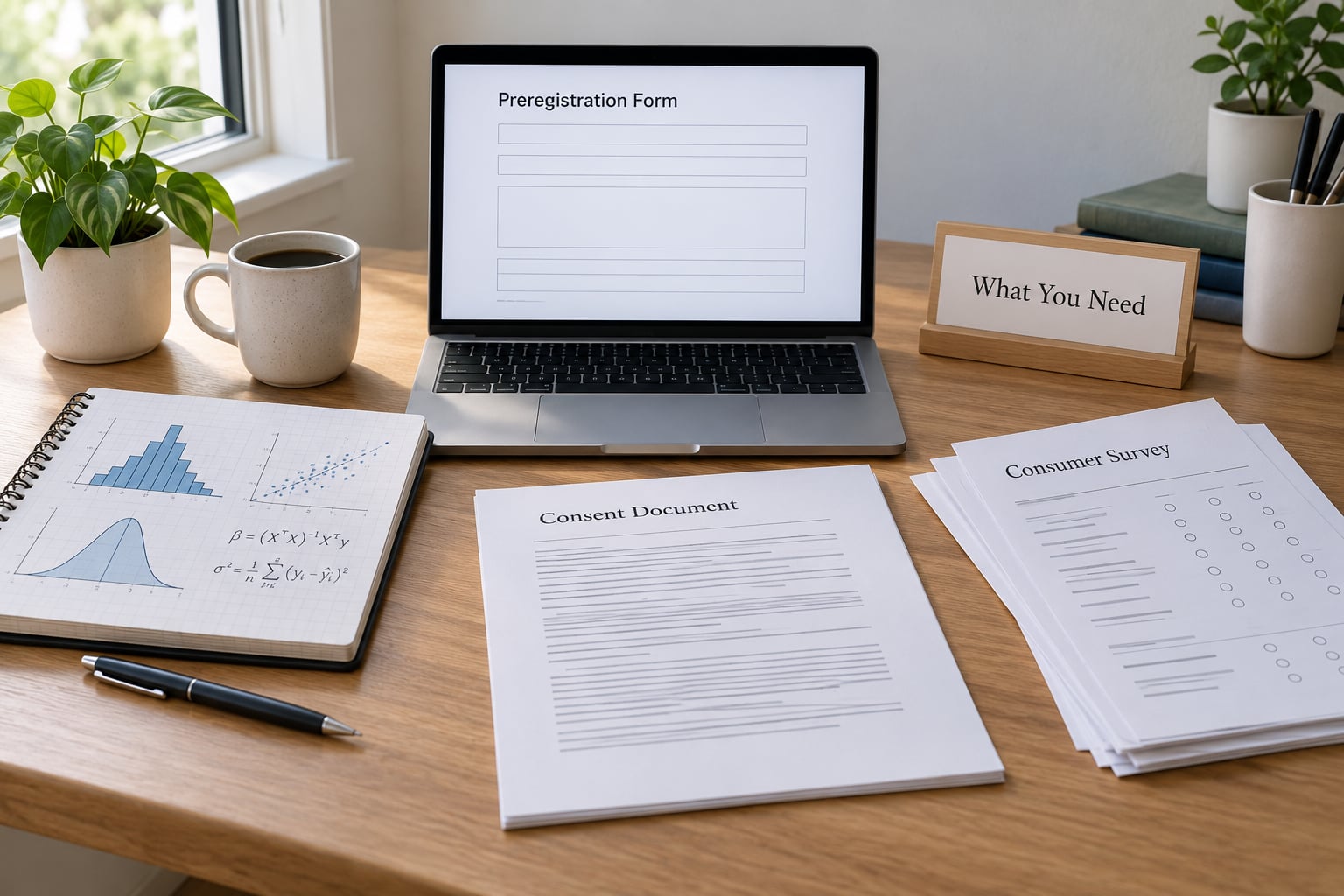
The essential starting point is a written analysis plan created before data collection. Everything else supports it. Without that document, the moment you see a number you have no way of knowing whether you are following the plan or rewriting it, and neither does anyone reviewing the readout.
- A pre-analysis plan. One page if possible. Research question, primary outcome, secondary outcomes, exclusion rules, transformations, the statistical model, the stopping rule, the decision rule, and what you will do if the result is null.
- A sample size with a stated justification. Power alone is not enough. You also need the minimum practical effect: the smallest change in behaviour that would change a decision. A test powered to detect a 0.2 point shift on a five point liking scale wastes a quarter of your calendar finding something too small to act on.
- A data quality rule set for panel fieldwork. Speed thresholds, straight-lining limits, duplicate detection, quota definitions, and the rule for soft responders. Fix these before fieldwork, because they are analysis choices in disguise.
- A versioned place to keep the plan. A dated file with a commit history beats a shared doc. When someone asks in eight months what you decided, the timestamp is the evidence.
- A second reader. Someone who did not design the study, ideally an analyst or a stakeholder who will be asked to defend the finding.
If you are commissioning the work rather than running it, ask the vendor for the pre-analysis plan as a contract deliverable. If they cannot produce one before fieldwork starts, that is your first finding.
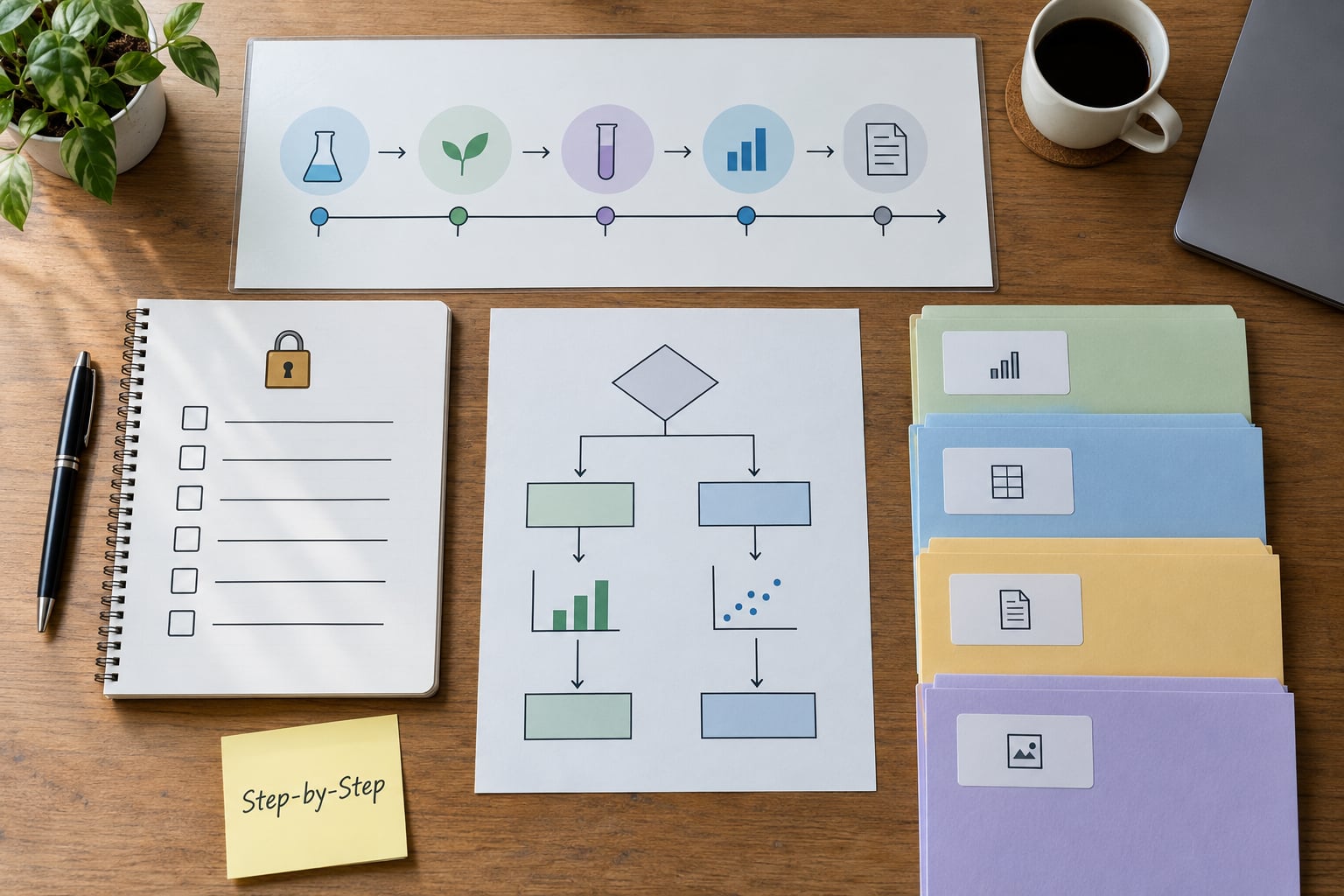
Step-by-Step
Step 1: Define the Question, Outcomes, and Decisions Before Collecting Data
Write down the specific consumer behaviour the study is about, the target sample, the primary outcome, the effect size that would matter, the test you will run, and the threshold that triggers action.
The hardest line is the decision rule. “Statistically significant at 95% confidence” is not a decision, it is an observation. A decision rule reads: if the primary outcome improves by at least 3 points with the confidence interval excluding zero, and no guardrail metric degrades by more than 1 point, we ship variant B.
Doing this first is what limits researcher degrees of freedom, which is the number of analytical choices that can be changed after seeing data. Every choice you lock here is a place you can no longer bend later.
Step 2: Preregister the Analysis and Label Exploratory Work
Preregistration is simply the plan written down and dated before results exist. It should cover hypotheses, exclusion criteria, variables, transformations, models, comparison groups, missing-data handling, and the interpretation you will apply.
Then be honest about the rest. Confirmatory tests are the ones registered in advance and allowed to make claims. Exploratory analyses are everything else: the segment cuts nobody planned, the open-ended responses coded after reading a sample, the ranking question you only add because the sponsor asked for it.
Exploration is not a sin. Hiding it inside a confirmatory claim is. A sentence in the readout such as “these subgroup patterns are hypothesis-generating and require a dedicated test” protects both the finding and the reader. One caveat from the evidence: pre-registration by itself does not reduce p-hacking or publication bias, so treat it as a commitment device rather than a guarantee.
Step 3: Set Stopping Rules and Protect the Study from Optional Peeking
Optional stopping means checking results daily and ending the test the day they clear the line. It feels like diligence. It is the single most common way a legitimate experiment produces a false positive.
Pick one of three routes. Fix the sample size and the end date in advance and do not look at outcomes until then. Or, if the calendar makes a fixed horizon impossible, use a design built for continuous monitoring, such as sequential testing or always-valid inference with confidence sequences. Or, if a stakeholder genuinely needs early answers, accept that you are running an exploratory pass and say so.
The failure mode to watch is not peeking, it is reacting. P-values move. A test that read 0.049 on day seven and 0.11 on day fourteen did not become less true, it just stopped getting lucky. Every practitioner thread on this topic describes some version of that experience.
Step 4: Run the Planned Analysis and Account for Multiple Testing
Execute the model you registered, report every planned outcome including the nulls, and correct for multiplicity when you test more than one thing.
The arithmetic explains why. Each independent look or each additional test at a 0.05 threshold carries roughly a 5% chance of a false positive. After 20 arbitrary variations on data containing no real pattern, the chance that at least one looks significant is about 64%. Nobody needs to lie for that to happen; running enough variations is enough.
| Situation | Correction | Use it when |
|---|---|---|
| A fixed handful of comparisons, any false positive is costly | Bonferroni, dividing alpha by the number of tests | Three or four pre-registered outcomes, a decision to ship |
| Same setting, slightly less conservative | Sidak, which assumes independence properly | Small numbers of planned comparisons where independence holds |
| Many outcomes, some misses are acceptable | Benjamini-Hochberg, controlling the false discovery rate | Large readouts, screener batteries, ranking questions |
| Many comparisons, dependencies between them | Benjamini-Yekutieli or a permutation test | Overlapping metrics, ratings that share questions |
Choose based on what a false positive costs. Wrongly rejecting one of two hypotheses wastes a week. Wrongly rejecting one of forty screener items costs almost nothing, so protect the small set instead of the whole list.
Step 5: Record Deviations and Report the Full Result
Keep an audit trail: unexpected data issues, changed assumptions, removed observations, manipulations that failed to land, analyses you ran that were not planned.
Consumer research has its own version of this that online A/B writing rarely covers. Panels run on incentives, so respondents satisfy instead of reading. If speeders and straight-liners get removed only from the cell that missed significance, you have manufactured a result, and the fix is a quality rule set applied uniformly, written before fieldwork.
Then report the whole picture. Effect sizes with confidence intervals, not bare p-values. Null outcomes, contradicted outcomes, inconclusive outcomes. A readout that only ever contains wins is the reporting half of p hacking, and it is the half that erodes trust fastest when someone reruns the work.
Step 6: Use an Independent Review or Reproducibility Check
Have someone who did not run the study compare the published result against the registered plan. The review is short: does the primary outcome match, do the exclusions match, was the model the one written down, was the sample size the one planned?
In an online programme, check for a sample ratio mismatch first. If the control and variant should have split traffic evenly and they did not, nothing downstream is trustworthy regardless of the headline number.
For larger claims, request the preregistration record and the analysis code. A 2018 analysis of 2,101 commercially run experiments found evidence of p-hacking in roughly 57% of them at the 90% confidence level, and the false discovery rate across the programme rose from about 33% to 42%. That is what unexamined freedom looks like at scale.
Common Mistakes
Here are the failure modes that come up most, with the fix attached to each.
- Flexible stopping. Checking a live dashboard daily and ending the test when it turns green. Fix: fix the horizon, or switch to sequential methods before launch.
- Silent exclusions. Dropping soft responders, speeders, or one awkward respondent without a pre-declared rule. Fix: write quality exclusions into the plan and apply them to every cell.
- Testing many outcomes without correction. Running twenty readouts and reporting the one that moved. Fix: correct for multiplicity, or declare the rest exploratory.
- Changing the primary measure. The brief said intent to buy, the readout says top-two-box liking, and nobody notices. Fix: name the primary outcome in the plan and leave it alone.
- Post-hoc segmentation. Cutting by age, region, or loyalty because one slice looked better. Fix: pre-declare segments, or label the cut exploratory and test it properly next time.
- Reporting exploratory work as confirmatory. The segment finding heads the deck with no caveat. Fix: one labelled sentence, and a follow-up study.
- Reporting only significant results. The programme view shows only the wins, so the record implies a hit rate nobody achieved. Fix: publish nulls internally at the same rate as wins.
Some flexibility is legitimate. Data genuinely breaks, samples genuinely fail quality screening, and a manipulation that does not land is a real finding that needs reporting. The line is not whether you changed anything. It is whether the change was decided by the data’s attractiveness or by a rule you would have applied the same way if the result had gone the other way.
A practical safeguard checklist: pre-analysis plan dated before fieldwork, primary outcome named, minimum practical effect set, stopping rule fixed, multiplicity correction decided, segments pre-declared, deviations logged, nulls reported, one independent reader, and a code or plan archive kept for twelve months.
Frequently Asked Questions
What is the difference between p-hacking and HARKing?
HARKing is Hypothesizing After Results are Known: you ran the analysis, it was not significant, and you then framed the exploratory finding as if it had been the original hypothesis. P-hacking is broader and usually happens inside the analysis itself, through optional stopping, many tests, or selective exclusions. Both share one feature: the analysis decision was driven by the result rather than by a rule fixed in advance.
Is preregistration always necessary to avoid p-hacking?
Not always, but it helps far more in some settings than others. In an online experiment where you can change the sample size, the stopping date, and the metric yourself, a short pre-analysis plan removes most of the room to manoeuvre. Evidence from the broader research literature is less encouraging: pre-registration alone has not been shown to reduce p-hacking or publication bias on its own. It works best paired with a fixed horizon, a decision rule, and someone else reading the plan.
What do I do when the experiment fails?
Run the registered analysis, report it fully, and stop. Then say it plainly: the test reached its planned sample size, the primary outcome did not clear the decision threshold, and the estimate with its confidence interval sits inside the range we considered unimportant. That readout is short, it is defensible, and it protects the programme from stacking another false positive on top of the last one. A null result is information about the idea, not a failure of the team.
Can I run unplanned analyses without it counting as p-hacking?
Yes, as long as you label them. Run the segment cut you are curious about, keep the output in a clearly marked exploratory section, and state that it generates hypotheses rather than testing them. The line is about what you claim, not about whether you looked. What breaks the discipline is promoting the exploratory finding into the headline claim, or using it to trigger a launch decision without a dedicated confirmatory test.
Can p-hacking happen in qualitative or observational consumer research?
Yes, and it is easier to miss because no p-value appears. In interviews and focus groups, analysts can pick quotes after reading, choose which sessions count, or code themes in ways that favour the sponsor’s prior. In observational work such as sales panel or purchase panels, the equivalent moves are changing the base, the time window, or the product definition after seeing the trend. The safeguards are the same in kind: decide the coding frame, the inclusion rule, and the base in writing, before reading.
Conclusion
Write the primary outcome, the analysis, the stopping rule and the decision rule down before the first response arrives, and date the file. Everything after that is bookkeeping: log deviations, report every outcome including the nulls, keep the exploratory work in its own labelled section, and let someone outside the study check the readout against the plan.
That is how you avoid p hacking in consumer experiments. The discipline is not resisting temptation after the numbers appear. It is making the decision before there are numbers to be tempted by.