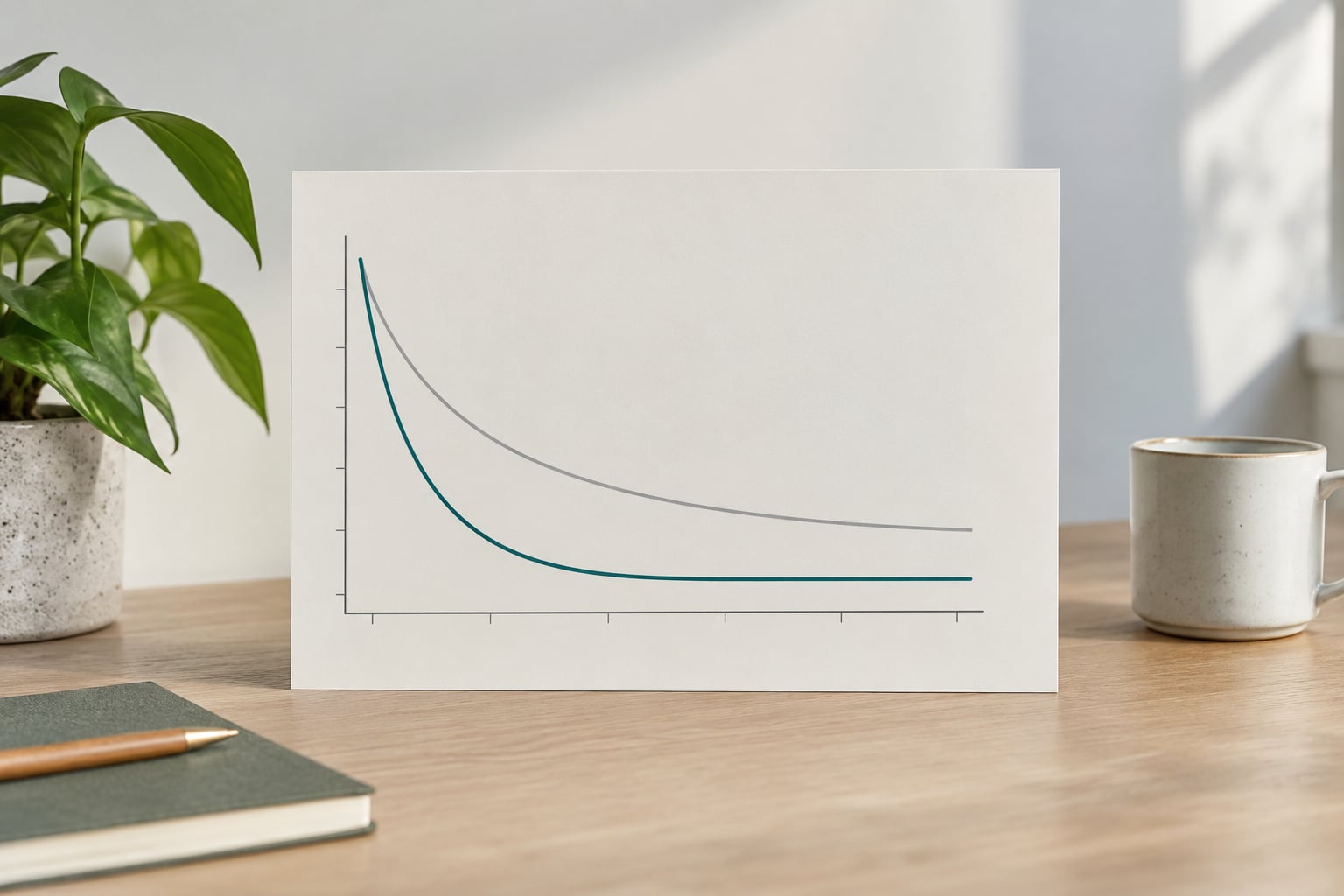
Hyperbolic discounting explains impulse buying because people value what arrives today far more than what arrives in a month, and the gap is far larger than any sensible calculation would justify. A shopper holding a 30 percent discount today weighs the pleasure of getting it now, and almost nothing for the money that will be gone in 30 days. The mechanism is measurable, it has a shape, and it can be drawn.
The useful part is not the label. It is that once you can see where on the discount curve a decision is being made, you can tell which tactics push a purchase forward, and which personal rules pull it back.
Table of Contents
- How Hyperbolic Discounting Explains Impulse Buying
- What Is Hyperbolic Discounting?
- Why Immediate Rewards Feel More Valuable
- How hyperbolic discounting turns a small discount into a trigger
- How Hyperbolic Discounting Differs From Other Discounting
- The Moment-by-Moment Process of an Impulse Purchase
- Why Hyperbolic Discounting Produces Impulse Buying
- Examples of Hyperbolic Discounting in Shopping
- The Difference Between Hyperbolic Discounting and Impulsivity
- What Encourages or Reduces Impulse Buying
- How to Apply the Concept Ethically in Marketing and Research
- Frequently Asked Questions
- Why is hyperbolic discounting a problem?
- Can you give me an example of hyperbolic discounting in real life?
- How do you overcome hyperbolic discounting?
- What mental illness causes impulsive spending?
- What are the psychological factors that contribute to shopping addiction?
- What is the difference between present bias and hyperbolic discounting?
- Conclusion
How Hyperbolic Discounting Explains Impulse Buying
Hyperbolic discounting is the tendency to prefer a smaller-sooner reward over a larger-later reward. Value collapses sharply over the first days and weeks of delay, then flattens out, so a modest gain available today outweighs a bigger gain weeks away even when the arithmetic says otherwise.
Impulse buying is the shopping case where that shape does the most damage. The reward is immediate, the cost is deferred and vague, and the two never get compared on the same scale.
What Is Hyperbolic Discounting?
Any reward that arrives later is worth less to you right now. Temporal discounting is the general habit of shrinking a future reward by how far away it sits. Hyperbolic discounting is the specific shape that shrinking takes in human behaviour: a steep fall at first, then a long flat tail.
The classic demonstration shows the shape without a single graph. Offer someone 100 today or 110 tomorrow, and most take the 100. Then offer 100 in 30 days or 110 in 31 days, and most wait for the extra 10. The extra 10 is worth exactly the same in both pairs, yet the first pair feels like an obvious decision and the second one feels obvious the other way round. That inconsistency is the curve.
Researchers write it as a discount function. In the standard form, subjective value equals reward divided by one plus beta multiplied by delay, where beta is the discount rate for that person and that reward, and delay is measured in whatever unit the study chose, often days.
Two things follow from that formula. Beta rises when a reward is small, which is the money situation: a 20 unit saving feels worth chasing, a 2,000 unit bonus does not get the same grip. And because the denominator grows with delay and then stops dominating, the value curve flattens once you are past the first few weeks.
Richardson, Steeve and Maddow (2007) formalised this as a three-parameter model that lets the discount rate vary with reward size, which is why the same person can be patient about a holiday and reckless about coffee. Ho and Morse (1999) worked out how these functions combine to model impulsive choice quantitatively, and that work is still the methods reference for the field.
Why Immediate Rewards Feel More Valuable
The present value of a future reward is the amount of today’s reward that feels equivalent. Under hyperbolic discounting, present value falls steeply, reaches a break point somewhere in the days-to-weeks range, and then changes very little for months. A reward two years out is valued almost the same as one six months out, even though the wait is four times longer.
How hyperbolic discounting turns a small discount into a trigger
Take a 300 unit item reduced to 210 for two days. The saving is 90 units, which is small in absolute terms, so most of the value of the deal lands in the immediate zone rather than the future one. The future cost of that 90 units, the things it was going to cover this month, is discounted hard enough to feel like nothing. Meanwhile the item itself can be owned within the hour. Reward present, cost distant, decision easy.
Add the uncertainty that sits on the far side of the delay. The money you will not spend is not a specific bill; it is a vague sense of flexibility that shrinks as payday approaches. Delayed regret works the same way in reverse. It does not arrive with the receipt, it arrives ten days later when the item is not working out, and by then it has no purchase value left to discount.
The loop is the problem. Buying feels good now, the correction arrives later, and the correction has already been spent. Bickel and colleagues (2016) describe delay discounting as measuring excessive preference for immediate acquisition of a reinforcer, which is exactly the bridge sentence between the mathematics and the shopping cart.
How Hyperbolic Discounting Differs From Other Discounting
Hyperbolic discounting is one observed pattern among several. Exponential discounting is the standard assumption in older economic models, and it is worth knowing how the two differ before anyone calls your shopping habits irrational.
| Delay | Hyperbolic (beta 0.05) | Exponential (beta 0.002) | No discounting |
|---|---|---|---|
| 0 days | 110 | 110 | 110 |
| 1 day | 105 | 110 | 110 |
| 7 days | 82 | 108 | 110 |
| 30 days | 59 | 104 | 110 |
| 90 days | 38 | 94 | 110 |
| 1 year | 26 | 71 | 110 |
| 5 years | 15 | 37 | 110 |
Under the hyperbolic column, value falls by roughly half inside a month and then keeps inching down. Under the exponential column, value erodes gently and never collapses. Real human choices look more like the first column, which is why economists who assumed the second column kept getting surprised by savings rates.
Present bias is the separate idea competitors tend to blur together. Discounting describes the curve. Present bias describes a preference for anything happening now over the same thing happening later, and you can have one without the other. A person with a perfectly steep curve can still be present-biased in a flat stretch, and a person with a mild curve can still grab whatever is in front of them.
Steep discounting is the phrase researchers use for the high-beta end of the range, where the smaller-sooner option wins across most of the delay range rather than just the first week. Story, Rebele and Schubert (2016) review how consistently steep rates show up across clinical populations, which is worth keeping in mind before treating a steep curve as a personal failing.
The Moment-by-Moment Process of an Impulse Purchase
One basket tells the story better than any theory. You planned to buy a pair of running shoes and a light. You open a retailer app to check the shoes, and a banner for a 48-hour event is on the home screen.
The trigger is the notification, which costs nothing and takes no intention. Attention goes to the banner rather than the shoes you came for. Then valuation happens in a hurry: the discount is read as a saving, the item feels like a limited window, and the future cost of the money has not been calculated at all because nothing on the screen asks for that calculation.
Checkout friction is the last gate. If the account is saved, the address is saved and one tap completes payment, the remaining delay between wanting and owning is close to zero. The reward arrives while the discount curve is still at its peak. Post-purchase rationalization finishes the job, usually within a day: it was a good deal, it was on the list, roughly.
Every step of that sequence happens in under four minutes, while the cost of being wrong is discovered over weeks. The mismatch in timescale is the whole mechanism.
Why Hyperbolic Discounting Produces Impulse Buying
Impulse buying needs four ingredients to happen, and discounting supplies the first one. An immediate reward has to exist, otherwise there is nothing to bring forward in time. Attention has to be available, and notifications, endless scrolling and checkout designs all deliver it without asking. The reward has to feel uncertain or finite, because scarcity and countdowns turn an open-ended want into a closing window. And there has to be some arousal, which novelty, colour and a good mood supply.
Low prices and short timeframes work on the steep part of the curve, where the discount rate is highest and a modest reward loses the least value in transit. Scarcity messages add loss aversion on top, since a claim that an offer will end makes the reward feel like it is being taken away. One-click checkout removes the pause that would otherwise let a rational evaluation happen. Buy-now-pay-later moves the cost into the flat tail, where it barely registers at the moment of purchase.
None of these levers works alone, and that is where the research becomes useful. Korlyakova (2014) applies the hyperbolic model directly to impulse buying opportunities, which matters because it turns the marketing intuition into a tested model rather than a borrowed analogy. Keren and Roelofsma (2011) go further and argue the hyperbolic shape follows from prospect theory, where gains and losses are not treated symmetrically and the certainty of an immediate outcome carries extra weight.
Examples of Hyperbolic Discounting in Shopping
A buy-one-get-one offer is the cleanest case. The saving is real, but its value is registered now, on a purchase already in progress, while the cost is the second item sitting unused in a cupboard for a year. That cost lands in the flat tail and is discounted to nearly nothing.
Add-on items exploit the same window from the other side. The main product is settled and the cart is open, so a low-value extra feels like a rounding error rather than a decision. The immediate benefit is a small upgrade feeling; the delayed cost is money that never gets logged anywhere.
Food and drink purchases compress the delay furthest. A drink at the station is consumed within minutes, which means the reward is never discounted at all. This is why hunger and thirst produce the least deliberation of any category.
Free delivery moves a cost across the curve in the other direction. The saving exists, but the buyer experiences it as removing a small irritation right now, not as 40 units set aside for something later. Threshold effects work the same way: free delivery over a certain total quietly raises the size of the basket, because the marginal cost of the next item reads as zero at the moment of decision.
Flash sales compress both ends. A countdown timer makes a months-long delay feel like hours, and the limited duration implies that waiting will cost more than it saves. The buyer is not miscalculating the price. They are miscalculating the distance.
Buy now pay later is the most direct application. The reward is owned today in full, the payment is scheduled for a date far enough ahead that the discounting has flattened almost completely, and the interest is treated as an abstraction rather than a cost.
The Difference Between Hyperbolic Discounting and Impulsivity
Hyperbolic discounting describes a decision pattern. Impulsivity describes a person-level tendency, usually measured with questionnaires or reaction-time tasks. They overlap heavily, and neither one causes the other on its own.
A shopper can have a steep discount curve and steady impulse control. Their saving and health decisions stay poor over time, but they do not fill a basket at midnight, because a rule stops them. Another shopper has a mild curve and a chronic appetite for novelty, and the curve simply shapes how quickly the appetite turns into a purchase.
It also helps to separate impulse buying from three neighbours. A planned purchase is decided in advance and executed on schedule. Emotional spending, often called retail therapy, aims at a mood change rather than the item. Habitual buying repeats without much evaluation, the same coffee order every morning. Impulse buying is the one with no prior intention and no plan, which is why the discount curve gets to run unopposed.
What Encourages or Reduces Impulse Buying
Some triggers sit in the environment and some sit in the person. It is worth knowing which is which, because the fixes are different.
Countdown timers, claims that a deal is ending, an almost-finished progress bar at checkout, saved payment details and a one-tap buy button all remove something from the interval between wanting and owning. Visibility works the same way: a product sitting in the category you browse daily is closer to purchase than one you have to search for. Mood matters too, since boredom and low-mood spending are among the most commonly reported triggers in community discussions, and they rarely involve a considered price comparison.
The personal side has rules. Each of the following targets a specific part of the mechanism rather than relying on willpower.
- Shift the reward out of the steep zone. A mandatory waiting period of a week moves the decision from the part of the curve where value collapses to the flatter part, where a rational comparison is possible. Waiting rules work because they change the timing, not the intention.
- Write a note to your future self. Before a discretionary purchase, write what you are buying it for and what it replaces. This makes the delayed benefit concrete instead of abstract, and abstract futures lose value fast.
- Remove the checkout friction. Do not save cards for retailers you buy from occasionally, leave items in the basket rather than paying immediately, and keep discretionary spending on a separate payment method. Friction is the cheapest available intervention.
- Do the arithmetic that the screen never does. A purchase that fits inside the budget line can still empty the category. Checking what the money is already committed to is the step that turns an isolated affordable item into a visible trade-off.
- Allocate the money the day it arrives. Community reports describe payday as the real trigger, with no particular purchase in mind until the balance appears. Assigning the money to a purpose before it feels spendable does more than any rule applied afterwards.
None of this requires every purchase to end in a refusal. A waiting period that ends in a purchase has still worked, because the purchase survived the part of the curve where the decision is worst.
How to Apply the Concept Ethically in Marketing and Research
For marketers and pricing teams, the same model that explains the problem describes the whole surface. The steep early segment is where countdown timers, short limited-time offers and free-delivery thresholds operate. The flat tail is where subscriptions, annual plans and loyalty programmes operate, since their benefits are not deferred by very much and their cost is. Knowing the segment a mechanic plays on makes it much harder to misapply it.
The ethical line is straightforward enough to write down. Make the trade-off visible rather than hidden, including the total cost of a buy-now-pay-later plan and the real terms of a renewal. Do not manufacture a deadline that does not exist. Avoid framing a neutral item as one that will be taken away, and separate genuine stock constraints from ones written into a banner. Build delay into high-consideration purchases if the customer would thank you later, which most of them would.
For researchers, the interesting questions sit in the follow-up rather than the conversion. What share of impulse purchases is returned, and how quickly? Does a discount-driven first purchase predict repeat purchase at all? Do customers who are given a cooling-off period report higher satisfaction six months later? What does regret look like at day 30, and does anything in the experience reduce it? Measuring only the first purchase rewards exactly the behaviour this article is about, and the long-run measures are the ones that tell you whether the mechanic helped.
A note on overclaiming, since this area attracts it. Discounting is a well-supported description of how choices look, not a complete account of why. You do not need a story about brain rewiring or dopamine to explain the effect, and a steep discount rate is not by itself evidence of any condition.
The clinical question deserves a careful answer rather than a confident one. Steep delay discounting shows up in ADHD, bipolar disorder, substance use disorders and compulsive buying disorder, so it is a transdiagnostic pattern rather than a diagnosis. It is common enough in people with none of those that it cannot be read as a symptom. If spending is persistent, causes distress, and keeps happening after you have tried to stop, that is a reason to speak to a qualified clinician, not a conclusion to draw from a discount rate.
Frequently Asked Questions
Why is hyperbolic discounting a problem?
Because the curve falls steeply in the first days and weeks, future rewards lose most of their subjective value long before the wait is over. That produces present bias and self-control failure across spending, saving and health decisions at once. Because the pattern repeats daily, small losses compound into large ones that no single purchase would have caused on its own.
Can you give me an example of hyperbolic discounting in real life?
Offer someone 100 today or 110 tomorrow and most take the 100. Then offer 100 in 30 days or 110 in 31 days, and most wait for the extra 10. The extra 10 is identical in both pairs, so the only thing that changed is proximity. That inconsistency between the two choices is the clearest demonstration of the hyperbolic shape without a graph.
How do you overcome hyperbolic discounting?
Attack the timing rather than the intention. Put a mandatory waiting period on discretionary purchases so the decision moves out of the steep segment of the curve. Make the future benefit concrete by writing a note to your future self, add friction by removing saved payment details, and check what the money is already committed to before treating an item as affordable. Waiting periods work even when the eventual answer is yes.
What mental illness causes impulsive spending?
No single illness causes it. A steep delay-discounting rate appears across ADHD, bipolar disorder, substance use disorders and compulsive buying disorder, which makes it a transdiagnostic pattern rather than a diagnosis. It is also common in people with no condition at all, so a discount rate never identifies a disorder by itself. Persistent spending that causes distress is worth raising with a qualified clinician.
What are the psychological factors that contribute to shopping addiction?
Steep delay discounting is one, but not the only one. Emotional relief spending, scarcity and loss framing, low self-esteem, easy credit, and reward-linked habits all feed the cycle, as do guilt followed by compensatory buying. Research treats compulsive buying disorder as a recognised condition with clinical criteria, and a shopping habit that runs in circles for months is worth a professional assessment rather than a self-diagnosis.
What is the difference between present bias and hyperbolic discounting?
Present bias is a preference for whatever happens now over the same thing happening later. Hyperbolic discounting is a claim about the shape of the curve that describes how much value a reward loses as it moves away in time, falling sharply and then flattening. The two often get used as if they were synonyms, but one is a direction of preference and the other is a function. You can have a steep curve without being present-biased in a given moment.
Conclusion
Hyperbolic discounting explains impulse buying because it makes the present look larger than it is and the future look smaller than it will turn out to be. The reward arrives now, the cost arrives in weeks, and the two are never weighed against each other.
So do three things. Name the immediate reward you are actually after, put a pause between wanting and paying, and check the purchase against the larger delayed goal it quietly weakens. Updated for 2026, and the curve itself has not changed since anyone first drew it.