Understanding how nudges change behavior at the point of sale comes down to altering how a choice is presented at the exact moment a shopper is most ready to act: what sits at eye level, which option the till screen highlights, which bundle is framed as the standard. That moment pairs unusually high intent with unusually low attention, so a small change in presentation moves what ends up in the basket without removing or restricting any option. The mechanism is easy to describe and messier to measure, so this guide covers the chain, the tactics that work, how to test one, and where a nudge stops being helpful.
Table of Contents
- What Is a Point-of-Sale Nudge?
- What are the three types of nudges?
- Where a nudge stops being a nudge
- How Do Nudges Change Behavior at the Point of Sale?
- How nudges change behavior at the point of sale, step by step
- Why the till beats every other moment in the store
- The Most Effective Point-of-Sale Nudge Types
- How to Choose a Nudge for a Retail Goal
- How to Test Whether a Nudge Works
- Examples of Ethical and Unethical Nudges
- Frequently Asked Questions
- What is the difference between a nudge and manipulation at the point of sale?
- Are point-of-sale nudges ethical?
- What is the most effective nudge for increasing basket size?
- How can a retailer test whether a nudge changes behavior?
- Do checkout defaults and preselected options count as nudges?
- Conclusion: Start With the Customer’s Decision Environment
What Is a Point-of-Sale Nudge?
A point-of-sale nudge is any change to the way a purchase option is presented in a shop or at the checkout that shifts what people choose while keeping their actual options open. The clearest examples are physical: a product moved to eye height, a third option added to make a second look better, a till screen that opens on the larger meal, a queue sign that tells you what is slow today.
The idea comes from Richard Thaler and Cass Sunstein’s Nudge (2008), which named the surrounding system the choice architecture and proposed the idea of libertarian paternalism: you may help a person make a choice they will thank you for later, as long as you never remove the right to choose otherwise. Thaler used a plain image for it, the GPS that lets you type in the destination but does not oblige you to follow the route. It also asks for nothing in return, which is the whole test.
Three things distinguish a nudge from the tactics it is often confused with. Persuasion argues a case, using information, argument or emotion to win agreement. Discounting changes the price. Coercion removes the choice altogether by making one option unaffordable, illegal or impossible. A nudge sits between information and coercion, and its only lever is the shape of the choice set.
What are the three types of nudges?
The most common academic split separates economic nudges, which change the costs or benefits attached to a choice, from dynamic nudges, which change when or how long a choice is available, and environmental nudges, which change where a choice sits in physical space. That taxonomy is the one used here, and it maps cleanly onto a shop floor: economics covers defaults, bundles and tier pricing, dynamics covers limited-time messaging and queue timing, and environment covers placement, signage and layout. Retail teams often group the same tactics by bias instead, by things like anchoring or the decoy effect, which is less tidy but easier to brief a supplier on.
Where a nudge stops being a nudge
The line is disclosure. If a shopper can see what you did, understand why it changed their choice, and decline it without losing anything, it is a nudge. If the design only works because nobody noticed it, it is a dark pattern. That single test is the subject of its own section below, because it is where most practitioner arguments in the field actually happen.
How Do Nudges Change Behavior at the Point of Sale?
Answering how nudges change behavior at the point of sale means describing a short chain rather than a single trick. A nudge works by borrowing a habit the shopper already has. People resolve routine choices quickly and reserve careful thought for decisions they expect to be difficult. At the counter, the basket is already full, the queue is moving, and the shopper has not yet begun to think about the next thing. That is the window a nudge aims at.
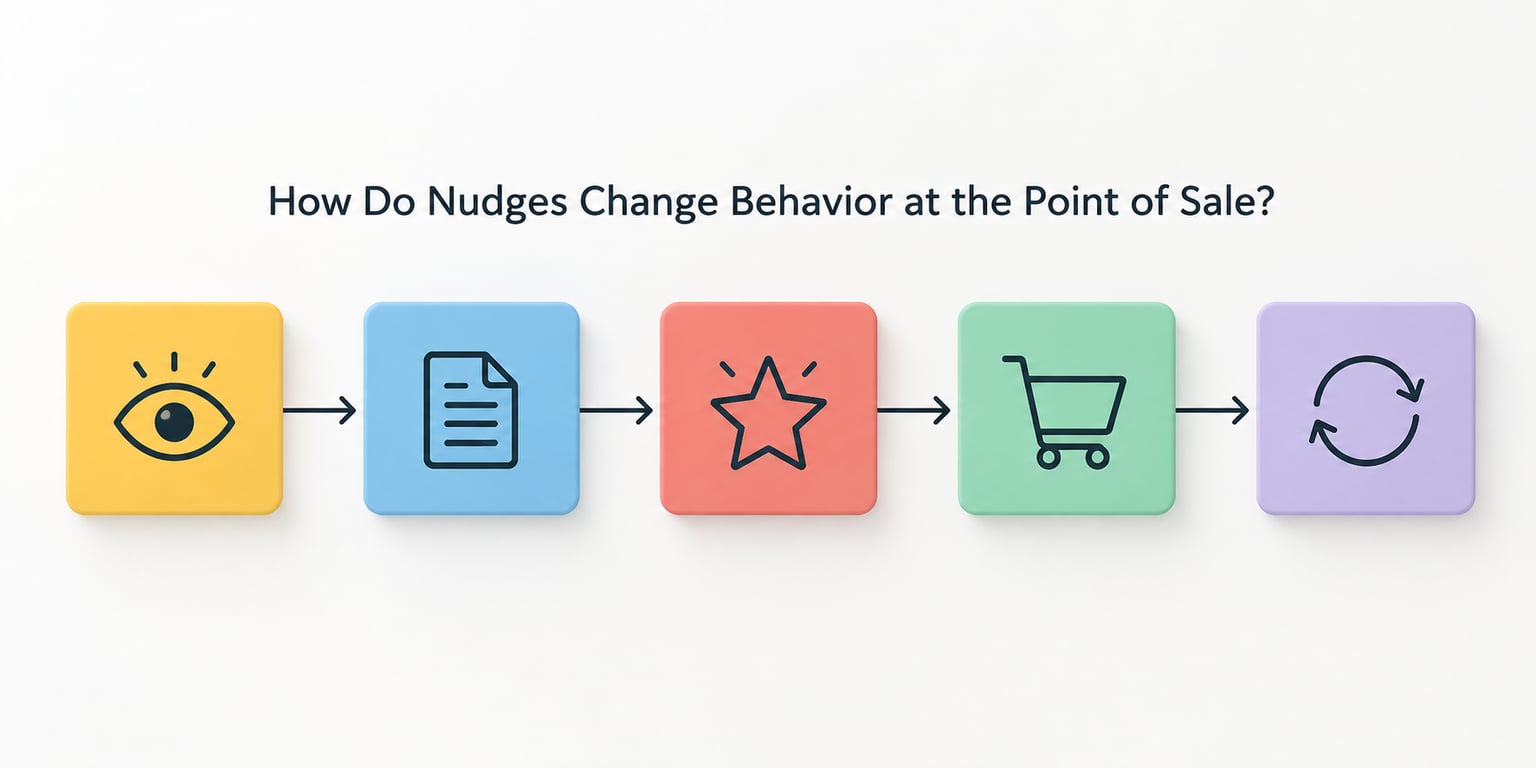
- Attention. The shopper notices something. Eye level, endcap facing, the screen at the till, a sign at head height in the queue. Whatever is not noticed cannot influence anything.
- Framing. The noticed item is interpreted through a frame: per unit rather than per pack, a saving rather than a cost, a limited-time offer rather than a normal price.
- Salience and default. One option is made easier to accept than the rest, either by being highlighted, preselected, or simply being where the eye already is.
- Choice. The shopper takes the path of least resistance, which is not the same as the path they would have taken deliberately.
- Repeat behaviour. The next visit starts from a different expectation, which is where habit forms and where a nudge either compounds quietly or gets noticed.
How nudges change behavior at the point of sale, step by step
Steps one to three happen before any decision is made and take seconds. Steps four and five are where the commercial result shows up, and where the ethical questions live, because a nudge that reliably changes behavior will reliably change behavior you did not intend to change as well.
Why the till beats every other moment in the store
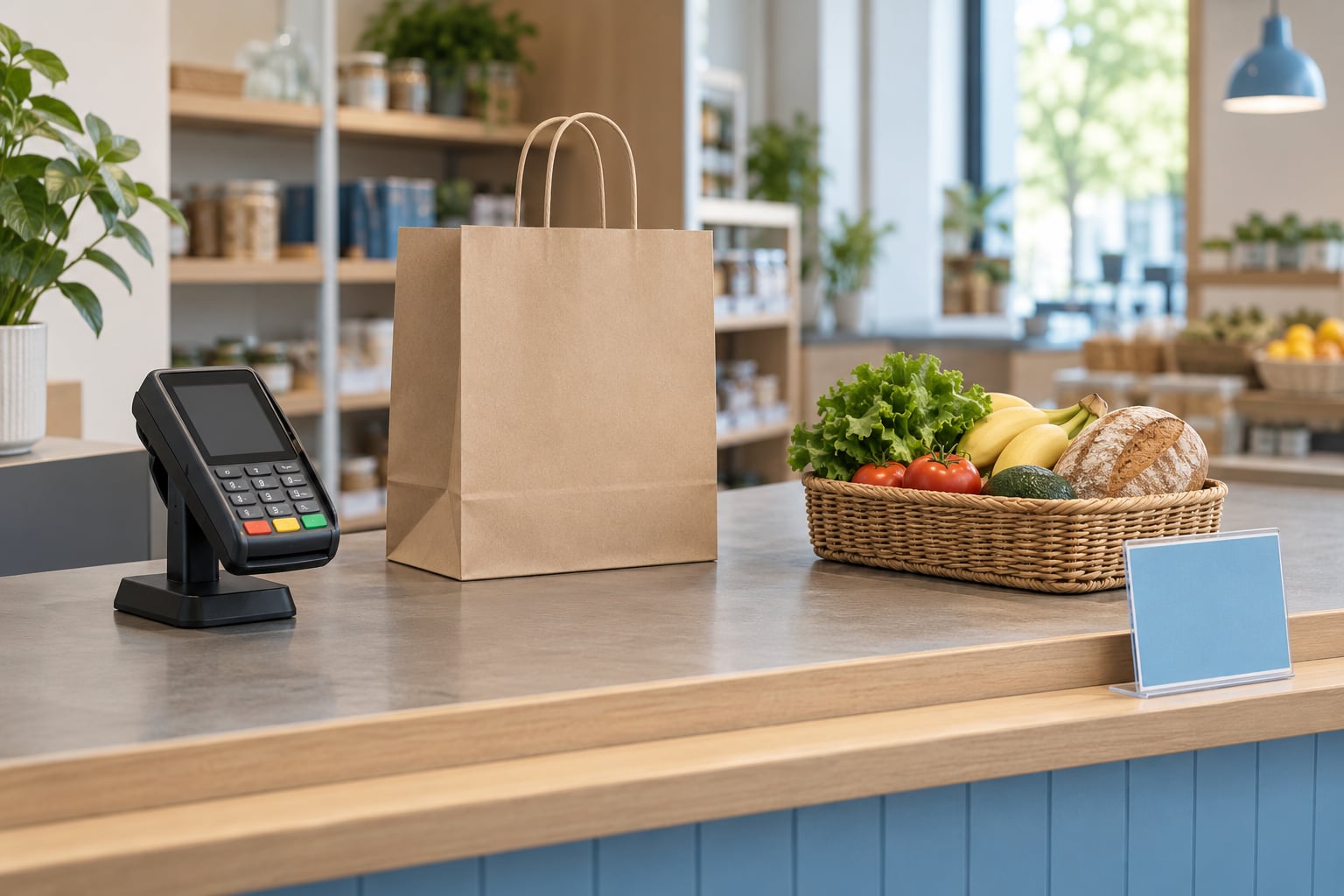
Four things stack up at the transaction moment. Intent is at its peak, because the shopper has already decided to buy. Attention is at its lowest, because there is a queue, a card terminal and a bag to pack. The choice is socially visible, with staff and other customers watching, which quietly adds authority. And there is no second visit, so the cost of saying no is immediate and obvious. It is also why how nudges change behavior at the point of sale tends to be so pronounced here rather than elsewhere in the shop.
Anywhere else in the store, at least one of those is missing. At the shelf, intent is low and the shopper is not being watched. In the queue, intent is high but attention is on time. The till is where all four line up, which is why it does more work per unit of effort than almost any other surface a retailer owns.
The Most Effective Point-of-Sale Nudge Types
The tactics below are listed by mechanism rather than by channel, because the same bias shows up in a physical store, on a website and on a menu. Retail practitioners who test in stores tend to find that nudges work at category level, shifting how a shopper thinks about a whole group of products, far more reliably than they work on a single item.
| Tactic | Behavioral mechanism | Best use | Ethical caution |
|---|---|---|---|
| Eye-level and endcap placement | Salience: attention goes to what is at eye height and at the end of an aisle | New lines, seasonal ranges, products worth being seen | Promoting items you would not stock if shoppers knew the margin |
| Default option at the till | Status quo bias: the path of least resistance gets taken | A standard meal size, reusable bag, standard delivery | A default the shopper would not have chosen, or a hidden preselected add-on |
| A third, asymmetric option | Decoy effect: a dominated option makes a neighbouring option look better | Plan tiers, service levels, upgrade framing | A decoy that exists only to make a poor deal look reasonable |
| Bundle and multi-buy framing | Anchoring and mental accounting: the pair is judged against the parts | Coffee and pastry, multipacks, wine with a cheese board | A bundle cheaper per item that still costs more in total |
| Cross-sell at the moment of relevance | Timing: intent is highest the instant the main item is chosen | Sauce with the meal, filters with the vacuum, cards with the printer | Staff scripts that push an item on a customer who did not ask |
| True scarcity and limited-time framing | Loss aversion: losing an option stings more than gaining one feels good | Real limited runs, end-of-day stock, seasonal lines | Invented counts and restarting countdowns, the fastest way to lose trust |
| Social proof and authority cues | Herding: what other people chose feels safer | Best-seller tags, staff picks, verified review counts | Inflated or stale counts, which shoppers now check on their own phones |
| Friction removal | Every step deleted is attention kept | Contactless payment, one-tap receipts, clearer queue signage | Removing a step that later protects the customer, such as a confirmation |
Not every row is equally easy to justify. Scarcity and social proof carry the highest short-term lift and the highest reputational cost when they are overstated, because those are the two cues shoppers are most likely to check for themselves. Placement and friction removal are quieter and rarely embarrass anybody.
How to Choose a Nudge for a Retail Goal
Start from the goal, not from the tactic. Retailers lose weeks proposing clever shelf arrangements before agreeing on what the arrangement is supposed to move. A workable decision runs in four steps: name the outcome you want, locate the moment where the shopper actually makes that decision, pick the mechanism that fits that moment, and run the ethical check before anything gets built.
For basket size, the strongest options are the ones that remove work rather than add persuasion: pair two products that are used together, or place the add-on where the main item has already been chosen. For abandoned baskets in physical retail, the equivalent is a queue problem, not an offer problem, so signage and till speed usually beat a discount. Promoting a relevant product works when relevance is real and specific, and falls flat the moment it is vague.
Encouraging repeat purchase is the hardest of the five, because a single visit rarely contains the information a shopper needs. Defaults and loyalty enrolment help mostly when they are transparent, since a scheme a shopper chose deliberately is one they are more likely to keep. Supporting customer well-being is the case where a nudge is most defensible, because supermarkets that swap sweets at the impulse zone for fruit, nuts or a drink are working in the direction the shopper would choose if they had thought about it.
David Halpern’s team built a simple framework from their work inside the UK’s nudge unit, and it is worth borrowing: make the choice easy, attractive, social and timely. Run a proposed nudge against those four words before you run it against customers. If a tactic is timely but not easy, it usually fails on effort, and no amount of messaging fixes that.
It also helps to place tactics on a spectrum. A nudge is a suggestion. A push is a rule or a fee, such as a charge for a bag that was previously free. A shove is an outright ban, such as removing a product from the shelf entirely. Only the left end of that spectrum is nudge territory, and the further right you go, the more legal attention you invite.
How to Test Whether a Nudge Works
Hold something out. Pick a set of comparable stores or registers, keep them on the current layout, and apply the nudge only in the test group. Then compare like-for-like periods and strip out footfall, seasonality, stock mix and local events before you claim a result. Teams that skip this step routinely credit a nudge for a change that was already going to happen, and practitioner forums describe that confusion as one of their most persistent frustrations.
Watch more than sales. Conversion, average basket value and attach rate tell you whether the tactic moved a number. Returns, complaints, loyalty churn and repeat purchase tell you whether it moved something you will regret. A nudge that lifts margin in week one and lifts complaints in month three has not succeeded, however good the first chart looks.
It is also fair to be sceptical about the evidence, because the field has had a rough decade. A 2021 meta-analysis in PNAS pooled 212 behavioural studies and reported an average effect size of 0.43, a moderate figure that was widely read as vindication. A 2022 correction paper re-analysed that literature and found effects close to zero once publication bias was accounted for, and much of the wider priming literature has since failed to replicate in laboratory settings. The honest reading is not that nudges do not work, it is that the average published effect is smaller than the early headlines implied, results vary sharply by context, and some well-known studies did not survive scrutiny.
That leaves a practical rule. Rather than asking whether an effect is statistically significant, ask whether you are better off running the nudge than not, given that it is cheap, reversible and testable. A nudge that is genuinely small, cheap, high-frequency and reversible often clears that bar even at a modest lift, which is the attitude most practitioners apply anyway. The KFC Australia work is a good example of scale rather than magnitude: a line capping side orders at four per person, tested as one proposition among nine, reportedly lifted chip sales 56% in a single South Australian district.
Two practical warnings from the practitioner side. Nudge fatigue is real: once a shopper recognises the tactic, it stops working and can start working against you, so the same scarcity message repeated every week decays. And backfire is possible, particularly with health-adjacent prompts that read as a lecture to people who feel judged by them. If a nudge produces measurable annoyance, it is not a cheap tactic any more.
One last point on scale. The sharpest critique in the field is that nudges are informed tactics, not behaviour change programmes. A shelf adjustment can shift a purchase; it will not change a habit that runs on belief, social context or infrastructure. Anglian Water’s Keep It Clear campaign is the usual counter-example, pairing prompts with a genuine service outcome and measuring blocked-drain reductions within weeks, which is a different kind of intervention from a sign above a basket.
Examples of Ethical and Unethical Nudges
The scenarios below use the same retail situation twice. In each pair, the mechanism is identical and only the honesty changes, which is the practical proof that ethics is not about which biases you use but about whether what you say is true.
| Situation | Transparent version | Manipulative version |
|---|---|---|
| Subscription offer at the till | Clearly labelled, easy to cancel, a reminder before the first charge | Preselected, cancellation buried, trial that converts silently |
| Limited-time message | A real end date and a real quantity, same price for everyone | A countdown that restarts every time the page reloads |
| Bestseller tag on a shelf | Based on genuine recent sales and dated on the tag | Inflated, never updated, applied to a slow-moving line |
| Message while shoppers queue | Practical guidance on wait times and what is in stock | Urgency that manufactures anxiety about missing a last item |
| Product swap at the counter | A relevant alternative offered with the original still available | The cheaper option quietly removed to force a trade up |
| Loyalty enrolment | Opt-in, clear value, one tap to leave | A ticked box that quietly adds a card fee |
Regulators have now written this line into law rather than leaving it to taste. The EU Digital Services Act prohibits certain interface patterns outright, including ones based on false scarcity and on pressuring users into decisions they would not otherwise make. The US Federal Trade Commission has pursued businesses over fake review counts and hidden subscription flows. In the UK, the Digital Markets, Competition and Consumers Act adds enforcement powers aimed at exactly this kind of interface design, on top of an existing unfair commercial practices regime.
Shoppers notice, and they respond. Practitioner and shopper forums describe the reaction to a repeated fake countdown as annoyance followed by distrust, and distrust at that level does not cost you one basket, it costs you the store. That is the practical argument for the ethical version, and it holds even for a team that does not care about being a good actor.
Two cultural notes worth keeping. The endowment effect, where an object feels more valuable once it is yours, is not hardwired: Henrich’s work on market-integrating societies suggests it is partly learned and varies across cultures, so a nudge tested in one market should not be assumed to travel. And the most-used cues in a physical store are the ones that change the environment rather than the message, which is both the cheapest and the most durable way to work with this effect.
Frequently Asked Questions
What is the difference between a nudge and manipulation at the point of sale?
A nudge changes how a choice is presented while leaving every option available and understandable. Manipulation goes further: it hides information, invents urgency, or makes the easy path the only workable one. The test is disclosure. If a customer can see what you did, understand why it changed your choice, and decline it at no cost, it is a nudge. If the design works only because nobody noticed, it is a dark pattern.
Are point-of-sale nudges ethical?
Usually, when the shopper keeps a real choice and would be accepted as refusing. Thaler and Sunstein called this libertarian paternalism: you may help someone make a decision they will thank you for later without removing the option to go their own way. Ethics turns on three things, whether the information is true, whether the influence is disclosed, and whether the result serves the customer. Break any one of the three and you have crossed into a dark pattern.
What is the most effective nudge for increasing basket size?
No single tactic wins everywhere, but friction-based nudges beat persuasive ones. Moving an add-on to the moment the shopper is already at the till, framing two items used together as a pair, and removing a step from the queue all outperform louder messaging. In practice, small, cheap, high-frequency nudges beat large campaigns, and they tend to work at category level rather than on a single product or a single visit.
How can a retailer test whether a nudge changes behavior?
Run a holdout. Keep a set of comparable stores or registers on the current layout, apply the nudge only in the test group, and compare like-for-like periods. Watch attach rate, average basket value, conversion and returns, and remove footfall, seasonality and stock mix before you claim a win. If no holdout is possible, alternate by week and describe the result as directional rather than proven.
Do checkout defaults and preselected options count as nudges?
Yes, and they are among the strongest, because doing nothing becomes a decision. A preselected gift wrap, a loyalty opt-in already ticked, or a till screen that opens on the larger meal all steer choice without adding pressure. The check is whether the default is the option most customers would have chosen anyway, and whether removing the tick is exactly as easy as leaving it.
Conclusion: Start With the Customer’s Decision Environment
Pick the one decision your customer makes most often in your store, walk the path that decision takes them along, and delete the first piece of unnecessary friction you find. That single move is usually the clearest answer to how nudges change behavior at the point of sale, because it works with the choice the shopper was already making rather than pushing a new one. Most stores already hold a nudge that outperforms anything in a campaign budget. Add one transparent change on top, hold some stores out, and measure the commercial number and the customer number together.