Friction is usually treated as a defect. A checkout that takes six clicks, an approval that needs four signatures, a form that asks for your date of birth to check a box. Used on purpose, the same idea becomes a decision tool: how friction can be used to improve decisions is really a question of where you place cost so that people slow down exactly where slowing down pays.
The short version: add effort when a choice is hard to reverse, easy to regret and easy to make by reflex. Remove effort everywhere else.
One thing to clear up before we go further, because the word gets stretched. Designed friction is effort you add on purpose to protect a decision. Motivational friction is the dull weight, guilt and avoidance you feel when starting something difficult. They are opposites wearing the same name. A lot of people searching this topic are asking about the second one, and the honest answer is that a pause and a checklist will not fix dread. That needs a smaller task.
Table of Contents
- What Decision Friction Actually Is
- Useful and Harmful Friction at a Glance
- How Friction Changes Decision Quality
- How Friction Can Be Used to Improve Decisions
- Five Forms of Useful Friction You Can Add
- A deliberate pause before an irreversible action
- A default set to the safer option
- A check that makes consequence visible
- A cooling-off period
- A second pair of eyes, or a pre-mortem
- Where Decision Friction Works Best
- How to Test Whether Friction Improves Decisions
- Common Ways Useful Friction Backfires
- A Decision-Friction Audit Checklist
- Frequently Asked Questions
- What is useful friction in decision-making?
- Is adding friction always better for decision quality?
- How can a business measure whether friction improves decisions?
- What is the difference between useful friction and a dark pattern?
- When should a cooling-off period or confirmation step be used?
- Conclusion
What Decision Friction Actually Is
In decision-making, friction is anything standing between an intention and the action: extra steps, extra seconds, extra information, extra people, or a small interruption that makes the automatic response harder to complete.
Behavioural scientists usually split thinking into a fast, automatic mode and a slow, deliberative one, in the shorthand popularized by Daniel Kahneman. Fast thinking handles most of what you do in a day, and it is fast precisely because it skips the checking. Slower thinking takes longer and costs attention, which is exactly why people avoid it when a decision is available right now.
So friction is not the tax itself. It is the interval friction buys. Most of the time that interval is wasted effort. Occasionally it is the difference between a choice you can undo and one you cannot.
Richard Thaler and Cass Sunstein made the related case in Nudge that choice architecture shapes behaviour without instruction, and later coined sludge for friction that exists only to serve the system putting it there. A confirmation dialog that exists to prevent a mistaken charge is friction. One that exists to make a cancellation hard to find is sludge. They look identical from the inside. The difference is who it serves.
Useful and Harmful Friction at a Glance
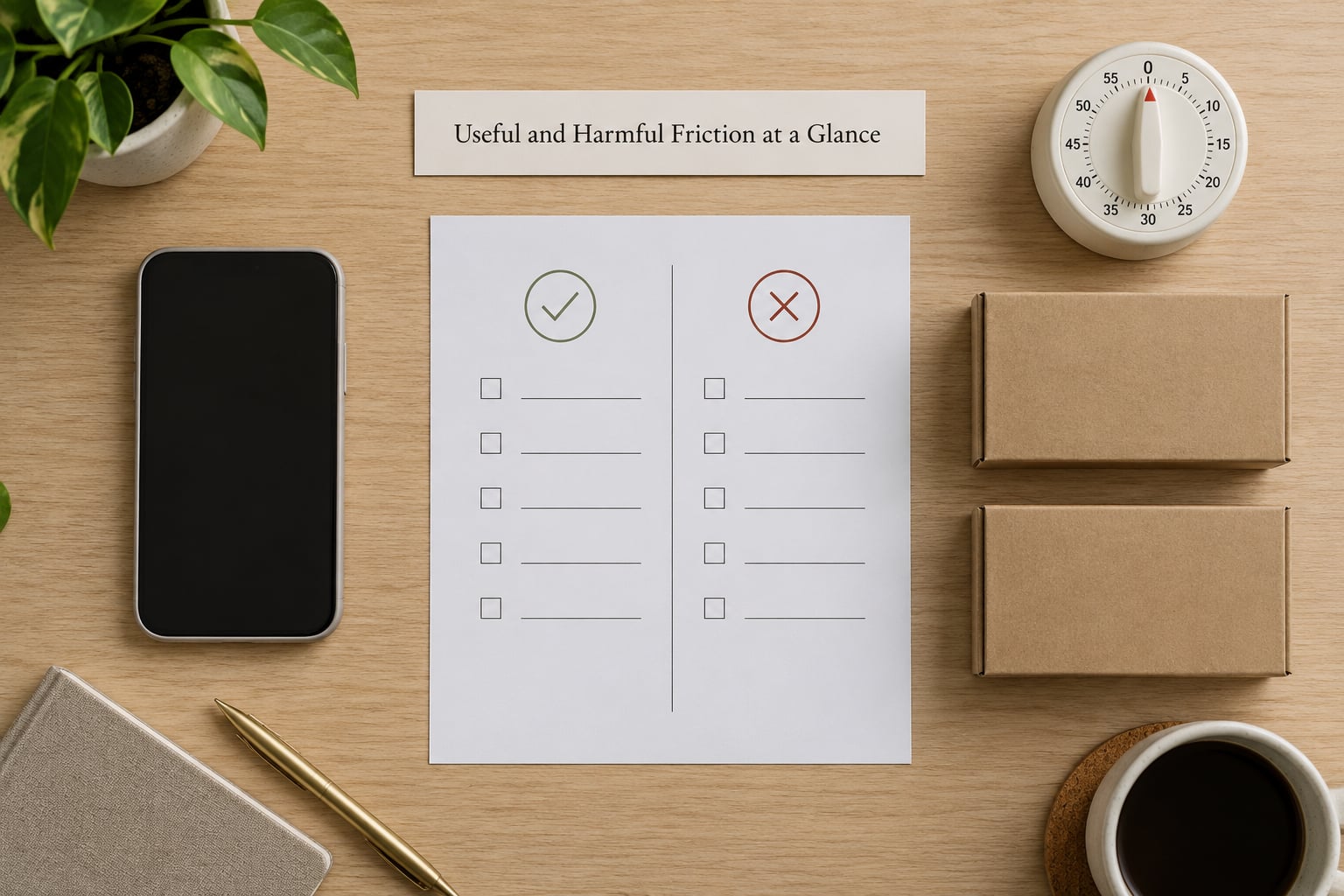
The table below sorts a decision three ways. Notice that only the middle column earns its cost.
| Type | Purpose | Typical intervention | Likely effect | Risk |
|---|---|---|---|---|
| Low friction | Remove the tax from something routine and reversible | Fewer fields, saved defaults, one-click repeat | Faster completion, less abandonment | Impulse buys slip through unchecked |
| Useful friction | Protect a choice that is costly to reverse | Confirmation step, second reviewer, pre-mortem, waiting period | Fewer reversals, fewer errors, higher confidence | Slow for people who already knew |
| Harmful friction | Extract effort with no matching value | Hidden cancellation paths, forced phone calls, vague warnings | Frustration, workarounds, abandonment | Damage to trust and to decisions |
How Friction Changes Decision Quality
Useful friction works by widening the gap between impulse and action. That gap can be built five ways.
Delay. Time is the simplest lever. A purchase sitting in a cart overnight is a purchase reconsidered in daylight, and most overnight carts do not survive to morning.
Effort. Requiring a person to do something small, such as typing the word reason before an irreversible change, turns a reflex into an act. Effort is only useful when it is proportionate; a large one just teaches people to find a shortcut.
Information. Showing the annual cost instead of the monthly one, or the total time a commitment will take, changes the frame without changing the facts. Kahneman and Amos Tversky’s prospect theory explains why: people judge losses at roughly twice the weight of equivalent gains, so a clear view of what is at stake shifts behaviour.
Social input. A second reviewer or a pre-mortem moves the decision out of one person’s head. In Thinking, Fast and Slow, Kahneman reports that even merely imagining a meeting in which your plan is challenged raises the quality of a forecast.
Commitment. An if-then plan decided in a calm moment, or a limit set before the impulse arrives, holds later when the hot-cold gap makes you a stranger to your own intentions.
Reflection and manipulation run on the same hardware. The difference is direction. Friction that gets people to stop and reconsider what they already wanted is helpful. Friction that makes stopping painful so they comply faster is sludge. The test is whether you would still endorse the choice if you knew the obstacle was deliberate.
Knowing how friction can be used to improve decisions means picking the lever that matches the bias, not the one that is easiest to build. A delay does nothing for anchoring, and a second reviewer does nothing for a decision that was never ambiguous.
How Friction Can Be Used to Improve Decisions
Here is the sequence I use, and it works the same on a checkout flow, a hiring process or a personal finance decision.
- Name the decision. Write it as one concrete sentence with a date on it, such as whether to accept the offer. Vague decisions get vague friction.
- Find the failure mode. Ask which bias is doing the work here: sunk cost on something already paid for, anchoring on a first number, present bias against a delayed benefit, or status quo inertia. Friction aimed at the wrong bias does nothing.
- Pick the lightest intervention that fits. A written one-liner costs nothing and works on a decision worth a few hundred dollars. Save the second reviewer for the ones with real consequences.
- Test it on a small slice. Run it on the next five cases, or on one quarter of users if you own the process. Watch what happens, not what you hoped.
- Remove anything that only adds cost. After a set period, keep the steps that changed an outcome and cut the rest. Friction that never fires is decoration.
Stop adding friction at the point where completion falls and no error rate improves. That is the signal you have moved past protection into sludge.
Five Forms of Useful Friction You Can Add
A deliberate pause before an irreversible action
Use a pause when the action cannot be undone and the feeling is strong. Implementation: a short wait, a required phrase, or a screen that states the consequence plainly rather than shouting about it.
Benefit: it hands the decision back to slower thinking at the exact moment fast thinking is loudest. Limitation: a pause only works if the wait is long enough to matter, and long enough to matter feels slow to the person waiting.
Example: an employer that pauses a resignation notice for 48 hours, with the reason in writing, sees fewer exits that both sides regret.
A default set to the safer option
Use a default when one option is clearly better for most people and switching is genuinely worth the effort. Implementation: set the protective option as the resting state and make changing it a visible, labelled action rather than a hidden one.
Benefit: it removes effort for the majority without removing choice, which is the part of nudge theory that holds up under scrutiny. Limitation: defaults are read as endorsements, so a default that protects the organisation rather than the person will be felt as pressure.
Example: retirement contributions set to a percentage that covers a realistic retirement, with a single screen to change it.
A check that makes consequence visible
Use a check when the cost of the option is spread over time and therefore invisible at the moment of choice. Implementation: convert the price into hours of work, the term into months, or the fee into the total charged over the full period.
Benefit: nothing changes about the decision except the frame, which is why people rarely resent it. Limitation: it works on people who are paying attention, and it can look like an attack if the arithmetic is selective.
Example: showing the total interest on a finance agreement next to the monthly figure, using the actual terms rather than the advertised rate.
A cooling-off period
Use a cooling-off period for purchases, contracts and public commitments. Implementation: a fixed window, typically 24 to 72 hours, that must expire before the action can complete, with a stated cancellation route that is as easy as the purchase.
Benefit: it converts a decision made under arousal or scarcity into one made the next morning. Limitation: it delays revenue and it lets a determined buyer route around the wait, so measure whether reversals actually fall rather than assuming they will.
Example: a subscription that offers the first month as a trial and puts the cancellation button on the same screen as the sign-up confirmation.
A second pair of eyes, or a pre-mortem
Use a second reviewer when the outcome is shared with people who were not in the room when it was decided. Implementation: a second named reviewer for anything above a threshold, or a 15-minute pre-mortem where the group assumes the plan failed and lists why.
Benefit: it surfaces disconfirming evidence while it is still cheap, which is the only time it is cheap. Limitation: reviewers who are not accountable rubber-stamp quickly, and pre-mortems can turn into a ritual that nobody takes seriously after the third run.
Example: an approval threshold where any spend over a set amount needs a second signature and a one-line reason for the exception.
Where Decision Friction Works Best
The variable that decides this is usually not importance, it is irreversibility. A large decision that can be unwound in a week needs less friction than a small one that quietly locks you in for years.
| Decision | Stakes | Reversible? | Suggested friction | What to watch |
|---|---|---|---|---|
| Everyday, repeated | Low | Yes | Almost none; compress it | Completion time |
| Purchase above a set amount | Medium | Mostly | Cooling-off period, total cost shown | Reversal and return rate |
| Subscription or contract | Medium | Awkward | Shorter initial term, cancellation in the same flow | Cancellations in month one |
| Money, investment or debt commitment | High | No | Written rationale, 72-hour wait, second reader | Reversals, regret reports |
| Leaving a job or a relationship | High | No | Written reasons, pre-mortem, delayed notice | Reconsideration requests |
| Hiring, promotion, firing | High | Hard | Structured scorecard, second reviewer, escalation threshold | Outcome spread across groups |
| Research participation | Varies | Varies | Consent step restating the purpose, opt-in rather than opt-out | Comprehension, drop-off |
| Moral or ethical choice | High | No | Written justification naming who is affected | Consistency with stated values |
Frequency matters as much as stakes. A choice you face daily should cost seconds; a choice you face once a year should cost minutes. The clearest demonstration of the cost side is a recent Behavioural Insights Team study that put 3,793 US and UK adults through four versions of an AI interface. In the condition that made people reflect before answering, choices on moral dilemmas improved, but task completion fell from 94% to 65%. Friction bought quality with throughput. Decide consciously which of those you are willing to pay for.
That same finding cuts the other way too. Reflection helped on moral dilemmas and did less well where anchoring was in play, because pausing does not remove a reference point that is already sitting on the screen.
How to Test Whether Friction Improves Decisions
Any deliberate friction deserves the same scrutiny as any deliberate speed-up. Here is a plan that takes about a fortnight.
1. Record the baseline. For two weeks, log the decision and its outcome before you change anything. Reversals, complaints, refunds, second requests, escalations. Without a baseline you cannot claim improvement later.
2. Pick one success measure. Choose one primary outcome and two guardrails. Primary is usually the error rate you expect to fall. Guardrails are completion rate and support contacts.
3. Compare like with like. Split traffic if you can, or alternate days if you cannot, so seasonality does not masquerade as an effect. Keep the change small enough that both groups experience the same underlying demand.
4. Check the uncomfortable measures too. Confidence after deciding, whether people would make the same choice again, whether abandonment moved rather than fell, and whether the people who dropped out were disproportionately the ones the friction was meant to help.
Optimize for completion and you will discover that fewer people do anything, which reads as a win in a dashboard. Decision quality is what you are buying; make that the thing you count.
Common Ways Useful Friction Backfires
Too much of it. A four-step confirmation for a low-risk action trains people to click through all four without reading. Correction: scale friction to stakes and cut it back when accuracy does not improve.
Warnings that say nothing. Generic all-caps banners train people to ignore text near the button. Correction: state the specific consequence and the number.
Fields nobody uses. Asking for information you never read is pure tax. Correction: delete the field, or say what it will be used for.
Confusing defaults. If the resting option is hard to describe in one sentence, it will be misread. Correction: name the default explicitly, for example the option that keeps the existing arrangement.
Implementation that excludes people. A confirmation that requires a mouse, a phone call during business hours, or reading speed that assumes fluency excludes exactly the people with the most at stake. Correction: give a phone, in-person and assistive-technology path to the same step.
Friction at the wrong moment. A pause placed before the user has understood their options pauses nothing. Correction: put the pause after comprehension, not before it.
Friction as an excuse. The honest diagnostic: would you still add this step if it were not going to delay you? If the answer is no, you have rebuilt procrastination with paperwork. For people managing ADHD or executive-function difficulty, extra designed friction is often the wrong tool entirely, and the honest move is to lower the cost of starting instead.
A Decision-Friction Audit Checklist
Run this on one real decision at a time. Six prompts, ten minutes.
- Trigger. What moment starts this? A date, a message, an impulse at 11pm?
- Goal. What is the person actually trying to protect, in one sentence?
- Current effort. How many steps sit between intention and action right now, and what do they cost in seconds and attention?
- Likely bias. Which of loss aversion, present bias, anchoring, sunk cost or status quo is most likely to be in charge here?
- Proposed friction. What exactly will you add, how big is the cost, and who pays it?
- Removal criterion. What result, over what period, tells you to take it out again?
The sixth prompt is the one people skip, and it is the one that keeps a friction audit honest. Friction without an exit condition becomes permanent by default.
Frequently Asked Questions
What is useful friction in decision-making?
Useful friction is effort added on purpose at the moment of choice so that a person stops and reflects before acting. Common forms include a cooling-off period, a confirmation step, a second reviewer or a pre-mortem. It pays off when the decision is hard to reverse and easy to make by reflex, such as signing a contract, quitting a job or committing money.
Is adding friction always better for decision quality?
No. Adding friction helps when a decision is irreversible, high-stakes or biased by a known effect. It hurts on routine, repeatable, easily reversed choices, where extra steps create sludge, push people into workarounds and cut completion. A recent Behavioural Insights Team study of 3,793 US and UK adults found reflection improved moral-dilemma choices but cut completion from 94% to 65%.
How can a business measure whether friction improves decisions?
Record a baseline first, then change one thing and compare. Track the error rate or reversal rate you expect to fall, and track completion and support contacts as guardrails so improvement is not bought with abandonment. Segment results to check whether the people who dropped out were the ones the friction was meant to protect, and set a removal criterion before you start.
What is the difference between useful friction and a dark pattern?
Both add effort, but they point in opposite directions. Useful friction protects the person making the choice and stays cheap relative to what is at stake. A dark pattern taxes the person to protect the system, typically by hiding cancellation, manufacturing urgency or adding steps that exist only to slow a reversal. The transparency test: would you endorse the choice if you knew the obstacle was deliberate?
When should a cooling-off period or confirmation step be used?
Use a cooling-off period for purchases, contracts and public commitments where reversal is possible but not pleasant, typically 24 to 72 hours. Use a confirmation step immediately before an irreversible action, stating the specific consequence rather than a generic warning. Skip both on low-risk, repeatable actions, where they cost completion and teach people to click past them.
Conclusion
Start with one decision that cost you something in the last year. Write down what happened between the intention and the action, mark the point where the choice was still cheap to change, and add the smallest step that would have slowed you there: a written reason, a one-day wait, a second reader. Then watch whether it worked, and take it out if it did not.
That single map is usually enough to show you how friction can be used to improve decisions in your own case. You do not need a policy, a redesign or a new committee. You need one decision, one failure mode, and the smallest reversible step that interrupts it.