An ad script that holds attention is a written sequence built so the first three seconds earn the next thirty. It names one specific audience moment, breaks the pattern the viewer expects, proves the claim early, and closes on a single ask. The format matters less than the order of those jobs.
Most drafts do not fail on the opening line. They fail on the handoff, where the hook stops being about anything in particular and the body starts talking about the brand. Learning how to write an ad script that holds attention is mostly a matter of fixing that gap and testing the result out loud. The seven stages below take roughly ninety minutes on a 30-second spot, and every stage gives you something you can show a colleague before you move on.
Table of Contents
- What You Need Before You Write a Single Line
- How to Write an Ad Script That Holds Attention Step by Step
- Write the Attention Promise First
- Open With a Pattern-Interrupting Hook
- Map the Emotional Attention Arc
- Write the Video Beat by Beat
- Add Specific Proof and Sensory Detail
- End With One Clear Call to Action
- Test, Time, and Refine the Script
- Common Mistakes and the Fix for Each
- Frequently Asked Questions
- How long should an ad script be?
- What makes a strong opening hook for an advertisement?
- How many words should a 30-second video ad script contain?
- Should an ad script include directions for visuals and sound?
- How do I keep an ad script from sounding too salesy?
- How can I test which ad hook will hold attention?
- Conclusion
What You Need Before You Write a Single Line
Six inputs, and most of them already exist somewhere in your brand documents. If you cannot fill them in, you will feel the gap halfway through the hook and go back to the brief anyway.
- The brief and its single job. Awareness, consideration, a demo, a sign-up. Write it as one sentence: “After thirty seconds, a cold prospect should understand that we cut onboarding to one day.”
- The audience moment. Not a demographic. A specific Tuesday-evening frustration, a deadline, a conversation they had with a colleague this week.
- The desired viewer action. One. Start the playlist, book the demo, tap through, send the message, change the setting.
- Proof you actually own. A number you can defend, a named customer result, a demo clip, a rating, a before-and-after.
- Brand voice in three adjectives. Plain, dry, warm, precise. Also the two words the brand never uses.
- Format and production limits. Aspect ratio, runtime, whether sound can be relied on, whether anyone is available for on-camera delivery, and the budget for reshoots.
Keep all six on one page. A script that needs two pages of context to explain is usually a script with two ideas in it.
How to Write an Ad Script That Holds Attention Step by Step
Work in this order and do not skip forward. The temptation is to open with a hook because it is the fun part, but a hook written before the promise exists is just a surprise with nowhere to land.
Write the Attention Promise First
Before you write a single line of dialogue, finish this sentence: “Someone who is [specific situation] will finally get [specific outcome], and it takes [specific effort or time].” That sentence is the attention promise, and every later decision gets checked against it.
The strongest promises come from tension the viewer feels but rarely says out loud. Practitioners on r/FacebookAds describe this as the difference between a hook that works and one that is merely clever: naming the exact thing someone is thinking at 9pm on a Sunday works far better than a generic curiosity gap. Test that pattern often enough and you will notice most hook problems started as vague promises.
You know the promise worked when a colleague can restate it after one reading without notes. If they cannot, it is not specific enough to hold anything up.
Open With a Pattern-Interrupting Hook
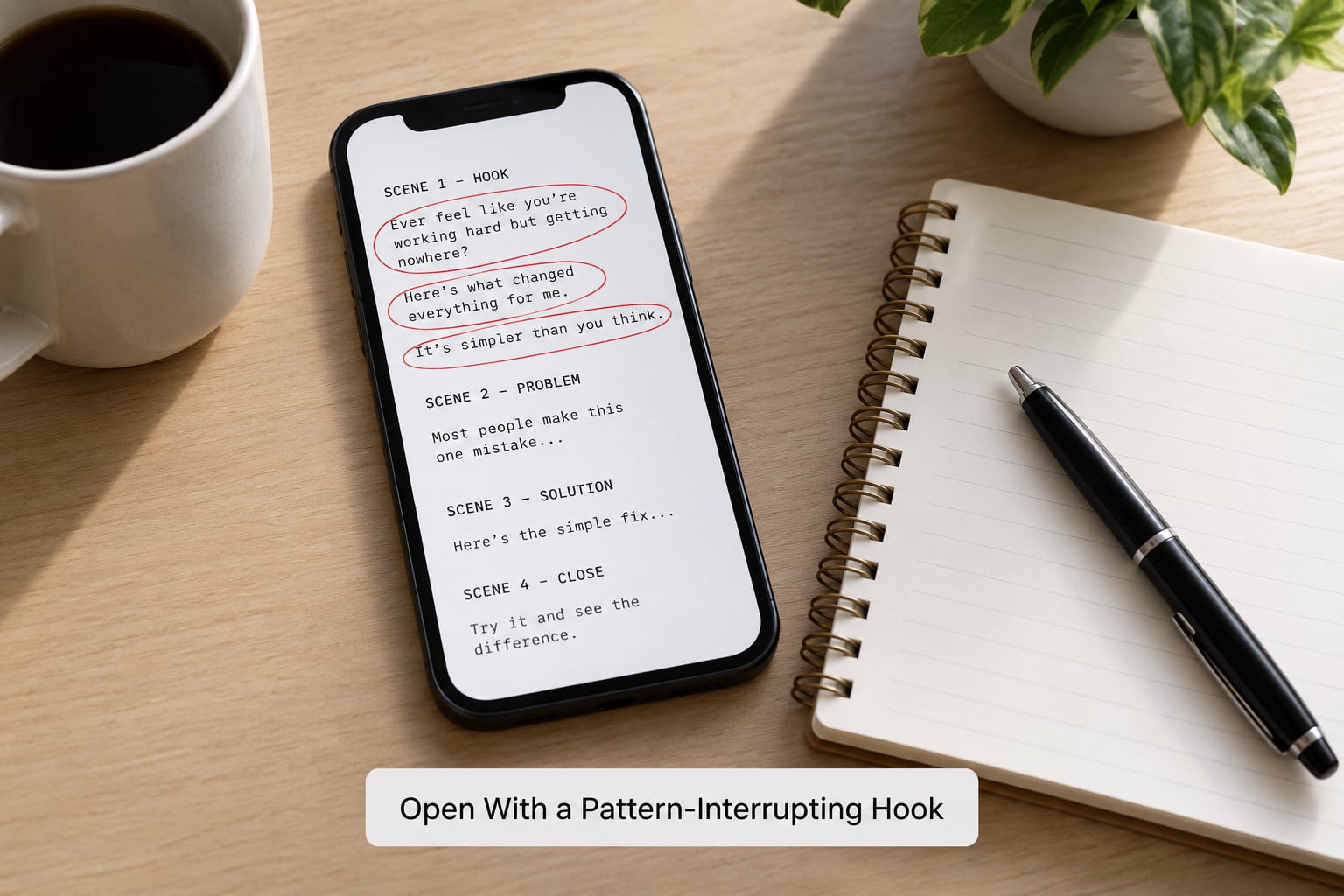
The first three seconds work because they break an expectation. A pattern interrupt is any moment where the viewer expected one thing and got something else: a face instead of a logo, a voice that starts mid-sentence, a number where a slogan should be.
Five hook types cover most commercial work:
- Result-first. Open on the finished outcome, then rewind. “It used to take four days. Now it takes forty minutes.”
- Problem-first. Name the pain precisely enough that the viewer nods. “Your onboarding checklist lives in four different tools.”
- Curiosity gap. Show a surprising partial result, then promise the reason. Only works if you actually close the gap on screen.
- Rapid demo. Motion and hands in frame from frame one. Nothing sells speed like speed.
- Bold claim, bounded. State the claim and immediately attach who it is for. On r/FacebookAds, writers keep pointing out that bounding the claim is what stops a premium brand from sounding like clickbait.
Write ten opening lines before you choose one. Then read each aloud and mark the two that made you want to hear the second sentence. That reaction is the only reliable test you can run before production, and ten lines is roughly twenty minutes of work.
Map the Emotional Attention Arc
Attention moves through states, and each scene needs one. Skipping a state leaves a flat stretch where viewers decide they have seen enough. Map roughly seven: curiosity, recognition, surprise, tension, relief, trust, action.
A 30-second spot often runs like this: curiosity at 0-3 seconds, recognition at 3-8 as the viewer spots their own situation, tension at 8-15 as the cost of doing nothing becomes visible, relief at 15-22 when the solution appears, trust at 22-27 where proof lands, and action at 27-30. Brand films may stretch trust much longer and compress relief into a single shot.
Write the state above each beat in your draft. If two consecutive beats carry the same state, one of them is redundant.
Write the Video Beat by Beat
A production-ready beat has four fields: the visual, the spoken line, an estimated duration, and the tension level the viewer should feel. Write it as a table so the editor, the voice artist and you are arguing about the same document.
Keep spoken lines short. Most people narrate video ads at roughly 140 to 160 words per minute, so a 30-second spot has about 65 to 75 words of voiceover before pauses, and much less if there is music under it. Write to that budget from the start rather than cutting later.
Sound-off viewing is the default, not the exception. Any essential information needs to exist as on-screen text as well as narration, and the two should not be identical sentences. The caption is a summary a stranger can read in two seconds.
Add Specific Proof and Sensory Detail
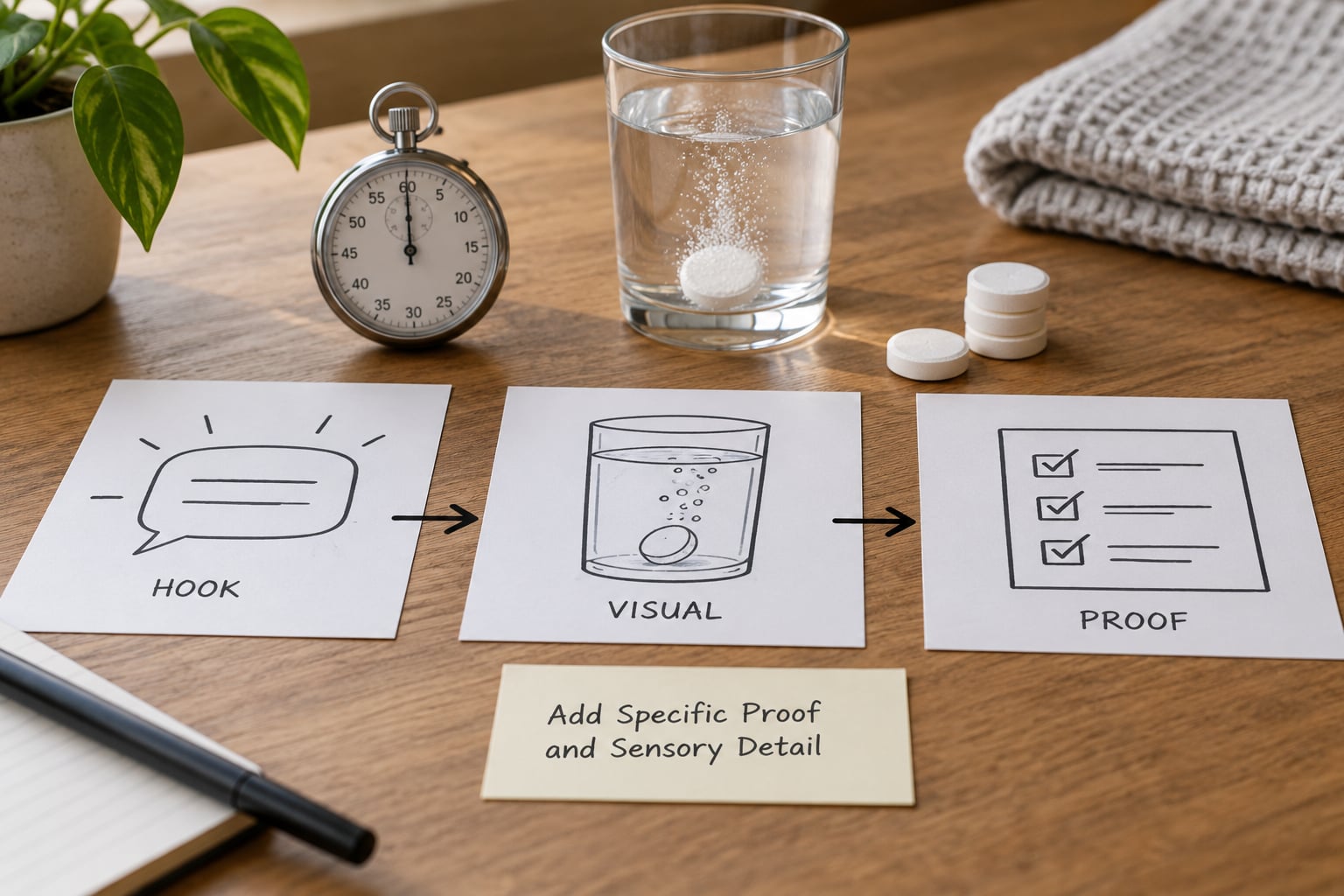
Specificity is the reliable lever. Vague benefit claims get scrolled past; a named constraint, a concrete number, or a visible before-and-after stops the scroll. Social media managers say this constantly, and it is the cheapest fix available to you.
Dramatise the benefit by showing the moment rather than describing it. Instead of “reports build in minutes”, show someone hitting send at 4:51pm and a finished report at 4:52pm with the clock visible. Instead of “batteries that last”, show the phone that still has charge at the end of the day.
Bound every claim you make. Say who it is for and under what conditions, and attach proof in the same beat rather than in the fine print. A curiosity gap that never closes reads as a bait-and-switch and costs you the back half of the view.
End With One Clear Call to Action
Pick one action and say it in the imperative. “Start the trial” beats “learn more about our solutions”. The closer should connect back to the opening tension, so the viewer can feel the loop close rather than simply be asked for something.
Give the transition a visual too. Show the button, show the calendar, show the phone with the app open. If the offer needs a screen of qualifying questions, you have chosen the wrong action for a 30-second spot.
Test, Time, and Refine the Script
Read the whole script aloud at normal pace and time it. Anything over budget gets cut before you argue about wording. Then read just the first three seconds five times in a row; the line that starts sounding flat by the third reading is usually the weakest one, even if it is the cleverest on the page.
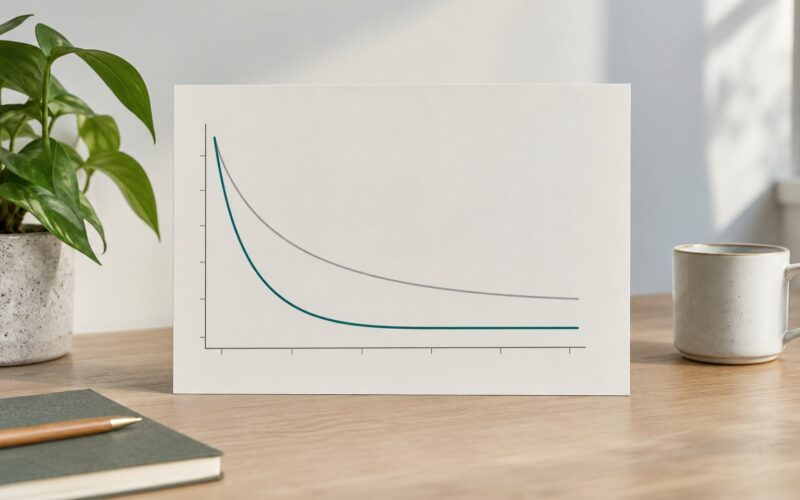
Once it is live, look at where people leave. Retention curves show a cliff at a specific second far more clearly than they show a slow leak, and a cliff almost always points to one sentence. Diagnose it as a promise problem rather than a pacing problem: the script asked for attention it did not pay for.
Revise one variable at a time. Swapping the hook while also shortening the body means you will never know which change did the work.
Common Mistakes and the Fix for Each
- Opening with a greeting. “Hi, and welcome to…” buys nothing. Start on the problem or the result, and let the brand name arrive by the five-second mark.
- Leading with features. Nobody wants a specification list. Lead with the change the feature creates, then let the spec support it in the proof beat.
- Sentences that run too long. A spoken sentence over about 15 words loses the listener at the clause boundary. Split it and let the visual carry half.
- Generic claims. “Better results”, “next-level solutions”, “unlock your potential”. Replace each with a number, a named constraint, or a demonstrated moment. If you cannot, delete it.
- Stacked hook styles. Two or three hook patterns inside five seconds and the viewer registers none of them. One pattern per opening.
- Two or three calls to action. Competing asks split the intent and lower completion on all of them. Keep one and move the rest to the landing page.
- A script that ignores visuals. If the words would work as a radio read, the script is half-written. Decide what each line is doing on screen.
- A promise the body never pays off. This is the most common expensive error. If the hook says the ad will explain something, the body must explain it before the call to action.
Frequently Asked Questions
How long should an ad script be?
Length follows the format and the attention budget, not a target you pick in advance. A 15-second social video carries about 30 to 35 spoken words, a 30-second spot about 65 to 75, and a 60-second commercial about 130 to 150. Radio runs slightly longer because there is no visual reset. The real limit is how many attention states you can move through without repeating one.
What makes a strong opening hook for an advertisement?
A strong hook breaks an expectation and creates immediate relevance for one specific viewer. It names something they recognise, shows motion or contrast, and raises a question the ad genuinely answers. The test is simple: after reading it aloud, do you want to hear the second sentence? If ten options produce no reaction at all, the promise behind them is too vague rather than the wording being wrong.
How many words should a 30-second video ad script contain?
Around 65 to 75 spoken words, assuming narration with light music underneath. Most people narrate at roughly 140 to 160 words per minute, and pauses, breath and music all eat into that budget. If your ad carries text on screen that carries the meaning, you can drop toward 50 words. If two people talk over each other, subtract another 15 or so.
Should an ad script include directions for visuals and sound?
Yes, if a second person will produce the ad. Write each beat with the visual, the spoken line, an estimated duration, and any sound cue. Visuals matter even more because most viewers start muted: essential information needs to exist as on-screen text as well as narration, and the two should not be the same sentence. The caption should read as a two-second summary.
How do I keep an ad script from sounding too salesy?
Cut the adjectives and keep the nouns. Words like revolutionary, seamless and next-level describe the writer’s excitement, not the viewer’s life, and they are the fastest way to sound desperate. Replace each one with a specific fact, a number, or a demonstrated moment. Bounding a claim to a named group also helps: the constraint reads as confidence rather than hype.
How can I test which ad hook will hold attention?
Write ten candidate hooks for the same promise, then read them aloud and keep the two you want to hear continued. Score each survivor on specificity, relevance, believability and momentum, and shoot or run the top two against the same body. Once live, check where retention drops; a cliff at a specific second points at one sentence and usually means the body did not pay off the promise.
Conclusion
How to write an ad script that holds attention comes down to order: promise, hook, arc, beats, proof, one ask, then the read-aloud pass. The order matters more than the wording, because each stage is checkable and the next one has something to build on.
Start tonight with the smallest possible version. Write the audience tension in one sentence, then draft three stronger opening lines for the same promise and rank them out loud. Everything after that is much easier.