Why neuromarketing claims deserve skepticism? Because most of them rest on studies too small to trust, interpretations built on reverse inference, scoring systems nobody outside the company can check, and predictive accuracy that clears chance by a margin too thin to run a campaign on. The underlying science is real. The marketing built on top of it frequently outruns what the data can carry.
That distinction matters more in 2026 than ever, because the vocabulary has moved from conference rooms into pitch decks. A brand manager who asks for a neural scan of a logo is usually asking a reasonable question about attention and emotion. What comes back is often a confident slide with a percentage attached and no way to check the arithmetic.
This guide covers how neuromarketing studies actually work, what each tool can and cannot measure, the specific failure modes that recur across the literature, and a practical way to audit a claim before you pay for one. It also covers what the field gets right, because a blanket dismissal throws away genuinely useful methods.
Table of Contents
- What Does Neuromarketing Actually Claim?
- Why Neuromarketing Claims Deserve Skepticism
- 1. Reverse inference
- 2. Small, unreplicated samples
- 3. Proprietary scoring formulas
- 4. The leap from correlation to prediction
- 5. Neuro-myth laundering
- What Evidence Can Neuromarketing Claims Actually Provide?
- What the field does well
- Which Red Flags Should Marketers Look For?
- Three more patterns worth knowing
- How Can You Test a Neuromarketing Claim Yourself?
- Step 1: Convert the claim into something measurable
- Step 2: Find the original source, not the summary
- Step 3: Read the methods section only
- Step 4: Do the arithmetic nobody did
- Step 5: Check the context gap
- Step 6: Run a field test with a business outcome
- Step 7: Check whether you needed the scanner at all
- What Is the Most Responsible Way to Use Neuromarketing?
- Frequently Asked Questions
- Does skepticism mean neuromarketing is never valid?
- Why is neuromarketing important?
- Who is considered the father of neuromarketing?
- Does Coca-Cola use neuromarketing?
- What are the criticisms of neuroscience?
- Can neuroscience tell marketers exactly what customers will buy?
- Is neuromarketing pseudoscience?
- Conclusion
What Does Neuromarketing Actually Claim?
Neuromarketing is the application of neuroscience and physiological measurement tools to questions about consumer response. In practice that means functional magnetic resonance imaging, electroencephalography, eye tracking, skin conductance response, pupillometry, and facial coding, applied to advertising, packaging, pricing, or retail environments.
Read Montague, a neuroscientist whose early work is often treated as a founding reference, defined the field’s ambition plainly: measure brain activity associated with the neural value of products while people choose between them. Gerald Zaltman’s work on implicit processes and Eric Schwartz’s writing about consumer neuroscience pushed the same idea from the lab into business press. The promise has stayed roughly constant ever since: measure what people feel before they can put it into words.
Here is what a study actually looks like in practice. Recruit a small group of participants, put them in a scanner or cap or chin rest, show marketing stimuli while recording signals, then convert the signal into a marketing recommendation. That last step is where most of the trouble starts, because the conversion runs through a scoring system that is often proprietary and unauditable.
So there are two very different things sold under one name. One is a genuine cognitive-science practice: controlled experiments on attention, memory, reward learning, and automatic processing, with pre-registered hypotheses and replication. The other is a marketing practice where a brain region gets a name attached and a design recommendation comes out the other end. Only the first is a science in the ordinary sense.
Worth saying what the word “neuromarketing” does. It borrows the prestige of a hard science without inheriting its constraints, and that borrowing is doing a lot of work in boardrooms. Practitioners on r/neuro have noticed exactly this, describing the term as putting “neuro” next to “marketing” to borrow legitimacy. One 2019 thread replying to a Medium article on measuring advertising put it more directly: neuromarketing is a pseudo-science, and most of the studies are not peer-reviewed sales pitches.
Why Neuromarketing Claims Deserve Skepticism
The skepticism is not aimed at the instruments. fMRI and EEG are real, expensive, and genuinely informative about limited questions. It is aimed at a specific pattern of inference that runs through the field’s best-known claims. Five failure modes account for most of it.
1. Reverse inference
Reverse inference means inferring a specific thought or feeling from activity in a brain region, without evidence that the region uniquely encodes that thought. Almost every brain area is active in many situations, so “amygdala activation” tells you arousal and threat sensitivity, not a story about your consumer’s inner life.
One famous case shows how casually this gets applied. An fMRI analysis of Super Bowl XL commercials in 2006 concluded that a FedEx ad produced less amygdala activity than a Budweiser ad, and then described the difference in terms of a viewer becoming a “caveman.” The activity measured was real. The interpretation walked straight past what the measure can support, because the study never established that a calm viewer was experiencing anything recognizably like rational deliberation.
2. Small, unreplicated samples
Consumer neuroscience studies commonly run with sample sizes in the low dozens, sometimes around twenty. That is small enough that a handful of unusual participants or one site difference can drive the result, and small enough that the confidence intervals around a reported accuracy figure are usually wide.
The broader behavioral science literature has a replication problem, and the participant numbers typical of marketing brain studies sit in the range that problem was built on. A finding that has not been repeated by an independent lab, on an independent sample, with the analysis plan fixed in advance, is a lead. Sometimes it becomes a finding. Often it does not.
3. Proprietary scoring formulas
This is the structural conflict of interest, and it is the one the least scrutiny gets. A vendor’s raw signal has to become a recommendation, and the formula doing that translation is generally non-public. You cannot audit it, you cannot compare it to a competing vendor’s formula, and you cannot run the study again yourself.
A 2013 review published by researchers at Columbia examined the websites of sixteen neuromarketing companies. Very few described their methodology in enough detail to verify. Roughly half of the companies that presented themselves as neuroscience-based were not even using EEG or fMRI. If a supplier’s own marketing page cannot tell you what it measured, the person reading that page is not going to learn it later.
4. The leap from correlation to prediction
Predictive validity is the degree to which a measurement predicts a real-world outcome, such as sales, rather than merely correlating with brain activity. Most neuromarketing claims are made at the correlation level and are sold at the predictive level. That is a large gap, and the evidence that closes it is thin.
The most often-quoted data point in the critical literature comes from a 2007 study by Brian Knutson and colleagues, which reported predicting consumer product preferences from brain activity at about 60% accuracy. For a binary choice, chance is 50%. A method that beats chance by ten points on a handful of trials in a laboratory is not a forecasting instrument for a national brand launch.
5. Neuro-myth laundering
The last failure mode is statistical, not scientific: a weak finding gets repeated in a business publication, loses its caveats, gets quoted in a vendor deck, and is now an industry assumption nobody remembers checking. Popular explainers accelerate it. Some of the most-read guides on the topic open with the claim that consumers decide within seven seconds of seeing a product, or that 95% of purchasing decisions are made unconsciously.
These numbers circulate without a source. The 95% figure in particular has no traceable origin in the marketing literature, which is a useful signal in itself. A precise statistic with no discoverable source is a decoration, not a finding. Next time one of these lands in a deck, ask for the study, the author, the year, and the sample size. Watch what happens to the claim.
What Evidence Can Neuromarketing Claims Actually Provide?
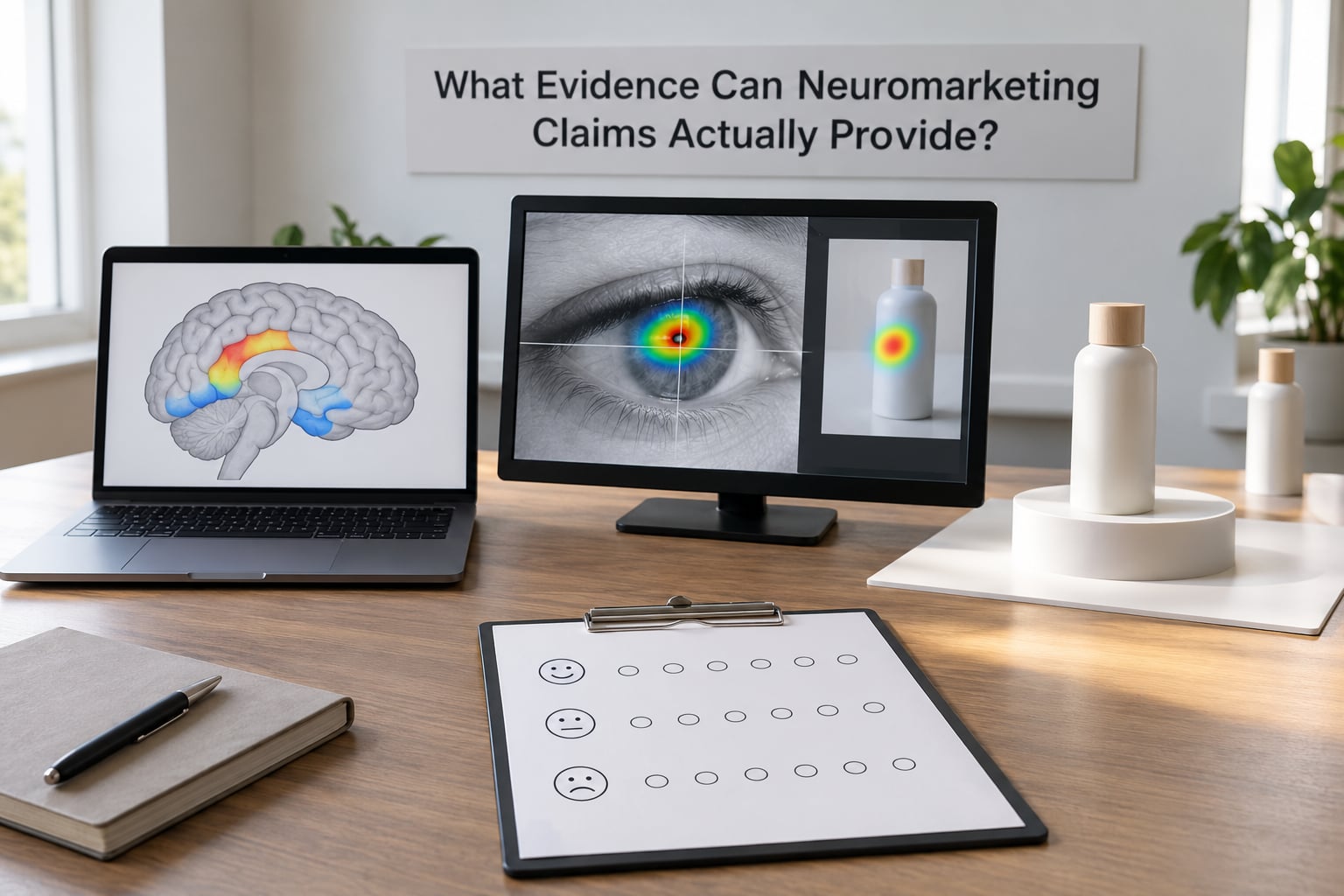
The honest answer is that each tool can answer a narrow question well, and marketers routinely ask it a different question. The table below is the map I wish every vendor slide included.
| Method | What it actually measures | What it cannot prove |
|---|---|---|
| fMRI | Blood-oxygen changes across the whole brain, with good spatial resolution and poor temporal resolution | Why a person responded, or what they will buy outside the scanner |
| EEG | Electrical activity at the scalp, fast and cheap relative to fMRI, weaker on source location | A specific thought; decoding a consumer’s purchase intention from a logo |
| Eye tracking | Where gaze lands and how long it dwells | Whether the person liked it, or whether attention became preference |
| Skin conductance response | Sweat-gland activity, a general arousal signal | Whether arousal was excitement, fear, or discomfort |
| Pupillometry | Changes in pupil diameter, linked to arousal and effort | Any specific emotional or cognitive content |
| Facial coding | Movement in defined regions of the face, scored against expression templates | Deception, or an internal emotional state behind the movement |
Two of those rows deserve emphasis, because their limits are routinely overstated. Eye tracking tells you a person looked at a shelf for two seconds, which is genuinely useful for layout questions and useless as proof of preference. Facial coding is sold as reading emotion off the face, but the mapping from facial movement to a specific emotion is contested in the research literature, and the accuracy figures depend heavily on which template, which rater, and which ground truth you accept.
Now put the famous studies in the same frame. None of these are frauds, and the problem is more interesting than fraud. It is that reasonable, published findings get summarized into conclusions they cannot carry.
| Study or claim | Method | What was reported | The question a skeptic asks |
|---|---|---|---|
| Coke versus Pepsi preference (Montague and colleagues, 2004) | fMRI | Brand-preference activity, including a strong ventral putamen response for the brand a person reports preferring | Do people with a stated preference really choose differently from people without one? |
| Product preference prediction (Knutson and colleagues, 2007) | fMRI | Around 60% accuracy at predicting which of two products a person would prefer | Is ten points above a 50% baseline reliable across a different sample and a real shelf? |
| Super Bowl XL commercial analysis, 2006 | fMRI | Amygdala and ventromedial prefrontal activity compared across a FedEx and a Budweiser ad | How does lower amygdala activity license the claim that the viewer became a “caveman”? |
| Shampoo commercial pre-test cited in NeuroFocus work | EEG | Reported superior emotional engagement of a test creative versus a control | What is the scoring formula, and did the result predict any real sales change? |
| New Scientist cover test in the New York Times | fMRI plus online voting | Reader brain responses combined with cover preference to argue emotion drives cover choice | How many people, how many replications, and does online cover preference translate to newsstand sales? |
| Buyology, Martin Lindstrom, 2009 | fMRI plus EEG, commissioned studies | That 90% of consumer decisions are made by the subconscious | Where is the study, who reviewed it, and where is the 90% figure derived from? |
The pattern in that last column is consistent: the studies are small, the effect sizes are modest, and the confidence interval around the headline claim is rarely reported. Note also what the Buyology case is really about. The book was a commercial success, it was reviewed as unreadable by some critics, and its central statistic did not survive contact with the research literature. That is the template for most neuromarketing claims that escape scrutiny.
What the field does well
None of the above means the tools are useless. A serious counterweight matters for a balanced verdict, and there are four contributions the evidence does support.
First, hypothesis generation. Consumer neuroscience has surfaced mechanisms that are easy to miss with self-report alone, including reward-learning dynamics and the way choice architecture alters the value of a default option. Generating better hypotheses is a legitimate contribution even when the predictive claims fail.
Second, screening out designs that fail. A stimulus that produces no measurable attention or arousal signal is sometimes a design that genuinely has no hook. Weak evidence is still evidence when the alternative is a concept nobody can defend in an internal review.
Third, forcing specificity. Writing a hypothesis that a brain region should respond in a particular way makes vague marketing talk harder to sustain. That is an uncomfortable effect for the industry, which is not the same as a bad one.
Fourth, the defensive value of shared language. A team that agrees on what “attention” and “arousal” mean has a harder time arguing past one another on taste alone.
The distinction to hold onto: the field is reasonably good at generating and testing hypotheses about mechanism, and weak at forecasting what a specific campaign will sell. Most neuromarketing failures are failures of the second kind wearing the clothes of the first.
Which Red Flags Should Marketers Look For?
Here is the audit. Eight questions, asked in order, will separate a study from a sales pitch. If a supplier hesitates on the first three, you have your answer.
- What exactly was measured? Demand the raw signal and the unit. A method described only as “neuroscientific analysis” or “advanced consumer neuroscience” is describing a vendor, not a method.
- How many people were in the study? Below thirty and the result is fragile. Ask for the number, not for a description of the recruitment process.
- How was the signal turned into a recommendation? If the scoring formula is proprietary, ask for its validation: has it been checked against a real outcome such as sales, shelf conversion, or click-through, on a study the vendor did not design?
- What is the comparison against chance? Any accuracy figure needs a baseline. Sixty percent on a binary choice is ten points above chance. A claim that never states its baseline is hiding something.
- Has it been replicated independently? Not by a sister company in the same group, not by a press release. Independent means unaffiliated, and the reanalysis should use its own pre-specified plan.
- Does the conclusion match the measure? An attention metric is not a preference metric. A physiological arousal signal is not an emotional interpretation. If the recommendation requires a leap the instrument does not support, the recommendation came from somewhere else.
- Who paid for it, and who reviewed it? A commissioned study and a peer-reviewed one are different objects. Ask whether the write-up went through a journal, a conference, or a marketing award, and whether the raw data is available.
- Would the result change a decision? This is the one vendors skip. Ask what they would do differently if the score came back neutral. A method that produces a recommendation for every input is not measuring anything that varies.
Three more patterns worth knowing
Statistical language, first. A single study with several brain regions measured and no correction for multiple comparisons will produce at least one apparently significant region by chance. Mentioning p-values without mentioning corrections is a warning sign, and a study that reports fifteen regions and one effect should get more suspicion than a study that pre-specified one region.
Ambiguous populations, second. Many studies run on university students in one country, then get used to justify a national campaign. You are not looking at buyers; you are looking at people who agreed to lie in a scanner. That is a real limitation, not a fatal one, but it is fatal when the deck does not mention it.
The amplification pathway, third, and it is the most common route by which a bad claim becomes industry orthodoxy. A preliminary result appears in a trade outlet, gets summarized without caveats, gets quoted in a conference session, and after two years nobody remembers that the caveats were stripped. The original paper sits behind the practice unchallenged. If you find a neuromarketing belief in your organization and cannot name the study, assume the caveats were lost somewhere in that chain.
How Can You Test a Neuromarketing Claim Yourself?
You rarely need a scanner to do this. The verification work is mostly reading and arithmetic, and it takes an afternoon for a claim someone is about to spend real budget on.
Step 1: Convert the claim into something measurable
“This packaging triggers an emotional response that makes shoppers buy impulsively” is not a claim you can evaluate. Ask what measurable outcome would have to be true, over what period, relative to what alternative. A testable version sounds like: this package increases unplanned purchases of the category by a stated margin against the current design, in store, over four weeks. Anything that cannot be written that way is a belief wearing a measurement costume.
Step 2: Find the original source, not the summary
Search by author, year, and method rather than by the finding. If the claim traces back to a press release or a vendor case study and not to a paper, that is the answer. If it traces back to a paper, get the paper.
Step 3: Read the methods section only
You do not need to follow the statistics to spot most problems. Sample size, participant profile, task, and comparison condition will tell you most of what you need. Check the sample size against the claim’s strength, and check whether the conclusion section hedges more than the summary did.
Step 4: Do the arithmetic nobody did
Take the reported accuracy and compare it to the baseline for that task. Then ask how many correct predictions the method would produce on a hundred real shoppers at that margin, and what that means in units of a marketing budget. A method that beats chance by ten points has value in a screening context and no value as a forecast.
Step 5: Check the context gap
Ask whether the setting, the task, and the population match where the recommendation will be used. Watching a brand logo for two seconds in a scanner is a different task from choosing a shampoo in a store aisle with a competitor on the same shelf. Studies that never test the real context should be described as screening, and priced as screening.
Step 6: Run a field test with a business outcome
If the claim survives the first five steps, stop arguing and test it. A/B tests on packaging, shelf or storefront layouts, and creative variants give you a causal answer on the outcome you actually care about, and they give you a real revenue figure rather than a standardized score.
Step 7: Check whether you needed the scanner at all
Focus groups, copy testing, sales data analysis, and implicit association tests are far cheaper, faster, and often more valid for the question in front of you. Behavioral science on decision-making has a substantial and replicable literature, and for most everyday marketing questions it is the better first place to look.
The one thing none of these steps replace is stating what you do not know. A recommendation delivered with a stated confidence level is professional. The same recommendation delivered as a percentage with no baseline is a sales tactic wearing a lab coat.
What Is the Most Responsible Way to Use Neuromarketing?
Used as one input among several, the serious methods add up. Used as the decisive input, they reliably produce certainty the evidence does not support.
Treat behavioral insight as a source of hypotheses, sitting alongside sales data, customer observation, brand strategy, and qualitative research. When it disagrees with sales data, that disagreement is interesting, and it usually means the neural measure captured something real about attention while missing the price, the promotion, the reputation, or the month of the year that actually moved the number. Consumers are not disembodied brains. They are people with budgets, histories, and social lives that no scan has captured yet.
Report the uncertainty, including yours. State the sample size, the baseline, and what the result cannot tell you. A team that understands the limits of a method trusts it more, not less, and it stops making decisions the evidence cannot support.
On the ethical side, the risk is real and it is not primarily about fMRI. The concern is with a method that bypasses deliberation. Work on consumer autonomy and dark patterns treats the reduction of people’s considered choice as the thing to be avoided, and the tension is sharpened when the targeting data comes from physiological signals people never agreed to be measured by.
The amygdala’s primary function is threat detection, which is a useful reminder that a measurement device held near someone’s head is not a neutral gesture in the room. Any use of physiological research with consumers should rest on informed consent, and the consent should cover the downstream use, not only the scan. If a study is a good idea only if the participant does not know what it feeds into, it is the wrong study.
The ethical test I use is simple. If the consumer knew the full method and its purpose, would the marketing decision be defensible? Most legitimate applications pass. The ones that only work when nobody is looking do not.
Frequently Asked Questions
Does skepticism mean neuromarketing is never valid?
No. Skepticism means judging each claim according to its methods, evidence, context, and commercial interests. Consumer neuroscience has produced real findings about attention, reward learning, and automatic processing, and neural measures are useful for screening concepts and generating hypotheses. The skepticism targets the specific inferences that get made: reverse inference, tiny unreplicated samples, unauditable scoring formulas, and claims about predicting sales that the reported accuracy cannot support.
Why is neuromarketing important?
Neuromarketing matters because the vocabulary is now common in marketing strategy, and much of it rests on a thin layer of published research. When claims like a 95 percent subconscious decision figure circulate without a traceable source, they shape briefs and budgets. Understanding the limits of the methods protects a real scientific field, built on cognitive science, cognitive neuroscience, and behavioral economics, from being discredited by the marketers borrowing its name.
Who is considered the father of neuromarketing?
Read Montague is the name most often attached to the field, and he is usually described as its father. His early-2000s work using fMRI to study brand preference, including the 2004 Coke versus Pepsi study, supplied the template most of the field’s legitimacy still rests on. Gerald Zaltman’s research on implicit processes and Eric Schwartz’s writing helped carry the idea into business press, though Zaltman and Schwartz are better described as amplifiers than founders.
Does Coca-Cola use neuromarketing?
Yes, in the ordinary sense that a company this size runs behavioral and neuroscience-adjacent research. The most-cited Coca-Cola example is the 2004 fMRI work associated with Read Montague, which included the Coke and Pepsi brand preference study. Companies of this scale also commission eye-tracking and retail-environment work, since that is cheaper and more common. What is not established is any specific claim that Coca-Cola acts on neural measurement more than on testing, and at that scale the neural study is usually one input among many.
What are the criticisms of neuroscience?
The main criticisms are reverse inference, inferring a specific thought from brain-region activity without showing the region is specific to that thought; small sample sizes, typical of consumer neuroscience studies; weak replication and limited transparency, highlighted by a Columbia review of sixteen neuromarketing company websites; proprietary scoring methods that nobody outside the vendor can audit; the leap from correlation to prediction, where a reported 60 percent accuracy against a 50 percent baseline is sold as forecasting; and neuro-myths, such as the 7-second decision and 95 percent subconscious claims, repeated with no traceable source.
Can neuroscience tell marketers exactly what customers will buy?
Rarely, if ever on its own. Brain measures may reveal aspects of attention, memory, arousal, or reward processing, and the 2007 Knutson study reported product-preference prediction at about 60 percent accuracy on a binary choice against a 50 percent baseline. That margin is a screening signal, not a forecast, and it comes from small laboratory samples rather than from shoppers in stores. Real purchases are driven by price, availability, habit, and reputation, none of which a scan measures.
Is neuromarketing pseudoscience?
Partly, and the answer depends on which version you mean. When neuromarketing means controlled cognitive-science research on consumer choice, it is legitimate and its findings replicate in the wider behavioral literature. When it means a vendor converting an opaque signal into a design recommendation nobody can audit, it is closer to pseudoscience, and practicing neuroscientists on forums such as r/neuro describe it that way. The label fits the second category well, which is exactly why the first deserves protection.
Conclusion
The verdict on why neuromarketing claims deserve skepticism is a qualified one. The instruments are real, some of the findings hold up, and the field has contributed useful hypotheses about attention and reward. The claims made in the name of that field are usually stronger than the evidence behind them, and the gap is not accidental. It is structural: small samples, opaque scoring, and a business incentive to end every study with a recommendation.
Start with one action. Find the most influential neuromarketing claim in your organization, the one that currently shapes a decision, and trace it back to the original paper. Look at the methods section, the sample size, and the baseline for the accuracy figure. Nine times out of ten the paper says something narrower than the claim, and the interesting part of the exercise is finding the sentence where the narrowing happened.