The pain of paying is the unpleasant, loss-like feeling that arrives when you hand over money, and it is measurably stronger when you pay with cash than when you pay by card. Cash makes the loss visible and immediate; a card turns the same purchase into an abstract promise and a bill that shows up later. That single difference changes both how spending feels and how much of it happens. Everything below is the state of the evidence as of 2026, including the parts that cut against the headline.
Table of Contents
- What Is the Pain of Paying?
- Why the Pain of Paying Is Lower with Cards Than Cash
- How Does the Payment Method Change What We Feel?
- Why Does Cash Make a Payment Feel More Painful?
- Why Do Cards Feel Less Painful?
- Does the Pain of Paying Disappear with Digital Payments?
- What Factors Can Make Any Payment Feel Painful?
- What Does This Mean for Spending and Marketing?
- Frequently Asked Questions
- What is the concept of the pain of paying?
- Why is the pain of paying lower with cards than with cash?
- Is it better to pay cash or use a credit card?
- Why do people use credit to pay instead of cash?
- Do debit cards reduce the pain of paying the same way credit cards do?
- How can I make credit card spending feel painful again?
- Conclusion
What Is the Pain of Paying?
The pain of paying is the negative feeling triggered by the act of paying, not by the financial cost itself. The distinction matters. A purchase can be entirely affordable and still sting, and a purchase that wrecks your month can go through without any feeling attached to it. Behavioral economists treat payment pain as a mental cost layered on top of the real one.
The idea sits inside a larger framework called mental accounting, popularized by Richard Thaler. We do not track money as one clean pool. We sort spending into categories, attach a value to each, and feel losses more sharply than we feel equivalent gains. A $40 bottle of wine paid in cash registers as a real outflow from a real envelope, so it lands in the loss column. The same wine on a card with a $4000 limit reads as a small reduction in an abstract number, so it barely registers at all.
Most people meet this idea through the work of George Loewenstein and DK Prelec. In their 1998 paper on self-deferred payment, they described the pain of paying as the coupling of consumption and payment. When you pay at the same moment you eat, drink or use something, the two events are mentally linked, and discomfort from one bleeds into the other. Separate them, and the discomfort has nowhere to attach.
Why the same restaurant meal feels different depending on how you settle
Prelec and Loewenstein’s memorable example was the diner ticket. You eat the meal, enjoy it, and then a server hands you a check that breaks the spell. Many diners ask for the check to be brought before the food arrives, or ask the server to add it to a tab, and the room shifts. The food has not changed. The timing of the payment has.
That is the whole mechanism in miniature. Move the payment to a different day, route it through a different object, and the meal stops hurting.
Why the Pain of Paying Is Lower with Cards Than Cash
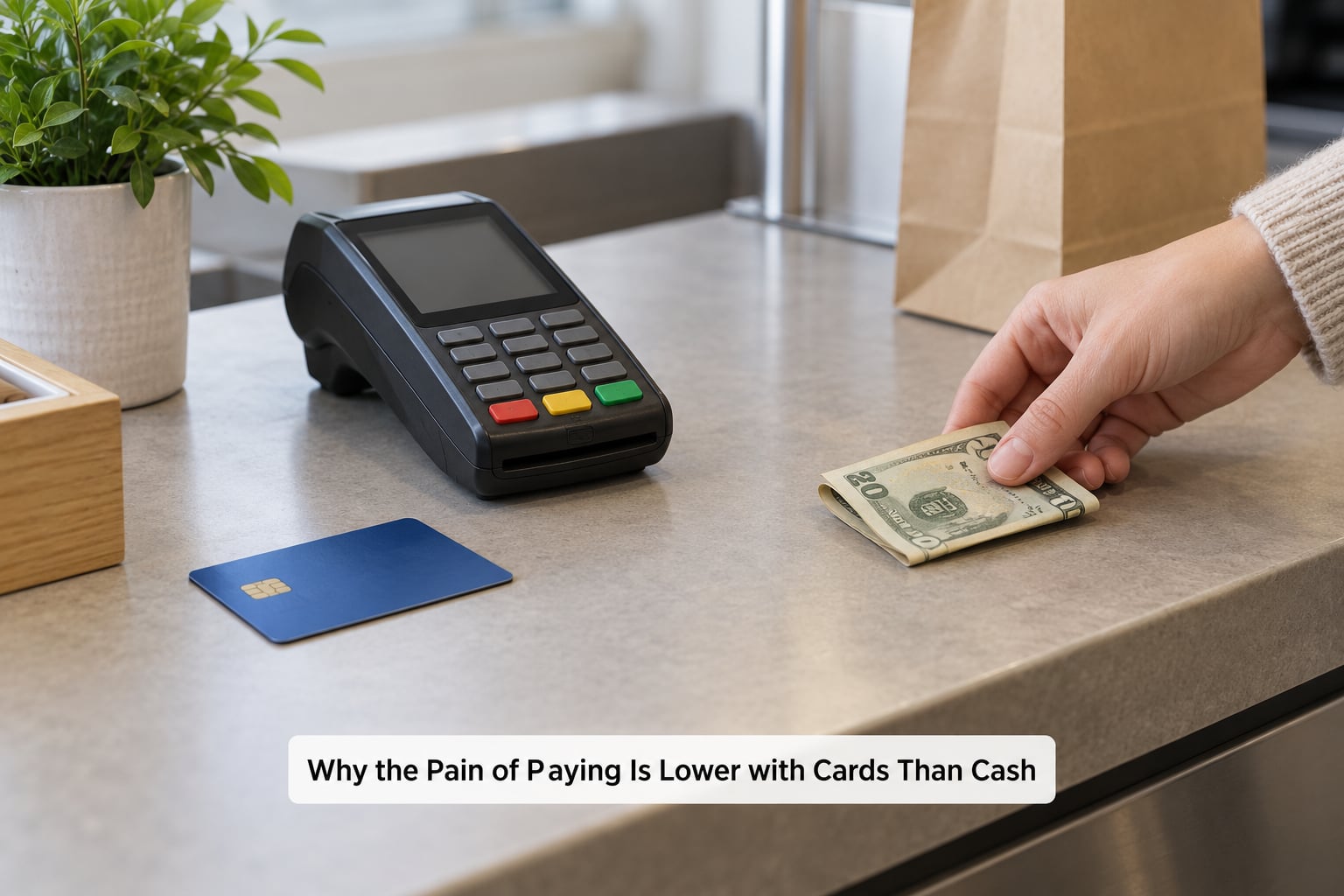
Four mechanisms do the work, and they stack. Understanding why the pain of paying is lower with cards than cash means looking at each one rather than treating the card as a single trick.
Payment visibility: you register what you can see leaving
Cash is a physical object that changes hands. You watch it go, you watch the drawer close, and in many cases you watched yourself count it out beforehand. Card payment removes the object entirely. There is no moment at which anything visibly leaves you, so there is no moment for the loss to be registered.
Payment timing: the bill is not the meal
Card spending decouples the moment of purchase from the moment of payment by days or weeks. Prelec and Loewenstein’s argument is that the further apart those two events sit, the weaker the mental link between the enjoyment and the cost. The statement arriving is a different event from the buying, and your mind files it separately.
Abstraction: an abstract number is a weaker loss than a physical one
A 2019 study in the Journal of Consumer Psychology, titled “Compared to Dematerialized Money, Cash Increases the Pain of Paying,” tested exactly this with prices held constant. Cash lost.
Debt salience is the flip side. When a balance is visible and the statement shows a large number, the pain arrives late but it does arrive, and it can be brutal. Card payment does not remove payment pain so much as push it downstream.
Credit-limit anchoring: the balance on the statement is not the price
This is the cognitive half of the story, and it depends on the credit limit rather than the card. Dilip Soman and Amar Cheema showed that people encode credit limits as reference points and then judge purchases against the limit instead of the price. A 200 dollar concert ticket sounds large next to a 60 dollar dinner. Against a limit of 8000 dollars, it sounds like a rounding error. Carey Morewedge and colleagues replicated and extended the finding in later work.
Neither half operates alone. Emotional mechanisms decide how the payment feels, cognitive mechanisms decide how large the price feels in your head.
How Does the Payment Method Change What We Feel?
Cash versus credit is a false binary. The useful version is a ladder, and the middle rungs are where most of the interesting variation sits.
| Payment method | When you pay | How visible the outflow is | Effect on felt pain | Typical spend effect |
|---|---|---|---|---|
| Cash | At the moment of purchase | Very high | Strongest | Smallest baskets, fewer impulse buys |
| Debit card | At the moment of purchase | Low, but the balance drops | Low to moderate | Close to cash for most people |
| Credit card | Days later, in one lump | Very low | Lowest | Largest baskets, most overestimation |
| Contactless card | At the moment of purchase | Almost none | Low | Slightly above chip and PIN |
| Mobile wallet | At the moment of purchase | None | Low, and faster to repeat | More frequent small transactions |
| Buy now, pay later | Over several installments | None at purchase, fragmented later | Lowest at the till | Largest total basket in studies |
Two columns deserve a note. Debit cards sit in the middle because the money leaves your account immediately, but most people never see the account balance move, so they behave nearly like credit for everyday purchases. And a 2026 systematic review in the Journal of the Economic Studies reached the general conclusion that the more abstract the method, the more attention falls away from the money itself.
Why Does Cash Make a Payment Feel More Painful?
Four things happen with cash that do not happen with a card, and they compound.
The object leaves your hand
Handing over a physical bill is the closest thing spending has to a sensory event. You feel the weight in your hand, then you do not.
You counted it first
Most people take a stack out of a wallet or a pocket and subtract from it mentally. That subtraction is a deliberate act performed seconds before the payment.
It draws from one obvious category
Cash almost always comes from a single source with a visible amount in it. The bill in front of you has a number on it, and that number came out of something you could see.
It cannot be quietly undone
There is no reversal, no later reconciliation. In behavioral terms, cash is a closed mental account. Once it is gone, it is gone, and the account is closed on the spot.
That is why people describe cash as a moment of reckoning. One person on a cognitive science forum thread put it plainly: physically handing over money is the moment the spending becomes real, and with a card it never quite does.
Why Do Cards Feel Less Painful?
Cards do not simply remove the sting. They change who feels it most, and they can move the sting to a place where it does less damage to your behaviour and more damage to your bank balance.
Cards partly equalize tightwads and spendthrifts
Manoj Thomas and Gilbert Morwitz built a scale measuring spending restraint, running from self-described tightwads to spendthrifts. Before payment, the two groups plan very differently. Give both groups a credit card, and the gap narrows noticeably. A tightwad who would have skipped the restaurant orders the meal anyway.
This is the least flattering finding in the literature. The card did not teach restraint. It removed the one moment where restraint was being enforced.
The card itself becomes a craving cue
Work by Richard Feinberg, and later by Priya Raghubir and Joydeep Srivastava, found that simply exposing people to a credit card logo before a purchase increased spending intentions, particularly for less restrained consumers. That is about branding, not payment. It suggests the credit card premium, the extra willingness to pay that shows up when payment is decoupled, is partly a cue effect wearing a behavioral costume.
Small balances and minimum payments hide the number
A minimum payment is engineered so the number you see tells you as little as possible. It is a salience filter, and it works because most people treat the minimum as the cost of the purchase.
The selection problem nobody mentions
Here is the honest caveat. People who choose credit cards are not randomly assigned to them. People who already prefer cash may be more budget-constrained in the first place, which would make their cash payments feel heavier for reasons that have nothing to do with cash. The clean evidence is the subset of studies that randomly assign a payment method, and those still show a gap. But the observational comparisons, including most of the large survey work, cannot separate the mechanism from the people.
Does the Pain of Paying Disappear with Digital Payments?
It fades further, and that creates a different problem. Tap to pay takes away the handover completely. A mobile wallet removes the card. Split checkout across installments removes the total from view. A 2026 systematic review on emotion-driven consumption reached the general conclusion that cashless and abstract methods reduce attention to the money being spent.
What users notice is precisely the missing step. Forum discussion around contactless payments describes the tap as the final piece of ceremony being deleted, and many people report losing track of spending entirely once everything moves to a card or a wallet, only discovering the total on the statement.
Payment still feels costly in a few situations. Large, unplanned purchases that blow a stated budget. Anything paid under real financial stress, where debt salience is high. Categories that are already tied to guilt, like gambling, alcohol, or a subscription a person suspects they do not use. And any purchase where the price is unusually visible, for instance a big number on a screen at the moment of confirmation. Strip away the payment ritual and the purchase still has to pass those tests.
What Factors Can Make Any Payment Feel Painful?
The payment method is one input among several, and a 2026 cross-cultural preprint on personality, culture, and pain of payment suggests the input weight varies with the person and the context.
Purchase size relative to the budget
The pain scales with the share of resources at stake, not the absolute number. Forty dollars is trivial in one budget and a serious event in another.
Budget tightness and financial stress
Under stress, the mental accounts get tighter, not looser. People become more sensitive to outflow visibility exactly when they can least afford to be, which is one reason stressed shoppers end up using cards more, not less.
Necessity versus want
Discretionary purchases carry a mental charge that groceries do not. The same card payment feels different for a treat than for a utility bill, because the budget category it is charged to is not the same category.
Debt salience
Paying down a card balance with real money is one of the most painful payments most people make, precisely because the outflow is visible and the payoff is abstract.
Time of day and stress
Late-night and high-stress purchases combine weak attention with a decoupled payment method, which is close to the worst case for restraint.
Personality and culture
More restrained consumers show a larger card-versus-cash gap, which means the method matters more for exactly the people who needed it to matter most.
What Does This Mean for Spending and Marketing?
For anyone working in pricing, brand, or checkout design, the practical reading is that payment visibility is a design variable. Anything that separates the moment of consumption from the moment of cost raises willingness to pay and total spend. Hidden fees, three-click checkout, and reward framing all push in the same direction. Retailers know this, which is why the request for a gift receipt, the offered upgrade, and the pre-ticked donation box all appear at the point where the payment pain is at its lowest.
The ethical version of that knowledge is straightforward: if you use it, the customer should still understand the total they are committing to. Price presentation and payment method interact, and the interaction is where most pricing-psychology mistakes hide.
Five ways to put some of the pain back
If the goal is to bring the feeling back without going fully back to cash, five interventions have support or strong practical backing.
One, separate categories physically. Cash in an envelope per category works because it makes a mental account visible, which is the exact mechanism a card strips away.
Two, choose a card that shows the balance. Balance-linked cards and real-time spending alerts restore the visibility that plastic and plastic-plus-app removed. There is a design proposal in the literature for a card that darkens as the balance grows, which is the same idea made physical.
Three, add a 24-hour rule on non-essential purchases. Waiting one day weakens the link between the impulse and the payment, which is the link the whole effect runs on.
Four, label the spending category out loud before checkout. Naming the mental account explicitly makes the outflow legible again.
Five, lower the limit, or pay in full with automatic clearing of the balance. Removing the credit limit removes the anchor that made prices look small in the first place.
A one-week test you can run yourself
Pick a single non-essential category, run it cash-only for a week, and record what you would have bought and what you actually bought. Keep the receipt pile. The comparison people report is rarely about the money. It is about how many purchases they decided they did not need once they had to hold the cash.
What to do first
If you take one thing from this, notice when your payment pain actually arrives. For most card users it is not at the checkout. It is at the statement, when the number is finally visible. That delay is the entire subject of this article, and it is also the thing you can move.
One last note. This is behavioral research, not financial advice. Rules, credit terms, and payment protections vary by country and by issuer, and how a given card works for you depends on your own situation. Check the specific terms with your own provider.
Frequently Asked Questions
What is the concept of the pain of paying?
The pain of paying is the unpleasant, loss-like feeling triggered by handing over money, which is separate from the actual financial cost. Behavioral economists treat it as a mental cost added to the real one, shaped by mental accounting, payment timing, and how visible the outflow is. Prelec and Loewenstein (1998) described it as the mental coupling of consumption and payment.
Why is the pain of paying lower with cards than with cash?
Because a card removes the visible object, separates the bill from the moment of purchase, and turns the price into an abstract number judged against a credit limit instead of a real one. A 2019 Journal of Consumer Psychology study found cash more painful than dematerialized money even with prices held constant. The result is a weaker, slower registration of the loss.
Is it better to pay cash or use a credit card?
It depends what you are optimizing. Cash usually produces smaller baskets and fewer impulse buys because the pain is immediate. Credit usually produces larger baskets because the pain is deferred and often discounted against the limit. The Behavioral Scientist’s glossary entry on the topic explicitly declines to rank them universally, and for good reason: the effect depends on the person, the purchase and the budget.
Why do people use credit to pay instead of cash?
Credit smooths consumption across time. It lets someone buy now and pay from a future paycheck, which removes the need to hold a large cash buffer. It also adds rewards, protections, and a record of spending. Psychologically, it lowers the pain of paying at the moment of purchase, which is the part most people notice and few examine.
Do debit cards reduce the pain of paying the same way credit cards do?
Partly, and most writing skips this. The money leaves your account immediately with a debit card, so the payment is still tied to the purchase in time. In practice most people never watch the account balance move, and most studies find debit spending closer to credit than to cash for everyday purchases. It is a middle case, not a clean copy of credit.
How can I make credit card spending feel painful again?
Restore visibility. Use cash envelopes per spending category, pick a card that shows a live balance with real-time alerts, add a 24-hour rule on non-essential purchases, name the budget category out loud at checkout, and pay in full so the limit never becomes the reference point. These target the same mechanisms the card removes: object, timing, and category.
Conclusion
Why the pain of paying is lower with cards than cash is not one trick. It is a visible object removed, a bill moved to another day, a category made abstract, and a price measured against a number that has nothing to do with it.
The useful part for an individual is knowing which of those four to put back. Start with visibility, because that is the one that does not require giving up the convenience you actually want.