Mixing two brand archetypes confuses consumers because each archetype works as a retrieval cue, a shortcut a buyer uses to recognise a brand and file it under a set of known values. Two equally weighted cues compete for the same slot in memory, so recognition gets weaker, not stronger, as exposure increases.
That is the awkward part of the argument. Most teams assume a richer mix gives a brand more range. In practice a mix only works when one archetype clearly outranks the other and the brand never presents them as equals.
Small-business owners I read on this topic keep hitting the same wall: they run a workshop, pick two archetypes because both felt true in the room, then watch marketing and sales produce material that sounds like two different companies. This piece explains the mechanism behind that failure, gives you a diagnostic you can run yourself, and ends with a six-step fix.
Table of Contents
- What Happens When a Brand Mixes Archetypes?
- Why Mixing Two Brand Archetypes Confuses Consumers
- How consumers use archetypes to recognize brands
- How mixing two brand archetypes confuses memory
- Where conflicting archetype signals appear
- Confusion Archetype Blends: Quick Diagnostic
- Common Archetype Blends That Create Consumer Confusion
- How to Tell Whether Your Brand Is Too Confused
- How to Fix a Mixed Brand Archetype
- Choose one primary archetype
- Use the second archetype as support, not the story
- Remove signals that reverse the position
- Decide whether to blend or build a sub-brand
- Test whether the archetype mix now feels clear
- Frequently Asked Questions
- Can a brand use more than one archetype without confusing consumers?
- What is the difference between brand flexibility and inconsistent positioning?
- Should a brand choose one archetype or let its audience decide?
- How do you test whether consumers understand a blended brand identity?
- Can changing a brand’s archetype damage its existing recognition?
- What to Do First
What Happens When a Brand Mixes Archetypes?
When a brand mixes archetypes without ranking them, buyers get more messages and less memory. Awareness climbs, but the brand stops feeling like a single familiar thing, and shoppers fall back on price, reviews or whichever competitor they already recognise.
In practice the symptoms show up in a fixed order. Ad recognition gets slower, meaning someone sees the asset and cannot immediately place the brand. Comment threads fill with variations of what the company actually is. Different segments describe the same company in incompatible terms.
Some teams notice the cost in the wrong place first. Marketing sees flat engagement while sales insists the problem is pricing or product. Both can be right, because an ambiguous brand removes the reason to choose the brand at all.
Worth flagging one thing early: an archetype mix is not the same as brand-strategy misalignment. One is a consumer-side problem about meaning and recall. The other is a business-side problem about what the company sells and who it serves. Fixing the wrong one wastes a rebrand cycle.
Why Mixing Two Brand Archetypes Confuses Consumers
An archetype mix is a problem only when two identities are carried with equal weight. A brand with one dominant archetype and a clearly subordinate second one is not confused; it is layered. The difference is rank, and rank is what most brand guidelines never state.
How consumers use archetypes to recognize brands
Archetypes compress a long cultural story into a fast shorthand. Nobody remembers that a brand is careful and plain-spoken; they remember that it feels like the trustworthy neighbour, and that shorthand does the sorting for them.
Three things happen at once when it works. The archetype names a familiar category, so the buyer knows what to expect. It sets an expectation that the product can then meet. And it offers a shortcut for self-expression, letting the buyer signal something about themselves with very little effort.
That third point matters more than brand teams expect. Consumers often pick the option whose personality fits the one they already have. If a brand sends two personality cues, the buyer cannot tell which version of themselves it is inviting, so the self-congruity check quietly fails.
The archetypes themselves come from Carl Jung’s work on recurring character types, later picked up in marketing by Mark and Pearson and others as a practical positioning tool. The framework travelled from psychology into consultancy, which is part of why blending is treated so casually today. The research base is thinner than the practice.
The academic work that exists points the same way. A 2016 study by Bechter and colleagues examined advertising between archetype and brand personality, and the wider literature on archetypal branding keeps returning to the same finding: customers get confused about a brand’s image when campaigns lean on differing archetypes. That line is often quoted. What it does not spell out is the recall mechanism underneath, which is worth setting out next.
How mixing two brand archetypes confuses memory
There are five mechanisms, and they compound. Consumers rarely notice any one of them; they just feel that the brand is vague.
- Competing retrieval cues. Two archetypes occupy the same entry point in memory. Whichever one the buyer meets second feels like a correction, not a bonus.
- Contradictory value signals. A Jester sells spontaneity and a Caregiver sells reliability. Together they ask for trust and irreverence in the same breath.
- Expectation mismatch. The cue sets a prediction, and conflicting cues make the prediction unreliable, so the buyer hedges rather than commits.
- Attribution dilution. When behaviour could be explained by either archetype, credit for good experiences gets split and brand equity never accumulates in one place.
- Choice friction. At the moment of purchase the buyer needs one reason to say yes. Two archetypes hand over a menu instead of an answer.
Unprompted recall is where this shows up first. Ask a sample to name a brand from a description with no logo and no colour, and an unranked duo produces a noticeably lower hit rate than a single-archetype brand of the same size and spend.
Where conflicting archetype signals appear
Confusion rarely lives in one place. Look across seven surfaces and you will usually find the pair splitting across all of them rather than one department going rogue.
- Positioning. The statement names two ideas and never says which leads.
- Identity. Two colour systems, two type systems, or a logo treatment that tightens and then softens.
- Brand voice versus brand tone. Voice is personality and stays fixed; tone is phrasing and flexes by channel. Teams that swap these end up with two voices.
- Product design and packaging. Bold, minimal, utilitarian lines next to a decorative, giftable range.
- Campaigns. One push is quietly rebellious, the next is quietly corporate, with no stated reason for the switch.
- Customer experience. Onboarding talks like a coach, support closes like a bank.
- Internal teams. Sales and marketing reciting from different scripts, which is the pain point practitioners raise most often.
Notice the last one. When the archetype is undefined, the disagreement is not just external. Teams optimise for different ideas of what the brand is, and the buyer eventually meets both versions in the same week.
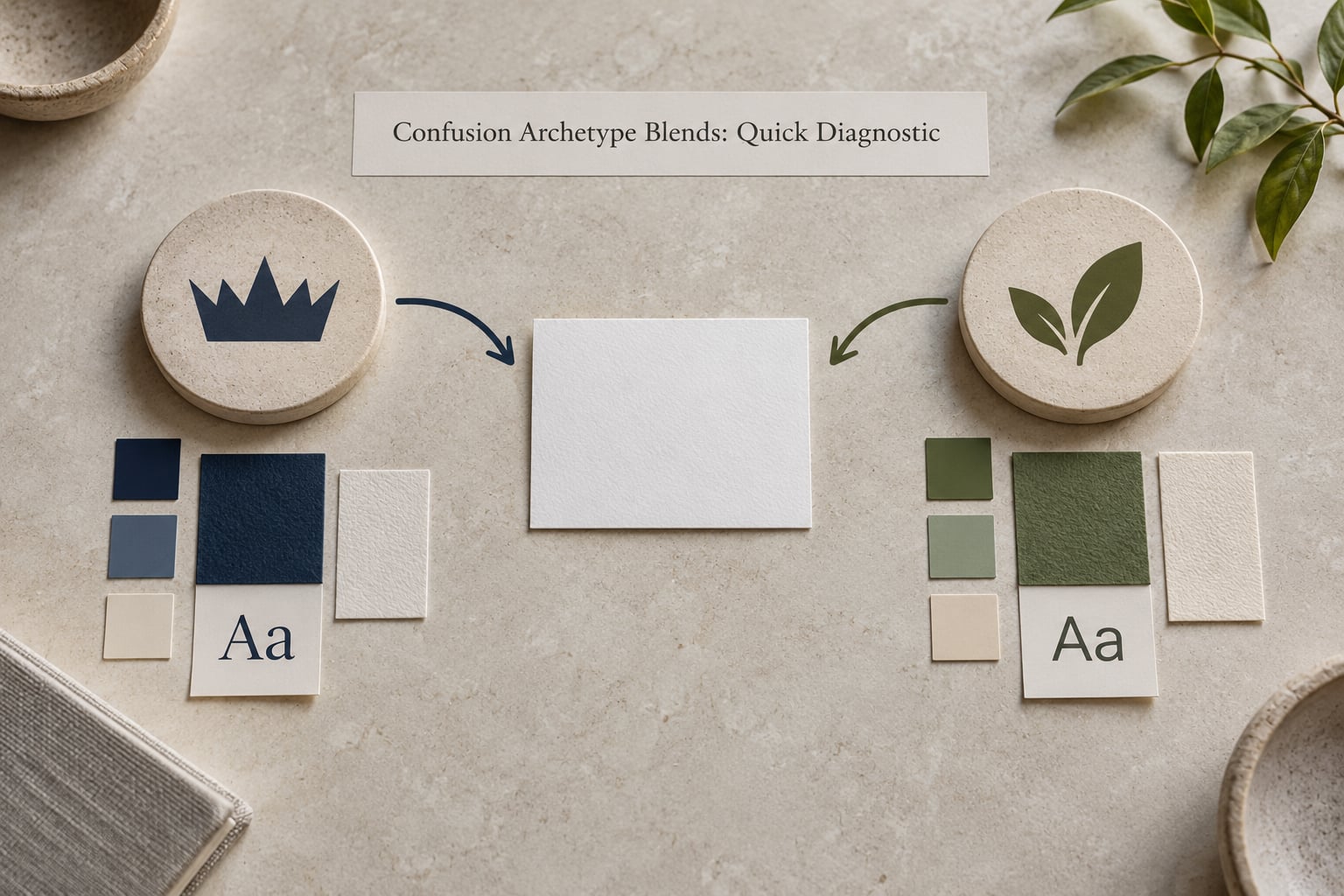
Confusion Archetype Blends: Quick Diagnostic
Score each signal on a three-step scale: clear, soft, or contradictory. Clear means one archetype can explain it with no strain. Soft means it could belong to either one. Contradictory means it actively argues against your stated position.
| Signal | What to look for | Reading |
|---|---|---|
| Positioning statement | Two brand ideas, no stated order | Contradictory |
| Logo and colour system | Two palettes or two type systems live at once | Contradictory |
| Social content | Personality flips between posts in the same week | Contradictory |
| Tagline and headline copy | Asks for trust in one asset and swagger in the next | Soft or contradictory |
| Product or service design | Range covers two personalities with no link | Soft |
| Onboarding and support | Different tone from the marketing site | Soft |
| Category entry points | Buyers place the brand in two different categories | Contradictory |
Three or more contradictory readings means the mix is not layered, it is split. Two soft readings with no contradictions means you probably have a healthy primary with useful supporting traits.
Then ask four quick questions. Do competitors describe you using one word? When you ask your team what the brand stands for, do you get one answer or three? Can a new hire say what the brand is after a week? Do your best customers use the same three words about you that your marketing does?
That last question catches more than surveys do. If loyal customers describe you differently from your own copy, the copy has drifted, not the customers.
Common Archetype Blends That Create Consumer Confusion
Not every pairing fights equally. Some archetypes share underlying values and blend well; others run on opposite assumptions about power, care and control, and those are the pairs that break in public.
| Pairing | Why they clash | Conflict | Resolution |
|---|---|---|---|
| Jester and Caregiver | Playfulness reads as unserious in health and family contexts | High | Caregiver primary, humour as seasoning |
| Rebel and Caregiver | Rule-breaking versus protection and reassurance | High | Pick one; sub-brand for the other |
| Hero and Jester | Competence and triumph versus parody of authority | High | Hero primary, use humour in supporting copy |
| Magician and Hero | Transformation through self-belief versus transformation as promise | Medium | Magician primary, evidence from Hero claims |
| Explorer and Magician | Freedom and discovery versus wonder and illusion | Medium | Rank one; keep the other in visuals only |
| Creator and Sage | Expression versus instruction; both want to be the teacher | Medium | Creator primary, Sage informs proof points |
| Everyman and Jester | Relatable honesty versus performance | Medium | Fine if humour never mocks the user |
| Ruler and Magician | Control versus illusion; can read as manipulative | Medium | Watch tone closely; Ruler needs earned authority |
| Innocent and Sage | Low rarely conflicts; values can coexist | Low | Usually safe as a primary and secondary pair |
| Lover and Creator | Shared aesthetic sensibility; few contradictions | Low | Safe pair if the audience overlaps |
Two worked examples. A beverage brand that ran a loud, irreverent identity for years, then launched a functional range with a clinical, restrained palette, produced exactly the confusion you would predict. Loyal buyers liked one version of the company and quietly skipped the other.
Compare that with a company whose identity is plainly a Sage with regular Explorer support: sober education in the core brand, adventure imagery in campaign backgrounds. One idea leads, the other decorates. Buyers describe it with the same handful of words every time.
Now the honest counterpoint. One agency position that ranks well on this query argues that brands often land on a combination of two archetypes, with one dominant, and that duos are productive and valuable. That is half right, and the missing half is the decision rule. A duo is productive when the hierarchy is explicit, written into the guidelines, and enforced across every asset. Without that, the duo is just inconsistency with better branding.
One more caution about the numbers floating around this topic. Agency content in this space frequently quotes a specific percentage revenue loss attributed to brand inconsistency, with no source attached. Treat any uncited statistic like that as a prompt to measure your own business, not as evidence.
How to Tell Whether Your Brand Is Too Confused
Your brand is too confused when different people describe it in ways that cannot both be true. That contradiction, not any single odd asset, is the reliable signal.
- Recognition is slow. Your team covers the logo in a test and people guess the category but not the brand.
- Comments answer the wrong question. Threads are full of what the company should be doing rather than whether you like the product.
- Expectations break at the point of use. Customers arrive expecting one kind of experience and meet another, especially first-time buyers.
- Segments read you differently. Your developer audience and your enterprise buyer describe two businesses with the same name.
- Competitors define you. When buyers describe you, your rival’s language shows up.
- Internal alignment drifts. Sales and marketing keep producing material that needs reconciling before it ships.
Then check the data, because internal opinion runs hot. Look for engagement that falls as spend rises, paid traffic that arrives and leaves without converting, a widening gap between prompted and unprompted brand recall, and sentiment variance where individual posts swing hard in both directions with no product news to explain it.
One caution: paid bounce rates are a symptom, not a diagnosis. A single archetype brand can have a terrible landing page, and a mixed brand can convert well when the offer is urgent. Read the numbers alongside the qualitative signs before you go changing anything.
How to Fix a Mixed Brand Archetype
Fixing a mixed brand takes one decision and six moves. The decision is which archetype leads. Everything after that is enforcement.
Choose one primary archetype
Choose the archetype that matches your purpose, the benefit you can actually evidence, and what buyers already expect from you. Purpose first, because an archetype you cannot evidence turns into a promise you break.
Then write the rank into the positioning statement in plain language: this is who we are, and this is the supporting trait we borrow from. A sentence that says which one leads is worth more than a page of personality adjectives.
Once you have it, use it to settle arguments. When someone proposes a campaign idea, ask which archetype it serves. If it serves the secondary one only, it is a candidate for a sub-brand or a partnership rather than the core identity.
Use the second archetype as support, not the story
A secondary archetype works as seasoning: it can shape colour and imagery, inform a campaign’s mood, or set tone in a specific context. It should never set the story.
Set limits and write them down. A reasonable version says the secondary archetype may influence visual styling, may appear in campaign backgrounds, and must never appear in the headline, the product promise or customer-facing onboarding.
Keep brand voice and brand tone distinct while you do this. Voice stays yours, always. Tone flexes by channel and audience. When teams confuse the two, they end up with a second personality, which is how a well-intentioned duo turns into an accident.
Remove signals that reverse the position
Go through every live surface and delete anything that argues against the primary. That includes a colour system used on some assets and not others, a tone shift in support emails, a second logo lockup nobody can explain, and category language borrowed from the other archetype.
Budget for the unglamorous part. Most mixed brands do not have a messaging problem, they have an asset inventory problem: thirty campaign templates, four logo variants and a style guide nobody opens.
Decide whether to blend or build a sub-brand
Some second ideas are too large to support. If the second archetype serves a genuinely different audience, price level or buying context, a sub-brand is the cleaner fix. Deksia makes this point usefully: diversification through brand architecture is an alternative to blending.
Use this rule of thumb. Same audience and same buying moment means blend. Different audience or a different purchase decision means sub-brand. A new line for a different job to be done is not an identity problem, it is an architecture problem.
Category expansion is the case where this gets tested hardest. A company that succeeds in one category often moves into an adjacent one where its buying logic, vocabulary and competitors all change at once. Carrying the original archetype wholesale into that market tends to produce a brand that feels imported, and blending a second archetype in tends to make it feel split. Separate naming usually wins.
Test whether the archetype mix now feels clear
Run four tests before you relaunch. An unprompted recall test with no logo, colour or category hint. An association test asking which three words come to mind. A comprehension test where people describe what the brand does in one sentence. A message reaction test on new assets, asking whether they feel on-brand.
Set the threshold before you look at the results, because it is tempting to move it. Unprompted recall up, association words concentrated on one idea, and fewer comments asking what the company stands for.
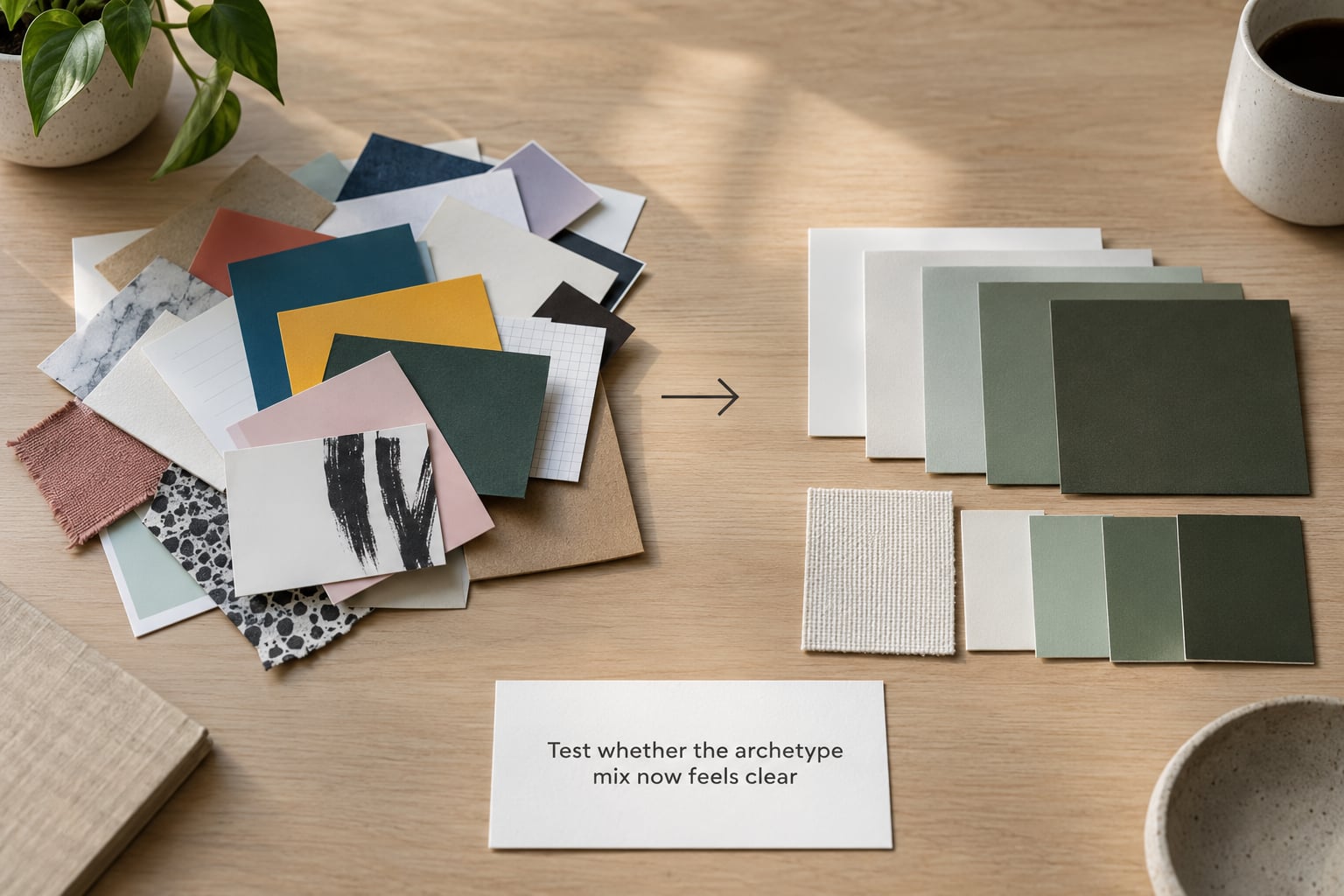
If results do not move after two rounds of changes, the problem is usually upstream. It is often the offer, the pricing or a strategy misalignment between the brand and the business, and no amount of archetype work will fix it.
Frequently Asked Questions
Can a brand use more than one archetype without confusing consumers?
Yes, as long as one clearly outranks the other and the hierarchy appears in your guidelines. The supporting archetype can shape visuals, imagery and campaign mood, but it should not carry the headline, the product promise or customer-facing onboarding. If you cannot write down which one leads, you do not have a hierarchy yet, you have two competing brands sharing a name.
What is the difference between brand flexibility and inconsistent positioning?
Flexibility means adapting how you say something while the underlying brand idea stays fixed. Inconsistency means the underlying idea itself changes, so buyers get no stable thing to recognise or recommend. A useful check: the audience should be able to describe what you stand for in the same three words across every channel and every quarter. Tone may move. The position may not.
Should a brand choose one archetype or let its audience decide?
Choose one yourself, then test it against what your audience already says about you. Audience research validates a position, it does not hand you one. Letting the audience pick sounds generous but it usually produces the average of several audiences, which is nobody’s brand. Pick the archetype your evidence supports, then check that your best customers already describe you that way.
How do you test whether consumers understand a blended brand identity?
Run four tests: unprompted recall with no logo or colour, an association test for the three words people volunteer, a one-sentence comprehension test, and a message reaction test on new assets. Compare the results against a single-archetype brand of similar size and visibility. Set your pass threshold before you start, otherwise you will rationalise whatever the numbers turn out to say.
Can changing a brand’s archetype damage its existing recognition?
It can, and the risk is highest when you change the archetype without changing the assets that carried it. Recognition lives in colour, shape, language and repeated exposure, so a repositioning that keeps those familiar elements usually survives. Reforecasting takes two to three quarters of consistent investment. If recognition matters more than repositioning, keep the primary archetype and change the expression instead.
What to Do First
Write one sentence naming your primary archetype and the secondary one that supports it. Then list every live asset that contradicts that sentence, and delete or demote the three that matter most. Ranking is the whole fix; everything else is tidying.