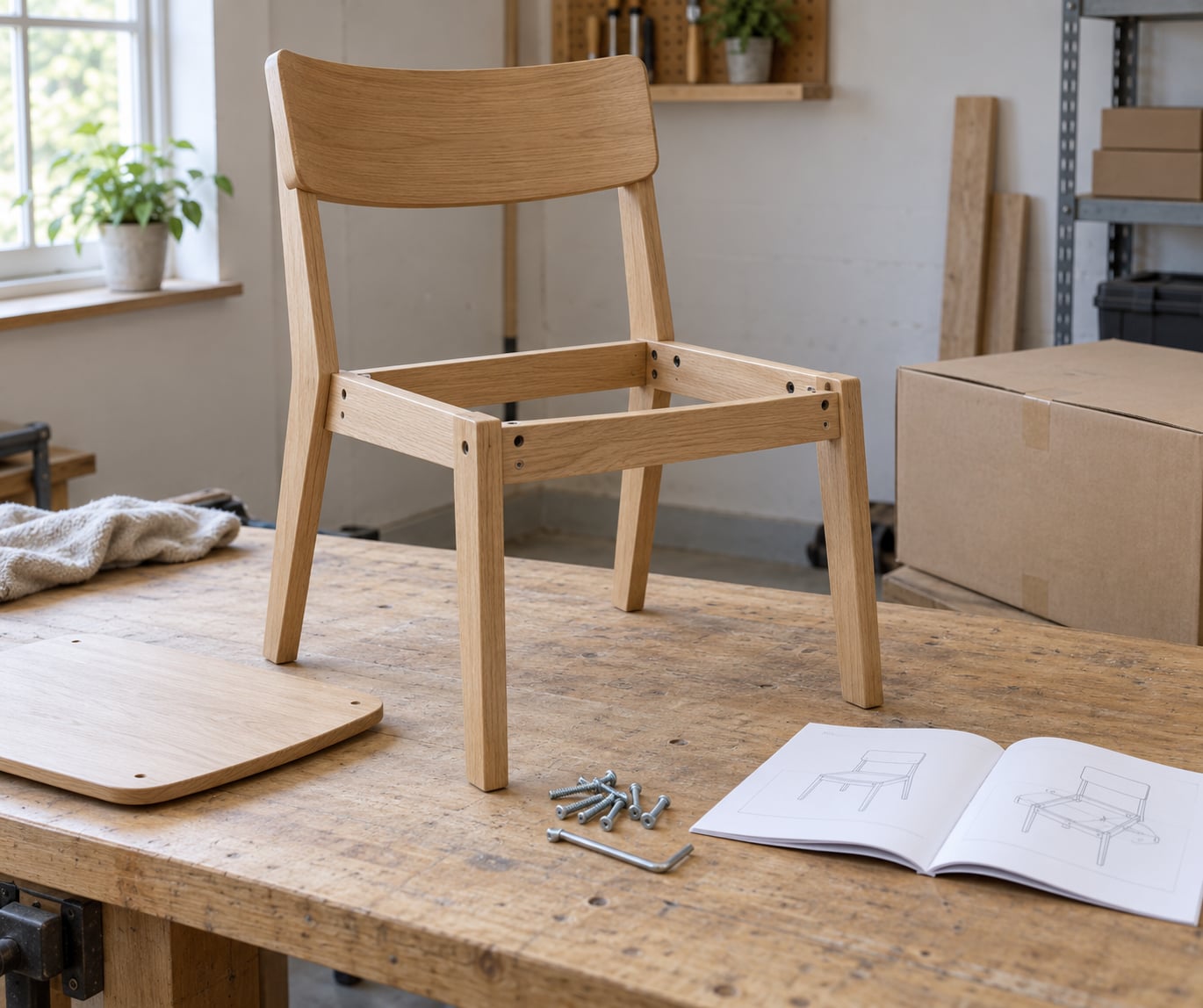
The IKEA effect raises willingness to pay because the labor you invest inflates what the finished object is worth to you. Effort creates dissonance, and the mind resolves it by rating the outcome higher. Add ownership and the satisfaction of finishing, and self-assembled goods draw bids well above pre-assembled equivalents, roughly 63% higher in the seminal experiments.
The finding comes from Norton, Mochon and Ariely’s 2011 working paper, When Labor Leads to Love: The IKEA Effect, later published in the Journal of Consumer Psychology. The furniture retailer supplied the name; the research supplied the mechanism, and the mechanism is now one of the most-cited levers in pricing and product design.
What follows is the causal chain in order, the numbers behind it, and the conditions under which it quietly fails. That last part matters more than the headline figure, because the effect only appears when the effort succeeds. A crooked drawer does not create willingness to pay. It creates a bad review.
Table of Contents
- What Is the IKEA Effect?
- How Does the IKEA Effect Raise Willingness to Pay?
- Why Does Effort Make Something Feel More Valuable?
- Does Research Really Show Higher Willingness to Pay?
- When Is the IKEA Effect Strongest?
- Does the IKEA Effect Work for Every Product?
- How Can Marketers Apply the IKEA Effect Ethically?
- What Can Brands Measure?
- Frequently Asked Questions
- Why do people pay more for something they assembled themselves?
- Does the IKEA effect make custom-made products more expensive?
- What makes an IKEA task increase perceived value?
- Is the IKEA effect the same as sunk-cost fallacy?
- How can a brand use the IKEA effect without irritating customers?
- Does unsuccessfully assembling a product still increase willingness to pay?
- Conclusion
What Is the IKEA Effect?
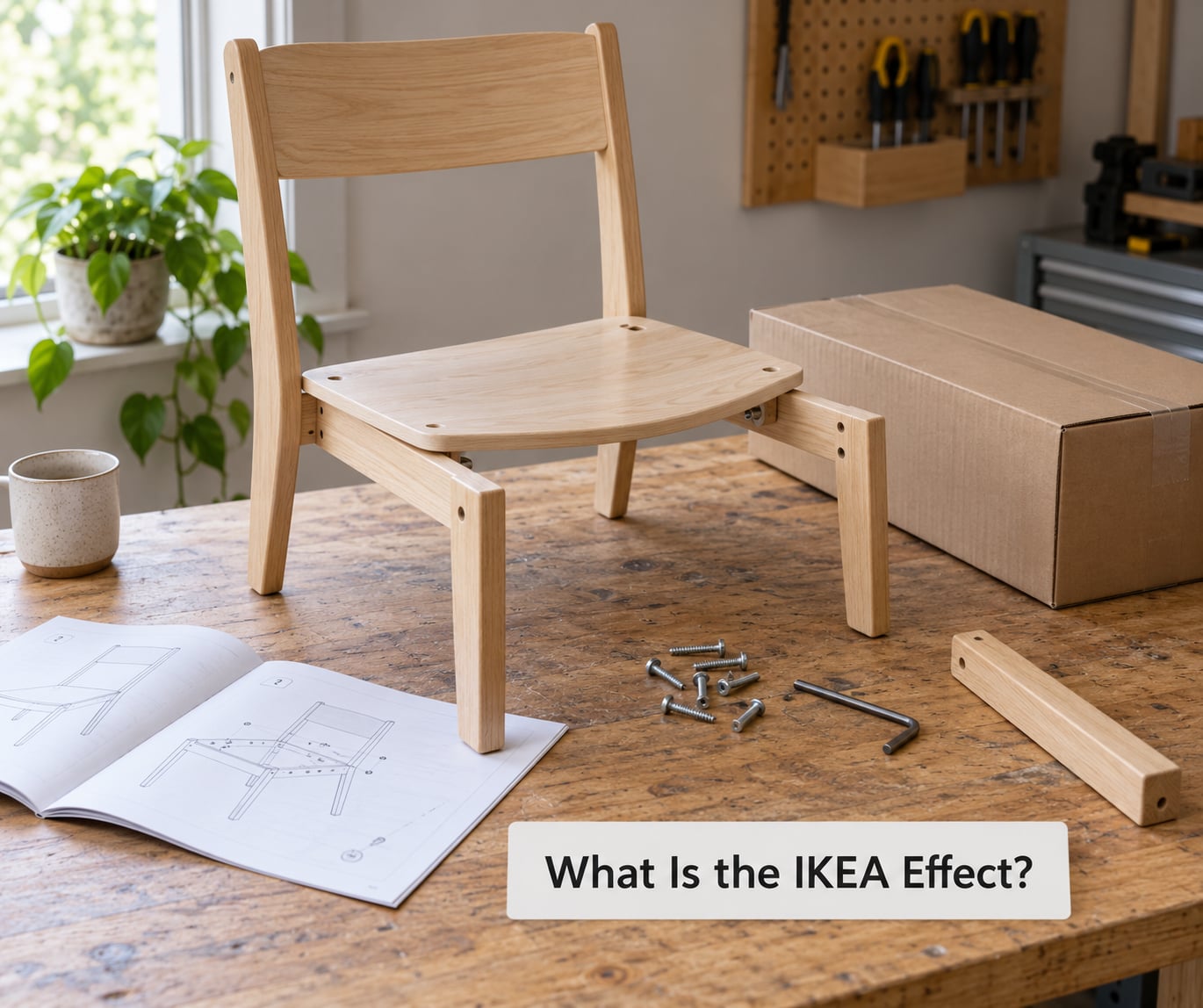
The IKEA effect is a cognitive bias in which people place a disproportionately high value on products, ideas or outcomes they have partially created themselves. The self-assembled desk is not the same object to the person who built it as the identical desk delivered ready-made, even when the two are functionally interchangeable.
Norton, Mochon and Ariely named it after the Swedish flat-pack model, where the customer takes home a carton and supplies the assembly labor. That framing is deliberate: the effect is not really about furniture. It is about any outcome where a person invests time and then has to live with the result.
Two things separate it from ordinary effort. First, the effort has to be invested in the outcome itself, not in getting access to it. Waiting in a queue is effort; assembling the product is effort in the product. Second, the task has to reach successful completion. The researchers’ own conclusion is blunt: labor leads to increased valuation only when it results in successful completion of the task.
That success condition is the part most retellings drop. It is the hinge the whole effect turns on, and it explains the experience people describe when a self-built piece of furniture ends up slightly wrong: the attachment does not survive the failure.
How Does the IKEA Effect Raise Willingness to Pay?
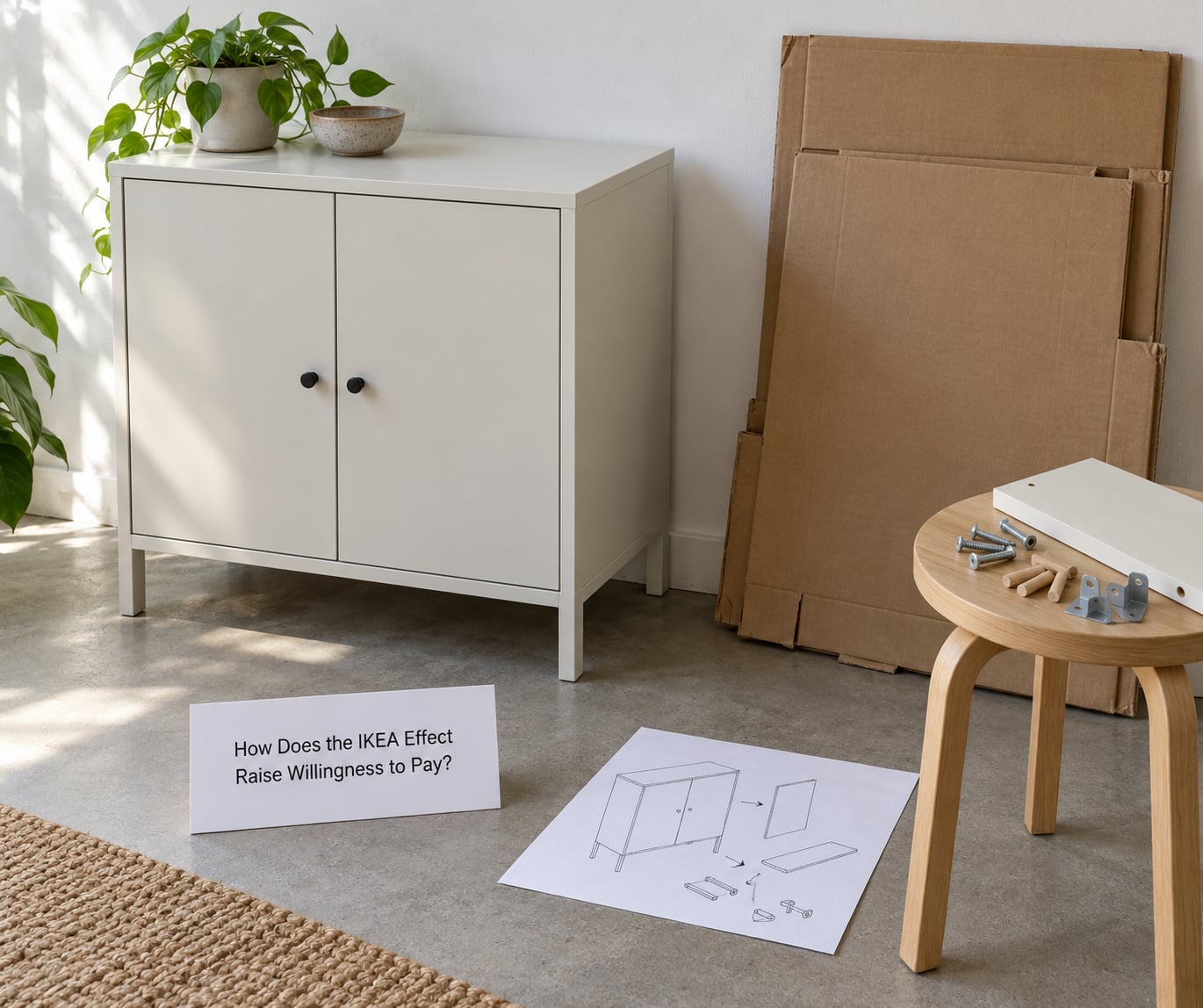
The chain runs: labor invested, value inflated, willingness to pay raised. The inflation comes from dissonance rather than from any change in the object itself. The object is exactly as functional after assembly as it would have been in a box, which is precisely what makes the valuation increase interesting to a pricing team.
The step people usually skip is the third one. Raised perceived value does not automatically become a higher price. Willingness to pay is a stated or inferred valuation; purchase behavior is a separate outcome constrained by budget, habit, trust and the alternatives on the shelf. A builder who now values the shelf more may buy a second one, or may simply defend the choice to a partner. Treat the uplift as a shift in the reference point, not as guaranteed incremental revenue.
Why Does Effort Make Something Feel More Valuable?
Five mechanisms get cited, and they overlap more than the tidy lists suggest.
- Effort justification, where the mind treats the invested time as evidence the outcome must be worthwhile.
- Endowment effect, in which possession, even imagined or temporary, raises the valuation of what is held.
- Sense of accomplishment, as finishing something difficult produces a satisfaction that transfers to the object.
- Perceived locus of causality, because people value outcomes more when they feel they caused them.
- Self-completion, where the finished piece carries the identity of the person who made it.
Read together, they describe one loop rather than five separate biases. The first three generate the feeling; the last two explain why the feeling survives long enough to change what someone will pay.
Self-completion is the piece that scales commercially. Effort spent on a task you chose, for a goal that matters to you, produces a result that carries your identity. A dentist who configures their own practice dashboard defends that dashboard differently from one that arrived pre-set, because the configuration says something about how the practice works.
Does Research Really Show Higher Willingness to Pay?
Yes, in controlled settings, and the effect sizes are large enough to notice. The classic study used real money rather than hypothetical intent, which is what gives it weight in pricing conversations.
| Task | What participants did | Willingness-to-pay result |
|---|---|---|
| Self-assembly box | Built a small box from parts, or received the same box pre-assembled | Self-assembled box drew roughly 63% higher willingness to pay |
| Origami | Folded a paper crane themselves, or received one already folded | Self-folded items drew bids of roughly double the pre-assembled ones |
| Real-money bids | Bid on a completed or unbuilt box using money at stake | Builders averaged 78 cents against 48 cents for non-builders (standard deviations of 0.63 and 0.40) |
| Build-A-Bear style customization | Chose, filled and dressed a plush item | Used widely as an illustration of the effect; not a controlled condition in the original paper |
| IKEA effect versus trophy (Bühren, 2020) | Compared a self-assembled object with a won award | Trophy winners showed a stronger willingness-to-pay link, which the authors read as a limit on the IKEA effect alone |
Two methodological points deserve more attention than they usually get. First, willingness to pay was measured with incentive-compatible mechanisms, where participants could actually win what they bid on. Stated-preference surveys without that consequence systematically overstate what people will pay, and the difference between the two methods is often larger than the effect being studied.
Second, the 63% figure circulates far beyond its context. It comes from one condition in one study, with student and consumer-participant samples, on simple objects. The honest way to use it is as evidence that the effect is real and potentially large, not as a margin assumption for your own catalogue.
Replication is the other open question. The mechanism is not in serious dispute, but the magnitude varies with task and population, and the 2020 comparison work found the IKEA effect did not clearly beat a simpler story about status objects. Practitioners tend to land in the same place: they accept the direction and argue about the size.
When Is the IKEA Effect Strongest?
Five conditions reliably strengthen it, and they are worth treating as a checklist before you design an effortful step into a product.
- The task is chosen, not imposed. Voluntary effort reads as self-expression; mandated effort reads as a tax.
- The effort is meaningful to the person. Effort tied to a goal they hold raises value more than effort tied to yours.
- The task is completed successfully. Incomplete or technically poor work reverses the effect.
- The outcome is genuinely improved by the work. Self-made goods valued less than store-bought ones when the self-made version was objectively inferior.
- The result expresses identity. Personalisation that reflects who the customer is outperforms personalisation that reflects who you are.
The failure modes are just as instructive. Effort that produces a worse result than the alternative gives people something to complain about rather than something to defend. Effort that is long rather than meaningful produces abandonment. And effort imposed on someone with no choice can produce the opposite of attachment, because the only thing the customer can express is resentment.
There is also a timing component. The effect is strongest while the labor is recent and the outcome is visibly new. A shelf assembled on Saturday and listed for sale three months later carries very little of it.
One counter-argument deserves a fair hearing, because it is raised often: flat-pack furniture is cheaper than assembled furniture, so does the effect really raise willingness to pay, or does the retailer simply discount the labor? Both can be true. Willingness to pay and the price actually charged are different quantities, and a retailer can harvest the participation effect while still discounting the labor component. The studies measured the first, not the second.
Does the IKEA Effect Work for Every Product?
It works where the customer can plausibly make the outcome better for themselves, and it fails where the work is pure friction with no contribution to the result.
Physical assembly is the clean case. Flat-pack furniture, model kits and craft kits all let the customer produce something that fits their space, their display, their taste. The customization counter is the same, except the customization happens at the point of assembly rather than through a dropdown.
Digital products work when there is real configuration to do. Setting up a dashboard, choosing a notification policy, connecting an integration, naming a workspace: each is a small assembly task with a real outcome. The effect does not attach to a toggle that has no consequence.
Services are mixed. A client who shapes a brief, plans a route or assembles a meal plan participates and usually values the result. A client made to fill in a twelve-field intake form to qualify for a discount is doing admin, and no amount of branding changes that.
Subscriptions are the hardest case. Ongoing chores rarely produce the completion event that the effect needs, and a settings screen you visit once is not the same as a table you assembled with your hands. The strongest digital version of this effect I have seen is in onboarding: a first session where the customer’s own choices shape a working setup they will actually use.
Routine and replenishment purchases are where the effect mostly does not apply. Nobody wants to participate in a coffee subscription. The effort has to be worth something to the person, or it is just friction wearing a marketing hat.
How Can Marketers Apply the IKEA Effect Ethically?
Six applications hold up, and each one has a version that is manipulative and a version that is useful. The difference is whether the customer’s labor improves the product or merely protects your margin.
- Customization with visible consequences, where the customer’s choices change what the product actually does, and they can see the difference afterwards.
- Configuration at the point of assembly, letting a shopper specify dimensions, finish or layout before the item is built to order.
- Education before purchase, where a short course or a well-written guide makes the customer competent enough to succeed at the task they are about to attempt.
- Packaging as a genuine experience, treating the unboxing as something worth designing rather than as a container that happens to be opened once.
- Onboarding that builds rather than collects, constructing a working setup in the first session instead of asking for information in twenty screens.
- Post-purchase participation, through repair guides, refill systems or configuration updates that reward the owner for engaging with what they already own.
The line is straightforward. If removing the effort would make the product worse for the customer, you are co-creating. If removing the effort would only make your process cheaper, you are manufacturing friction, and the success condition will eventually fail for a share of customers who do not enjoy it.
Three specific mistakes to avoid. Do not add difficulty to justify a higher price; that is a pricing strategy wearing a psychological costume, and it fails exactly where completion is hardest. Do not hide costs inside the task, because effort plus surprise is not engagement. And do not frame participation as a favour to the brand, since the effect depends on the customer’s sense of ownership, which evaporates when the effort is transparently about them.
On the copy side, persuasive text research suggests the effect carries into language as well as assembly. Writing that describes the customer as the maker rather than the buyer shifts the same mechanism without adding any work, which makes it the cheapest version of this to test.
What Can Brands Measure?
The honest answer is that no single metric proves the effect is operating. Each one supports an inference and none closes the case alone.
- Conversion rate shows whether participation changed behaviour, but not whether valuation rose.
- Willingness-to-pay research, using incentive-compatible bidding or conjoint analysis, measures the valuation itself and is the only method that speaks directly to the claim, at the cost of realism and money.
- Completion rate on the effortful step is the leading indicator. Falling completion predicts the failure condition, so it is worth watching weekly.
- Satisfaction and return rates separate good effort from bad effort, since the difference shows up as defects and returns rather than as complaints.
- Retention and referral capture the long-run form of the effect, where owners defend and recommend what they built, though attribution takes a long time.
Stated-preference surveys sit at the bottom of that list. People are good at describing what they would pay and poor at doing it, especially for a product they have already invested time in.
Frequently Asked Questions
Why do people pay more for something they assembled themselves?
Because investing labor in an outcome inflates how valuable it feels, and the increase survives into valuation. Norton, Mochon and Ariely found that people who built a box themselves bid about 63% more than people who received the same box pre-assembled. The object is unchanged; the owner’s valuation of it is not.
Does the IKEA effect make custom-made products more expensive?
It can, when the customization is meaningful and the customer made the choices. It is not automatic, and it is not a pricing formula. Two conditions do most of the work: the effort must be chosen rather than imposed, and it must produce a result the customer considers successful. Miss either one and the uplift tends not to appear.
What makes an IKEA task increase perceived value?
Effort tied to a task the customer chose, that ends in completion, and that improves the outcome rather than merely delaying it. Perceived value rises most when the finished object reflects the person who made it, so personal relevance matters more than the amount of time spent.
Is the IKEA effect the same as sunk-cost fallacy?
No, though the objection comes up constantly. Sunk-cost fallacy describes continuing an activity because of money already spent. The IKEA effect describes valuing an outcome more because of labor invested, and it depends on task completion rather than on irrecoverable expense. The two can overlap in a subscription or a hobby, which is where the confusion starts.
How can a brand use the IKEA effect without irritating customers?
Make the labor improve the product for that specific customer, and let them finish it. Configuration that changes the outcome, onboarding that produces a working setup, and a first session that ends with something usable all qualify. A long form or a fiddly registration step does not, because it creates work without creating value.
Does unsuccessfully assembling a product still increase willingness to pay?
No, and this is the boundary most retellings miss. The original research concludes that labor raises valuation only when the task is completed successfully. Self-made goods that were objectively worse than the store-bought version were valued less, not more, which is why a completed task is the unit of analysis rather than effort spent.
Conclusion
The causal chain is short: chosen effort, successful completion, inflated perceived value, higher willingness to pay. Remove any link and the effect weakens or reverses. The first practical step for a brand is to find one place where a customer’s participation genuinely improves what they get, rather than a place where participation would simply protect a margin.