
Commitment and consistency is Robert Cialdini’s second principle of persuasion: once a person makes a voluntary, public or explicit commitment, they feel an internal pull to behave in ways that match it. That is how commitment and consistency drive repeat purchase — the second order stops feeling like a fresh decision and starts feeling like the obvious continuation.
The reason that matters commercially is simple. A repeat purchase usually happens when the customer no longer re-evaluates the product, and that is a different event from satisfaction. This guide covers the mechanism, the evidence behind it, the triggers that carry the most weight, and how to build the pattern without engineering fake yeses.
Table of Contents
- What Is Commitment and Consistency in Consumer Behavior?
- How Commitment and Consistency Drive Repeat Purchase
- The four-step chain from a first yes to a second order
- What the founding experiments actually measured
- What Makes Customers Stay With a Brand After the First Purchase?
- The product has to perform as promised
- The effort has to be matched to the value
- Other people have to be visible
- Trust has to compound across touchpoints
- There has to be an emotional reason, not just a functional one
- Which Commitment Triggers Lead to the Strongest Repeat Purchases?
- How Can Marketers Apply Commitment Without Manipulating Customers?
- Three anti-patterns that break the mechanism
- How Do You Measure Whether Commitment Is Working?
- Sources cited
- Frequently Asked Questions
- Is repeat purchase always a sign of brand loyalty?
- What is the difference between commitment and consistency in marketing?
- Do loyalty programs make customers buy more?
- How do subscriptions encourage repeat purchase without pressure?
- What is a good second-purchase rate for a new product?
- Can brands build loyalty when products are bought only occasionally?
- Conclusion: Start With One Reliable Reason to Return
What Is Commitment and Consistency in Consumer Behavior?
Commitment is the decision itself: the opt-in, the first order, the membership, the referral, the promise made in public. Consistency is the pressure that follows, the tendency to behave in line with what you have already done.
Two things sit next to this in most marketing writing and are worth separating from it. Familiarity is knowing a brand exists — it makes buying slightly faster, not more likely. Convenience is a short delivery or a stored card — it makes the second order effortless, but the customer feels nothing about it and drifts the moment it lapses. Commitment is the one that changes self-image.
Self-perception theory, set out by Daryl Bem in 1972, supplies the explanation. Bem argued that when internal cues are weak, people infer their own attitudes by watching their own behaviour. A customer who picked this brand, paid for it, and told a friend about it has evidence, and the easiest reading of that evidence is that they are someone who chooses this brand.
Not every small action counts as a real commitment device. Four qualities separate the ones that last from the ones that evaporate:
- Voluntary — the customer chose it freely, without a condition attached.
- Public — somebody else knows, whether a colleague, a friend or an audience.
- Explicit — it was stated as a commitment, not inferred from behaviour.
- Costly — it took effort, money or time to make.
A newsletter opt-in that took eleven seconds, with no frequency stated, clears one of those bars at best. A plan chosen deliberately, with an effort involved, clears all four — and that is why subscription and loyalty mechanics outperform one-off discounts at holding attention.
How Commitment and Consistency Drive Repeat Purchase
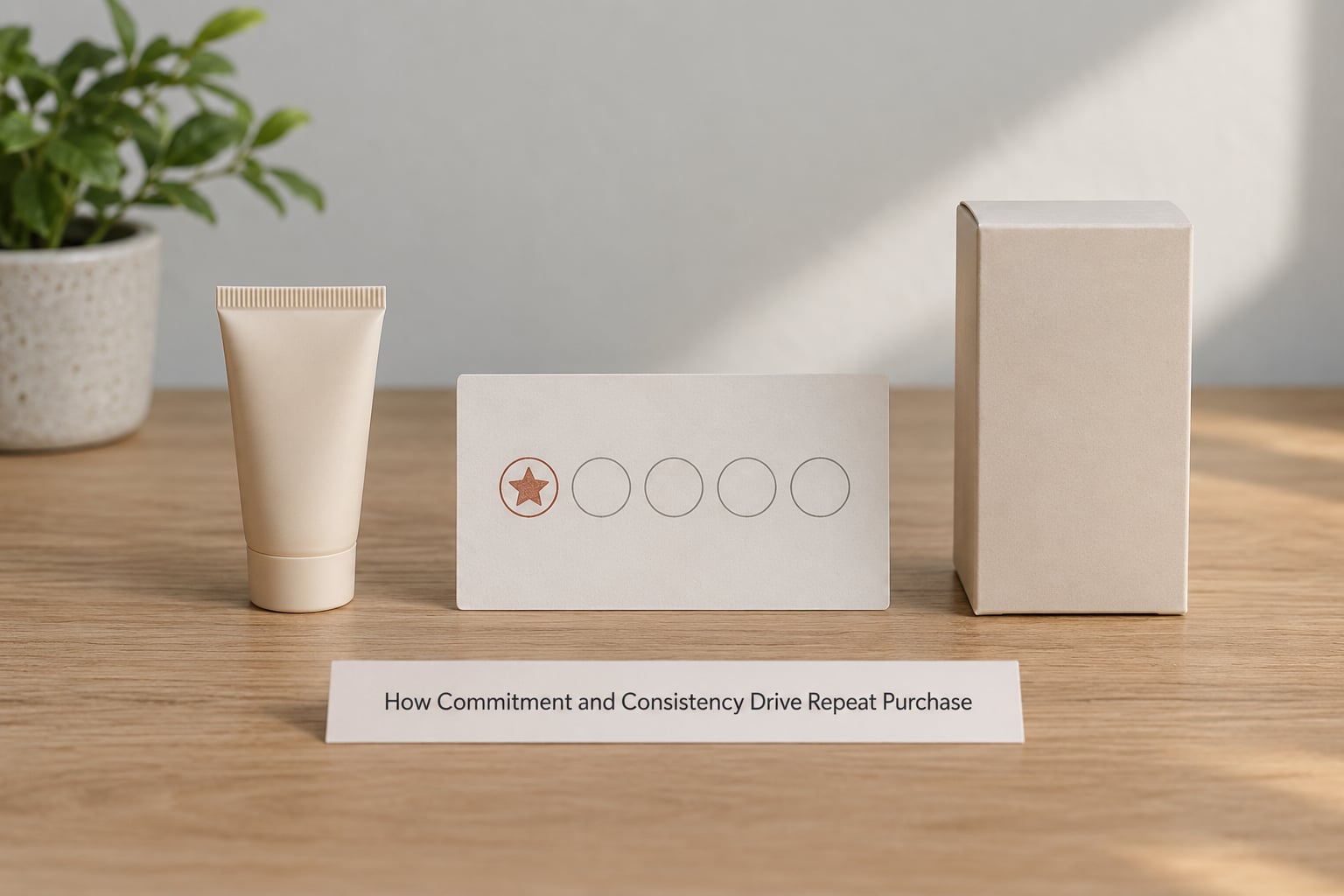
The chain runs in four steps, and every step removes something from the decision the customer used to face.
The four-step chain from a first yes to a second order
- Commitment — the customer acts: subscribes, orders, joins, refers.
- Self-image update — the action becomes evidence about who they are, which is the step Bem described.
- Expectation alignment — a customer who sees themselves as a regular buyer starts reading the next interaction as routine rather than as a claim to be evaluated.
- Lowered friction and risk — the next purchase needs less searching, less comparison and less reassurance, so it happens sooner and more often.
That last step is the commercial one. Repeat purchase is cheaper to win than a first purchase, and a customer working from an updated self-image reaches the order with far less deliberation.
What the founding experiments actually measured
Freedman and Fraser’s 1966 study, published in the Journal of Personality and Social Psychology, put the effect size on the record. Householders who agreed to a small request first — a window sign for a safety campaign — were far more likely to agree to a much larger later request, such as installing a large outdoor display board, than were householders who had refused the small request first.
The often-quoted split from that work is roughly 55% compliance for those who had already said yes against about 17% for those who had said no. The small request was not persuasive on its own. It worked because it created a record that later behaviour tried to stay coherent with.
Cialdini took this from a laboratory setting into selling and marketing in Influence: The Psychology of Persuasion. The useful translation for a retention team is that the first commitment is not the goal. It is the setup for the second one.
What Makes Customers Stay With a Brand After the First Purchase?
A commitment starts a pattern; something has to keep it running. In practice five conditions do most of the work, and none of them is a discount.
The product has to perform as promised
Everything else rests on this. A commitment made against a weak expectation turns into regret, and regret resolves in the direction that costs you least — a bad review, a refund, silence.
The effort has to be matched to the value
A large first order or a considered configuration raises the stakes and makes the customer more likely to look for a second use. Effort that feels like friction, on the other hand, gets remembered as a hassle and suppresses the next order.
Other people have to be visible
Reviews, photos, referral threads and shared recommendations turn a private decision into a social one. That public layer makes quitting more awkward, which is a real effect but a fragile one if the underlying product drifts.
Trust has to compound across touchpoints
Forum practitioners describe retention as small consistent actions stacking up: fast callbacks, remembered preferences, proactive delivery updates. Customers read consistency as a rational signal of stability, and stability supports a higher price at the second order.
There has to be an emotional reason, not just a functional one
Function says refill the bottle. Feeling says this is the brand for my kitchen. Only the second one survives a price comparison, a cheaper alternative and a slow month.
Which Commitment Triggers Lead to the Strongest Repeat Purchases?
Not all commitments are equal. The strength of the resulting repeat purchase tracks with how deliberate the act was and how visible it was.
| Commitment trigger | How it is built | Expected effect on repeat purchase |
|---|---|---|
| Completed first purchase | A real order, delivered and used | Baseline self-image update; strongest when the product performs as described |
| Subscription or replenishment | A chosen cadence with a stated delivery date | Highest consistency of all: the next order stops being a decision at all |
| Membership or tier | Enrollment, sometimes with an upfront fee | Public and costly, so it survives small price gaps |
| Referral or review | A public act in someone else’s eyes | Strongest social layer, plus advocacy that acquires new customers |
| Small repeated actions | Reading, saving, configuring, returning to a saved list | Weak alone, compounding fast when accumulated across visits |
The subscription row is the reason replenishment categories convert repeat purchase so easily. Once a delivery date exists, the customer is no longer choosing a brand on the day they order; they are confirming something already set up.
Small repeated actions are the underrated row. A visitor who reads, saves and returns several times has built a record without ever being asked for anything formal, and when they finally buy, that first order lands on top of an existing self-image rather than starting from nothing.
One widely reported benchmark puts loyalty programme members at roughly 2.5x to 3.1x higher repeat purchase rates than non-members, with the gap widening as the programme matures. Treat that as a directional signal rather than a promise, since mature programmes mostly attract customers who were already repeat buyers.
How Can Marketers Apply Commitment Without Manipulating Customers?
The principle is neutral. A mechanism that makes people more self-aware about their choices is useful; the same mechanism aimed at making them stop noticing is a dark pattern. The line is whether the customer would still call the commitment voluntary after thinking about it.
A workable framework:
- Set expectations you can keep. If you promise monthly delivery, ship monthly. Most trust damage in this area comes from over-promising, not from persuasion.
- Make the terms clear at the moment of commitment. Frequency, price and how to leave belong in the signup, not in the small print nobody opens.
- Keep cancellation as easy as joining. A cancellation flow that takes four screens converts a loyal customer into an ex-customer and tells everyone watching.
- Reward the behaviour you actually want. Points for repeat orders are fine; points that make the second order more expensive to skip are not.
- Ask once, and let silence be an answer. Consent that has to be re-earned every month is not commitment, it is nagging.
Three anti-patterns that break the mechanism
An engineered yes ladder stacks cheap requests until the larger one feels inevitable. Customers recognise it, and the consistency pressure turns into resentment. Lowballing works the same way in reverse — a low opening price that rises later exploits the sunk cost of the customer’s own commitment, which reliably produces churn and bad reviews. Escalation of commitment pushes customers to defend a bad decision with a bigger one, and the result is a customer who blames you for their own choice.
If you want a fast self-check, apply the time-machine test: would this customer still choose the same arrangement in a year, knowing what they know now? Genuine commitment survives that question. Engineered commitment cannot survive it.
How Do You Measure Whether Commitment Is Working?
Repeat purchase rate on its own tells you that something happened, not what caused it. The commitment metrics sit one step earlier in the chain, and they show you which link is weak.
| Metric | What it signals | How to read it |
|---|---|---|
| Commitment device opt-in rate | Whether the invitation is clear and valued | A low rate points at unclear value, not at a weak mechanism |
| Second-purchase rate | How much of the self-image update converted | The cleanest single test of the mechanism; compare against signup cohorts, not monthly totals |
| Purchase frequency | Whether the pattern has settled into routine | Rising frequency with flat second-purchase rate means you are retaining the same cohort, not converting new ones |
| Time between orders | How much friction the second order still carries | Shortening intervals point at replenishment and subscription mechanics working |
| Subscription renewal and churn | Whether the promise held | Churn spikes in the second term usually mean the first delivery disappointed |
| Referral rate | Whether commitment went public | Referrals per active customer, not total signups |
| Cohort retention | Whether the pattern survives time | Plot by signup cohort; averages hide a cohort that never converted |
Read these by cohort. A blended monthly average can look healthy while the cohort you enrolled six months ago quietly stalled.
There is also a quality check on the metric itself. If second-purchase rate rises only when discounting deepens, you did not build commitment, you trained customers to wait. Genuine commitment shows up as repeat purchase at full price and shorter cancellation rates.
Sources cited
- Cialdini, R. B. — Influence: The Psychology of Persuasion.
- Freedman, J. L. and Fraser, S. C. (1966) — foot-in-the-door compliance without pressure, Journal of Personality and Social Psychology.
- Bem, D. J. (1972) — self-perception theory, Advances in Experimental Social Psychology.
- Loyalty programme repeat purchase lift and brand consistency revenue figures as reported in industry write-ups from rivo.io and brandquantum.com.
Frequently Asked Questions
Is repeat purchase always a sign of brand loyalty?
No. Repeat purchase can come from habit, convenience, a locked-in subscription or simple inertia, none of which is loyalty. Loyalty is a preference that survives a competitor offering something better or cheaper. The distinction matters when you read your numbers: check whether second purchases hold at full price, whether they continue after the reorder reminder stops, and whether customers describe the brand positively when asked.
What is the difference between commitment and consistency in marketing?
Commitment is the decision a customer makes: subscribing, ordering, joining, referring. Consistency is the pressure that follows, the internal pull to behave in line with what they already did. In marketing terms, the commitment device is the thing you build and the consistency is the behaviour you get back. Forum users often separate both further from loyalty, which is a felt state rather than a recorded decision.
Do loyalty programs make customers buy more?
They usually help, though the honest answer is that the lift is smaller than the marketing suggests. Widely reported figures put members at roughly 2.5x to 3.1x the repeat purchase rate of non-members, but mature programmes disproportionately attract customers who were already repeat buyers, so part of that gap was there beforehand. Programmes work best as a reason to keep choosing you, not as the reason customers choose you in the first place.
How do subscriptions encourage repeat purchase without pressure?
They remove the decision rather than applying pressure to it. A stated cadence turns replenishment into a confirmed arrangement, so the customer is not arguing themselves into buying again. Keep the terms clear at signup, ship on the schedule you promised, and make cancellation as easy to find as the join button. Anything that traps a customer past a stated end date works against the same mechanism it claims to strengthen.
What is a good second-purchase rate for a new product?
It depends on the category, so treat any single benchmark with caution. Replenishment categories routinely convert the majority of first buyers into second buyers, while considered purchases and durable goods sit far lower. The more useful comparison is your own cohort history, tracked from signup month rather than blended into a monthly average, because a rising second-purchase rate in a healthy cohort means far more than an impressive industry average.
Can brands build loyalty when products are bought only occasionally?
Yes, but the design changes. Where repeat purchase is rare, consistency of experience and service carries more of the load than purchase frequency does. Fast callbacks, remembered preferences, proactive updates and steady delivery standards give customers repeated evidence that the brand is reliable between the rare orders. Annual and seasonal buyers rarely need a loyalty programme; they need a brand that behaves identically every time they come back.
Conclusion: Start With One Reliable Reason to Return
Commitment and consistency drive repeat purchase because the first decision changes how the second one is processed, not because the customer re-evaluated the product and liked it more. The first order, the opt-in or the referral creates a self-image, and later behaviour gets pulled toward that image with far less friction than a cold start would carry.
So start where the chain starts. Fix the first experience so the commitment is built on something true, give the customer one clear reason to come back, make that next action easy rather than repeated, and then measure repeat purchase by cohort at full price. If those four hold, the mechanism works for you. If they don’t, more prompts will not save it.