Galvanic skin response (GSR) is the small change in the electrical conductivity of the skin that happens when sweat glands fill, and understanding how galvanic skin response works in research means following one chain: a stimulus lands, the sympathetic nervous system activates, eccrine sweat glands start filling, skin conductance rises, and an amplifier turns that change into a number in microsiemens. Because nobody can consciously switch sweat secretion on or off, researchers treat it as an involuntary index of how strongly a person was aroused. It tells you intensity, not whether the feeling was pleasant.
Here is the short version most researchers need before they book a lab.
- GSR, electrodermal activity (EDA), skin conductance and skin conductance response (SCR) all name the same thing recorded through skin electrodes.
- The signal is driven by sympathetic sudomotor activity, so it indexes arousal intensity rather than emotion type or emotional valence.
- Skin conductance and skin resistance move in opposite directions, because conductance is the reciprocal of resistance.
- A recording splits into a slow tonic level (skin conductance level, SCL) and discrete phasic responses to specific stimuli.
- Amplitudes cannot be compared between people or between devices without a within-subject baseline, so a raw figure on its own is close to meaningless.
Table of Contents
- What Is Galvanic Skin Response?
- How Galvanic Skin Response Works in a Typical Study
- How the measurement chain runs in five steps
- What Does a Galvanic Skin Response Measurement Mean?
- How Is Galvanic Skin Response Used in Market Research?
- How Do Researchers Record Galvanic Skin Response?
- What Factors Can Affect the Results?
- How Is Galvanic Skin Response Analyzed?
- What Are the Limitations of Galvanic Skin Response Research?
- How Can Researchers Improve the Reliability of a Study?
- Frequently Asked Questions
- What does galvanic skin response tell us?
- What does GSR stand for in psychology?
- What does a high GSR reading mean?
- Is galvanic skin response the same as lie detection?
- How long should a GSR study or stimulus last?
- When should a researcher combine GSR with interviews or other measures?
- Conclusion
What Is Galvanic Skin Response?
Galvanic skin response is a psychophysiological measure of how much the skin’s electrical properties shift with sweat gland activity. The same measurement appears in the literature under several names, and they are interchangeable in practice.
GSR, electrodermal activity and skin conductance are the three labels you will meet most. Skin conductance response, or SCR, refers specifically to the discrete phasic spike that follows a specific event, while skin conductance level, or SCL, refers to the slowly drifting baseline underneath those spikes.
The physiology is straightforward. Eccrine sweat glands are densely packed on the palms and soles, roughly a thousand glands per square centimetre, and they empty onto the skin surface rather than into a duct. As the glands fill, they raise the conductive surface area of the skin, so conductance goes up and resistance goes down. The trigger is cholinergic sympathetic sudomotor activation, which is one arm of the autonomic nervous system’s fight-or-flight response.
That is also why GSR is not a heart rate measure, and not a general “stress” reading. It has no direct relationship to cardiac output, it responds to a narrower set of events than the heart does, and it says nothing on its own about whether a reaction was pleasant, painful, or boring. Researchers who blur those lines end up with conclusions they cannot defend.
How Galvanic Skin Response Works in a Typical Study
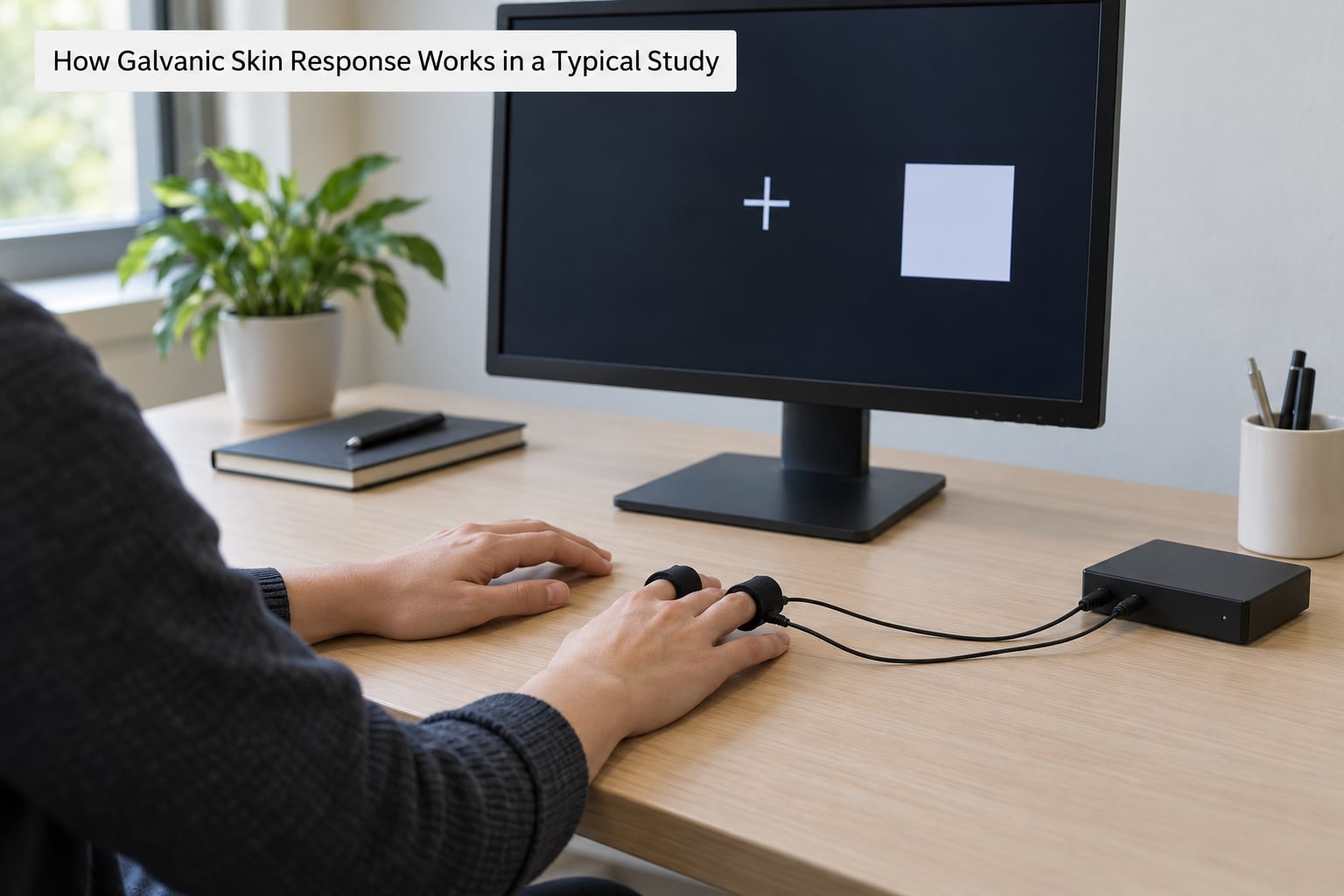
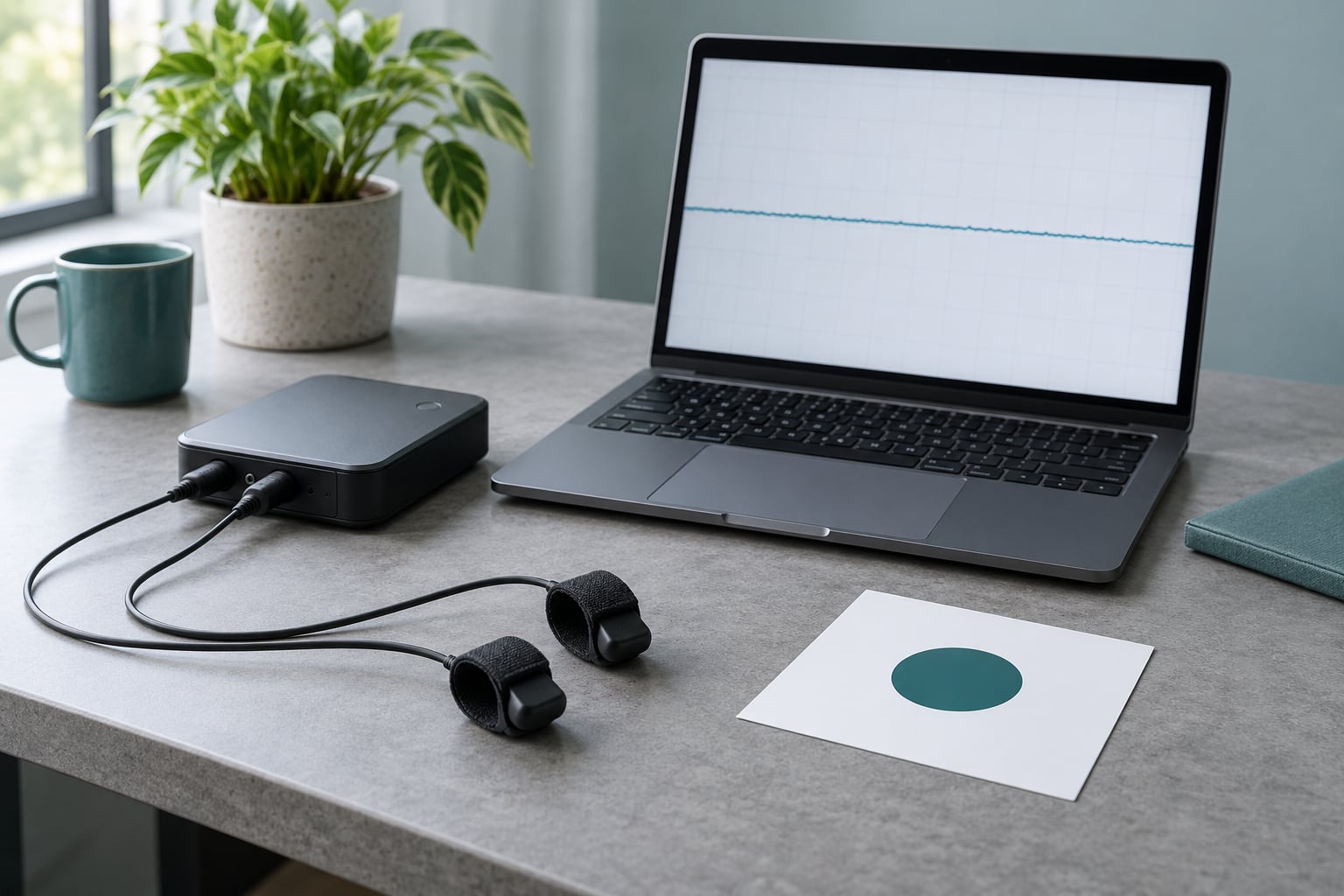
On the hardware side, the setup is deliberately plain. Two electrodes go on the index and middle fingers of the non-dominant hand, a small current passes between them, and the system reports the resulting conductance. Finger placement is standard because palm and finger skin carries the highest gland density available without invasive measurement.
How the measurement chain runs in five steps
- Attach the electrodes. Two gel or dry electrodes sit on adjacent fingers of the non-dominant hand. Poor contact produces drift and noise that no amount of later filtering removes cleanly.
- Apply a low excitation voltage or current. Constant-voltage and constant-current systems both work. Constant-current designs are common in lab equipment because the reported value stays stable as skin properties change.
- Convert and digitise. An amplifier measures the difference and a digitiser samples it, usually at 32 Hz or higher. The output is conductance in microsiemens, the same unit historically written as micromho.
- Record a baseline and present stimuli. A quiet rest period establishes the participant’s own reference level. Stimuli then run for at least five seconds each, because the electrodermal response lags its stimulus by roughly one to five seconds.
- Mark the events and save the trace. Each stimulus, response and rest window gets an event marker so analysis can slice the continuous signal into windows later.
The lag is the detail that catches out beginners. Present a two-second image, take the next stimulus immediately, and the responses arrive after the stimuli have gone, tangled together and impossible to attribute. Five seconds of stimulus plus a short calm interval is a workable default.
What Does a Galvanic Skin Response Measurement Mean?
Researchers read a GSR recording in two layers, and confusing them produces nonsense. The tonic layer, SCL, is the slow drift in the participant’s general level of sympathetic activation across the session. The phasic layer, SCR, is the set of discrete responses that follow identifiable events.
What a phasic response supports is narrower than most non-specialists assume. A clean SCR after a stimulus tells you the participant registered something, that the moment had some relevance to them, and that it produced arousal worth orienting toward. It can reflect an orienting response to something simply new, a sign of cognitive effort, a change in task difficulty, or genuine emotional arousal. Those causes are not distinguishable from the electrodermal trace itself.
What it cannot support is a valence claim. The same amplitude pattern appears for an appealing advertisement, an unpleasant one, and a genuinely stressful one. Two conditions that differ only in whether participants liked the content can produce identical or even opposite-looking conductance, and telling them apart needs self-report, interview, or another modality.
Tonic drift is a different animal again. A slow climb over a session usually reflects adaptation, ambient temperature, participant anxiety about the study, or slow physical changes, not a sequence of emotional events. Many analysis pipelines remove the tonic component before looking at responses, and that is usually the right call.
How Is Galvanic Skin Response Used in Market Research?
For consumer and insight teams, GSR earns its place because it captures reaction in the moment, before people edit their answers into something presentable. It is not a replacement for asking, though. It is most useful as a second channel next to a question.
Advertising and copy testing. Researchers show stimuli and measure which frames produce responses, then compare with recall and liking. A high response with low recall points to a strong but unremembered moment. Useful research question: which headline produces the strongest orienting response before the first product shot?
Packaging and shelf impact. This is where the method earns its keep. Eye-tracking measures such as fixation, dwell time and approach behaviour are read alongside conductance, which flags the pack that holds attention but fails to convert it.
Concept and early-stage work. Because verbalised concept reactions are so heavily influenced by what people think the researcher wants, a continuous physiological trace acts as a partial corrective.
Website, app and in-store experience. Task-level spikes identify friction points in usability testing without requiring the participant to verbalise frustration mid-task.
The honest summary is that GSR sharpens a finding, it does not produce one on its own. Teams that report “this pack scored higher on arousal” have a useful observation. Teams that report “this pack scored higher on emotional response” have overreached.
How Do Researchers Record Galvanic Skin Response?
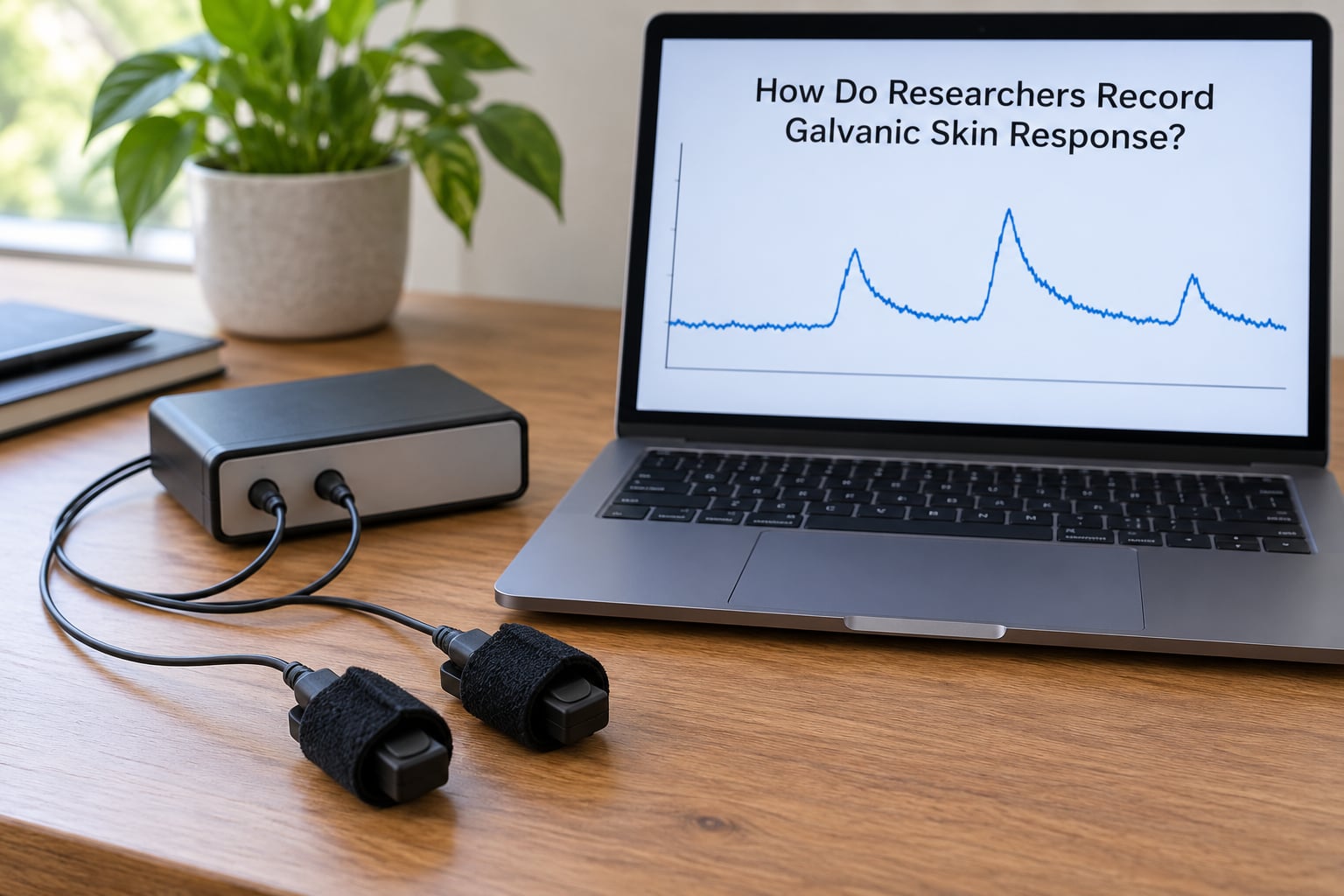
Sensor format matters more than most buyers expect. Finger electrodes with gel give the cleanest contact and are the standard in laboratory work. Wrist straps and smartwatches avoid the fingers but land on denser, hairier skin that produces noisier traces. If the study is a controlled lab comparison, fingers win. If participants must move around or the study is longitudinal, a wearable may be the only practical option, and the analysis should account for the placement difference.
Sampling frequency is the second decision. The phasic component sits in a low band, roughly 0.05 to 1.5 Hz, so anything from 32 Hz upward captures it comfortably. Recording at 128 Hz or more adds resolution for event timing, at the cost of storage. The trade is straightforward: sample fast enough to place events precisely, and no faster than the analysis needs.
Event markers do the real work of keeping a study honest. Every stimulus onset, response window, instruction change and rest interval should be logged as a marker on the same timeline as the physiological trace. Without markers, analysis is guesswork.
Documentation closes the loop. A methods section that names sensor model, placement, excitation method, sampling rate, filter settings, baseline protocol, room temperature and how artefacts were handled can be reproduced. One that says “GSR was measured” cannot.
What Factors Can Affect the Results?
Most of the bad data in a GSR study comes from confounds nobody wrote down. The list is short enough to check every time.
Temperature and humidity. Ambient temperature strongly affects sweat gland activity. A warm room produces higher conductance before any stimulus appears.
Hydration and recent activity. A well-hydrated participant, or one who has just walked to the lab, will read differently from someone who has been sitting for an hour.
Caffeine, nicotine and medication. Caffeine and nicotine both raise sympathetic activity. Any medication affecting autonomic function changes the baseline and belongs in the screening form.
Respiration and movement. Deep breathing shifts conductance on its own. So does shifting posture, typing, or adjusting a sensor, which is why movement artefacts need to be marked rather than scored.
Anxiety and fatigue. Nervous participants generate nonspecific responses to the apparatus and the researcher, not to the stimulus. Tired participants drift and respond late.
Electrode contact. Contact area and pressure change the measurement itself. Practitioners ask constantly how much the reading shifts when contact area or pressure varies, and the answer is: enough to matter. Use fixed, comfortable placement and inspect the trace before the session starts.
Individual differences. Baseline conductance varies enormously between people. The literature splits them into labile and stabile subjects, sometimes called electrodermal lability, and the distinction predicts how many spontaneous nonspecific responses a person generates before any stimulus.
My rule is simple. If a condition can plausibly move sweat, record it and control it or report it.
How Is Galvanic Skin Response Analyzed?
Analysis is a fixed pipeline, and the order matters more than the software used.
- Inspect the raw trace first. Look for drift, movement spikes and electrode pop before touching anything. A trace that looks broken stays broken.
- Establish a baseline. Use a rest period at the start, and consider a rest block later in the session. Some protocols use a short sigh or deep exhale as a mild, repeatable physiological anchor.
- Decompose tonic from phasic. Apply a smoothing or low-pass filter to estimate SCL, then subtract it to leave the phasic component. Median filtering, moving averages and spline methods all appear in the literature; the choice matters less than reporting it.
- Detect responses. Thresholds are commonly set between 0.01 and 0.05 microsiemens, with onset defined as the first sustained crossing of the threshold and offset as the point conductance returns to baseline. A response with no return to baseline inside the window still counts, and is reported as a non-recovered response.
- Measure each response. Latency from stimulus to onset, peak amplitude over baseline, rise time from onset to peak, recovery time from peak to offset.
- Aggregate within participant. Count responses, mean amplitude, mean latency, and the proportion of stimuli that produced any response at all. This response rate is often more informative than amplitude.
- Then compare across participants. Use within-subject contrasts, because between-subject amplitude comparison on unbaselined data is not defensible.
On the numbers, published reference values usually sit around 0.05 to 0.5 microsiemens for a single SCR and 1 to 30 microsiemens per square centimetre for SCL. Treat these as orientation rather than pass or fail thresholds.
For small samples, non-parametric tests or mixed models that account for repeated measures within participant are the usual choice. If you are combining GSR with heart rate variability, eye tracking, facial coding or self-report, keep the channels synchronised on one clock from the start.
What Are the Limitations of Galvanic Skin Response Research?
The limitations are not subtle once you know them, and most of them are avoidable by design rather than by better equipment.
Weak emotion specificity. GSR tracks arousal, not the content of the feeling. A method that cannot separate a pleasant response from an unpleasant one cannot support emotional claims on its own.
Individual variability. Baseline level, habituation rate, lability and sweat gland density all differ between people. Habituation in particular means a repeated stimulus produces progressively smaller responses, so stimulus order becomes a confound unless you counterbalance it.
Novelty and attention. The orienting response to something new is the easiest response to elicit in the whole system. A first impression of a stimulus is arousal whether or not it means anything.
Demand characteristics. Participants who know physiological measures are being recorded produce different signals. So do participants who think you can read minds from the machine, which is exactly why the lie-detection framing has caused so much damage.
Small samples and placement artefacts. Underpowered designs detect only large effects, and a slightly poor electrode contact on one finger of one participant can produce a response that looks perfectly plausible in a figure.
The last limitation is methodological rather than technical, and it is the one to worry about most. A GSR difference that is statistically significant but has no interpretable magnitude, no self-report corroboration and no physiological plausibility is a finding about your sample, not about your audience.
How Can Researchers Improve the Reliability of a Study?
Most of the gains available come from the protocol rather than the equipment.
Screen participants. Record caffeine, nicotine, medication, skin conditions, recent exercise, sleep and cycle-related factors that matter for your population. Exclude rather than correct when you can.
Standardise the environment. Fix the room temperature, use the same chair, keep the same lighting, and state the value in your methods. Run everyone in the same time window where circadian effects are plausible.
Give electrodes a settling period. Electrodes need a minute or two after attachment before readings stabilise. Start the baseline after that, not before.
Run a proper baseline and a post-study measure. A rest period at the end, with a mild physiological anchor, gives you a drift check you can actually report.
Use long enough stimuli and space them. At least five seconds on screen, with a calm interval between stimuli, plus time for non-specific responses to settle.
Counterbalance order and randomise conditions. Habituation makes stimulus order a real variable, and fixed-order designs quietly build it into your results.
Check that participants are paying attention. A simple comprehension question at the end is enough to catch passive responding.
Preregister the measures and windows. Decide the response threshold, the window length and the comparison before you look at the data.
Pair it with another channel. Self-report at minimum; interview, eye tracking or facial coding where the question demands it.
Report transparently. Sensor model, placement, excitation type, sampling rate, filters, baseline protocol, temperature, exclusions, and the exact statistics used.
On hardware, lab-grade finger systems give cleaner data and consumer wearables give reach. If the study runs in a quiet room with fixed conditions, buy the cleaner signal. If the research happens in a store, a wearable is the only realistic instrument, and the design should accept that constraint rather than pretend it is not there.
Frequently Asked Questions
What does galvanic skin response tell us?
It tells you how strongly the sympathetic nervous system responded to a stimulus, not what the person felt. A clear phasic response after an image, ad or task step indicates arousal and orienting attention. Emotional valence, the difference between pleasant and unpleasant, has to come from self-report or another measure.
What does GSR stand for in psychology?
Galvanic skin response. In psychophysiology the same measurement is also called electrodermal activity (EDA), skin conductance, or electrodermal response. Skin conductance response (SCR) names the discrete phasic response to a specific event, while skin conductance level (SCL) names the slower baseline underneath it. The terms are interchangeable.
What does a high GSR reading mean?
A high reading means more sweat gland activity and therefore higher conductance at that moment. In practice it means stronger sympathetic activation, which can come from emotion, cognitive effort, pain, novelty or plain nervousness. On its own it cannot tell you whether the response was positive, negative, or both, so never report a high value as evidence of a positive emotional reaction.
Is galvanic skin response the same as lie detection?
No. The polygraph was built on electrodermal measurement, and the association has outlived the evidence. Electrodermal responses are non-specific, they habituate across repeated questions, and they respond to fear of detection itself. A trained operator improves results slightly, but the method cannot establish deception on its own and courts have not accepted it for that purpose.
How long should a GSR study or stimulus last?
Each stimulus should stay on screen for at least five seconds, because the electrodermal response lags the event by roughly one to five seconds. Leave a short calm interval afterwards so responses settle before the next stimulus. Session length is usually limited by fatigue and habituation, so a quiet baseline, the stimulus set with spacing, and a closing rest block fit comfortably into a 30 to 45 minute session.
When should a researcher combine GSR with interviews or other measures?
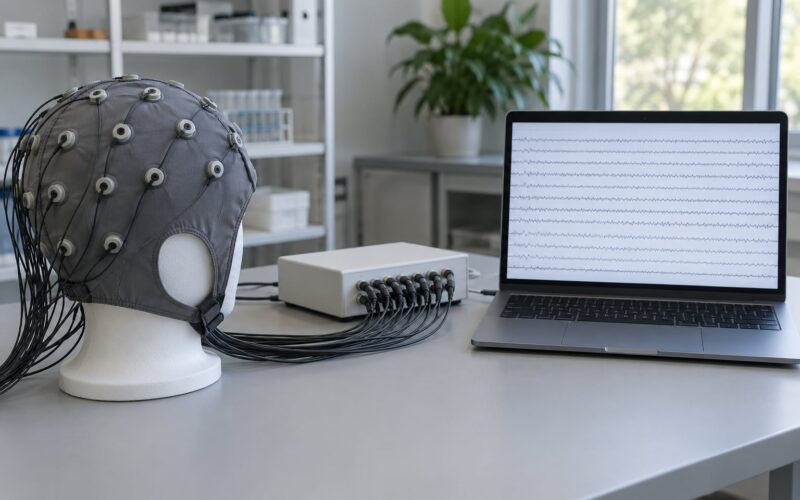
Whenever the research question is about meaning rather than intensity. If you need to know what a participant felt, why, or in what words, GSR must sit alongside self-report, a post-task interview, or verbal recall. Eye tracking, facial coding, heart rate variability and EEG each add a different channel, and any of them strengthens a finding that arousal data alone cannot carry.
Conclusion
Start by writing down what your research question actually needs. If it needs intensity, galvanic skin response gives you a clean, continuous, non-invasive measure of sympathetic arousal that very few alternatives can match. If it needs meaning, the physiological trace alone will not get you there.
Then control the boring things: temperature, caffeine, contact quality, stimulus duration, order, and a proper baseline. A device can be picked in an afternoon; the discipline to run a clean session is what separates a usable GSR study from a noisy one.
As of 2026, the standards for reporting electrodermal work are well established and mostly free. Use them, publish the parameters, and the data will keep working for you long after the session ends.