
An emotion vocabulary for brand research is a named, versioned list of feeling terms, each paired with its intensity variants, the triggers that reliably produce it, and the brand behaviour it should influence. You build it from what consumers actually say, not from a dictionary of emotion words, so researchers and brand teams label the same feeling the same way instead of arguing about what a word means.
Most emotion lists fail for the same reason: nobody ever asked what decision the list was for. A vocabulary built for a repositioning decision needs different granularity than one built for a quarterly tracker, and the same word can carry different intensity across categories, segments and markets.
The whole build takes a few focused sessions once the transcripts exist. Most of the effort goes into deciding what counts as an emotion and writing definitions tight enough that two coders tag the same passage identically.
Table of Contents
- What You Need
- Step-by-Step: How to Build an Emotion Vocabulary for Brand Research
- Step 1: Define the research question and the decision behind it
- Step 2: Collect the language people already use
- Step 3: Separate emotions from evaluations and behaviours
- Step 4: Create a usable emotion taxonomy
- Step 5: Write definitions and inclusion rules for every code
- Step 6: Test the vocabulary before you use it
- Step 7: Pilot, refine and maintain the codebook
- Which Emotion Framework Should You Start From?
- How to Code Emotion in Transcripts and Open-End Answers
- What a code is, in one sentence
- Inductive, deductive and hybrid coding
- Where AI-assisted coding helps, and where it breaks
- Common Mistakes
- Frequently Asked Questions
- How to build emotional vocabulary?
- What are some examples of emotional vocabulary?
- How many emotion words should a working lexicon contain?
- Can ChatGPT do qualitative coding?
- What are the three types of coding used in qualitative research?
- How do you code themes in qualitative research?
- Conclusion
What You Need
Four things, roughly. Everything else is optional.
- The research brief or decision memo. This is what sets the vocabulary’s scope, and it should already exist.
- Existing brand and customer material. Positioning documents, prior research, brand-guideline language and the words your own teams already use.
- Raw qualitative material. Interview transcripts, open-end survey verbatims, review text, support comments or social listening exports.
- A codebook and somewhere to keep it. A shared spreadsheet is fine at the start; qualitative analysis software is better once two or more people are coding.
Before anything else, settle four parameters: the purpose, the audience, the category and the method. Purpose means the decision the vocabulary serves. Audience means whose language you are collecting. Category means the purchase context, because the emotion attached to a kitchen knife is not the emotion attached to a software licence.
Method matters more than most people expect. Depth interviews give you vivid, idiosyncratic phrasing. Open-end survey questions give you breadth but flatter language. Review mining gives you emotional language that arrives already attached to a moment, which is often the richest source available.
If you have no transcripts yet, stop here. Building a vocabulary from a published framework with no participant language produces a list that looks rigorous and tells you nothing new.
Step-by-Step: How to Build an Emotion Vocabulary for Brand Research
Step 1: Define the research question and the decision behind it
Turn a broad interest in emotion into a specific research question attached to a specific decision. “What do customers feel about our brand” is not a research question. “Which emotions distinguish category loyalists from switchers, and which of those can positioning realistically claim” is.
Fix five things in writing: the audience, the category, the moment or journey stage you care about, the comparison you are making, and the intended use of the result. Use in positioning, use in ad testing and use in a tracking questionnaire are three different vocabularies wearing the same coat.
Then set a test for success before you start. A good test: two researchers, working separately, should reach the same emotion code for the same stretch of interview text at least 80 percent of the time. If the vocabulary cannot do that, it is not finished, no matter how elegant the taxonomy diagram looks.
Step 2: Collect the language people already use
Gather emotional expression from as many unprompted sources as you can reach: transcripts, open-ended survey items, product reviews, complaint and cancellation emails, social listening, and any previous research sitting in a shared drive. Collect widely, then be ruthless about cutting.
Preserve original wording before you interpret any of it. Paste verbatims into a single sheet with a source column, because the vividness of a phrase is often carried by its exact form. “I felt like I was being humoured” is a different research finding than “disrespected”, and you only get the first one if you kept the words.
Expect a lot of vivid but ambiguous material. “My kitchen died” and “they have no shame” both point somewhere, but not yet at a defined code. Leave them exactly as they are; Step 4 is where you decide what they mean.
One practical warning. Survey platforms ship their own emotion scales, and respondents trained by previous studies answer in those terms. Where you can, mix depth interviews in so your list is not just a repackaging of a vendor’s item bank.
Step 3: Separate emotions from evaluations and behaviours
This is where most lists quietly go wrong. Feeling words such as anxious, relieved, proud or disappointed describe an emotional state. Value judgments such as good, trustworthy or premium are evaluations. Behaviours such as repurchasing, complaining or quietly avoiding the brand are actions. They are not interchangeable, and a vocabulary that mixes them cannot be coded reliably.
Run a simple classification exercise. Take a random sample of 50 coded or candidate phrases and sort each into feeling, evaluation or behaviour. Expect roughly 20 percent of them to argue with you.
The classic trap is a phrase like “it feels reliable”. Reliability is an attribute people infer; the feeling underneath it might be relief, because nothing broke, or vigilance, because you are checking. If the attribute stays in the vocabulary, two researchers will code those passages differently forever.
Also separate intensity from identity. Worried, anxious and panicked are three points on one scale, not three separate findings. You want them as one emotion with three levels, and you will wire that into the taxonomy in Step 4.
Step 4: Create a usable emotion taxonomy

Build a structure that is broad enough for discovery and precise enough for analysis. Group emotions by trigger, by intensity, by how long they last, or by the research purpose. Grouping by trigger usually wins in brand work, because triggers are what a brand can actually do something about.
Do not import a published taxonomy before you have read your own data. Frameworks such as the Geneva Emotion Wheel or Plutchik’s wheel are useful as a sanity check, but a structure that does not match the words in your transcripts will make you force-fit the data and then argue about whether the forcing was fair.
Give every category a plain-language definition written for a colleague who was not in the room. If a category needs a paragraph to explain, it is probably two categories.
Here is a working example of the shape, built for a mid-market everyday purchase where switching is easy and trust is the real decision:
| Emotion | Intensity partner | Typical trigger | Brand behaviour it should drive |
|---|---|---|---|
| Relieved | Reassured, then complacent | The thing simply worked first time | Repeat purchase without re-evaluation |
| Anxious | Uneasy, then wary | Fine print, unclear pricing, a support wait | Checking reviews before buying again |
| Proud | Pleased, then validated | Being seen as clever for choosing it | Sharing, gifting, advocacy |
| Disappointed | Let down, then resentful | A promise the brand made and broke | Quiet churn, no complaint filed |
| Betrayed | Wronged, then angry | A change in terms after years of loyalty | Public complaint, review, competitor switch |
| Respected | Taken seriously, then loyal | Being treated as capable rather than managed | Long tenure, forgiving small failures |
| Overwhelmed | Confused, then disengaged | Choice density, unclear navigation | Abandonment mid-journey |
| Comfortable | Unremarkable, then indifferent | Nothing special, nothing wrong | Default retention, no preference |
Note what the uncomfortable rows are for. Comfortable sounds like a win and usually is a diagnosis. Comfortable plus no preference means the brand is interchangeable, which is a positioning problem the brand team needs to hear about rather than a satisfaction problem.
Two practical questions decide whether a row earns its place. Is the emotion specific enough that two coders can recognise it in a verbatim? Does it point somewhere, at a trigger the brand controls or a response the brand could design for? Rows that fail both tests are background, and background does not need a code.
Step 5: Write definitions and inclusion rules for every code
Turn each emotion into a usable research code. Four fields per row: what it includes, what it explicitly does not include, the likely triggers, and a verbatim example of the language. That last field does more work than the other three combined, because a real quote ends an argument faster than a definition does.
Definitions are what stop coding drift. Disappointed, frustrated and betrayed are the classic trio. The usual split: disappointed is a gap between an expectation and an outcome, frustrated is effort blocked repeatedly without resolution, betrayed is a breach of something the person believed was agreed. Write that down and the three stop bleeding into each other.
Write the exclusion line carefully. “Does not include: annoyance at a single incident with no expectation formed” is more useful than “mild irritation”, because it tells a coder what to do with a phrase rather than asking them to judge its weight.
Keep the language in the codebook plain. If a code cannot be described in one sentence a new analyst would understand on their first day, the code is not ready.
Step 6: Test the vocabulary before you use it
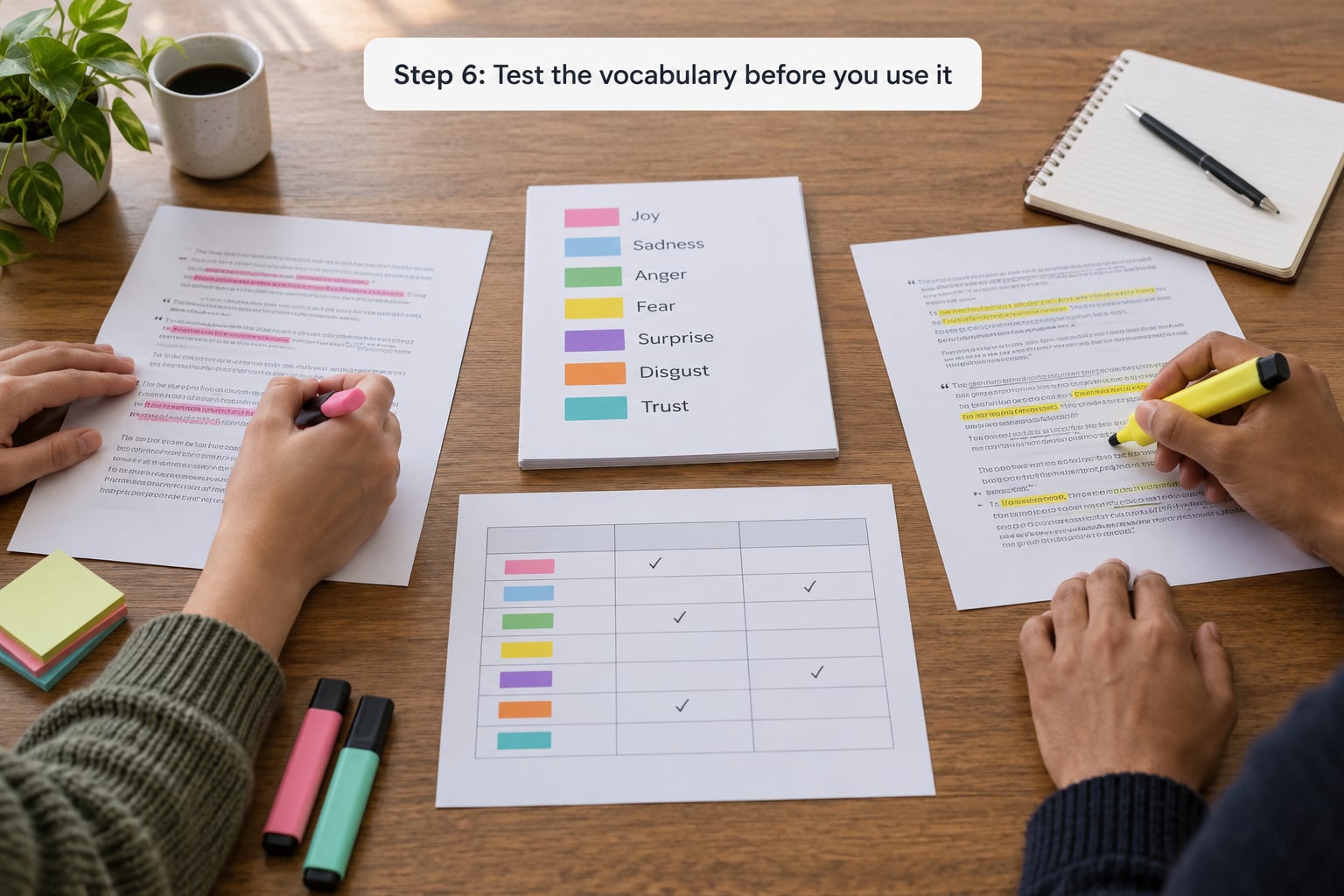
Run a lightweight test. Take ten to fifteen excerpts that a moderator flagged as emotionally loaded, give them to two researchers who did not build the vocabulary, and ask each to code every emotion present. Do not let them discuss it first.
Then sit down with the disagreements. Each one is a defect in the codebook, and it is cheaper to find twenty of them here than to find them across a full study. Usually the disagreements cluster: one code is too broad, one label is ambiguous, or two codes genuinely overlap.
Three fixes cover most of it. Split a code that keeps absorbing two different feelings. Add an exclusion line where a code bleeds. Rename a label that reads as a value judgment rather than a feeling.
Check the second thing too: does the vocabulary actually catch what participants say? Pull a random sample of 20 verbatims you did not use to build the list and code them with no options list. If new emotion terms keep appearing that the codebook has no row for, the list is too narrow even if agreement is perfect.
Step 7: Pilot, refine and maintain the codebook
Apply the vocabulary to a small set of interviews or open-end responses, roughly a tenth of the material, before committing the rest. Keep an additions log: new term, where it came from, which existing code it was mistaken for, and who decided what.
Add new terms rather than stretching old ones. A lexicon that forces a new emotion into an ill-fitting row will keep producing bad data, and the team will stop trusting the codes a few weeks in.
Version it. Number the codebook, date it, and log every change. When someone asks in six months why anxious and uneasy are split into two rows, the answer should be a line in the change log rather than an argument in a meeting.
Decide who owns it. In most teams the answer is the insights lead, with the brand strategist as the consumer of the output, because a vocabulary that only the research team can read will not survive contact with the frontline. If nobody owns the lexicon, it dies the week the project closes.
For reporting, every emotion you report needs four things: a plain-language definition, how often it appeared, which triggers drove it, and what it implies for the decision in Step 1. Frequency without definition is a data dump. Definition without implication is a glossary.
Which Emotion Framework Should You Start From?
You do not have to start from zero, and you do not have to start from a framework either. Here is how the common ones differ and when each one earns its place.
| Framework | What it gives you | When to use it |
|---|---|---|
| Geneva Emotion Wheel | 20 emotion families placed on a valence and arousal grid | When you need a defensible, widely cited structure and want to avoid inventing your own categories |
| Plutchik’s wheel of emotions | 8 core emotions plus dyads and blends formed by combining them | When you want fast coverage of a new space and can accept that the combinations are theoretical rather than observed |
| Wheel of Emotions (marketing versions) | Often a funnel or journey-shaped diagram from unaware to advocate | Treat as a communication model for presenting findings, not as a coding scheme |
| PANAS | 20 short affect items split into pleasure and arousal dimensions | For a self-report questionnaire instrument you need to keep short, not for coding open text |
| VAD model | Valence, arousal and dominance as three continuous coordinates | When you need to place emotions in space and compare segments or markets, especially across languages |
| Survey platform libraries | Ready-made emotion and sentiment item banks | As a starting scaffold only, then strip out anything that collides with your brand’s own language |
Two warnings. A structure borrowed from a framework does not become a vocabulary, because a vocabulary needs triggers, verbatims and behaviour links, and frameworks rarely carry those. And a model built on self-report questionnaires cannot be dropped unexamined onto interview verbatims, where respondents describe a feeling about a situation rather than about the brand.
It is also worth remembering that Mehrabian’s 3-7-27 rule is about communicating feelings under specific conflicting-message conditions, not about how much of an opinion is emotion. It does not license the claim that 93 percent of brand decisions are emotional. Plenty of agency decks still use it that way.
How to Code Emotion in Transcripts and Open-End Answers
What a code is, in one sentence
A code is a short label you attach to a piece of text so that many pieces of text with something in common can be found, counted and compared later. Emotion coding is simply that process applied to feelings, and a code only earns its name if you can give an example that should be coded with it and an example that should not.
Coding is where a vocabulary either proves itself or gets quietly abandoned. Do it on extracts, not whole transcripts, and always keep the surrounding context available, because most emotional codes depend on what happened in the sentence before.
Inductive, deductive and hybrid coding
Three approaches, and most emotion work uses the third.
- Inductive. Codes emerge from the data. You read for patterns and name them as they appear, which is how genuine discovery happens but how you end up with forty vague labels.
- Deductive. Codes come from a theory or an existing framework in advance. Fast and consistent, but it forces data into a shape that may not fit it, and the things that do not fit get dropped.
- Hybrid. Start deductively with your Step 1 decision, then keep an open additions log for anything the framework did not anticipate. This is the one I would use for a brand emotion vocabulary, because the decision gives the codes purpose while the log protects you from missing something the theory did not have a slot for.
Where AI-assisted coding helps, and where it breaks
Use it for the first pass, not the last. A language model is genuinely good at extracting candidate emotion phrases from a large verbatim set and grouping near-synonyms you would have merged by hand.
It is unreliable exactly where your study needs rigour. It flattens intensity, so worried and panicked come back as the same label. It invents plausible emotion terms that no respondent used, and those terms then leak into your codebook looking like findings. It applies different standards to different chunks of text, which quietly destroys the inter-rater agreement you spent Step 6 measuring.
So verify by hand. Check every term that enters the codebook against the actual transcript. Have a second person re-code a sample. And keep a record of which passes were machine-assisted, because a pilot and a full analysis run differently and you will want to know which one you are reading about.
Common Mistakes
Six failure modes account for nearly every emotion vocabulary that ends up in a slide deck and never again.
Treating every positive or negative word as an emotion. Good, nice, great and bad are evaluations. Someone can rate something as great while feeling anxious about it. Fix: run the feeling, evaluation, behaviour sort from Step 3 on every candidate term, and delete anything that lands in the other two columns.
Using overlapping labels without definitions. Frustrated, annoyed, fed up and irritated get applied at random, so the counts mean nothing. Fix: write the inclusion and exclusion lines, then run the two-coder test and treat every disagreement as a defect to fix.
Importing a fixed theory before reviewing the data. You end up with a taxonomy your transcripts cannot fill and a coding exercise that takes twice as long. Fix: read a representative sample of verbatims first, then choose the framework that best organises what you found.
Confusing intensity with distinct emotions. Twenty rows where eight would do makes the vocabulary harder to remember and impossible to track over time. Fix: cluster words that share a trigger, then keep one emotion with an intensity ladder beneath it.
Writing labels that lead the respondent. A code called aspirational status or caring family emotion tells a moderator and a coder what to hear, and both will oblige. Fix: name the feeling the person reported, not the marketing meaning you want to attach to it.
Changing definitions during analysis without recording the revisions. Counts before and after the change stop being comparable, and nobody can tell which. Fix: log every change with a date and a reason, and re-code the earlier material if the change was significant.
A few habits keep the whole thing alive. Write definitions for new starters, not just for the research team. Refresh the lexicon every year or two, because consumer language drifts and words decay. Keep a version number in the file name. And give the brand team a plain-language version of the taxonomy so the vocabulary survives the end of the project.
Frequently Asked Questions
How to build emotional vocabulary?
Build emotional vocabulary in seven moves: define the decision the vocabulary serves, collect unprompted emotional language from interviews, open-end survey answers and reviews, sort candidates into feelings versus evaluations versus behaviours, cluster the feelings into a small taxonomy with intensity levels, write a definition, an exclusion and a real verbatim for each code, then test with a second coder before full analysis. Start from real participant language, not from a published framework.
What are some examples of emotional vocabulary?
Useful emotion words cluster into families that share a trigger: relief and reassurance, anxiety and wariness, pride and validation, disappointment and resentment, betrayal and anger, respect and loyalty, overwhelm and confusion, and comfort. Each needs an intensity partner, a likely trigger, the brand behaviour it should influence, and an example of the words real respondents actually used. Comfort is worth watching, since it usually signals indifference rather than satisfaction.
How many emotion words should a working lexicon contain?
Between 15 and 30 emotion codes is the working range, each with two or three intensity levels underneath it. Fewer than 15 and you will force-fit distinct feelings into the same code. More than 30 and nobody recalls the vocabulary, so coding becomes inconsistent and reporting becomes unreadable. The right number is whatever passes your two-coder agreement test and covers the emotions your own transcripts actually contain.
Can ChatGPT do qualitative coding?
It is useful for a first pass. A language model can extract candidate emotion phrases from a large verbatim set and group near-synonyms, which saves hours of reading. It is unreliable where rigour matters: it flattens intensity, invents emotion terms no respondent used, and applies different standards to different chunks of text. Verify every new term against the transcript and have a second person re-code a sample before anything enters the codebook.
What are the three types of coding used in qualitative research?
Inductive coding develops codes from the data as patterns emerge, which supports genuine discovery but often produces vague or overlapping labels. Deductive coding applies codes defined in advance from a theory or framework, which is fast and consistent but risks forcing data into a shape that does not fit. Hybrid coding starts deductively and keeps an open additions log for anything the framework did not anticipate, which is the usual choice for brand emotion work.
How do you code themes in qualitative research?
Read a sample of the material and note recurring ideas without naming them yet. Group the notes into candidate themes, then give each theme a short label, a definition and an example that should be included and one that should not. Test it by having two researchers code the same extracts independently and comparing disagreements. Keep a dated change log so that any revision to a definition is recorded rather than remembered differently by each person.
Conclusion
A usable emotion vocabulary is small, evidence-led and attached to a decision. Start by writing down the brand decision the vocabulary has to serve, because that single constraint removes most of the words that would otherwise drift in.
Then collect real participant language before you collect any theory. Read the verbatims, keep the exact wording, sort feelings from evaluations from behaviours, and cluster what survives into a taxonomy small enough to remember and precise enough for two coders to agree on.
Write the definitions, test the list with a second coder, and only then scale it up. If the emotion words never make it past the research deck, the problem was almost never the list itself.