Most of what you buy is decided in a fraction of a second, long before you start weighing options. That is how system one thinking shapes everyday purchases: an automatic system reads the shelf, the screen or the offer, produces a feeling about the right choice, and hands that answer to your conscious mind as a conclusion rather than a suggestion. Slow reasoning arrives later and mostly ratifies it.
The clearest example is not dramatic. It is the coffee you order without being asked, the chocolate bar that appears in the basket at the till, the phone case you added because it sat in the cart already. Nobody in those moments ran a comparison. Recognition did the work.
Below I break the mechanism into the parts you can actually observe: which purchases automatic thinking decides outright, what a first impression is made of, how price cues get read, when deliberate review takes the wheel, and a handful of ways to slow the whole thing down when you want to. Updated for October 2026.
Table of Contents
- What Is System One Thinking?
- How System One Thinking Shapes Everyday Purchases
- System 1 thinking vs System 2 thinking
- Where Does Fast, Automatic Buying Happen?
- What Purchase Decisions Does System One Make First?
- How Do First Impressions Become Purchase Choices?
- How Does System One React to Price and Value?
- What Are the Most Common Automatic Buying Triggers?
- When Does System Two Take Over?
- How Can Marketers Design for Automatic Thinking Responsibly?
- How Can Shoppers Slow Down an Impulse Purchase?
- Frequently Asked Questions
- Is system one thinking the same as an impulse purchase?
- How quickly does system one influence a purchase decision?
- Does system one thinking mean consumers are irrational?
- Can packaging and product placement shape what people buy?
- Why do discounts and reference prices affect perceived value?
- How can I tell whether a purchase deserves more thought?
- Start by Recognizing the First Purchase Signal
What Is System One Thinking?
System one thinking is the brain’s fast, automatic, largely unconscious mode of thought. It reacts instantly to familiar cues, runs on emotion and habit rather than logic, and handles the large majority of everyday purchase decisions before deliberate reasoning starts.
Daniel Kahneman, working with Amos Tversky, described this contrast in Thinking, Fast and Slow (Farrar, Straus and Giroux, 2011). Their earlier prospect theory work showed that people do not evaluate outcomes on a straight utility scale; they react to changes relative to a reference point and feel losses far more sharply than equivalent gains. The two-systems framing is what carried that insight into everyday language.
The reason it matters for shopping is simple. System 2 is expensive to run. It holds information in working memory, weighs options, and checks for errors, and it burns resources quickly. So it mostly sits in a low-effort monitoring mode, taking System one’s answer as good enough unless something interrupts it.
How System One Thinking Shapes Everyday Purchases
Automatic processing covers everything from a four-dollar purchase to a considered one, but it never fully switches off. Even on big decisions, the first reaction arrives before the spreadsheet does: a flicker of trust, a bad feeling about one option, an assumption that the more expensive one is the better one.
Researchers call this dual-process theory. The classic framing treats System 1 as autonomous and fast, System 2 as controlled and slow, with System 2 acting as a monitor that can accept or reject what arrives. Keith Stanovich’s later work complicates that picture, pointing out that rational thinking depends partly on your thinking disposition, not only on raw intelligence.
System 1 thinking vs System 2 thinking
| Dimension | System 1 thinking | System 2 thinking |
|---|---|---|
| Speed | Immediate, no conscious effort | Slow, serial, effortful |
| Awareness | Largely unconscious | Conscious and reportable |
| Driven by | Association, emotion, repetition | Rules, evidence, comparison |
| Typical output | A feeling, a lean, a shortcut | A judgement with reasons |
| Accuracy | Coherent but confidently wrong | Slower and more accurate on hard problems |
| Cost | Almost nothing | Attention and glucose, both finite |
| Where it shows up | Brand choice, checkout add-ons, price reactions | Comparing specs, reading reviews, checking warranties |
Both systems operate at once. That is why a person can order a coffee entirely on autopilot and then spend twenty careful minutes comparing two laptops in the same week.
Where Does Fast, Automatic Buying Happen?
Automatic thinking dominates when the decision is low-involvement, familiar and easy to reverse. The degree of deliberation, not the product itself, is what sets the balance.
Marketing textbooks group buying behavior into four types, and the split maps neatly onto the two systems. Routine purchases, like toothpaste or a preferred brand of pasta, are almost pure System 1. Limited-decision purchases, a new shampoo or a different cereal, lean on recognition plus a little comparison. Extensive purchases, a laptop or a used car, involve real evaluation. And impulsive purchases are the purest System 1 case of all, where the trigger arrives and the deliberation never happens at all.
Adding a single unfamiliar ingredient often moves a purchase up a step. So does a higher price, a longer commitment, or a consequence you would rather avoid. That is the whole mechanism: change any one of those and the same shopper pauses.
What Purchase Decisions Does System One Make First?
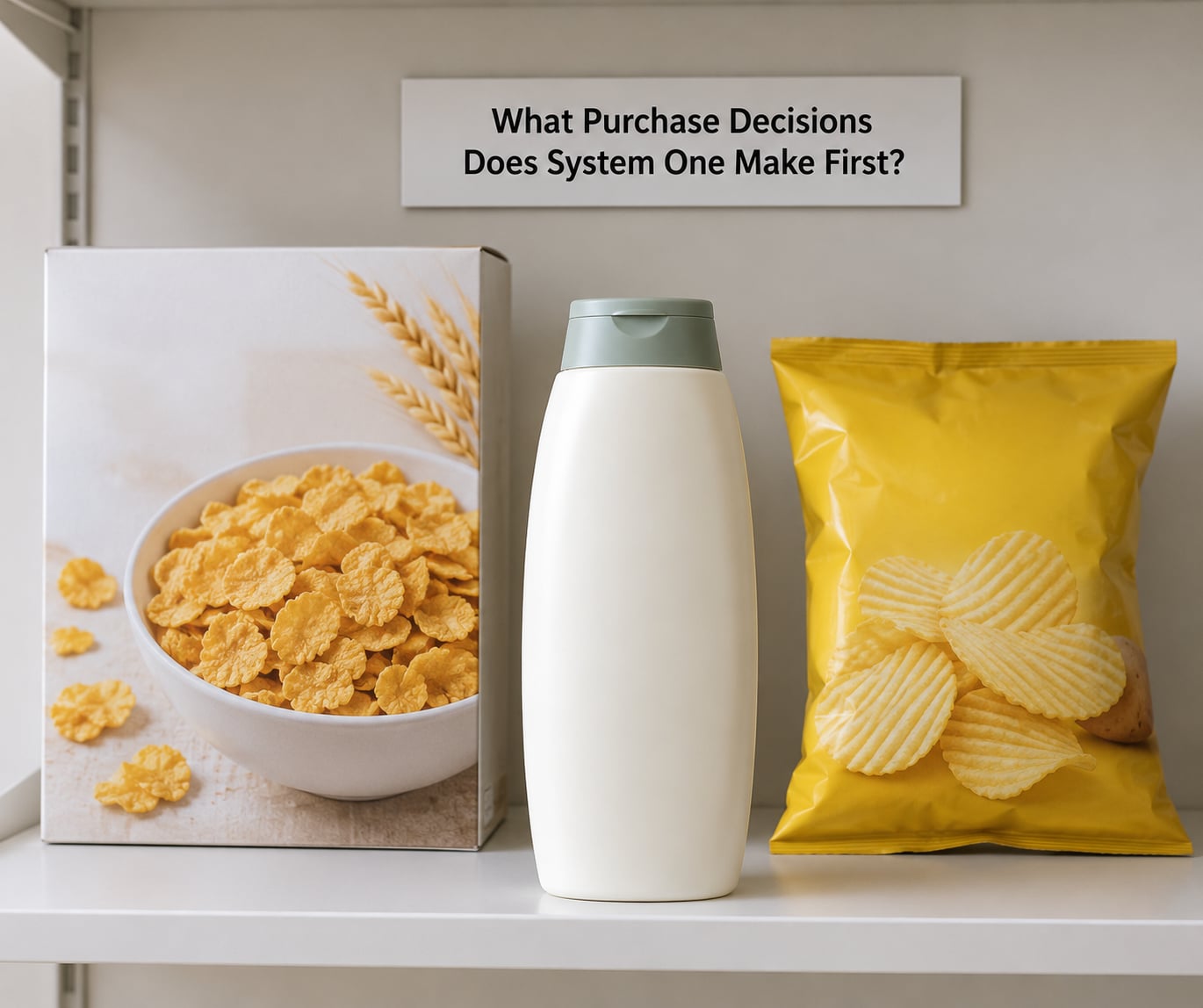
The sequence runs like this, and it happens in under a second: you notice something, you form an impression, and only then does any question of choosing get raised.
Familiarity comes first. A brand you have bought five times needs no evaluation. Recognition is treated as evidence of quality, and the whole assessment collapses into a nod.
Feeling follows. Warmth, mild trust, irritation at cluttered packaging. Affective reactions arrive ahead of any reasoning about the product itself.
Category cues narrow the field. Shape, color, bottle size, the visual grammar of the shelf. This is substitution at work: you take one of the two or three things that look like the thing you meant to buy.
Price reads instantly. The crossed-out figure, the size of the discount, the position in the range. You get a verdict before you know what you are judging.
Social proof arrives fast. Review counts, star ratings and the number of people already pictured with the product are read as a shortcut for popularity, and popularity is read as a shortcut for safety.
Risk is assessed without words. A brand you have never heard of produces a small flinch of uncertainty, and uncertainty is expensive: it takes more deliberation, so most products lose it.
How Do First Impressions Become Purchase Choices?
A first impression rarely stays an impression. It becomes the frame through which everything after it is read, because once System 1 has answered, System 2 tends to look for reasons that fit.
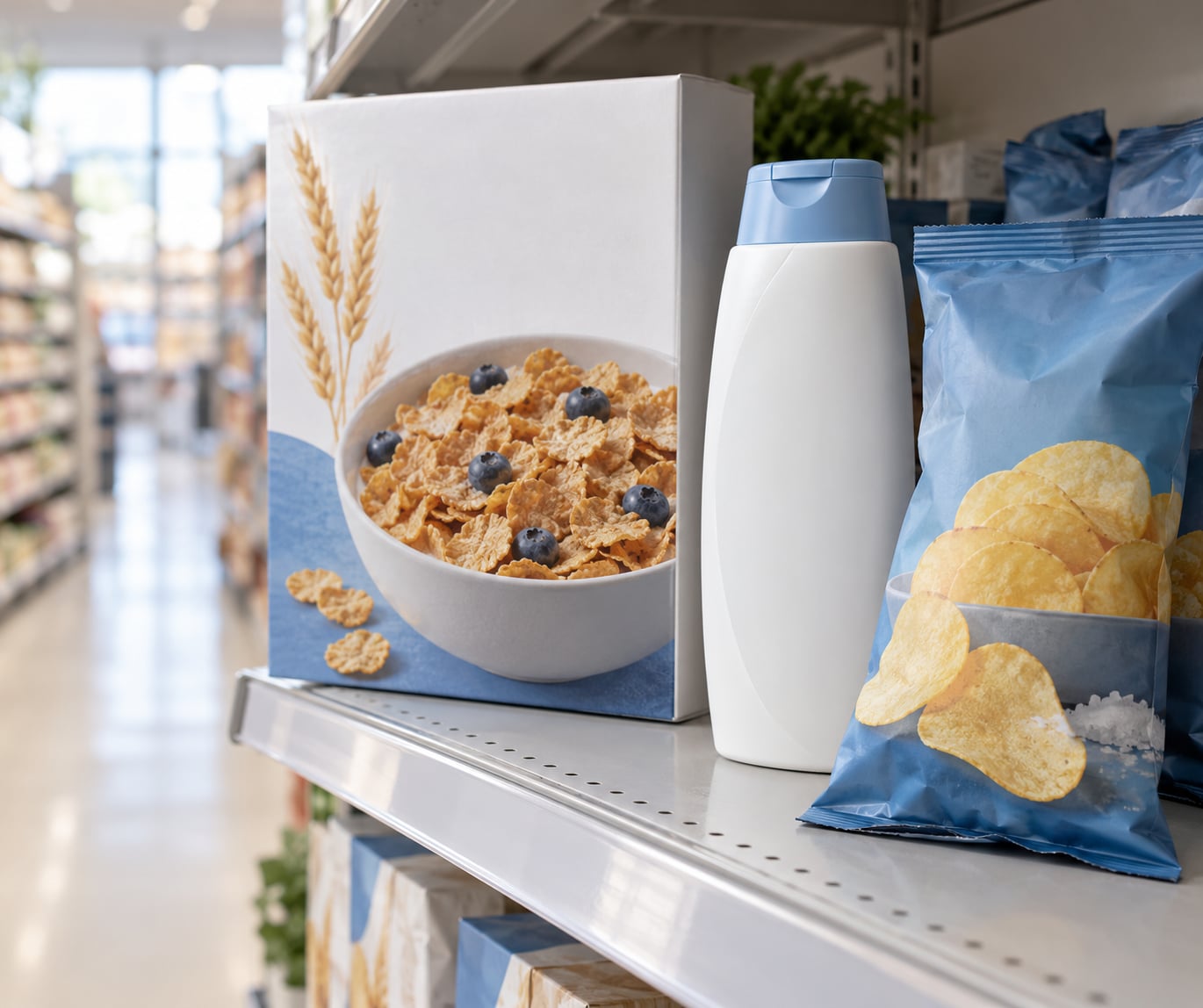
Physical design is the most direct lever. Eye-level placement beats the same product on a low shelf. Ends of aisles get browsed. Packages that look familiar get picked up, opened, read. Color carries category meaning, sometimes so strongly that shoppers have been found to mistranslate it: orange packaging for a vanilla-flavored product reads as orange-flavored, and a dark wrapper pushes a pale drink toward expectations of coffee.
Typography and naming do quieter work. A plain name creates no resistance, while a name that implies a benefit supplies System 1 with something to like before the product is understood. On screen, contrast substitutes for shelf position: a featured tile, a sponsored slot, the third item in a row someone else chose.
None of this is deceit. It is the ordinary language of a category, and most of the time it is harmless.
How Does System One React to Price and Value?
Price is the fastest signal on the page, which is why it does so much work before any reasoning happens. A familiar price is treated as a fair price, and an unfamiliar one triggers comparison whether you want it or not.
Anchoring means the first number you see becomes the reference for every number after it. The crossed-out figure sets the standard, and the sale price reads as a gain against it even though you were never going to pay the first one.
Framing changes the same product: monthly rather than annual, per portion rather than per item, small-and-cheap rather than large-and-priced-per-kilo.
Loss aversion explains urgency messages. Losing an option registers roughly twice as strongly as gaining one, so a limited window preaches loss, and plenty of people feel a discount as something they would be foolish to refuse.
The substitute for quality is price itself. An unfamiliar brand that costs noticeably more reads as safer, because expensive is a familiar signal for well made. It is a decent heuristic in domains where price tracks quality, and a poor one where it does not. That is the safeguard worth holding on to: the shortcut works in proportion to how consistent the market is.
What Are the Most Common Automatic Buying Triggers?
These are tendencies, not instructions. People are not obliged to obey any of them, and plenty of shoppers ride past a countdown without a flicker. Still, if you are honest with yourself about the last few things you bought unplanned, one of these fired.
- Familiarity. Recognition mistaken for quality. Works best on repeat purchases, where there is nothing to evaluate anyway.
- Emotion. Boredom, stress, nostalgia, relief. Mood and spending are linked closely enough that retailers schedule campaigns around it.
- Urgency cues. Countdown timers, limited windows, low counters. The deadline is manufactured, and it borrows the weight of real loss.
- Social proof. Review counts, best-seller tags, other people’s photos. Especially strong when you cannot judge the product yourself.
- Convenience. One-click checkout, saved details, products already in the cart. Every step you remove is a step where System 2 might have objected.
- Contrast. A cheap option makes the middle one look reasonable. Merely being cheaper can be the only reason anything happens at all.
- Perceived loss. An expiring trial, a wishlist item you were saving, a category you feel you have fallen behind in.
- Recommendation loops. Endless browsing, personalized rows, push notifications. There is no natural stopping point, so the choice never reaches a decision stage.
When Does System Two Take Over?
Deliberation gets recruited when something in the situation is unusual, expensive, hard to reverse or hard to explain. A product you have never used. A price far outside your normal range. A contract. A purchase other people will see.
Available attention matters just as much. The classic ego depletion work, associated with Roy Baumeister’s 1998 self-control model, argued that self-restraint draws on a limited resource: participants who spent effort suppressing a first preference chose less pleasant options later, and a follow-up commonly cited experiment offered radishes against chocolate cookies after a demanding task. That study has not held up cleanly under modern replication standards, and the ego depletion effect remains contested, so treat the mechanism as a useful sketch rather than a settled law. What survives replication is narrower and still useful: hungry, rushed, tired or emotionally loaded people buy differently, and buy more, than people in good shape.
Even when System 2 does engage, it often arrives after the fact. Post-purchase rationalisation is the quiet stage people skip: having bought, you look for reasons it was sensible, and those reasons feel like reasoning. Recognition of that pattern is a better defence than willpower, because the story feels true at the time it is written.
How Can Marketers Design for Automatic Thinking Responsibly?
If you work on the brand side, the honest version of this is straightforward. Design for recognition rather than confusion, because an unfamiliar product loses on attention before it competes on merits. State value plainly at the point of choice, where System 1 will actually look, instead of burying it in a page of claims.
Remove friction only where the purchase is genuinely easy to reverse, and add it back where it is not. That single rule does more for consumer trust than any disclaimer. Make defaults visible, test whether a claim survives a skeptical reader, and treat an intuitive feel as a hypothesis to check rather than a result to publish.
How Can Shoppers Slow Down an Impulse Purchase?
None of these are about willpower. They are about moving a fast answer into slower conditions, which is the only reliable way to change one.
- Write the reason first. One sentence, before you click. If you cannot finish it, that is your answer.
- Use a 24-hour rule on anything unplanned. Not for the emergency, only for the surprise.
- Park the cart. Walking away, or logging out, adds exactly the friction that gives System 2 a chance to speak.
- Check the state you are in. Hungry, tired, upset or rushed predicts different purchases than a settled afternoon does.
- Convert the price. Per portion, per month, per hour of use. A different unit changes what the number means.
- Compare against your own history. What did you pay last time, and would you buy it again at that price?
- Test the sale fiction. Would you still want this if the discount were gone? The discount is usually doing the persuading.
- Decide before the window opens. A list plus a fixed budget beats a mid-scroll change of heart, every time.
Frequently Asked Questions
Is system one thinking the same as an impulse purchase?
No. Impulse buying is a purchasing behavior; system 1 thinking is a processing mode. They overlap heavily, because an impulsive purchase usually follows a fast, automatic cue with no deliberation. But system 1 also runs your considered decisions, starting them before reasoning begins. A laptop choice is automatic at the start and deliberate at the end.
How quickly does system one influence a purchase decision?
Fast enough that it is usually finished before you notice it happening. Recognition of a brand, a reaction to a price, or a feeling about a package completes in well under a second, and the sense of having decided arrives afterward. Deliberate comparison, when it happens at all, starts from that verdict rather than from zero.
Does system one thinking mean consumers are irrational?
No, and the framing has been oversold. Automatic processing is efficient where the environment is stable and a shortcut has worked before, which is why experts in familiar domains beat deliberate analysis. It becomes costly when the environment is unfamiliar, the stakes are high, or the shortcut and the truth part company. Most buying lives somewhere between.
Can packaging and product placement shape what people buy?
Yes. Eye-level shelves and aisle ends get browsed more often, and packaging color, imagery and typography set expectations before the product is understood. Research on packaging has even found shoppers inferring flavor from wrapper color. Placement works partly through attention and partly through learned association, so it steers far more than it persuades.
Why do discounts and reference prices affect perceived value?
The first number you see becomes the reference point for every number after it, which is anchoring. A crossed-out figure sets that standard, so the sale price is read as a gain rather than a cost, and because losses register about twice as strongly as gains, a discount also feels like something not to lose. The product has not changed; only the frame has.
How can I tell whether a purchase deserves more thought?
Three signals usually mark it: the price is outside your normal range, the product is unfamiliar, or the choice is hard to reverse. Add two personal ones, since you know them better than any study does. If you are hungry or tired, raise the bar, and if you cannot write the reason in one sentence, that is usually enough information.
Start by Recognizing the First Purchase Signal
System 1 is not the problem, and treating it as the enemy tends to fail. It is fast, it is mostly right about familiar things, and it saves you from deciding everything from scratch.
What is worth doing is noticing the first cue. Familiarity, a discount, a countdown, a nudge from an algorithm, a feeling about a wrapper. Once you can name it, you can decide whether the purchase deserves the slower review that naming it just made possible. That is the whole practical case for understanding how system one thinking shapes everyday purchases: not to override it, but to catch it working.