
The Magician archetype is the Jungian-derived brand personality built on transformation, vision and the working of forces people cannot see. It shapes transformation claims by setting the register a brand is allowed to use: metamorphosis language, personal address, and a promise that the customer, not the product, will change.
That permission is the reason Magician copy feels magnetic and the reason it fails so publicly when it outruns the evidence. Getting the mechanism right matters for brand strategists, copywriters and founders deciding how boldly they can promise change, and for compliance-minded marketers working in skincare, health and financial services.
A word on the word magician: search results for it are crowded with personality typing and tarot. This article is about the brand-strategy reading, the one Margaret Mark and Carol S. Pearson wrote into The Hero and the Outlaw in 2001, not the INFJ personality type or the Major Arcana card.
Table of Contents
- What is the magician archetype in branding?
- Where does the magician archetype come from?
- What symbols and ideas define the magician?
- How the Magician Archetype Shapes Transformation Claims
- How do magician brands turn customer pain into possibility?
- Which language makes transformation claims persuasive?
- Why do consumers respond to magician-style promises?
- How can brands use the archetype without misleading customers?
- What do strong magician transformation examples look like?
- How can marketers test a magician transformation claim?
- Frequently Asked Questions
- What is the difference between the magician and alchemist archetypes?
- Is the Magician archetype suitable for every transformation brand?
- What makes a transformation claim credible rather than merely magical?
- How does magician branding affect customer expectations?
- Can transformation advertising promise instant results?
- How do I combine an emotional archetype with a rational product claim?
- Conclusion: Make the Transformation Credible
What is the magician archetype in branding?
The Magician is the brand personality that promises to move you from a present state to a possible one. Its canonical profile is short: the core goal is to make dreams come true, the strategy is to develop a vision and live by it, and the greatest fear is negative consequences.
That fear is the part most often left off agency profile pages, and it is the most useful thing about the framework. A brand built on transformation stakes its reputation on the outcome, so a broken promise does not read as a broken promise. It reads as a broken spell.
Where does the magician archetype come from?
The lineage runs from C. G. Jung’s Archetypes and the Collective Unconscious to a consulting tool, and the jump between the two is worth naming because it is the source of the archetype’s persuasive charge.
For Jung, an archetype is a structural pattern in the collective unconscious. It is a description of how human beings tend to organise meaning, not a claim about any individual. Mark and Pearson, both former Young & Rubicam executives, moved the idea into brand strategy and asked a commercial question Jung never asked: which of these patterns makes a brand memorable, and which one makes it likable?
Here is where the evidence gets thin, and I would rather say so than pretend otherwise. The market research underpinning the twelve-archetype typology has no publicly documented methodology, no control group and no stated margin of error. The risk is confirmation bias built into the tool: pick the archetype that flatters your brand and the description will confirm you. The anecdote corrections are instructive too. Howard Schultz credits product and experience rather than the Explorer archetype for what Starbucks became, and Apple logo designer Rob Janoff has said the bitemark was included for scale, not as a nod to Adam and Eve.
That does not make the framework useless. It makes it a useful fiction, and a useful fiction still has to be honest about what it is for.
What symbols and ideas define the magician?
Every recurring Magician symbol carries a different emotional promise, and mixing them without knowing which promise you are selling is how brands end up vague.
- Transformation and metamorphosis promises change, and usually names the customer’s own unrealised potential as the raw material.
- Wonder and awe promises that the brand sees something in the product that the customer has not noticed yet.
- Intuition and vision promises insight, often as access to knowledge other customers are not given.
- Alchemy promises that ordinary ingredients, hours or money are being combined into something rarer.
- Hidden knowledge and partial disclosure promises exclusivity, and it is the easiest symbol to abuse because secrecy is nearly free.
In the tarot and symbolic register, the Magician’s signature image is a table laid out with tools: instruments rather than tools, already chosen, already yours. The table is a workspace, which is why the archetype reads as active rather than passive. It sits in a small cluster with the Alchemist, who transforms materials, and the Sage, who understands them; the distinction matters when you are writing a claim.
How the Magician Archetype Shapes Transformation Claims
Here is the mechanism in one sentence: the archetype converts a present problem into a vivid possible future, supplies a symbolic vocabulary for change, and makes the promised transformation feel meaningful as well as useful.
That last clause is the whole game. A moisturiser that hydrates is a modest promise. A moisturiser that hydrates and marks the moment you stopped apologising for your skin is a transformation claim, and the customer buys the second one because it says something about who they will be.
Three things follow from that. The brand addresses one person rather than a crowd. The claim leans on verbs of becoming rather than verbs of doing. And the customer’s belief in their own potential becomes the load-bearing part of the promise, which is exactly where it can fail.
How do magician brands turn customer pain into possibility?
The progression runs from a surface problem to a deeper tension, then to hidden potential, then to a transformed future state. Skipping a step is what produces copy that sounds like a séance instead of a skincare line.
A beauty brand that starts at dry skin stays in the functional register. It reaches Magician territory when it reframes the dryness as the hours you stopped doing anything for yourself, names the ingredient work as the process that changes it, and lands on a future state the customer recognises as a version of themselves.
A financial education service works the same way. You do not understand your own finances is a problem statement. You have never been shown how your money actually moves is the tension. The process is the mapping, the account-by-account walkthrough, and the possible future is making decisions without the flinch. No promise of a figure, no guaranteed outcome.
Which language makes transformation claims persuasive?
Six patterns do most of the work. Each has a clear communicative job, and each has a specific failure mode.
- Before-and-after narrative. Puts the change in a scene the customer can picture, which is why it outperforms a specification. Fails when the after-image was lit differently.
- Threshold language. Words like begin, cross and the moment mark a boundary, and boundaries are memorable. Fails when the customer never actually reaches one.
- Transformation verbs. Alchemise, awaken, metamorphose, reimagine signal that the product works on identity, not on objects. Fails by being unmeasurable in a category that requires measurement.
- Vivid sensory detail. Naming texture, sound or scent gives the possible future a body, which is the difference between a feeling and a slogan. Fails when the sensory promise cannot be delivered by the product.
- Authority framing. An origin story, a founder’s principle or a heritage claim tells the customer why this particular brand knows something. Fails when the authority is borrowed rather than earned.
- Ritual and exclusivity. Private access, limited editions and a partial story make the transformation feel chosen rather than sold. Fails on repetition, because scarcity that recurs is just a discount policy in costume.
Understanding how the magician archetype shapes transformation claims is less about picking good words than about matching the device to the evidence. Every pattern above borrows credibility from a place the brand may not own.
Why do consumers respond to magician-style promises?
Consumers respond because a Magician claim does three jobs at once: it hands back a sense of agency, it offers a self-discovery story, and it reduces uncertainty. The archetype addresses one person and invites them to believe something about themselves that was not available before.
There is a further mechanism that practitioners notice repeatedly without having a word for it. Commenters on agency pages describe an immediate emotional recognition when they read their archetype description, the feeling of an anchor rather than a label. In a practitioner thread, a soapmaker reported the test returned Magician and confirmed language she already used about the alchemy behind her craft. That felt accuracy is the archetype working as intended, and it is worth separating clearly from validation.
Resonance is not evidence. A claim can move someone and still be wrong, and the gap between those two facts is exactly where trust is won or lost.
How can brands use the archetype without misleading customers?
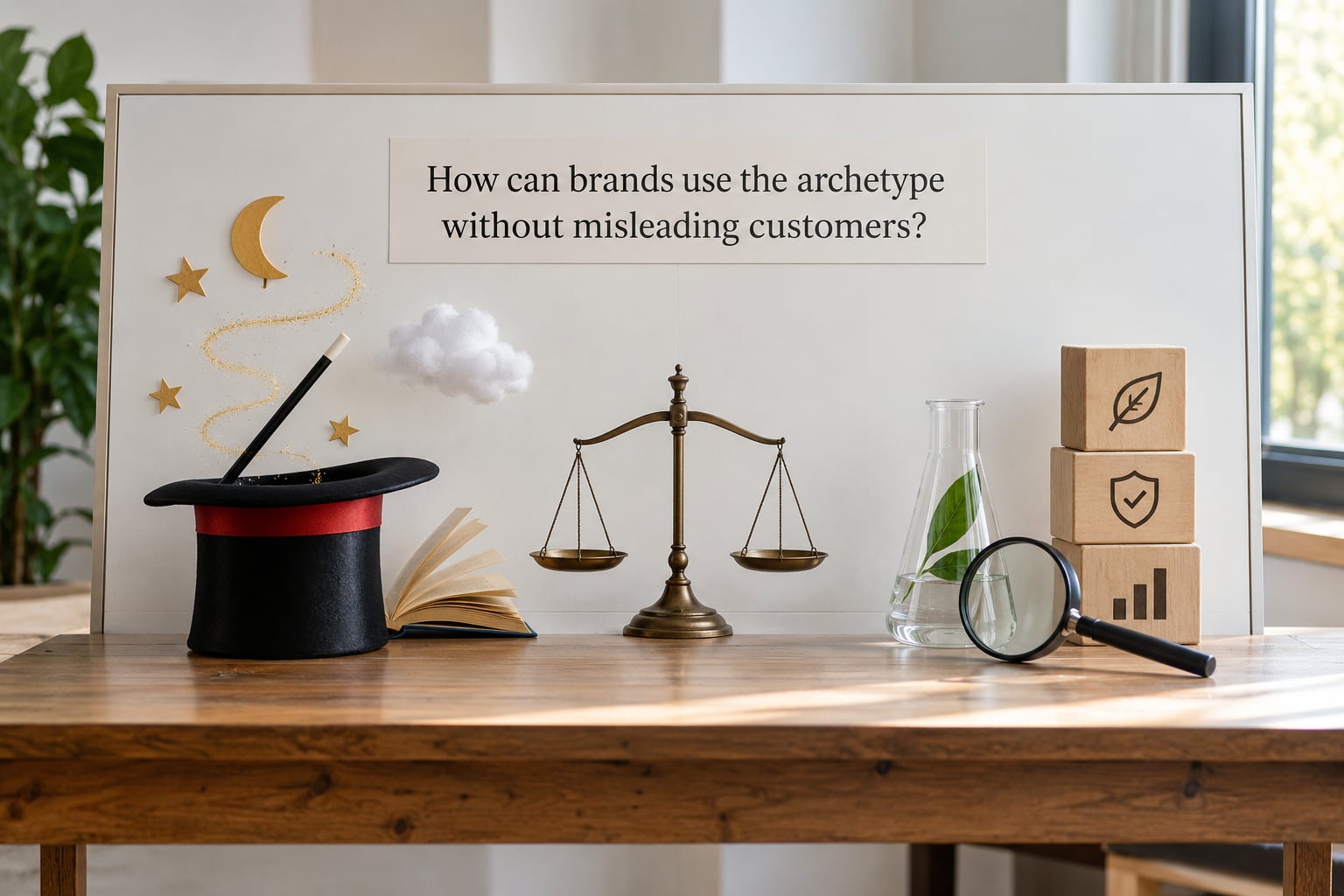
The guardrail is simple: imaginative framing stays in the frame, factual support stays on the ground. Keep every concrete benefit that is already true, and keep it specific enough to be checked.
The most useful architecture I know is problem, process, possibility. State the problem in the customer’s words. Show the mechanism that produces the change, including what it takes from them. Only then open up to the possible future state, and mark it as a possibility rather than a schedule.
Category sensitivity changes how much room you have. In skincare, cosmetics claims are regulated, so Miracle Broth style naming carries a documentary burden behind it. In health and wellbeing, transformation language touches medical claims. In financial services it touches performance promises. The vividness is not the problem. The absence of support for the vividness is.
A rewrite shows how much the guardrail costs. Our serum is infused with the concentrated magic of the sea says almost nothing checkable. By contrast, Our serum is formulated with a named marine ferment complex, and our panel study measured hydration at 72 hours says the same wonder with a receipt attached. Take the emotional frame, lose nothing, and add the line a sceptic can test.
Two habits help more than any single rule. Show the process, not just the outcome, since process transparency is the trust signal readers consistently praise. And describe the customer’s role honestly, because a transformation they have to do is a promise you can keep.
What do strong magician transformation examples look like?
The table below compares weak and stronger claims across categories, with the credibility risk named in each row. Strong claims keep the emotional promise and add the process.
| Category | Weak claim | Stronger claim | Credibility risk if weak |
|---|---|---|---|
| Skincare | Awaken the skin you have been hiding | Show the barrier-repair routine, the timeline and what a tester felt at week two | Regulated cosmetics claim, and a customer who bought the fantasy |
| Education | Become someone who finally understands money | Name the curriculum, the hours it takes and what learners can do after the last module | Sounds like a get-rich device and gets read as one |
| Fitness | Rebuild your body in 30 days | State the training load, the adherence required and the range of change participants reported | Impossible timelines, refund pressure and a very public failure |
| Home organisation | Transform your space and your sense of self | Show one room, one system and the hours the method actually took | Low risk, but nothing to prove and nothing to believe either |
| Luxury fragrance | A secret, revealed only to a few | Keep the mystery in the story and put the ingredients and the craft time in the detail | Mystique without substance reads as a price justification |
The category leaders in Magician territory, Dior’s Atelier of Dreams, La Mer’s Miracle Broth story, Diptyque’s scent-as-gateway framing, sit on the right-hand side of this table even when the writing is pure atmosphere. They name a process and a provenance, then let the transformation language do the rest.
How can marketers test a magician transformation claim?
Six steps, run in order, catch most of the damage before a customer does.
- Define the change precisely. If you cannot write the before and after states in one sentence each, the claim is not specific enough to test.
- Test emotional resonance separately. Show the claim without the product and ask what it feels like. If nothing lands without the brand name, the writing is carrying the promise on its own.
- Check comprehension. Ask ten people what the product does after reading the claim. Divergence means the metaphor is doing the explaining.
- Verify the evidence. Match every factual element in the claim to something you can show. Delete whatever you cannot source.
- Compare against a rational alternative. Put the Magician claim next to a plain benefit statement. If the plain version converts as well, you are paying for atmosphere you did not need.
- Revise anything that sets the wrong expectation. Specifically: instant results, guaranteed outcomes and claims that leave no room for the customer’s effort.
Two archetype questions come up constantly in practitioner threads and are worth answering separately. The first is whether your archetype is real or simply wished for, which shows up as different quizzes returning different answers for the same person. The check is to look at your existing behaviour and copy rather than your intentions, then ask whether your customers already describe you that way.
The second is how to combine two archetypes. A workable rule is to pick the one that owns your claim and let the second govern how you deliver it. A psychotherapist in one of those threads described exactly this: Magician as the primary focus, with Caregiver and Lover describing how that force is used. Sequence the others after the dominant one rather than blending them all at once.
Frequently Asked Questions
What is the difference between the magician and alchemist archetypes?
The Magician works on the person and works with forces people cannot see, promising that vision becomes reality. The Alchemist works on materials, promising that ordinary ingredients become something rarer through craft and patience. In claim language, the Magician says awaken or become, and the Alchemist says formulated from. Mixing them is common in fragrance and skincare, where both fit the evidence.
Is the Magician archetype suitable for every transformation brand?
No, and choosing it is a claim in itself. It fits brands where the outcome is identity-shaping and the process can be shown: beauty, coaching, craft, education, founder-led services. It strains in categories where outcomes are regulated or slow, such as clinical health, insurance and financial returns. Ask instead whether your customer really is the thing changing, because if the product is, the archetype is wrong.
What makes a transformation claim credible rather than merely magical?
Credibility comes from a mechanism the customer can inspect, a realistic timeframe, and an honest account of their own part. Magical claims supply atmosphere and withhold the mechanism. The test is whether a sceptical reader can find, somewhere, the process that produces the change. If the only support for a transformation promise is how the promise felt, it is decoration rather than evidence.
How does magician branding affect customer expectations?
It raises expectations faster than the evidence usually supports, because the archetype frames the brand as the catalyst who converts vision into reality. Customers arrive expecting a visible change in themselves, not a modest benefit from a product. That expectation gap is where refunds, negative reviews and regulatory exposure live, and it is also the stated greatest fear of the archetype: negative consequences.
Can transformation advertising promise instant results?
Rarely without evidence, because instant is the specific word that moves a promise from evocative to unsubstantiated. Immediate experiences are real for some products, such as a first-use sensory change, and can be claimed where a tester study supports the timing. Personal transformation measured in weeks or months cannot be promised overnight, and in skincare and health categories that kind of claim is regulated rather than merely risky.
How do I combine an emotional archetype with a rational product claim?
Keep them in separate sentences doing separate jobs. The emotional line names the future state and the reason it matters; the rational line names the mechanism, the timeframe and what the customer has to do. Write them in that order so the imagination arrives before the detail, and never let the emotional line carry a factual claim the rational line cannot support.
Conclusion: Make the Transformation Credible
The archetype earns its keep when symbolic possibility is backed by a clear mechanism, credible evidence and an honest description of the customer’s role. Start there rather than at the adjectives.
If you do one thing this week, take your single strongest transformation claim and split it into two lines: the future state, and the process that gets a person there. If you cannot write the second line, you do not yet have a claim. You have a mood.