
Respondents do not read a list of choices evenly, and that is why randomizing answer options matters in survey design. Position itself carries weight: the options read first get more attention, the ones read last stay most retrievable, and each option is judged partly against whatever sits next to it. If the order never changes, those effects do not cancel out. They pile onto whichever choice you happened to type first, and the result looks like a real finding.
Randomizing the options gives every choice an equal chance at every position, so the positional advantage spreads evenly across the sample and averages out in the aggregate. What is left is much closer to what people actually think.
Table of Contents
- What Is Option-Order Bias?
- How Answer Order Changes Survey Responses
- Why Randomizing Answer Options Matters for Research Quality
- What Research Problems Can Randomization Prevent?
- How to Randomize Answer Options Without Creating New Bias
- How Randomization Methods Compare
- What Should Stay Fixed in a Randomized Survey?
- How Can Researchers Test Whether Randomization Worked?
- Common Mistakes When Randomizing Survey Choices
- Frequently Asked Questions
- Should answer options always be randomized?
- What types of survey questions should not be randomized?
- Does randomizing answer order make a survey completely unbiased?
- How do I report the order of randomized answer options in my data?
- What is the difference between randomizing choices and rotating them?
- How many survey responses are needed to test option-order effects?
- Conclusion: Make the First Design Decision Fair
What Is Option-Order Bias?
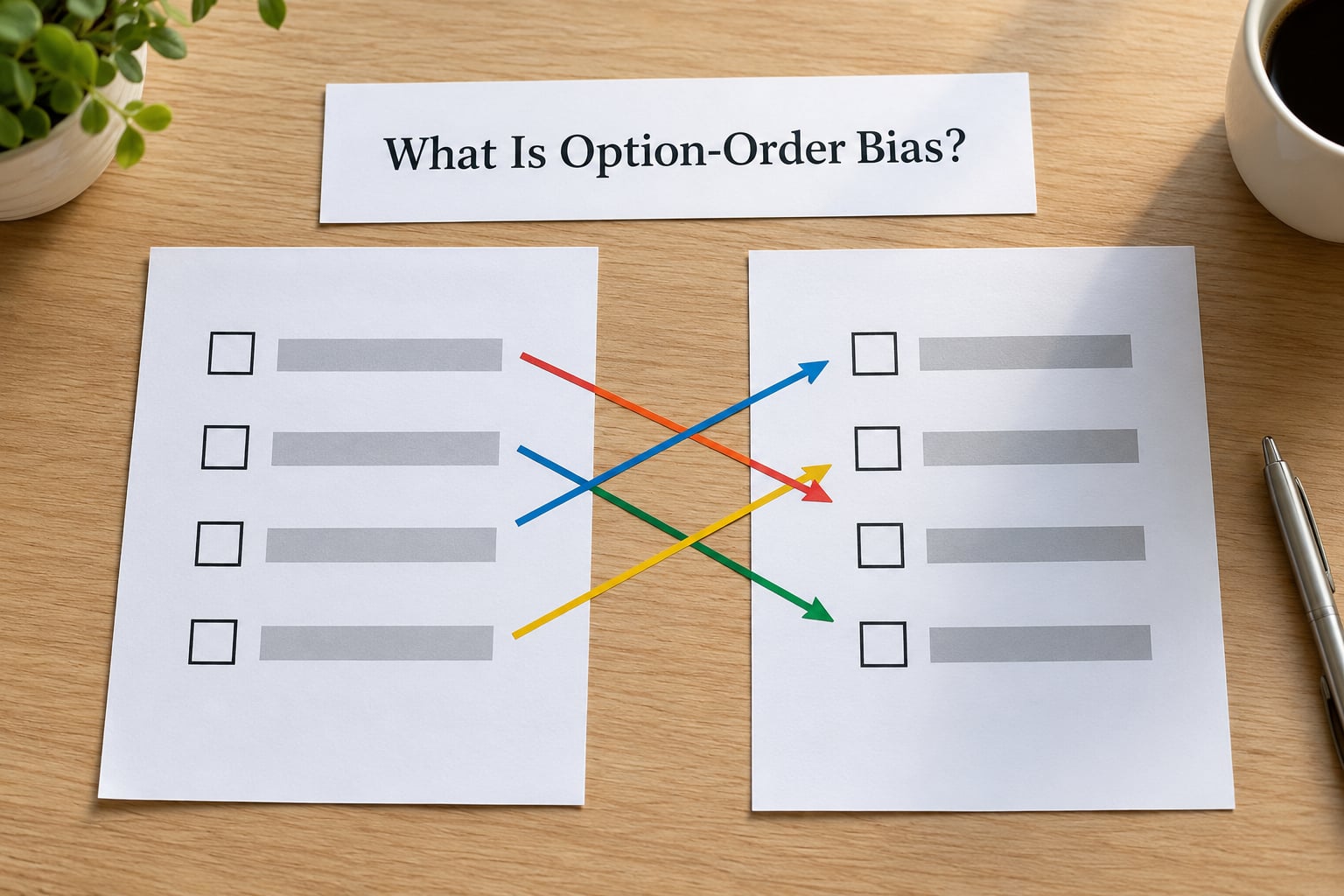
Option-order bias, often called position bias, is the change in responses caused purely by where an option appears, independent of what the option says. Swap two choices and nothing about their meaning changes, yet the shares can move by several points.
That is what separates order bias from the other suspects. Wording bias comes from how the question is phrased. Acquiescence bias comes from a respondent’s habit of agreeing. Social desirability bias comes from what seems like the acceptable answer. Order bias needs no bad intent and no awkward phrasing. It just needs a list and a position.
Three named effects do most of the damage:
- Primacy inflates options that appear early. They have the most room to be read carefully, and on a long list they are the only ones some respondents really register.
- Recency inflates options that appear late. They are the freshest items in mind at the moment the respondent clicks.
- Contrast inflates whichever option is being weighed relative to its neighbours. Moving one choice changes how another one looks.
The social science literature on this runs from Schuman and Presser’s experimental attitude surveys through Sudman and Bradburn’s work on response effects and Tourangeau and colleagues’ handbook chapters on the same ground. The finding is remarkably consistent: order matters most when options are similar, when respondents are less cognitively sophisticated, and when the instrument is long.
A short example makes it concrete. Ask four software tools which one you would use, always in the same order. The tool typed first collects a premium that has nothing to do with it. Run the same question with the order reversed and the premium moves to the bottom choice.
How Answer Order Changes Survey Responses
Respondents process a list of options one after another, not all at once. Every mechanism below follows from that single fact.
Serial evaluation. Each option is compared against what came before and after, not against an internal yardstick. This is why moving one option changes the measured value of another without either changing.
Working memory limits. Early in a long list, the respondent is holding several items in mind at once and comparing them. That is expensive work, and it favours early options that get studied properly. Primacy shows up strongest among respondents with the least capacity or motivation for that comparison, which is most of the people in a general-population panel.
Retrievability at the point of response. Recency is not about attention, it is about availability. When the respondent looks back down the list to press something, the last items are the ones the mind reaches for first.
Neighbour contrast. An option that sits between a very strong and a very weak choice looks strong by comparison. Take the weak option out of second place and the gap around it changes.
Satisficing. Respondents apply the cheapest satisfying rule they can find. Late in a questionnaire, the cheapest rule is often “click whatever is nearest.” A list where the same option is always nearest hands that respondent a systematic nudge.
Mode changes the strength of all of this. In interviewer-administered work, the order is spoken, so recall depends on the respondent’s memory rather than on visible text. In self-administered online panels the list stays on screen, which tends to strengthen recency and weaken primacy relative to the interview case.
Why Randomizing Answer Options Matters for Research Quality
The direct answer: randomization keeps a measurement artifact from being reported as a genuine preference.
Consider a brand tracker that asks which of six attributes best describes a category. Fixed order, and attribute one wins every wave while attribute six collects scraps. That pattern is indistinguishable from real preference once it lands in a deck. Randomize, and the winner changes as the field does. If attribute one still leads, you have learned something. If it does not, you spent three waves reading your own question layout.
The cost of fixed order shows up in three recurring shapes:
- A manufactured leader. The first option absorbs primacy and looks more popular than it is.
- A manufactured laggard. The last option collects recency penalties and starts-up avoidance, and gets written off as a weakness.
- A false gap between similar options. Two near-identical choices land either side of a strong neighbour, and the difference between them gets read as differentiation.
That last one bites hardest in brand and attribute work, where options are deliberately close together and the whole point is to separate them.
What Research Problems Can Randomization Prevent?
| Problem | What it does | Effect of randomizing options |
|---|---|---|
| Primacy | Early options attract more deliberate reading | Removed on average across respondents |
| Recency | Late options are most retrievable when answering | Removed on average across respondents |
| Contrast | Each option is judged against its neighbours | Removed on average across respondents |
| Fatigue-based satisficing | Tired respondents default to the nearest reachable option | Reduced, since no option stays nearest |
| Straight-lining on long lists | Respondents pick a fixed position for every item | Only partly reduced; still needs a diagnostic check |
| Acquiescence driven by phrasing | Agreement options collect extra picks because of how they read | No effect; this is a wording problem |
| Deliberate misreporting | Respondents answer for socially acceptable reasons | No effect; randomization changes only position |
Read the last two rows carefully. Randomization is a position control, not a truth serum. If your problem is a leading stem, an unbalanced scale or a respondent who is managing their image, shuffling the list will not touch it.
Nor does randomization fix a coverage gap. If respondents need a reason that is not on your list, shuffling your existing reasons changes nothing about what they can say.
How to Randomize Answer Options Without Creating New Bias
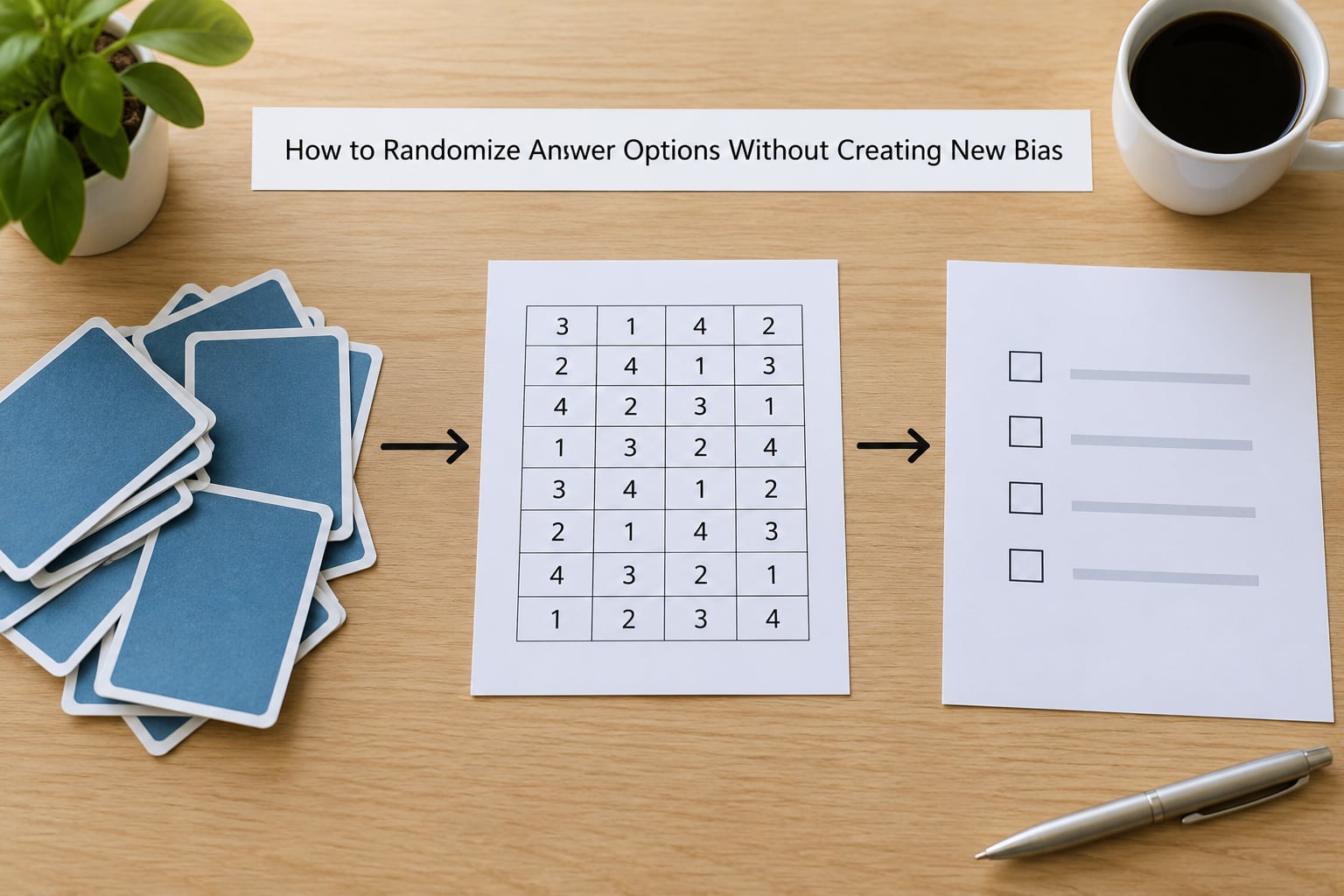
Randomization goes wrong when it is applied to things that were never interchangeable. The fix is to decide what is genuinely free to move before you switch anything on.
Step 1: sort options into interchangeable and fixed. Interchangeable means a respondent would not be confused or misled by seeing it in any position. Fixed means the position carries meaning. Attribute lists and unordered brand lists are usually interchangeable. Scales with endpoints, numbered ranges and logical sequences never are.
Step 2: pull the fixed items out of the shuffle. Most platforms will randomize every option in a list by default. You need to place your fixed items at the ends and randomize only the middle block. This is the step practitioners most often skip and most often regret.
Step 3: anchor the functional options. “Other (please specify)” normally belongs at the bottom. “None of the above” usually belongs where a respondent will look for an escape, and it must stay visible to any logic that filters on it. Anchor these rather than trusting them to a shuffle.
Step 4: choose a method that matches your sample. If you have a few hundred completes and a tight number of options, rotation balances position exactly. With thousands of completes and an awkward option count, simple randomization is fine. If you want one rule that handles both, use a random starting point and rotate from there.
Step 5: store the displayed order for every respondent. Without a per-response record of which position each option occupied, you cannot test the randomization afterwards and you cannot model order effects in the analysis. Check that your export includes it before you field.
Step 6: test the instrument. Run a split pilot with two different fixed orders and look at the differences. That pilot is the only thing standing between you and a layout mistake that ships.
How Randomization Methods Compare
| Method | How it works | Balance | Complexity | Best use |
|---|---|---|---|---|
| Simple randomization | Every respondent gets an independent random order | Balanced on average, uneven in any single sample | Low | Large samples, long or variable option sets |
| Rotation | Each respondent gets the next order in a repeating set | Position balanced within every block | Medium | Small samples, short fixed option sets |
| Complete randomization | Every possible order is equally likely | Full coverage, assumes a large sample | Low | Complex option sets where rotation is impractical |
| Random-start rotation | A random start point, then the order rotates from there | Near-balanced in every block | Low | The general-purpose default |
Rotation is the underused one. Small samples are exactly where imbalance hurts most, because with 200 completes and six options, a bad random draw can leave one option mostly in fifth place. Rotation removes that possibility by construction rather than by luck.
What Should Stay Fixed in a Randomized Survey?
Randomization is the wrong tool for anything whose position carries information.
Directional scales. Agree-disagree and Likert scales run from one end to the other. Shuffling them corrupts the data, because “strongly agree” no longer shares a scale position with anything. Practitioners describe accidental reordering of these scales as the single most damaging randomization mistake, and it happens because the tool’s randomize button applies to the whole list.
Numeric ranges. Age bands, income brackets and frequency scales have a natural order that the respondent uses to locate themselves. Moving the endpoints destroys the only cue they have.
Logic and screening questions. If an option controls a skip path or a display, moving it changes which respondents see the follow-up. Screening questions also often work better in a fixed order for reasons of flow rather than bias.
Escape options. “Other” and “None of the above” have functional positions. Randomizing them breaks exclude logic and produces unfilterable data.
Sequences that tell a story. Chronological or causal sequences, price ladders and funnel steps are read as a sequence. Shuffling them changes the object being measured.
Brands in a fixed competitive set. Sometimes order is the finding. In a ranking task, in a side-by-side comparison where the first item anchors the frame, or in a question about what comes first, reordering measures a different construct. Decide which one you are running before you shuffle.
How Can Researchers Test Whether Randomization Worked?
Randomization should be verifiable, not assumed.
Run a split-sample pilot. Split a small pilot into two halves, fix a different order for each, and leave everything else identical. You need enough completes per cell to see a difference that is more than noise; a few dozen per cell usually reveals a large layout problem, though smaller order effects need a proper power calculation.
Compare shares position by position. For each option, compare its share when it appeared in position one against its share in position two, three and so on. Under clean randomization these should be close. A gap that persists is a signal that the option’s content, not its position, is doing something you did not expect.
Check item nonresponse. A question with a long list and randomized order often shows more skips than the same question with a fixed order. If skips climb sharply, the list may be too long for the mode rather than badly ordered.
Check straight-lining. Look for respondents who selected the same position across a battery. Straight-lining is a different problem from order bias, but randomization changes its signature, so the diagnostic needs to run on positions rather than on option names.
Look at completion time. If a list takes noticeably longer after randomization, the survey is probably carrying a long list that respondents are reading in an unusual order. Randomization surfaces the length problem; it does not fix it.
Test interactions by subgroup. Order effects are not equal across respondents. Check whether the position gaps differ for more versus less cognitively sophisticated groups, and for mobile versus desktop respondents, since a long shuffled list can behave differently on a small screen.
Retrospectively, the same position-by-position comparison can be run on existing data if your platform logged the displayed order. If it did not, you cannot recover it after the fact, which is the practical argument for turning the logging on now.
Common Mistakes When Randomizing Survey Choices
Randomizing the whole list instead of part of it. The fix: anchor every fixed option and randomize only the interchangeable block. Most tools let you set fixed positions at the top and bottom of a list.
Randomizing “Other” or “None of the above”.strong> The fix: pin them, and re-test any logic that referenced their positions. Some platforms treat list positions as values, so moving an option silently changes what your filter matches on.
Accepting unequal exposure. Simple randomization on a small sample can leave one option mostly buried. The fix: use rotation, or use random-start rotation, so every option occupies every position an equal number of times within each block of respondents.
Changing option wording between versions. A split test where one arm has a rewritten option measures the rewrite, not the order. The fix: hold wording constant and vary only position.
Shuffling mutually exclusive options together. Options that cannot be chosen together are often written in a deliberate sequence that helps respondents scan. The fix: check whether the set is really unordered before you let it move.
Ignoring how the list renders on a phone. A shuffled fifteen-option list on a small screen can push options below the fold or hide them behind a collapsed “show more”. The fix: preview the shuffled state on mobile, not just the default state.
Not preserving the displayed order in the data set. The fix: confirm the export includes a per-response order record before you field, and document the variable name in your codebook.
One more, less obvious: some respondents notice the options change between two versions of the same survey and read it as a sign of a poor survey. That reaction is uncommon and concentrated in repeated-measures designs where people see the instrument more than once. Keeping the rest of the questionnaire identical helps.
Frequently Asked Questions
Should answer options always be randomized?
No. Randomize only when the options are genuinely interchangeable, meaning any position reads correctly and carries no meaning of its own. Attribute lists, unordered brand lists and single-select reason lists usually qualify. Directional scales, numeric ranges, logical sequences and functional options like Other or None of the above should stay fixed. The test is simple: would a respondent be confused or misled by seeing this option anywhere in the list?
What types of survey questions should not be randomized?
Do not randomize agree-disagree or Likert scales, numeric ranges and age bands, skip-logic and screening questions, Other or None of the above options, and any list where the sequence carries meaning such as a price ladder, a funnel or a timeline. Reordering a directional scale corrupts the scale itself, and moving a functional option breaks the logic that references it. Fixed order is the correct choice in all of these cases.
Does randomizing answer order make a survey completely unbiased?
No. Randomization controls position, and position is only one source of distortion. It does nothing about leading wording, an unbalanced set of response categories, missing coverage in your option list, acquiescence driven by how options are phrased, or respondents who answer to look good. Treat it as one control in a wider design process, alongside neutral wording, balanced scales and pilot testing.
How do I report the order of randomized answer options in my data?
Store the displayed position of every option for every respondent, not just the chosen option. Most platforms will export this if the setting is enabled before fielding, and it cannot be reconstructed afterwards. Check the variable names in your export and note them in your codebook, then you can compare response shares position by position and test whether the randomization worked as intended.
What is the difference between randomizing choices and rotating them?
Randomization gives each respondent an independent random order, so balance is achieved on average across many respondents. Rotation assigns each respondent the next order in a repeating set, so balance is guaranteed within every block. With a few hundred completes and a short fixed option list, rotation is the safer choice because it cannot produce an unlucky draw that buries one option. With a large sample, randomization is simpler and fine.
How many survey responses are needed to test option-order effects?
It depends on the size of the effect you are trying to detect, which is usually small. A split pilot with a few dozen completes per order will expose a severe layout problem, such as an option that wins only because it is always first. Detecting a two-point difference between positions needs far more, typically several hundred per cell. Work backwards from the difference that would change your decision and calculate from there.
Conclusion: Make the First Design Decision Fair
Why randomizing answer options matters is not really about randomization as a technique. It is about not letting the layout of your question end up in your findings as if it were an opinion.
Start where most teams skip. Go through every multi-option list and split the options into two piles: the ones where position carries no meaning, and the ones where it does. Only the first pile gets shuffled. Anchor the scales, the ranges and the escape options, then pick the lightest method that balances exposure across your sample and make sure the displayed order is stored for every respondent.
That single habit removes a whole class of artifacts before they ever reach a chart, and it takes less time than the explanation you will otherwise have to write.