
Share of voice is the percentage of a category’s total conversation your brand captures, and you can measure it with a spreadsheet and free data sources. If you want to know how to measure share of voice without expensive tools, the work comes down to three decisions: who counts in the denominator, what counts as a mention, and how often you repeat the count. Everything else is bookkeeping, not software.
Share of Voice = (Your Brand Mentions / Total Category Mentions) x 100
That formula is the whole idea. The messy part is the two numbers underneath it, and the mess is not technical — it is definitional. Every vendor defines the denominator slightly differently, which is why two SOV tools can show your brand at 22% and 34% in the same month and both be right. Run your own count and you control the definition. Updated for 2026.
Table of Contents
- What You Need
- Step-by-Step: How to Measure Share of Voice Without Expensive Tools
- 1. Define Your Share of Voice Scope
- 2. Collect Free Mentions and Visibility Data
- 3. Count and Classify Each Brand’s Mentions
- 4. Calculate a Simple Share of Voice Score
- 5. Report Trends and Turn Findings into Actions
- Common Mistakes
- Frequently Asked Questions
- What is the formula for calculating share of voice?
- How do I calculate share of voice in a spreadsheet?
- What is a good share of voice percentage?
- What is the difference between share of voice and market share?
- What is share of voice in advertising?
- How often should you measure share of voice?
What You Need
Share of voice only means something when the scope is fixed. Change the competitor list, the channel list or the date range and you have a different number, which is why month-to-month comparisons fall apart for most small teams. Set the scope once, write it down, and change it only on a schedule you announce in advance.
Six things have to be pinned down before you count anything:
- A competitive set of five to eight brands. Pick the companies you would fight for the same customer, not the biggest names in the industry. Include yourself. Keep the list short enough that you can realistically find mentions for every name.
- A channel list you can actually reach. Search, AI answers, earned media and one or two social platforms is plenty. Adding a channel you only sample occasionally makes the total look inconsistent month to month.
- A reporting period. Thirty days is the sweet spot: long enough that small brands register, short enough that campaigns can move it.
- A keyword and prompt set. Twenty to forty search terms and ten to fifteen written prompts that a buyer might actually type. Fix the set and never edit it mid-quarter.
- A spreadsheet. One tab for mentions, one tab for the scorecard, one tab for notes on where each count came from.
- Two to five hours a week. Less for search and media, most of it for AI answers and social.
Here is the tool stack. Every item below has a genuinely free tier, and the limits are stated as they behave rather than as marketing adjectives.
| Tool | What it covers | Free limit that matters | Cost |
|---|---|---|---|
| Google Search Console | Your own queries, clicks and average position | No cap; full history for a verified property | Free |
| Google Trends | Relative search interest by term and region | Sampled data, not exact volumes | Free |
| Google Alerts | New web and news mentions of each brand | Keyword caps on how many terms one alert can hold | Free |
| Bing Webmaster Tools | Search performance and indexed pages | No cap, site verification required | Free |
| Ahrefs Webmaster Tools | Referring domains and backlinks to your site | Your own verified site only, no competitor data | Free |
| Brand24 | Mention monitoring across web and social | Capped number of tracked mentions per day on the free plan | Free tier |
| AnswerThePublic | Question-shaped queries and visual search | Small daily allowance, then it asks you to wait or upgrade | Free tier |
| Platform search | LinkedIn, X, Instagram, TikTok, Reddit post and comment search | No cap, entirely manual | Free |
Notice what is missing. No enterprise listening platform, no paid rank tracker, no media database. The free stack covers volume and source location well enough to run a defensible monthly number, and it costs nothing but the hours in the table below.
Step-by-Step: How to Measure Share of Voice Without Expensive Tools

The workflow below is the one I would run for a small or mid-size team with no software budget. Five steps, roughly a month of counting, then a repeat that costs less each time.
1. Define Your Share of Voice Scope
Write the scope on one line at the top of the spreadsheet, the way you would write a test protocol. Something like: five brands, search plus AI answers plus earned media, one country, thirty days, twenty-five keywords and twelve prompts, counted on the last working day of the month.
Two choices cause most of the damage later. The first is the competitive set. Brands that rank for your keywords and brands that appear in AI answers are often different lists, and auto-discovered “competitors” from a tool tend to inflate the denominator with companies no buyer would consider. Pick the brands yourself.
The second is the prompt set. Write the questions a buyer would type before you look at any results: best tool for X, alternatives to X, is X worth it for a small team. Twelve prompts run through three assistants is a sample you can repeat. Prompts you invent after seeing who wins are not a measurement, they are a fishing trip.
2. Collect Free Mentions and Visibility Data
Collect channel by channel on a fixed schedule, and log where each count came from so the next person can reproduce it. Here is the realistic time budget for a five-brand set.
| Channel | How you collect it for free | Minutes per week |
|---|---|---|
| Search visibility | Export queries from Search Console, check where each competitor sits for your keyword set | 30 to 45 |
| AI answers | Run the fixed prompt set through ChatGPT, Perplexity and Gemini in fresh logged-out sessions, five runs per prompt | 60 to 90 |
| Earned media | Google Alerts per brand plus a manual pass through trade news and industry sites | 30 |
| Social mentions | Native platform search for each brand name, plus a free monitoring tier if you want an alert | 45 to 60 |
| Paid channels | Your own ad platform reports, which show impression share for your campaigns but not for competitors | 10 |
Plan on three to five hours a week in the first month and closer to two once the routines settle. That is the real objection to manual measurement and the answer to it: it is not free, it is small.
Paid search deserves a caveat of its own. Google Ads impression share only covers your own campaigns, so it can tell you that you are losing impressions inside your category but never what a competitor is spending. Treat it as a diagnostic for your account, not as a share of voice input.
3. Count and Classify Each Brand’s Mentions
Counting has to be boringly consistent, because two brands with the same number of mentions are not the same result if one sits in position one and the other sits in position nine. Tag every row with six fields: brand, channel, date, the query or prompt that surfaced it, position, and the URL or source.
Then classify each mention three ways. Mention type separates owned (your own site and profiles), earned (someone else wrote about you) and paid. Mention role separates comparison pages, listicles, how-to answers, review posts and news coverage. Sentiment takes a coarse pass: positive, neutral, negative, unclear.
Watch for two specific errors. Duplicate mentions inflate a brand that has a syndicated press release in six places, and counting a mention twice is the fastest way to manufacture a lead you do not have. Deduplicate by URL, not by headline.
One more distinction keeps your numbers comparable over time. Mention-based SOV counts every appearance equally. Visibility-based SOV counts only appearances in a position that earns attention, usually the top three. They answer different questions and they move in opposite directions, so reporting both beats averaging them into one blended number.
4. Calculate a Simple Share of Voice Score
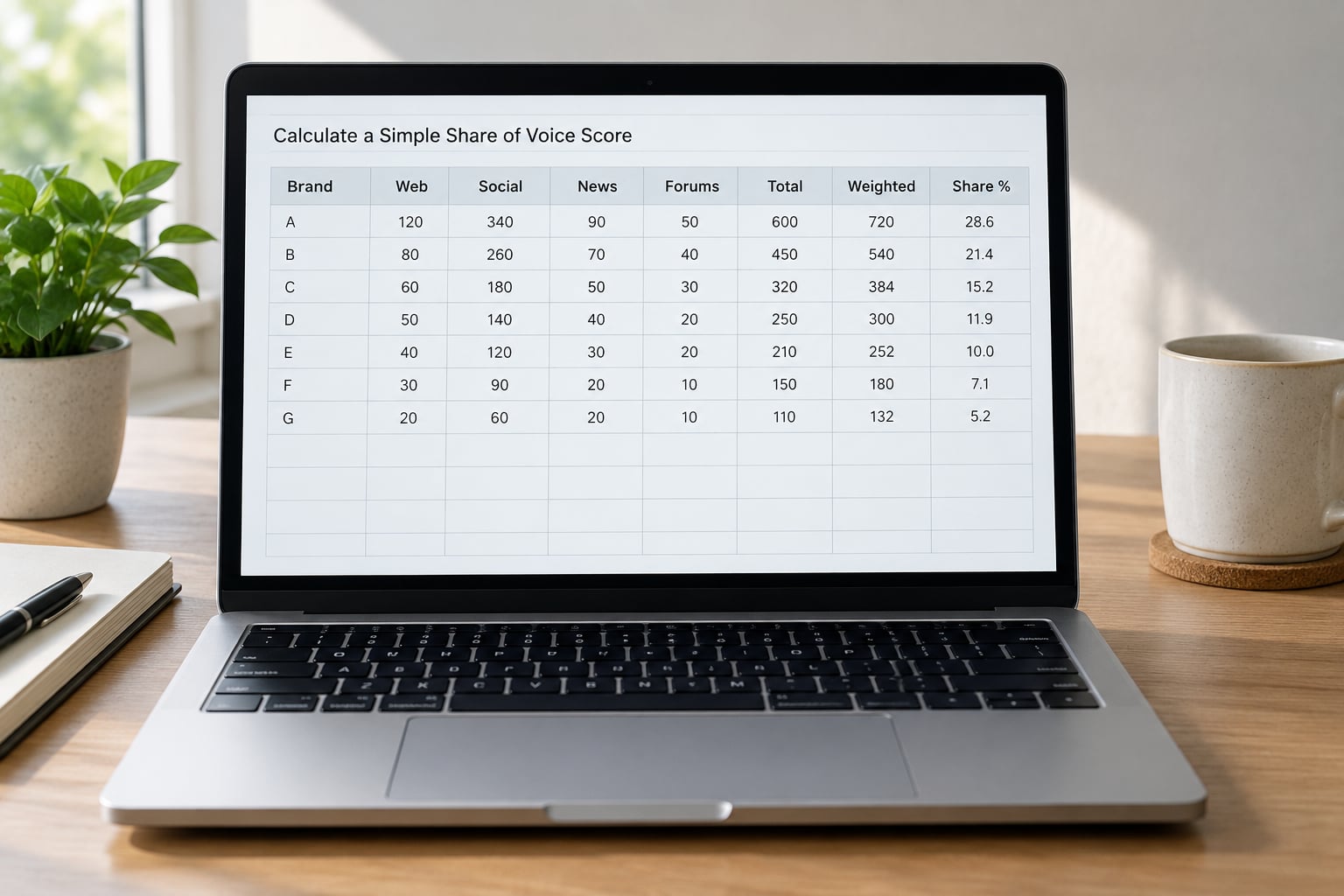
The raw calculation is one division per brand. Build it in columns so you can see the working: brand, raw count, share of voice percentage, and optionally a weighted score.
| Column | What goes in it | Example value |
|---|---|---|
| Brand | One row per brand in the fixed competitive set | Your brand |
| Channel | Where the mention appeared | AI answers |
| Date | Day inside the reporting window | Last working day of the month |
| Query or prompt | The search or prompt that surfaced it | best project tool for agencies |
| Position | Rank in the result, one is the top slot | 3 |
| Mention type | Owned, earned or paid | Earned |
| Source | URL or outlet | An industry publication article |
| Weighted score | Position weight times a type multiplier | 1.5 |
| Share of voice | Brand score divided by the total score across all brands, x 100 | 36.8 |
Here is a worked example. Five brands, thirty days, all channels combined, 581 recorded mentions in total. Raw counting gives the lead brand 214 mentions, its main rival 168, then 96, 61 and 42.
That produces 36.8% raw SOV for the leader, 28.9% for the second brand, 16.5%, 10.5% and 7.2% for the rest. It looks like a straightforward ranking, and it is the number most teams will report.
Now add position weighting. Count mentions in the top three results at full weight and everything below at 0.4, and the order changes. The smallest brand has 40 of its 42 mentions sitting in the top three, so its weighted score jumps while the leader’s long tail of lower placements shrinks. Weighted SOV lands at 37.0%, 26.8%, 15.8%, 10.6% and 9.7% — the last two brands have swapped places.
Neither version is wrong. One answers how often each brand shows up, the other answers who gets seen. Write down which weighting you used on the scorecard, or the next comparison will be meaningless.
5. Report Trends and Turn Findings into Actions
The first measurement is your baseline and it deserves no reaction at all. It is a starting line, not a verdict, and treating month one as a performance review is the fastest way to lose the habit.
From month two, read three things. Is your SOV rising faster than the category total? Which channel drove the change? Which competitor gained and on what — a new comparison page, a press win, a mention that landed in every AI answer at once?
Cadence depends on how fast you can move. Weekly works during a launch or a PR push. Monthly is the sensible default for most teams. Quarterly is enough if you run one campaign a quarter and no one acts on the number in between.
For leadership, keep the report to three lines: the number, the change since last month, and the one thing you are doing about it. Add the channel table underneath for anyone who wants detail, and state the denominator and the weighting in a footnote so the number can be audited.
Be honest about what the number is. Share of voice is a proxy for how loudly you are talking relative to the brands you chose to compete with. It is not revenue, it is not market share, and a rising SOV with flat sales usually means your messaging is getting louder rather than better.
Common Mistakes
These are the failures that turn a defensible measurement into a number nobody trusts six weeks later.
Using someone else’s competitive set. Auto-discovered competitors from a tool are built for discovery, not for a denominator. They drag in companies your buyers never consider, which flattens your percentage for no reason. Write your own list of five to eight and keep it.
Blending mention-based and visibility-based SOV into one headline number. If you weight some channels and not others, or count a mention on page four the same as position one, the total is not comparable to anything, including your own previous month.
Comparing numbers from different vendors. Each tool defines its own denominator, and results do not transfer between platforms. If you want a trend, run your own count with your own definition.
Mixing time periods. Mentions from last quarter leaking into this quarter’s tab inflate the leader and make every new campaign look ineffective. Close the window before you open the next one, and log the closing date.
Over-weighting one channel. AI answers can dominate a small sample and leave organic search, media and social invisible. Report channels separately, then sum. It is less tidy and far more useful.
Not recording sources. A mention with no URL or outlet cannot be verified, deduplicated or re-checked in three months. Record the source every single time, even when it feels redundant.
Presenting an estimate as a fact. Twelve prompts across three assistants is a sample, not a census, and a single decimal place implies precision you have not earned. Report to the nearest percentage point and name the sample size underneath.
Ignoring thin categories. For niche, local or new categories, keyword-based tools return almost nothing because there is not enough search volume, and the count looks like zero visibility when it is really a coverage gap. Fall back to platform search, community forums and direct asks to customers.
Frequently Asked Questions
What is the formula for calculating share of voice?
Divide your brand’s mentions by every mention recorded across the whole competitive set, then multiply by 100. The formula is Share of Voice = (Your Brand Mentions / Total Category Mentions) x 100. The only real decision sits in the denominator, which brands and which channels count as your category. Change that definition and the same underlying data produces a different percentage.
How do I calculate share of voice in a spreadsheet?
Put one row per brand in the competitive set, count mentions in a column to its left, and total the count column. Add a third column that divides each brand count by that total and multiplies by 100. For position weighting, add a column that multiplies each mention by a weight before summing, then run the same division on the weighted column. Keep both totals visible so the arithmetic can be checked.
What is a good share of voice percentage?
There is no universal benchmark, because the number depends entirely on your competitive set and channels. The useful test is relative: is your share above the level you held at your last baseline, and is it growing faster than the category total? A team holding 15% steadily in a three-brand category is doing well. The same 15% in a ten-brand category is weak.
What is the difference between share of voice and market share?
Market share is revenue, units or customers, which makes it factual and slow to move. Share of voice is visibility, mentions and impressions, which makes it noisy and fast to move. Share of voice usually shifts first and market share follows later, if it follows at all. Treat it as an early warning signal rather than a business result.
What is share of voice in advertising?
In advertising it usually means your impression share, the percentage of eligible impressions your campaigns won against the same competitors on the same inventory. Ad platforms report it for your own campaigns but not for competitors, so it tells you where you are losing auctions rather than how the category splits. Measure paid SOV separately from search, social and earned coverage.
How often should you measure share of voice?
Monthly is the right default for most teams, because thirty days gives small brands enough signal without delaying action. Measure weekly during a launch or a press push, and quarterly if campaigns run that rarely. Keep the counting window fixed either way, because a number is only comparable with the window that produced it.
Start with one month of groundwork. Write the competitive set, the channels, the prompt set and the window at the top of a sheet, then count every mention you can find in that window and call it the baseline. No software, no vendor demo, no percentage quoted from someone else’s denominator.
Once that baseline exists, the monthly loop is a couple of hours of counting and one division per brand. That is genuinely how to measure share of voice without expensive tools, and the number is yours because you defined it.