
Short answer: review volume and rating balance affect trust as two separate signals, and neither one carries a buying decision on its own. Review volume is a sampling cue, telling you how stable the average is. Average rating is a valence cue, telling you whether the typical experience was good. Getting a handle on how review volume and rating balance affects trust comes down to one question: how many people is that average describing, and how honest does it look?
That is where most purchase decisions quietly go wrong. A 4.5 from eight reviews and a 4.5 from eight hundred are the same number on screen and entirely different claims about the product. One is an anecdote with a decimal point attached.
Table of Contents
- What Is Review Volume and Rating Balance?
- Why the word balance gets misread
- How Review Volume and Rating Balance Affects Trust
- Research on how review volume and rating balance affects trust
- Why a High Rating Can Feel Untrustworthy
- How Review Volume Changes Perceived Reliability
- How Rating Balance Influences Consumer Decisions
- Category risk changes the exchange rate
- What Other Trust Signals Should You Check?
- How to read any rating in ten seconds
- Signs that review volume is inorganic
- Frequently Asked Questions
- Do people read reviews or just look at the star rating?
- How many reviews do you need before customers trust a brand?
- Why is a perfect 5.0 star rating suspicious?
- Can having too many reviews reduce trust?
- How do you recover a dropped average star rating?
- Does review volume matter more for cheap or expensive products?
- Conclusion
What Is Review Volume and Rating Balance?
Review volume is the raw count of ratings or written reviews a product has accumulated. Rating balance is the relationship between that count and the average score those reviews produce, plus the shape of the distribution behind the average. Balance does not mean a healthy work-life equilibrium, which is how search engines first read the phrase. It means whether the number of reviews plausibly supports the score being shown.
Think of volume as sample size and rating as the estimated value. A mean of 4.5 from eight observations is a guess. A mean of 4.5 from eight hundred is an estimate with a range around it, and the range tightens as the count climbs.
| Signal | What it indicates | What it cannot prove |
|---|---|---|
| Review volume | How many people weighed in; how stable the average likely is | That those people are typical customers, or that the reviews were not solicited |
| Average rating | Whether the typical experience was good | How consistent that experience is, or how recent it is |
| Rating distribution | Whether real disagreement exists and how sharp the good experience is | Anything about the identity or honesty of reviewers |
| Review recency | Whether the product still behaves the way it did a year ago | That older experiences still match the current version |
| Verified share | Whether reviews are tied to real transactions | That verified customers are representative of all buyers |
| Owner responses | Whether the business engages with complaints in public | That the underlying problem was actually fixed |
Each row answers a different question, which is why collapsing them into a single star display throws information away. A star rating and a review count sitting side by side is already a compressed summary of at least two separate measurements.
Why the word balance gets misread
Search results for this topic pull in trust fund balances and work-life balance because nobody has defined the term. In review contexts, the useful phrasing is volume-to-rating balance: the exchange rate between how many reviews you have and what they average. That framing is what the rest of this article uses.
How Review Volume and Rating Balance Affects Trust
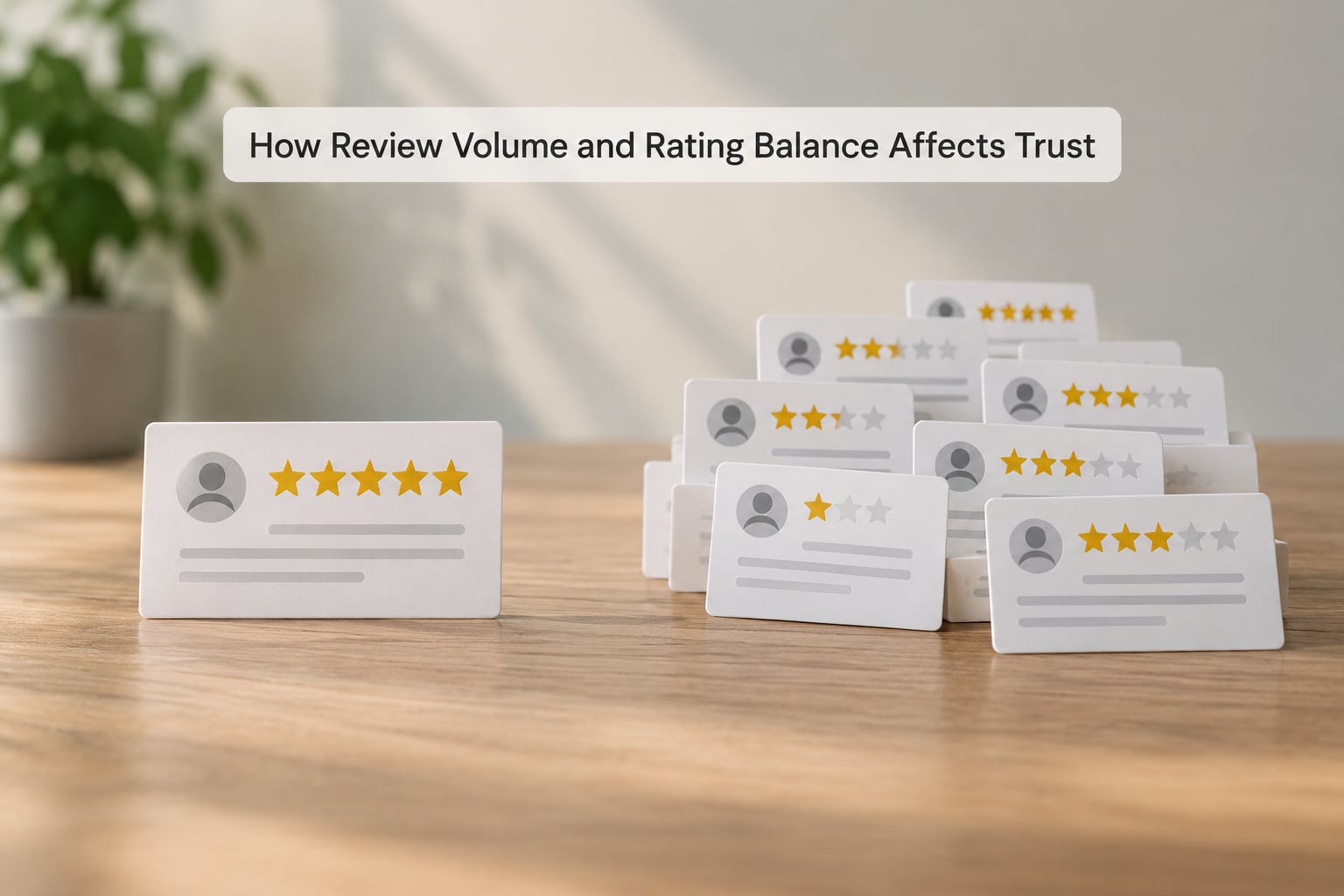
Consumers read the pair as familiarity, representativeness and credibility, in that order, which is how review volume and rating balance affects trust in practice. Volume answers how familiar the product is with real use. The distribution answers whether that use was broadly agreeable or sharply split. The average then says which side of the split dominates. Together they form the trust signal, and a gap between them gets resolved in the direction that makes the purchase feel lower risk, which is usually toward the larger sample.
Here is the same average behaving four different ways. These profiles are hypothetical, built to show how the read changes, not observed data from any store.
| Hypothetical profile | What the number feels like | Likely trust read |
|---|---|---|
| 4.5 stars, 8 reviews | A clean score with nothing under it | Dismissible. Easy to imagine early customers who liked it, or a page that was reset recently |
| 4.5 stars, 800 reviews | A solid average with a real spread behind it | Credible. The score has been defended against hundreds of people |
| 4.2 stars, 1,200 reviews | Honest rather than flattering | Strong. A practitioner claim repeated on LinkedIn holds that a 4.2 with 1,200 reviews outperforms a 4.5 with a much smaller count |
| 3.9 stars, 3,000 reviews | Below the comfort range but widely sampled | Believable but costly. The buyer expects recurring complaints and looks for a specific reason to accept them |
Research on how review volume and rating balance affects trust
The research does not settle in favour of volume, and pretending otherwise would make this less useful. A 2016 study in Emerald’s Networks Business Review, Do review valence and review volume impact consumers’ perceptions and purchase decisions?, found that valence had the stronger effect on consumer perceptions, and that negative reviews raised perceived risk. Volume softened the impact of negatives; it did not erase it.
Other lines of work explain why both signals persist. Signaling theory, from Spence’s 1973 job-market paper, treats costly signals as credible precisely because they are expensive to fake. A large honest review base is expensive. A perfect score is not. The 1970 lemons problem from Akerlof gives the reason buyers care at all: when sellers know more about quality than buyers, the average rating is the only public estimate available.
There is a useful counterweight to the pure-volume camp, and it is worth stating plainly. If you only remember one research finding from this area, make it the Emerald valence result. Rating direction carries more weight than raw count, which is why a wall of identical five-star reviews can read as worse than a page with real dissent in it.
Why a High Rating Can Feel Untrustworthy
A perfect 5.0 with a meaningful number of reviews behind it is genuinely rare, and that rarity is the problem. Real products fail in specific ways for specific customers, and a distribution with nothing under five stars describes a world where nobody was ever disappointed.
Yotpo makes the practitioner version of this case, arguing that a 4.7 with a few answered negatives converts better than a perfect 5.0, and that detailed reviews beat bare star ratings. A reputation-marketing guide goes further and names 4.2 to 4.5 as the conversion sweet spot, on the reasoning that a perfect rating signals inauthenticity.
Four patterns make a high average feel manufactured:
- A distribution with no three- or four-star entries anywhere in the history
- A review count that jumped inside a short window rather than accumulating
- Near-identical phrasing and structure across entries
- A review page that starts from zero with no earlier history to show
Forum readers treat the last one as disqualifying on its own. In Amazon Vine threads, buyers inspect the existing review set before they commit, and an empty or suspiciously clean page ends the check early. In SideProject discussions, a large-scale analysis of community comments framed brand grading as reflecting consistency of positive sentiment rather than raw count, which is a distribution argument dressed as an observation.
None of this means a high rating is fake. It means the burden of proof sits with the unusual profile, not the ordinary one.
How Review Volume Changes Perceived Reliability
Understanding how review volume and rating balance affects trust starts with one mechanism: more reviews shrink the error around the average. Confidence in a mean rises with sample size, so the same 4.2 reads very differently at twenty reviews than at two thousand. The perceived reliability gain is real but front-loaded, and it flattens out once the count is comfortably past the point where the average can move.
Total volume is also the wrong number to reach for in some cases. What matters more is how much of it is recent. SmartScout’s November 2025 retail-readiness guide treats recency, average rating and sentiment as separate inputs, and notes that a small set of detailed reviews can outweigh a large set of generic ones. A five-year-old review block describes a product that may have been revised twice since.
Verified purchase markers and reviewer history add another layer. A count of three hundred where a third carry verification markers tells a different story than three hundred unverified ones, even though the headline number matches.
None of that removes the unhappy-customer skew. Buyers point out constantly, on Reddit and Quora alike, that satisfied customers rarely write and dissatisfied ones write at length. When that is true, a rising review count can signal rising problems rather than growing confidence, and the average drifts down as the count climbs.
How Rating Balance Influences Consumer Decisions
Balance changes what the buyer expects to happen after purchase. A tight distribution around 4.8 suggests a consistently good experience, so failure feels like a fluke. A wide spread from 2 to 5 tells the buyer the product is great for some people and wrong for others, which pushes them toward fit questions: size, compatibility, use case, expectations.
That reframing matters more in some places than others. A restaurant with 300 reviews averaging 4.2 and a scattered one-star tail is probably consistent and busy. An online product with the same profile is being assessed on whether it fits the reader. A local service is judged partly on how recent the feedback is. Treating one pattern as universal across all of them is where most review-reading advice goes wrong.
Category risk changes the exchange rate
How much rating a buyer will trade for volume depends on the stakes:
- Low-risk impulse items. Volume carries most of the weight. Nobody runs a confidence calculation on a low-cost accessory; the count is a proxy for having been tried and survived.
- Considered purchases. Both signals matter and the spread starts to matter more, because buyers are comparing specific attributes rather than general quality.
- High-stakes decisions. Rating and distribution carry more weight than raw count. A four-figure purchase with forty detailed reviews can be more persuasive than the same purchase with four hundred vague ones, because specific detail is diagnostic and vague volume is not.
So the exchange rate is not fixed. The more expensive the mistake, the less a big number on its own will carry you.
What Other Trust Signals Should You Check?
Once volume and rating are separated, the rest of the profile is quick to read. Here is the order I would use, taking roughly ten seconds on a phone.
How to read any rating in ten seconds
- Recency. Sort by newest and skim the last ten. Is the product still behaving?
- Spread. Open the distribution. A missing one-star bar costs more credibility than a low average.
- Verified share. Note how many reviews carry a purchase marker rather than a free-text claim.
- Detail. Specific reviews that mention fit, materials or performance beat enthusiastic praise that names nothing.
- Response rate. A business that answers complaints in public is telling you it expects to still be selling the product in a year.
- Photos and video. Visual evidence is proof of possession, which matters most in categories where appearance is the point.
- Independent data. Warranty terms, third-party testing and published return rates sit outside the review system and are harder to manipulate.
Social proof carries the most weight when it agrees with the rest of the evidence. When a review profile is the only evidence available, and platforms make manipulation easy, sensible buyers discount all of it, including the honest reviews. That discount is the trust collapse effect: a manipulated ecosystem devalues itself, and the honest majority along with it.
Signs that review volume is inorganic
- Volume arriving in a burst rather than a trickle across weeks
- A distribution too clean for a real product, with nothing in the middle bands
- Template similarity in wording, length and structure across unrelated reviewers
- Reviewers with a long history of reviewing one category and nothing else
- A five-star wall paired with an average that sits well below five, which happens when older honest reviews are quietly outnumbered
Research on review fraud, including Luca and Zervas’s 2015 work on Yelp, treats patterns like these as detectable rather than invisible. Reviewers in forum threads make the same point without the statistics: templated text and a hundred reviews dumped in a week are named routinely as failure modes by the vendors who sell the opposite.
Frequently Asked Questions
Do people read reviews or just look at the star rating?
Both, in that order, and the star rating is usually the gate. Roughly 95% of online shoppers are reported to read reviews before buying, per a Reputation Stacker aggregation, and Quora threads split repeatedly on whether reading is worth the time. In practice the average decides whether someone clicks into the distribution at all, and the distribution decides whether they keep reading.
How many reviews do you need before customers trust a brand?
There is no magic number, but the threshold people quote in practice sits between 25 and 100 reviews for a general product, higher for anything expensive or technical. How review volume and rating balance affects trust changes at that boundary: below it the average swings several points on one new review, so buyers discount it. Above it the count stops doing much work and the shape of the distribution takes over.
Why is a perfect 5.0 star rating suspicious?
Because real products disappoint specific people in specific ways, and a distribution with no one- or two-star entries describes a product that never let anyone down. Vendors make the same argument commercially, with Yotpo claiming a 4.7 with answered negatives converts better than a perfect score. The reasonable read is not that 5.0 is fake, but that an unusual profile owes you more evidence.
Can having too many reviews reduce trust?
Yes, in one specific way: a large review count attached to a merely decent average can read as bought rather than earned, especially when the volume arrived in a short window. The 2016 Emerald study found negative reviews raise perceived risk, and bulk positive volume softens that risk without removing it. Volume buys you stability, not credibility, when the average does not move with the count.
How do you recover a dropped average star rating?
It is mostly arithmetic, and it takes time rather than tactics. A recovery service cited in research gives a range of three to eight weeks and 100 to 500 new reviews to move a damaged average back up, and warns that a sudden burst does not work because templated text gives the game away. Responding to the negatives in public helps for a different reason: it changes how the next reader reads the existing complaint.
Does review volume matter more for cheap or expensive products?
It matters more for cheap ones. For low-risk impulse purchases the count alone does most of the work, because nobody runs a confidence calculation on a small item. For high-stakes decisions the rating, the spread and the specificity of individual reviews carry more weight, and four hundred vague reviews can be less persuasive than forty detailed ones. The higher the cost of being wrong, the less raw volume will carry you.
Conclusion
Understanding how review volume and rating balance affects trust comes down to knowing which signal you are actually looking at. Start with the distribution and the average, then check whether the count is big and recent enough to mean anything, then confirm the reviews look earned rather than arranged.
If you do one thing before buying, open the rating histogram and read the one-star reviews. That single check settles more than the average ever will, and it takes about ten seconds.