
Translation converts existing words from one language into another while keeping the meaning intact. Multicultural marketing starts somewhere else entirely: it researches a culturally distinct audience, then shapes the message, offer, creative and channels around what that audience actually values. One is a language task. The other is a segment strategy that happens to need language work.
The confusion between the two is expensive. A brand pays per word for a translated asset, the copy arrives grammatical and lifeless, and the campaign underperforms against the exact audience it was meant to reach. I have watched teams relaunch the same message with research behind it and watch response change, without changing a single price or product.
So here is the working distinction: translation changes the words, multicultural marketing changes the campaign. Below, the two are compared attribute by attribute, then placed on a single spectrum so you can pick the right level of effort for the job in front of you.
Table of Contents
- How Multicultural Marketing Differs from Translation at a Glance
- Translation Changes the Words; Multicultural Marketing Changes the Campaign
- What translation actually is
- What multicultural marketing actually is
- Audience Research and Cultural Understanding
- Cultural Context, Symbols, and Emotional Meaning
- Creative Adaptation Versus Word-for-Word Messaging
- Channels, Media, and Customer Experience
- How Multicultural Marketing Differs from Translation in Measurement
- When Translation Is Enough and When Adaptation Is Needed
- Which Should You Choose?
- Frequently Asked Questions
- Is multicultural marketing the same as translation?
- What is the difference between localization and translation?
- What does multicultural marketing mean?
- What is transcreation, and when is it needed?
- Can AI translation replace multicultural marketing?
- How do you measure whether a culturally adapted campaign worked?
- Conclusion
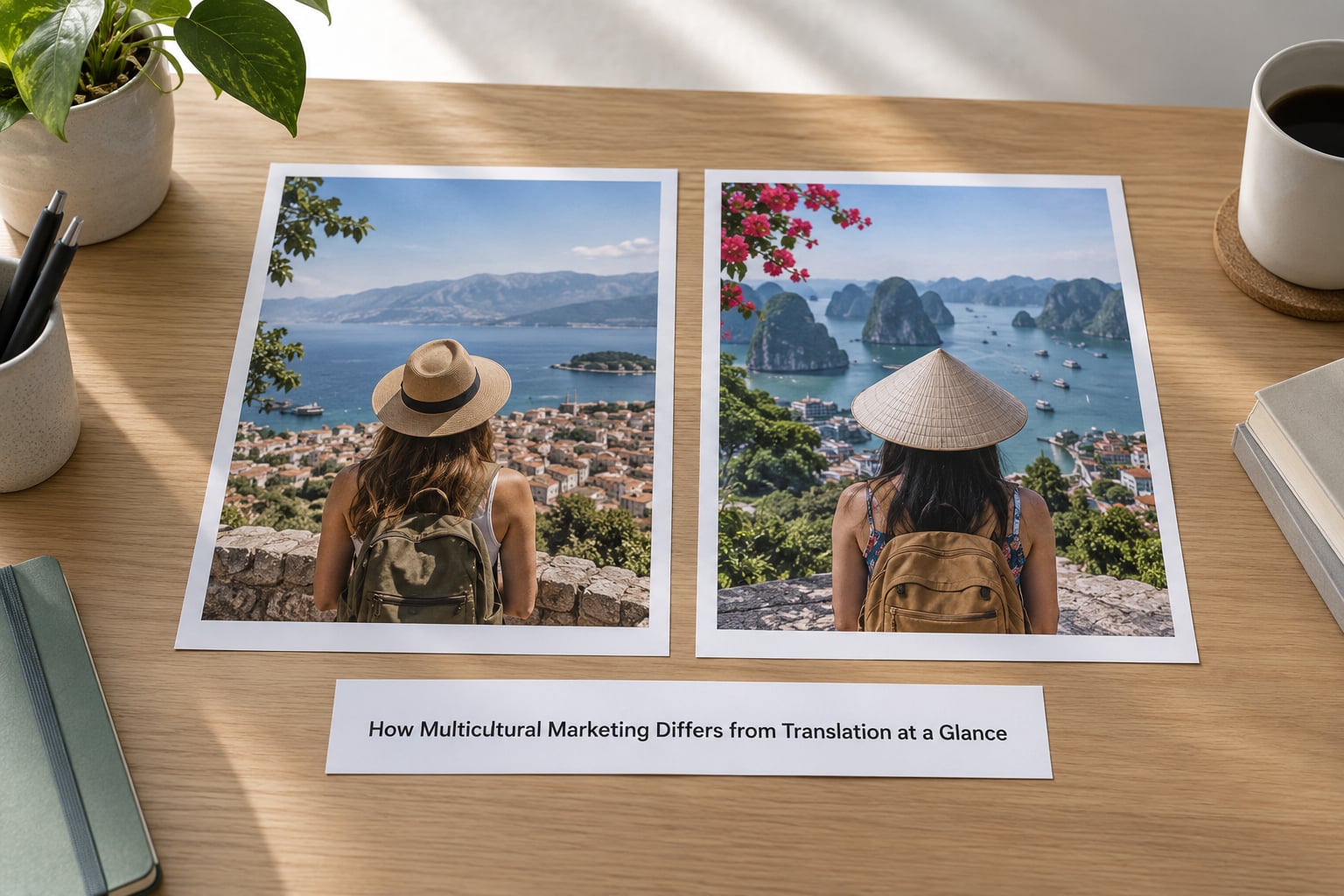
How Multicultural Marketing Differs from Translation at a Glance
| Attribute | Translation | Multicultural marketing |
|---|---|---|
| Primary purpose | Carry the same meaning into another language | Build relevance and trust with a culturally distinct audience |
| Scope | One asset, one language pair | Message, offer, creative, channels and customer experience |
| Starting point | Finished source copy | Audience research and cultural insight |
| Key question | Is this accurate and fluent? | Does this feel like it was made for people like us? |
| Who typically owns it | Localization or translation vendor | In-house marketing lead, cultural insights agency or multicultural agency |
| Typical output | Target-language copy, glossary, QA report | Segment strategy, adapted creative concept, channel plan, rationale per asset |
| Cost basis | Word count and language pair | Research depth, number of territories, creative complexity |
| Approval loop | One review round, often by a language reviewer | Multiple concept options, back-translation, rationale, local stakeholder sign-off |
| Success metric | Linguistic accuracy, consistency, turnaround | Brand lift, trust, resonance, conversion by segment |
| Typical failure | Grammatically correct, culturally flat copy | Stereotypes, insider assumptions, wrong channel, backlash |
Read the table top to bottom and one pattern keeps repeating. Every row where translation is strong is a row about language. Every row where multicultural marketing is strong is a row about people. That is the whole difference in one view.
Translation Changes the Words; Multicultural Marketing Changes the Campaign
What translation actually is
Translation takes a source text in one language and produces a target text in another with equivalent meaning. That equivalence is the quality bar, and it is a demanding one: register, formality, technical terminology and brand voice all have to survive the trip.
In marketing, translation covers a lot of ground. Product descriptions, help documentation, FAQ pages, metadata and titles, legal disclaimers, shipping notices and internal training material are all translation jobs. None of them requires you to reinvent the campaign, because none of them is trying to make someone feel understood.
The deliverable is the target-language version of something that already exists. Accuracy, terminology consistency and turnaround are what the client is buying.
What multicultural marketing actually is
Multicultural marketing designs a campaign for an audience defined by culture, ethnicity, language, religion, migration history or identity, rather than by country. In the United States that usually means segments like Hispanic, Black, Asian American, Middle Eastern, immigrant communities and LGBTQ+ audiences, each of which is large, internally diverse and underserved by a single national campaign.
The deliverable is not a translated version of your ad. It is a segment definition, a cultural insight, a message and offer that fits that group, creative built from real cultural reference points, and a media plan that matches how the group actually behaves.
Language adaptation still happens inside that work. It is one input, and often the smallest one.
Here is the test I use. If the brief begins with a finished English document and a list of target languages, you are commissioning translation. If the brief begins with a question like who lives here and what they care about, you are commissioning multicultural marketing.
Audience Research and Cultural Understanding
Translation research asks narrow questions. Which dialect? Formal or informal? Which industry terms are standard? What does this idiom actually mean? Does the register match the brand voice? A competent linguist resolves those and hands back finished copy.
Multicultural marketing research asks a different set. What does this community look like internally? How do they identify, and where do they get identity labels wrong? What language do they actually use at home, and how does that differ from formal Spanish or formal English? Which platforms carry word of mouth here, and which are mostly passive consumption? What does this product category already mean to them?
That last one catches teams out. A product that reads as premium in one culture reads as ostentatious in another. A payment method that feels routine in one market feels risky in another. Nothing is wrong with the product, but the meaning attached to it shifts.
The trap is treating a national label as a single audience. Hispanic is not one audience, and it is not only Spanish speakers. There are differences by national origin, generation, whether Spanish is spoken at home, and whether the category is one where family or community opinion drives the decision. Two of those differences can change the media plan and the offer entirely.
Practitioners report the same thing from the vendor side: quotes priced by word count leave no room for a discovery phase, so the cultural strategy never happens. That is not a vendor being lazy. It is the brief asking for the wrong deliverable.
Cultural Context, Symbols, and Emotional Meaning
Accurate translation and cultural fit are different tests. A slogan can render with perfect semantic accuracy and still land as strange, offensive or funny in the wrong way. Cultural meaning is carried by things words only point at: imagery, colour, gesture, humour, names, food, clothing, holidays, family structure and history.
Colour is the example that gets repeated most often because it is visually obvious and easy to miss in review. A colour that signals celebration and luck in one culture can read as mourning in another. A translation brief rarely mentions colour at all. A multicultural brief treats the palette as part of the message.
Humour fails differently. Jokes built on wordplay survive in some languages and collapse in others. A pun that lands as clever in the source market can read as a strange non sequitur, or worse, as an insult, depending on how close to a sensitive topic it sits. Nobody flags it because the translation is technically correct.
Acronyms are the practical trap. Brands build campaigns around an initialism that spells a real word in English, and the whole campaign depends on that spelling working. In another language the letters spell nothing, so the copy is accurate and the idea is gone. Undertow Languages uses a version of this in its published example: a battery safety message built on an English acronym, where the letter set has to be rebuilt in each target language rather than carried across.
Names of people, places and fictional characters carry their own baggage. Transliterating a name is a mechanical task, but choosing which name to use, and how familiar a given name sounds, is a cultural decision. So is deciding whether a spokesperson looks like the audience at all.
The failure mode practitioners describe most often is technically correct but culturally flat. The copy is not wrong, nobody can point to an error, and it simply does nothing.
Creative Adaptation Versus Word-for-Word Messaging
Translated campaigns run on a short loop: source copy arrives, linguist returns target copy, reviewer signs off. Adapted campaigns run a longer one, and the difference in stage count is where the budget goes.
A workable adapted process looks like this:
- Discover. Cultural insight research on the segment, plus listening sessions or social listening so the team hears how the audience talks about the category.
- Define. A written segment brief: who they are, what they want, what they distrust, and what the brand can credibly say.
- Ideate. Creative territories written in the target language from the start, not translated afterwards. This is the step teams most often skip, and skipping it produces a polished translation of a weak idea.
- Adapt. Headline, call to action, offer, testimonial, packaging and visuals each handled deliberately rather than derived mechanically.
- Test. Back-translation by an independent linguist, plus a rationale explaining every departure from the source. This is what lets a non-speaker stakeholder judge whether the adaptation held up.
- Refine. Revisions informed by that rationale, then a final consistency pass against the glossary and style guide.
Transcreation sits between translation and a full multicultural reset. It rebuilds a specific asset in the target language to preserve intent, tone and emotional impact, usually with multiple options and a written rationale. It is the right tool for a headline, a video script or a campaign line where the idea is strong but the words will not travel.
Machine translation has moved fast and it is genuinely fine for product specifications, support articles and internal drafts. It gets weak fast as soon as humour, register nuance, cultural reference or brand voice matters. The human review boundary is easy to state: a native speaker with copywriting skill reviews everything a customer will see in a persuasive context. A fluent translation of a flawed message is still a flawed message.
Channels, Media, and Customer Experience
Translation rarely changes the media plan, because the plan was already correct for the market. Multicultural marketing routinely changes it, because the audience was defined differently from how the media was bought.
The points where the journey changes are easy to list. Search behaviour may not match the assumed pattern, so paid and organic plans need rewriting. Community-led and creator channels may outperform the usual buying. Local events may do more work than a national media burst. Retail environments and shelf presentation carry their own conventions. Customer service may need language and hours that reflect when this community actually needs help.
Availability matters too. A campaign that advertises a culturally specific product or offer and cannot deliver it to the people who responded is a service failure wearing a marketing costume.
The examples that work best are the unglamorous ones. A support line that opens during a religious observance, a delivery window that matches when people are home, or a returns policy written in the language someone actually reads. None of that is copy, and all of it affects whether the campaign converts.
How Multicultural Marketing Differs from Translation in Measurement
Translation is measured on the deliverable: accuracy against the source, terminology consistency, QA pass rate, turnaround against the deadline. Those are the right metrics because those are the promises being made.
Multicultural marketing has to be measured on the audience. Beyond standard performance metrics, teams look at brand lift and preference within the segment, message recall, sentiment in community spaces, and trust. The trust measure is the one that surfaces real problems early, because it moves before revenue does.
There is also a check most teams skip: did anyone misread the campaign? Code-frame comments and inbound messages for misinterpretation, offence or complaint, then read them by segment. Stereotype risk makes this a brand-safety question, not a sentiment question. A campaign that lands as a costume rather than as recognition does damage that a click-through rate will never show you.
One practical note. Comparing a multicultural campaign against the same campaign run in English tells you whether the adaptation worked. Comparing it against an unrelated benchmark tells you very little.
When Translation Is Enough and When Adaptation Is Needed
Three variables decide most cases: content risk, creative complexity and market sensitivity.
Translation is enough when the content is factual, low-risk and carries no persuasive weight. Product specifications, warranty terms, shipping notifications, ingredient lists, internal training documents. Accuracy is the entire job.
Localization is the next step up, adding cultural, regional and technical conventions: date and currency formats, units of measurement, right-to-left layout, address formats, and local labelling requirements. It applies to anything regulatory or transactional rather than emotional.
Transcreation fits brand-defining assets where the words carry the idea: headlines, slogans, video and TV scripts, campaign lines, calls to action. Multilingual copywriting goes further, writing fresh copy from the brief rather than from the source text.
Full multicultural marketing is the choice when the audience is culturally distinct, the category is emotionally loaded, or the product itself is shaped by cultural or religious expectations around use, ingredients, timing or appearance. It is also the right answer for entry into a market where the brand has no existing relationship to trust.
Two extra cases deserve their own line. Regulated categories, where claims and warnings need local compliance review, are never a straight translation job regardless of how simple the copy looks. And any product whose use depends on cultural or religious expectations needs research before creative, not after.
If you want the decision made once rather than asset by asset, make it at the brief stage. Teams that wait end up correcting finished work, which is the expensive way to learn the same thing.
Which Should You Choose?
Use translation for accurate access to information the customer needs. Use localization when the market’s language and conventions matter but the campaign idea itself holds. Use multicultural marketing when you are building a relationship with people whose culture, identity or experience shapes how they see your category.
Here is the sequence that tends to work:
- Define the audience first. Not the language, the audience. Culture, generation, language use at home, and what they already think of the category.
- Set the cultural objective. Reach, relevance or trust. Each implies a different amount of adaptation.
- Sort assets by risk and creative load. Facts go to translation, brand-defining creative goes to adaptation, and the customer journey gets checked for anything that will break.
- Brief differently for each supplier type. A translation vendor needs source copy, a glossary, brand voice and a deadline. A multicultural agency needs the segment brief, research questions, the business objective and freedom on the concept.
- Bring local expertise in early. A native speaker with copywriting skill, or a cultural reviewer embedded in the segment, catches more than a review round at the end.
- Test before full rollout. Back-translation plus rationale, small-spend channel tests, and community listening during the flight.
The practical tell that you skipped multicultural work is when the translation comes back clean and the response does not move.
Frequently Asked Questions
Is multicultural marketing the same as translation?
No. Translation converts existing copy from one language into another while preserving meaning. Multicultural marketing researches a culturally distinct audience and then shapes the message, offer, creative and channels around what that audience values. Language adaptation is one input inside that work, not the whole job.
What is the difference between localization and translation?
Translation renders a source text into another language with equivalent meaning. Localization adapts content so it works in a specific market, including cultural, regional and technical factors such as date formats, currency, units of measure, right-to-left layout and local labelling rules. Translation asks whether the words are right; localization asks whether the whole experience fits.
What does multicultural marketing mean?
It means marketing designed for an audience defined by culture, ethnicity, language, religion or identity rather than by country. In the United States that usually means segments such as Hispanic, Black, Asian American, Middle Eastern, immigrant and LGBTQ+ audiences. Each is internally diverse, so the work starts with research rather than a single national label.
What is transcreation, and when is it needed?
Transcreation rebuilds a specific asset in another language to preserve intent, tone and emotional impact, rather than preserving words. It suits headlines, slogans, video scripts and calls to action, where the idea lives in the phrasing. A good process returns multiple options plus a written rationale explaining each departure from the source.
Can AI translation replace multicultural marketing?
No. Machine translation is reliable for factual content such as specifications, support articles and internal drafts. It weakens quickly on humour, register nuance, cultural reference and brand voice. A native speaker with copywriting skill should review everything a customer sees in a persuasive context, and machine output should never stand in for cultural research.
How do you measure whether a culturally adapted campaign worked?
Compare it against the same campaign run in English, then track brand lift, message recall and trust within the segment alongside conversion. Sentiment listening in community spaces catches problems early. Also code-frame comments and inbound messages for misinterpretation, because stereotype risk is a brand-safety issue that click-through rates will not reveal.
Conclusion
Translation changes the words in your campaign. Multicultural marketing changes who you are talking to, and rebuilds the campaign around them. Accuracy is the bar for the first; relevance and trust are the bar for the second.
Start with the audience rather than the language. Define what you actually want from that audience, then sort your assets by risk and creative load: facts to translation, brand-defining creative to adaptation, and the customer journey checked for anything that will break. Decide at the brief stage, bring in a native speaker with copywriting skill early, and test on a small budget before you commit.