
A persona is validated when every claim in it — the goals, the barriers, the buying triggers, the channels — can be traced to a specific piece of evidence and survives a stated threshold. If you cannot name the source, it isn’t a persona yet. It’s a plausible picture of a person, and plenty of teams ship campaigns, roadmaps, and ad budgets on top of one.
Here is the short version of how to validate a persona with real data: convert each attribute into a falsifiable claim, test stated claims against interviews, test behavioral claims against product and CRM data, and require at least two independent sources to agree before you keep an attribute. Then score it, write down the decision, and set a retest date.
This is about marketing, UX, and product personas. It has nothing to do with identity-verification personas, which is a persistent source of confusion in search results around this topic.
The full process takes about two to four weeks for an existing product with customer data, and considerably longer if you are starting from zero. The difficulty is in step 2, not in the interviewing.
Table of Contents
- What You Need
- Step-by-Step: How to Validate a Persona with Real Data
- 1. Turn the persona into testable claims
- 2. Match evidence to the claims
- 3. Run interviews that test the persona, not the respondent
- 4. Confirm patterns with surveys or behavioral data
- 5. Triangulate the findings across sources
- 6. Score the persona and choose an action
- 7. Document and retest the persona
- Common Mistakes
- Frequently Asked Questions
- What data is needed to validate a persona?
- How many interviews are enough to validate a persona?
- Can customer surveys prove that a persona is accurate?
- Should a persona be based on demographics or observed behavior?
- What score indicates that a persona should be rejected?
- Conclusion
What You Need
Before you collect anything, write down the decision the persona is supposed to improve. A persona that informs no decision does not need validating; it needs deleting.
The proposed persona itself. Every attribute on it, including the ones nobody can remember where they came from. Write each one on its own line.
The decisions it should inform. Which ad creative, which onboarding flow, which email sequence, which pricing page, which qualification question your sales team asks. Validation is measured against these, not against elegance.
Existing research and behavioral data. In most organizations this is already sitting in three or four tools nobody reconciles: the CRM, the support desk, the analytics suite, and a folder of survey exports. Pull the raw counts before you pull opinions.
Recruiting requirements. A screener that identifies people matching the segment, an incentive level, and a target count. Plan on 15 to 20 completed interviews for pattern confidence, and over-recruit by about a third because sessions get dropped.
Analysis capacity. Someone who can code interview responses into themes and pull a query for each behavioral claim. If one person has to do both, the behavioral checks get skipped, and those are the checks that matter most.
A decision owner. One named person who signs off on validate, revise, or reject. Without a name attached, the scorecard becomes a document nobody has to live with.
Step-by-Step: How to Validate a Persona with Real Data
1. Turn the persona into testable claims
Pull the persona apart into its component claims. Demographics, psychographics, goals, motivations, pain points, objections, channels, tech stack, buying behavior. Each becomes one row.
Then sort every row into one of two buckets: attributes someone can already cite a source for, and assumptions. Most personas are roughly half and half, and nobody in the room can tell which is which without looking.
Rewrite each assumption as a proposition with a stated implication. “Values quality over price” fails as a claim. “Will pay a 20% premium for build quality and will not switch to a cheaper option without a quality complaint first” is a claim you can test. The implication is what makes it worth testing.
2. Match evidence to the claims
Build an evidence matrix: one column per claim, one row per data source, and a cell for each combination marked confirm, challenge, or unresolved. The point is to find the claims that no source can reach, because those are the ones silently shaping your strategy.
Stated claims — what people say they want, believe, and prioritize — are testable by interviews and surveys. Behavioral claims — what people actually click, buy, abandon, renew, and churn — are testable only by behavioral data. Commercial claims — deal size, cycle length, who signs off — are testable in CRM records and recorded sales calls.
Most persona sheets mix the three categories in a single bullet list, which is exactly why they feel persuasive and prove nothing. Unmix them first, then look for the behavioral rows that currently have no supporting source. Add those to the evidence plan.
3. Run interviews that test the persona, not the respondent
Recruit people who actually resemble the target segment, using a screener rather than a warm contact list. A session with a friendly colleague tells you about your colleague.
Ask about the last real instance of the behavior, not about a hypothetical future one. “Tell me about the last time you evaluated a tool like this, start to finish” gets you a sequence with dates, objections, and workarounds. “What features would you want?” gets you a wish list that predicts nothing.
Probe for contradictions on purpose. When a participant says speed matters most, ask what they gave up to get it and what they clicked past in order to get it faster. Code every response as support, disagreement, or inconclusive, and keep the inconclusives — they are the honest signal that a claim is still open.
4. Confirm patterns with surveys or behavioral data
Interviews give you themes. Surveys and behavioral data tell you how common each theme is in the population. Take your strongest three or four themes from the interview round and quantify them against a representative sample of the segment.

Then compare the stated pattern with observed behavior. A stated preference for a comparison tool against a session record showing 80% of sessions starting on a pricing page is a contradiction, and the behavioral source wins. This is the rule that separates a validated persona from a validated conversation.
Run the same comparison at segment level and be careful what you claim. An average across a whole segment will hide a small, extremely profitable sub-group — and it will also hide a large group that churns before month two. State the population the metric was computed over every single time.
5. Triangulate the findings across sources
Convergence is the goal. An attribute confirmed by interviews, by survey data, and by observed behavior is strong. An attribute supported by one source alone is provisional, and you should label it that way rather than dropping it or promoting it.
Where sources conflict, weigh them by quality, sample fit, and recency. A behavioral dataset covering eighteen months of real sessions outranks a stakeholder’s recollection of a single conversation. Write the conflict down instead of resolving it quietly — an undocumented contradiction is how a persona ends up quietly wrong for two years.
6. Score the persona and choose an action
Score each core attribute, not the persona as a single number, then take the pattern. The thresholds below are a starting point; adjust them to how expensive a wrong call would be.
| Attribute | Pass threshold | Action if it fails |
|---|---|---|
| Core motivation | Stated by 70%+ of interview participants, no strong dissent | Revise or split the persona |
| Top barrier | Appears in 60%+ of interviews and in ticket or call data | Revise; remove if it is only internal |
| Channel behavior | Matches analytics within a reasonable margin | Replace the stated claim with the observed one |
| Buying criteria | Ranked in the top 3 by 70%+ of respondents | Merge into a second persona or drop |
| Willingness to pay | Confirmed by a live offer, not an opinion | Revise; re-test with a real price |
Three or more core attributes passing gets you a validated persona. One or two passing means revise. Zero passing means retire it, and that is a legitimate outcome rather than a failure of the exercise. This is where how to validate a persona with real data stops being a research question and becomes a threshold you can defend in a planning meeting.
Cost and confidence vary by method, so pick the mix that matches the stakes:
| Method | What it proves | Sample size | Cost band | Main limitation |
|---|---|---|---|---|
| Depth interviews | Motivation, reasoning, language | 15-20 completed | Low | No prevalence figures |
| Survey | How common a theme is | 200+ for stable percentages | Low | Stated, not observed |
| Product analytics | Observed behavior at scale | All available sessions | Free | Silent on motive |
| CRM and sales calls | Commercial reality | Full cohort, 6-12 months | Free | Biased toward closed deals |
| Usability testing | Whether the persona fits the design | 5-8 per round | Low | Not generalizable |
| Live offer or pre-sale | Willingness to act, not to agree | Full audience | Medium | Slow, needs a real product |
A live offer is the closest thing to a definitive test. Stated intent is cheap to produce and cheap to fake; a signup, a deposit, or a booked call is not.
7. Document and retest the persona
Write a one-page validation record next to the persona. It should carry the final attributes, the source and sample size behind each one, the evidence that contradicted them, a confidence level, the decision owner, and the retest date.
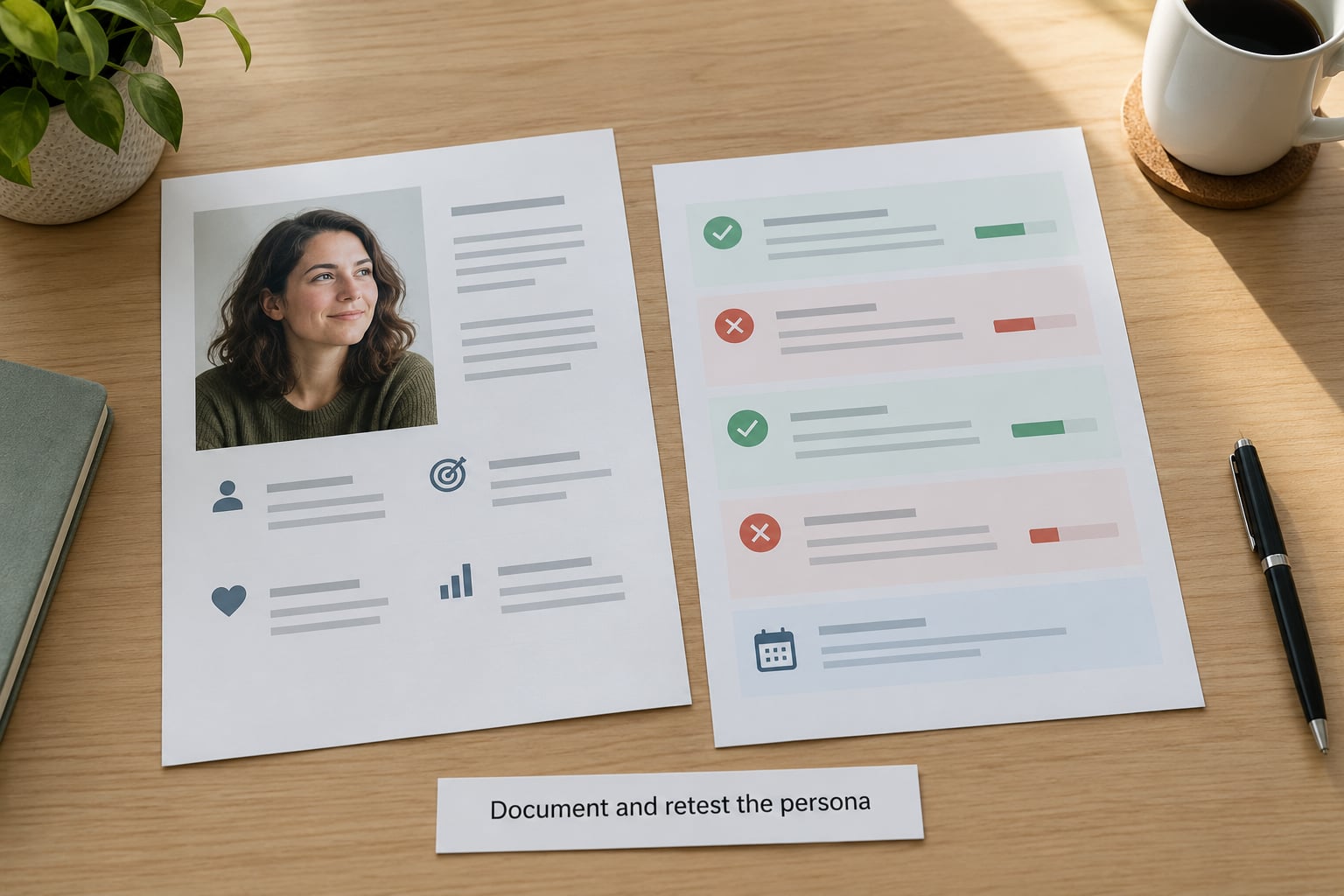
Then attach the persona to the metrics it predicts. If the persona says this segment responds to comparison content, watch that segment’s conversion on comparison pages. If the prediction stops holding two quarters running, the persona is stale whether or not anyone remembers validating it.
A six-month cadence is a reasonable default, and you can tighten it for 2026 planning cycles. Named triggers beat the calendar: a new product line, a visible shift in win rate, a new geography, a new channel, or a leadership change on the buying side.
Common Mistakes
Validating the poster, not the claims. A polished profile with a name and a stock photo gets mistaken for a validated persona. Fix: attribute every single field to a source, sample size, and date, and let unevidenced fields show as unevidenced.
Confirmation bias in the recruiting. You pick participants who agree with you because they are easier to book. Instead, screen for the segment rather than for agreement, and log how many recruits you rejected and why.
Hypothetical questions. “Would you use a feature that does X?” produces polite yeses from everyone. Ask about the last real occurrence and let the participant narrate it in order.
Leading questions. “How important is reliability to you?” pre-loads the answer. Try asking what happened the last time something broke, and what they did next.
Demographics standing in for motivation. Age and job title correlate loosely with behavior and rarely with reason. Treat demographics as recruitment criteria, then test motivations, barriers, and triggers separately.
Treating survey agreement as proof. Most people are polite, and agreement is cheap. Pair every stated claim with a behavioral check, and let the behavioral data break ties.
Burying contradictory evidence. A persona with three passing attributes and two failed ones is usually presented as a success. Report the failures next to the passes, in the same document, every time.
Never connecting it to a decision. Validation that changes no creative, no flow, and no budget is a research exercise, not validation. Name the decision at the start and re-check it at the end.
Two habits make the rest easier. Keep the raw material — transcripts, tickets, query exports — published to the team, and state the population behind every percentage. Practitioners in research communities keep asking for exactly these two things, and teams that supply them get their personas used instead of filed.
Frequently Asked Questions
What data is needed to validate a persona?
You need at least one qualitative source and one behavioral source that can contradict each other. In practice that means 15 to 20 depth interviews for motivation and reasoning, plus any two of product analytics, CRM records, support tickets, survey data, or recorded sales calls. Every persona attribute should name the source, the sample size, and the date behind it. Attributes backed only by stakeholder opinion stay labeled as assumptions until something tests them.
How many interviews are enough to validate a persona?
Fifteen to twenty completed interviews usually surface the dominant patterns, and you should keep going until the last three sessions stop producing anything new. Five to eight is enough for usability testing on a single flow but far too few to claim a pattern holds across a segment. If you need percentages rather than themes, move to a survey of a few hundred respondents, because a dozen interviews cannot carry a percentage.
Can customer surveys prove that a persona is accurate?
No. A survey measures what people are willing to tell you, which is not what they do. Surveys are good at ranking and sizing claims you have already heard in interviews, and bad at surfacing motives you have not. Treat a survey as a quantification tool for known themes, and require behavioral data to confirm or contradict the result. When the two disagree, believe the behavior.
Should a persona be based on demographics or observed behavior?
Observed behavior, with demographics used to recruit and to describe. Demographics tell you who to talk to and roughly how large the group is; behavior tells you what to design, say, and prioritize. A persona built on age, title, and industry alone is a targeting filter, not a description of motives and barriers. The test is whether each attribute predicts a decision you would make differently.
What score indicates that a persona should be rejected?
Reject a persona when no core attribute clears its threshold, or when the only supporting evidence is internal opinion. A practical rule: if your top three attributes are confirmed by fewer than 60% of participants and no behavioral source agrees, retire it. Partially supported personas are usually a signal to split the persona into two, or to merge it into a neighboring one, rather than to keep it as written.
Conclusion
Persona validation is a decision about evidence, not a confirmation exercise for the profile you already like. The teams that get it right are not the ones with prettier decks; they are the ones that can say which source stands behind every attribute, which contradiction they chose to keep, and what they would do differently if the persona is wrong.
Start now by taking the persona’s least-supported attribute — the one nobody can cite a source for — and rewriting it as a single falsifiable claim. Then decide which data source could disprove it, and go find that source. That is how to validate a persona with real data instead of intuition, and everything else in the framework is downstream of that one move.