
How to turn segments into usable personas comes down to four moves: qualify the segment, recover the motivations behind it with real research, write the findings into a fixed persona-card format, and test that the card changes a decision someone was going to make anyway. A segment tells you what a group of people did. It cannot tell you why, and neither can any amount of extra analysis on the same behavioural data. The persona is the layer that supplies the why, in language your team can act on. (This is about customer segments, not the personas feature inside Segment, the customer data platform.)
The awkward part is that most teams skip the middle. They have a segment named high-intent repeat buyers, 45 to 55, they need something to hand a copywriter, and they fill the gap with a stock photo and a first name. Six months later the persona sits in a folder nobody opens, because it contains nothing the segment label did not already say.
What follows is the workflow I use when a team brings me a segmentation output and needs personas that survive contact with a planning meeting. It is deliberately unglamorous. The research is the hard part, and no framework substitutes for it.
Table of Contents
- What You Need
- Step-by-Step
- 1. Define the Decisions Personas Must Support
- 2. Assess Segment Quality Before Building Personas
- 3. Prioritize the Segments Worth Developing
- 4. Research the Motivations Behind Each Segment
- 5. How to Turn Segments into Usable Personas
- 6. Validate Personas with Evidence and Users
- 7. Test Personas in Real Decisions
- 8. Assign Ownership and Establish an Update Cycle
- Common Mistakes
- Frequently Asked Questions
- How many personas should a team create?
- Should every market segment become a persona?
- Do personas need names, photos, and biographies?
- What evidence should be used to validate a persona?
- When should personas be updated or retired?
- Conclusion
What You Need
You need five inputs before the conversion starts. Gathering them first stops the most common failure, which is building a persona before anyone has agreed what decision it is meant to inform.
1. The segmentation output, written down. Not a screenshot of a dashboard. The actual criteria, the time window, the sample size and the source system. A persona built on a segment you cannot reproduce is a persona nobody can check.
2. Access to the underlying behavioural and first-party data. Purchase frequency, basket composition, channel of acquisition, product mix, tenure, response to past campaigns. This is the quantitative backbone, and it is what lets you check a persona’s claims later.
3. A route to attitudinal evidence. Interviews, survey responses, support tickets, call recordings, review text, community threads, sales-call notes. Without one of these you have no source for motives, and you should stop rather than invent them.
4. A written list of the decisions the personas must support. Who signs off on what, and when. This is the most useful document in the whole exercise, because it is what you use later to test whether the persona earned its place.
5. A prioritisation method and a shared template. Anything reproducible: a scoring sheet, a simple weighted table, a one-page card that every persona must use. Consistency matters more than elegance here, because inconsistent cards cannot be compared across teams.
Step-by-Step
1. Define the Decisions Personas Must Support
Write down the decisions first, in plain language, before you look at segments again. Typical entries: which offer goes to the retention campaign, which onboarding variant gets built, which objection the sales team leads with, which customer service process gets redesigned.
Then check your segmentation against that list. A segment is worth a persona only if a plausible decision changes when the team understands it better. Segments that inform no current decision can still be tracked, but they do not need a persona, and building one anyway is where the count starts inflating.
Output: a one-page decision list with an owner named against each line. Success test: every persona you build can be tied to at least one named decision, and any persona that cannot be tied is deleted rather than saved for later.
2. Assess Segment Quality Before Building Personas
Most segments should not become personas. Test each one against six criteria before assigning it any detail, because a persona built on a weak segment inherits every weakness of that segment and hides them behind a friendly name.
- Distinctiveness. Does this group behave differently enough from the others to justify separate treatment? If two segments would receive the same message, merge them.
- Size. Is the group large enough to matter commercially? A segment of 40 records is a curiosity, not a persona.
- Stability. Has the group held its shape across at least two or three time windows? Seasonal spikes produce personas that are wrong by spring.
- Accessibility. Can you actually reach these people, in the channels you use? An unaddressable segment is a description.
- Explanatory value. Does the group tell you something you did not already know? If it only restates a filter you applied, it adds nothing.
- Business relevance. Is there budget, headcount or strategic attention attached to acting on this group?
Output: a pass or fail scorecard per segment with a written justification for each rejection. Success test: rejected segments are removed before any persona detail is drafted, not after.
3. Prioritize the Segments Worth Developing
Score the survivors on a small weighted scale. The usual weighting puts strategic fit and decision impact above everything else, with size and researchability as modifiers rather than drivers. A smaller segment with clear strategic weight often deserves the persona; a huge segment nobody can act on does not.
Keep the list to three to five personas. Practitioners call the underlying form an archetype, and the distinction from persona is mostly about how the thing gets used. The rule that matters here is one persona per segment, maximum, and one segment per persona. Anything more and your team is comparing twenty cards and remembering none of them.
Document one sentence per segment explaining why it is on the list. If nobody in the room can defend that sentence, the segment is on the list for the wrong reason.
4. Research the Motivations Behind Each Segment
This is where the real work happens, and it is the step most teams compress into an afternoon. Behavioural data records what happened; motives live in what people say and do under pressure. You need both, clearly separated, so nobody downstream mistakes an interpretation for an observation.
For each shortlisted segment, gather attitudinal and contextual evidence aimed at six things: the job the person is hiring the product for, the goals behind it, the pain points that make the goal urgent, the trigger that starts a search, the barriers that stop a purchase, and the criteria the person actually uses to decide. Mine the sources you already have first. Support tickets and review text are often richer than a fresh survey, because people describe problems in their own words rather than yours.
Interviews and short surveys supply the rest. Recruit from within the segment criteria, not from a general panel, or you will spend the session hearing from people who do not belong. A dozen conversations per persona is usually enough to expose the dominant pattern, provided the segment is well defined.
Output: a per-segment evidence file where every claim carries a source and a confidence label, and interpretation is written in a separate column from observation. Success test: a sceptic on your team can trace any statement on the persona card back to a specific piece of evidence, or you delete the statement.
5. How to Turn Segments into Usable Personas
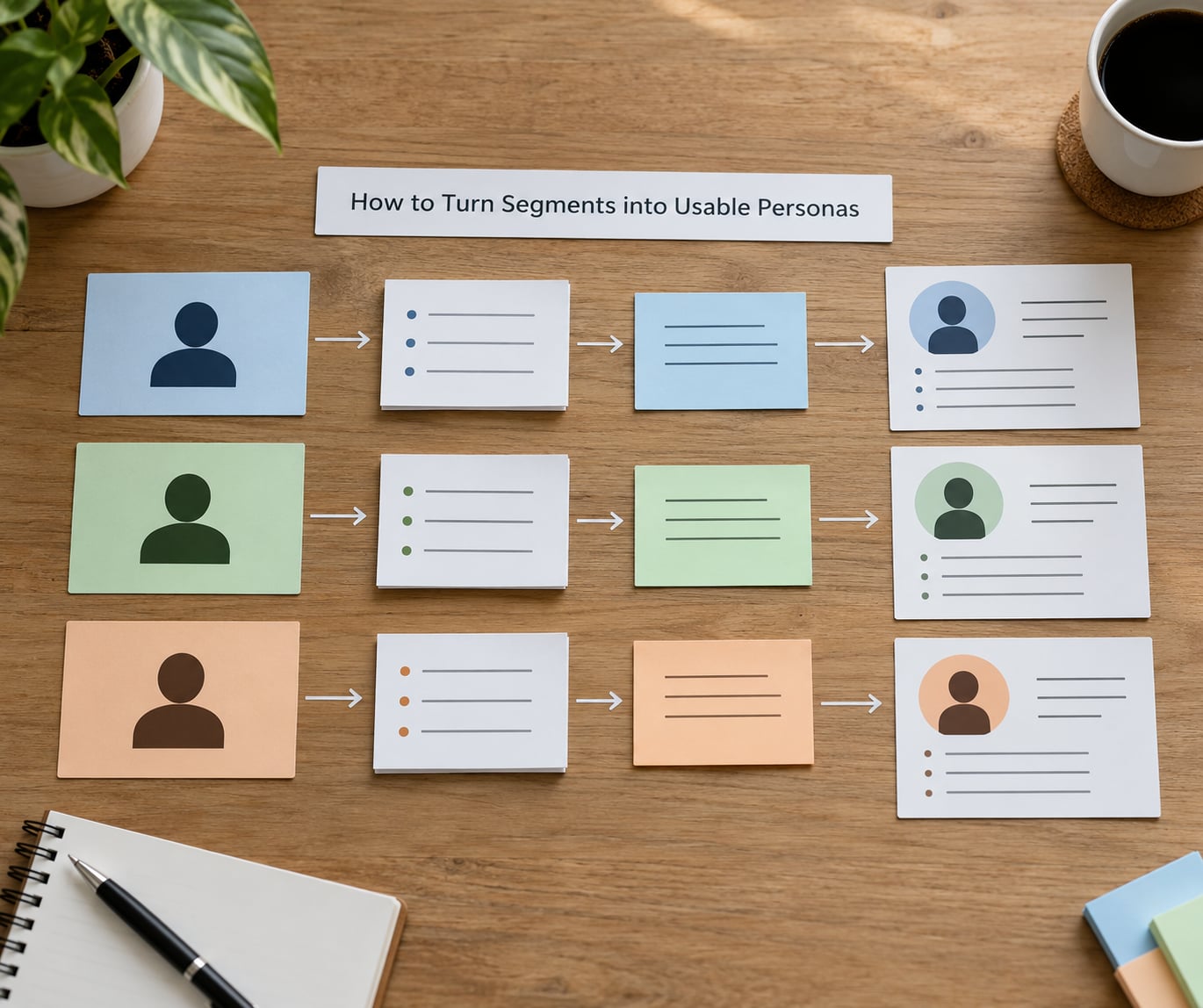
Synthesis is where good personas get flattened into bad ones. Resist the urge to write a character. A persona is a decision aid, so the fields that earn their place are the ones a copywriter, a product manager or a service designer will consult in under two minutes.
Use this field list, in this order, and keep every field populated from evidence rather than imagination:
- Descriptive label. A short role-style name such as Time-Poor Established Buyer. Avoid first names, ages and stock photos; they invite fiction and they hide the criteria.
- Segment criteria. The exact behavioural, demographic or value-based conditions that put someone in the group, with the time window and sample size.
- Job to be done. One sentence on what the person is trying to accomplish in this context, phrased as the progress they are after.
- Context and triggers. When the need appears, what happened just before, and what a successful outcome looks like from their side.
- Drivers and motivations. The two or three factors that genuinely move this group, ranked, with evidence behind each.
- Barriers and objections. What stops them, including the objections they raise and the ones they stay quiet about.
- Decision criteria. The factors they weigh, in their order of weight, and which ones are table-stakers.
- Representative language. Three to five phrases the group actually uses. This is the field teams quote most often and the reason verbatim interview language matters.
- Practical implications. What this means for message, channel, offer, product or service. Specific enough to argue with.
- Evidence and confidence. The sources behind the card, the date, and a high, medium or low confidence rating per major claim.
Output: a completed card per segment, built on the same template every time. Success test: hand the card to someone who did not build it and ask them to make a decision. If they need a meeting first, the card is not finished.
6. Validate Personas with Evidence and Users
Validation catches the two failure modes that survive synthesis: claims that were inferred and then read back as fact, and claims that are simply flattering. Run three passes.
Start with a factual check against the data. Every number, timeframe and behavioural claim must match the segmentation output. Next run a consistency check: if a persona’s goal is convenience but every driver points to price sensitivity, one of the two is wrong and you need to find out which.
Then test boundaries. Ask whether a real customer in the segment would recognise themselves in the card and whether someone in an adjacent segment would wrongly claim the same description. That second test is where badly bounded personas leak into the wrong campaigns.
Finally, put the card in front of stakeholders who did not commission it and ask them to name a decision it changes. Then, where you can, show a draft to a handful of people inside the segment and ask what is wrong with it. The failures are usually small and specific: a word this group would never use, a barrier that turned out to be a symptom, a trigger that fires two weeks earlier than you assumed.
Output: a revision log showing what was changed, what was cut for lack of evidence, and what was left uncertain on purpose. Success test: no vague adjective survives without a source behind it.
7. Test Personas in Real Decisions

Paper validation is not adoption. The only reliable test is to use the persona in a real brief while someone is still willing to disagree with you. Pick a live decision with a deadline inside the next month, a modest budget attached and a stakeholder who cares about the outcome.
Work the brief twice, once with the persona and once without, and record where the answers differed. Where the persona changed the choice in a way you can defend with evidence, you have proof it works. Where it changed nothing, you have found a persona that is decorative and can be rewritten around the decision it actually influences.
The more common outcome is distortion. A persona gets read as a script rather than a lens, and the team produces three variations of a message that was meant to be one sharp argument with different evidence. That is a fixable failure: state on the card what the persona should change and, just as importantly, what it should not dictate.
Output: a short case note recording the decision, the difference the persona made, and the resulting edits to the card. Success test: the persona altered at least one choice that someone would otherwise have made differently.
8. Assign Ownership and Establish an Update Cycle
Personas decay quietly. A segment that held its shape for two years can shift after a pricing change, a new competitor or a shift in how people buy, and a stale persona keeps influencing decisions with last year’s assumptions. So attach ownership and expiry to the card itself, not to the person who happened to build it.
Write the source systems, the extraction date and the evidence file location onto the card. Name a role as owner, usually whoever maintains the segmentation, and set a scheduled review rather than an open-ended promise. Quarterly works for fast-moving consumer businesses; twice a year suits subscription or contract businesses where the underlying behaviour is slower to shift.
Set explicit triggers that force an out-of-cycle review. Useful ones: the segment’s membership mix moves by more than a set threshold between periods, a major acquisition or product launch changes the offer, the persona’s confidence rating has sat at medium for two review cycles, or the team reports that decisions made with the card no longer land.
Decide the retirement rule in advance, because nobody retires a persona while it is still in someone’s presentation. A persona whose segment has collapsed, or whose decision has disappeared from the calendar, should be archived with a date rather than quietly dropped. The archive tells the next person what was tried and what replaced it.
Common Mistakes
Building a persona for every segment. Correction: apply the decision list first, and cap the set at three to five. If you cannot name the decision a persona informs, it does not ship.
Inventing demographics and biographies. Correction: ages, names, hobbies and job titles are decoration unless a decision depends on them. If retention messaging genuinely differs by life stage, source it; if not, drop the field.
Treating the persona as the segment with a nicer name. Correction: require at least three fields that behavioural data could never produce, such as job to be done, an objection in the group’s own words, and a decision criterion. If a field could be generated from the segment criteria, it belongs to the segment, not the persona.
Overloading the card with research. Correction: the card is a decision aid. Move evidence packs to an appendix and keep the card to the fields a team actually reads before acting.
Skipping validation because research feels finished. Correction: budget one peer review and one stakeholder test as a scheduled step. Most weak personas fail at the boundary test, and it takes an hour to run.
Treating personas as permanent. Correction: stamp every card with an owner, a review date and a confidence rating, and act on the triggers above.
Two habits help more than the rest. First, put the decision list in the same document as the cards, so the purpose travels with the artefact. Second, ask a non-insight colleague to use a card in a real task and watch what they look up. The things they struggle to find are the fields you are missing.
One more honest note: some teams do not need personas at all. If your personalisation runs on a handful of live behavioural segments and your team acts on them daily, the added layer may cost more than it returns. Personas earn their place when decisions need motivation and language, not when they need a targeting list.
Frequently Asked Questions
How many personas should a team create?
Three to five, drawn from the segments that map to your named decisions. Beyond that, teams start comparing cards instead of using them, and recall collapses. If you have more candidate segments, score them on strategic fit and decision impact, develop the top few properly, and leave the rest as segments. You can always promote a dormant segment to a persona later when a decision genuinely needs it.
Should every market segment become a persona?
No, and treating it that way is the fastest way to end up with decorative profiles. A segment deserves a persona only when understanding it better would change a real decision, and only when you have evidence about motives rather than just behaviour. Segments that fail the size, stability or actionability tests are better left as segments. Track them, keep the criteria documented, and revisit them when a decision appears that they might inform.
Do personas need names, photos, and biographies?
They work without them, and most research-driven practitioners drop them. A first name, a stock photo and a fictional biography encourage your team to fill in details you have no evidence for, which is exactly the invention that makes personas untrustworthy. A descriptive role label, the exact segment criteria and the person’s own vocabulary are more useful and harder to argue with. Add a name only if your organisation genuinely uses them in live work and the team is clear it is shorthand.
What evidence should be used to validate a persona?
Start with your own behavioural and first-party data, which confirms the segment criteria, and then add attitudinal evidence such as interviews, survey responses, support tickets, review text and sales-call notes, which supply the motivations. Each claim on the card should carry a source and a confidence rating so reviewers can see what is observed and what is interpreted. For a systematic approach, the data-driven persona work of Jansen, Salminen and Jung (2020) is worth reading before you automate anything.
When should personas be updated or retired?
Review them on a schedule tied to how fast your market moves, and out of cycle whenever a trigger fires: the segment membership mix shifts materially, pricing or product launches change the offer, or decisions made with the card stop landing. Retire a persona when the segment has collapsed or the decision it supported no longer exists, and archive it with a date rather than dropping it quietly. A persona with no owner and no review date is already retired in practice.
Conclusion
Start with one segment. Pick the one your next planning cycle actually depends on, write down the single decision it should improve, and gather only the evidence that decision needs. Build that one card, test it in the real brief, and see whether it changes anything. If it works, you have a method to repeat across the rest of your segments. If it does not, you have learned something useful for very little money.