
Stories are remembered better than statistics because the brain encodes a narrative with several systems at once — language, imagery, emotion and motor simulation — while a bare number mostly exercises language processing and leaves nothing else to attach to. That gives a story many handles for later retrieval. It does not make the story true.
That distinction matters more than the slogan does. Memorability and credibility are different properties, and plenty of marketing copy quietly swaps one for the other. The research on narrative memory is genuinely interesting, and it is also routinely overstated.
I spend a lot of time reading the primary literature on consumer psychology, and the honest version of this question is more interesting than the viral one. Jerome Bruner’s experiments from the 1980s found that listeners recalled the substance of stories far better than the content of dry fact lists, and he argued that the two modes of thinking — logical and narrative — are not ranked, just used for different jobs. Uri Hasson’s lab at Princeton later showed something stranger: when one person tells a story and another listens, their brain activity falls into measurable sync, and the tighter the coupling, the better the listener recalls. David Eagleman has made the same point from the neuroscience side, that narrative is not a soft wrapper around information. It is the format the brain was built to move.
Table of Contents
- Why Do People Remember Stories Better Than Statistics?
- How Memory Turns Experience Into a Story
- Why Stories Are Remembered Better Than Statistics: the Mechanisms
- Are Statistics Harder to Remember Because Numbers Are Abstract?
- What Role Do Emotion, Contrast and Unexpected Details Play?
- Does This Mean Every Story Beats Every Statistic?
- How to Make Statistics More Memorable
- How to Use a Story Without Losing the Evidence
- Frequently Asked Questions
- Are stories always more memorable than statistics?
- Why are people better at remembering statistics when they are surprising?
- Does a personal story make evidence more credible?
- How do you make a statistic stick without changing its meaning?
- What makes a short story easy to remember?
- Should brands lead with a story or a statistic?
- Conclusion
Why Do People Remember Stories Better Than Statistics?
Stories stick because they are easier to encode and easier to retrieve. A narrative gives language, emotion, sequence and cause-and-effect at the same time, so memory stores several cues instead of one. A statistic arrives as an isolated symbol that must be held in working memory and has nothing to attach to.
Both formats can be remembered well. They suit different jobs, and the useful question is never which one wins in general. It is what you are asking the reader to remember, and what you are asking them to believe.
How Memory Turns Experience Into a Story
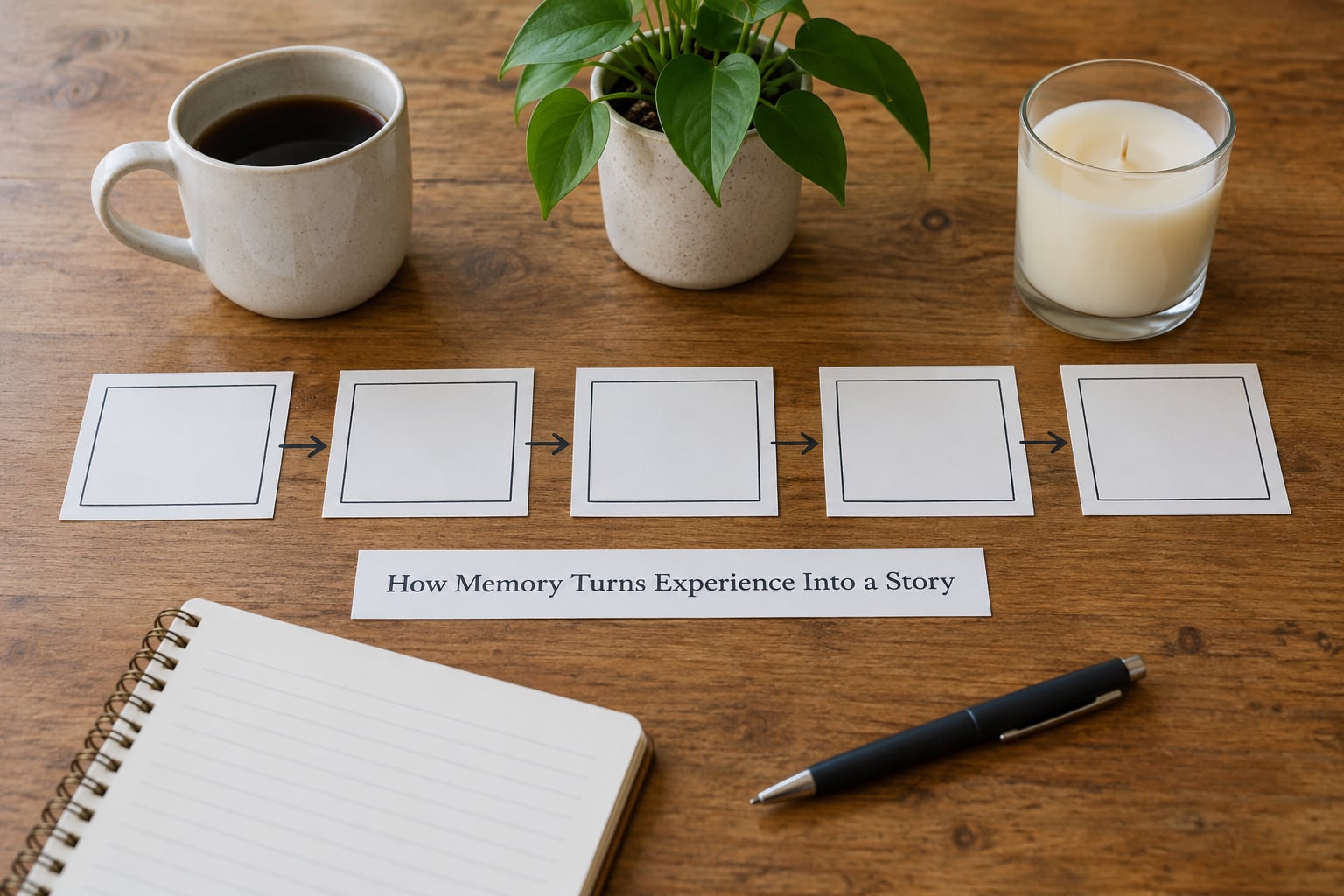
Your brain does not store a recording. It stores a reconstruction, assembled at the moment you recall something, from fragments that survived the day. Narrative is the shape those fragments usually arrive in.
Four things steer that process. Sensory detail narrows what gets encoded — the odd detail survives because it is distinctive, not because it matters. Prediction makes meaning: a story hands you a running model of what comes next, so each new fact slots into a structure you already built. Emotional significance acts as a tag, marking the moment as worth keeping. And selective forgetting quietly edits the whole thing, smoothing the gaps so it reads as a coherent sequence rather than a scattered pile of moments.
None of this is exotic. It is the ordinary machinery of recall, applied to a format with more moving parts than a number has.
Why Stories Are Remembered Better Than Statistics: the Mechanisms
Dual coding is the foundation. Information encoded both verbally and visually is recalled better than information encoded in one channel, and a story forces you to build a mental picture whether you meant to or not. A statistic rarely does.
Event models add structure. When a listener stores an event as happening in a specific place at a specific time, recall improves, because the memory becomes situated rather than free-floating. Narrative is event models with plot bolts on.
Narrative transportation describes how attention behaves. Deep in a story, monitoring and evaluation drop, the self loses track of time, and skepticism loosens its grip. A number never gets you there because there is nothing to be transported into.
Emotional arousal sharpens and narrows. Heightened emotion boosts encoding for the central material and can actually impair the surrounding detail. This matters commercially: a story built on tension gets its point remembered and its context forgotten.
Causality turns a list into a sequence. People remember “and then” chains far better than they remember co-occurring items, because cause and effect is the structure the brain already uses to make sense of events.
Retrieval cues multiply. Every vivid element in a story becomes a possible trigger later — a smell, a location, a phrase of dialogue, the feeling of the room. A statistic typically offers one cue, which is itself.
Are Statistics Harder to Remember Because Numbers Are Abstract?
Abstraction is part of it, but not the whole story. A number is a compressed label pointing at a quantity you may never have experienced directly, and unpacking it takes working memory the listener may not have. A figure with no anchor in the reader’s world is stored as a symbol plus a vague impression.
Processing fluency plays a role too. Information that feels easy to take in feels true and sticks better, and bare figures are often delivered in the least fluent way possible — fast, flat, uncontextualised, sandwiched between other figures. A number that arrives with a comparison, a consequence and a human decision attached is no longer abstract, and it stops being hard to remember.
| Dimension | A bare statistic | A story |
|---|---|---|
| Systems engaged | Largely verbal and symbolic | Verbal, visual, emotional, motor |
| Working memory demand | High — the figure must be held and unpacked | Low — the sequence carries the load |
| Retrieval cues | Usually one, and often weak | Many: place, image, emotion, phrase |
| Structure available at recall | None until context is supplied | Sequence and cause and effect |
| Best at | Precision, comparability, verification | Attention, motivation, retention |
The last row is the one practitioners skip. Numbers are better at precision, and precision is what most professional decisions actually need.
What Role Do Emotion, Contrast and Unexpected Details Play?
Emotion is the most reliable memory tag we know of, and it works through arousal rather than sentiment. Peak-end rule research by Kahneman and colleagues found that people judged an experience largely by its most intense moment and its ending, not its duration or average quality. Applied to communication, that means the opening line and the closing line carry more weight than the middle.
Contrast and surprise do a different job: they buy attention. A detail that does not fit the expected pattern survives because the prediction system flags it as worth updating.
None of this makes the content more trustworthy, which is where these techniques get misused.
| Device | What it buys you | Where it misleads |
|---|---|---|
| Emotional stakes | Dense encoding, lasting recall | One vivid case gets remembered as the norm |
| Contrast and surprise | Attention in the first seconds | Curiosity without substance underneath |
| Concrete sensory detail | A visual image to retrieve later | Detail can be quietly invented to suit the point |
Does This Mean Every Story Beats Every Statistic?
No. Memories are not evidence, and some contexts punish narrative hard.
Get medical or safety information wrong and the cost is not a bad impression. The same goes for financial risk, compliance and regulatory claims, where a specific figure and its source are the deliverable. Procurement teams, clinical reviewers and statistically literate investors are not looking for a hook. They are checking whether your number survives scrutiny, and a vivid anecdote in front of a verified figure often reads as an attempt to distract from it.
There is a name for the error that runs the other way too. Kahneman’s narrative fallacy describes our tendency to read coherent meaning into noisy, uncorrelated data — the tendency to see a line of stock prices, a sequence of sales calls, or a cluster of diagnoses as a pattern that explains itself. Narratives are the brain’s preferred format, and the format is not a filter for accuracy.
Marketers report this in both directions. Practitioners on LinkedIn regularly describe a single well-told customer story outperforming a deck of product differentiators on retention and recall. The same threads push back hard on narrative-led evidence, warning that when the story matters more than the substance, cherry-picking becomes the path of least resistance. Meanwhile teams confuse highlighting numbers with telling a data story — a percentage with no consequence and no action attached is decoration, not narrative.
How to Make Statistics More Memorable
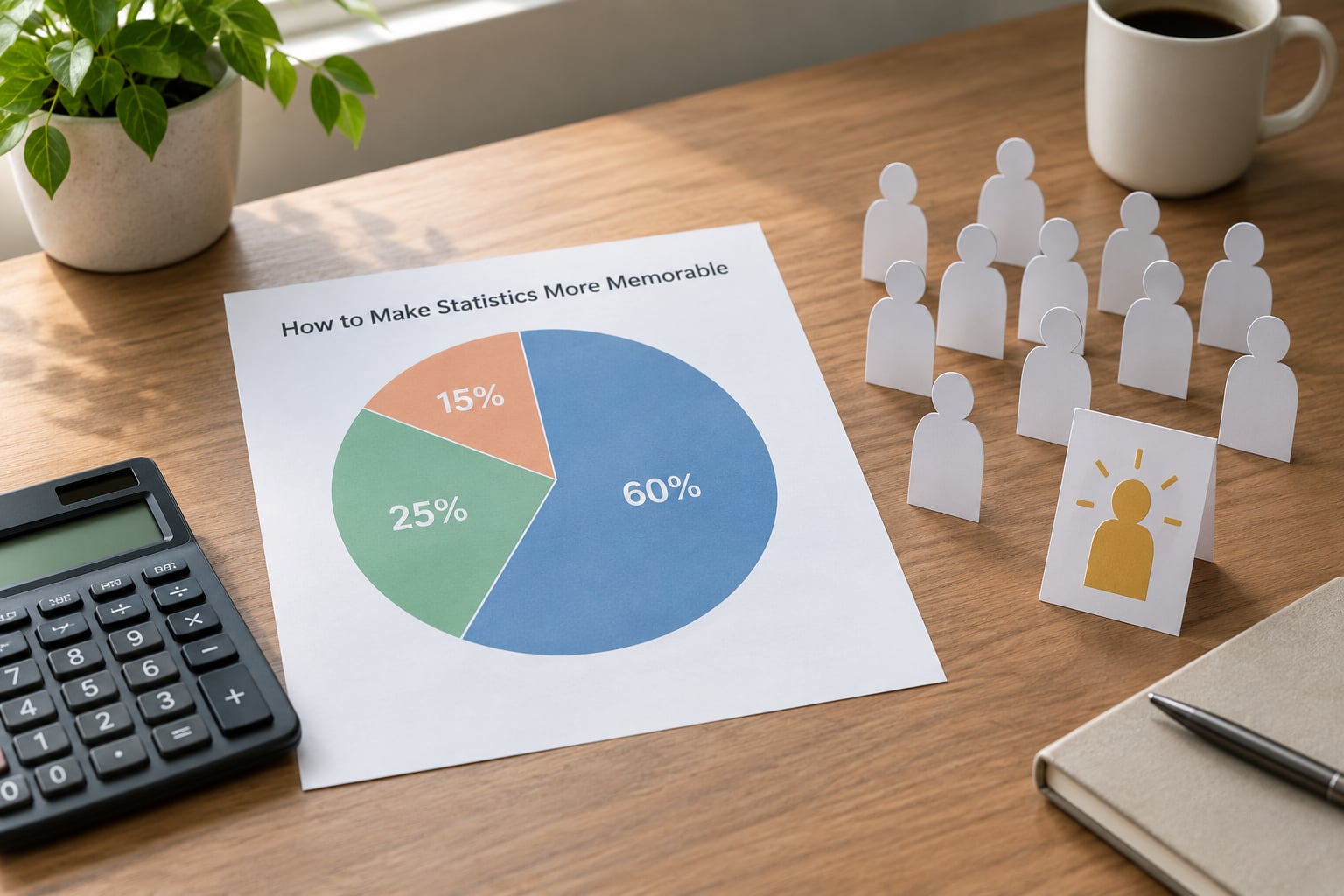
A bare number becomes sticky when you give it something to hang on. The same process works for a slide, a report or a campaign line, and it takes about five steps.
Give the figure a human anchor. Not a stock photo of a person pointing at a chart — a named decision someone actually made. “Support resolved 340 tickets in a week” sticks; “resolution efficiency improved 22%” does not, because the first one has a week and a queue in it.
Convert to consequence. Multiply the figure against something the audience already tracks in familiar terms: hours, headcount, minutes of waiting, weeks of runway. Comparisons to their own baseline beat comparisons to an abstract maximum.
Add exactly one concrete detail, and make it sensory rather than statistical. The number of unread emails is decorative. The screenshot of the notification at 11pm is not.
Show cause and effect, not co-occurrence. “Drop-off rose during onboarding” is a pattern. “New signups dropped at the identity verification step, so we moved it earlier” is a sequence, and sequences survive.
Close on the figure, not on the feeling. Story first, number last, and the number is the thing the reader can quote when you are not in the room.
Worked example, using your own numbers throughout: suppose onboarding completion sits at 54%. Restated, that is 46 out of every 100 signups hitting a wall inside the first session. Anchor it to one named account that stalled at the verification email on a Tuesday evening. Show the change — verification moved ahead of the workspace setup — and close on the improved completion figure. Same data, four or five times the retrieval surface.
How to Use a Story Without Losing the Evidence
The failure mode I see most often is a story that quietly replaces the claim. Someone describes one customer in vivid detail, the room nods, and everyone leaves believing the general case has been proven. That is anecdote promoted to evidence, and it collapses the moment someone asks how typical that customer was.
A structure that holds up: state the general claim, give one specific instance, show that the instance is drawn from a larger base, and name the base. Order matters — put the number where it is hardest to drop, which in practice means near the end of the case study and repeated in the summary.
Keep the source attached. A figure with no provenance reads as marketing regardless of how well it is framed, and anyone in the room who knows the literature will discount everything else you said. If you cannot name where a number came from, do not use it.
Match the format to the audience’s decision. If the reader has to defend the choice to a finance team, lead with the evidence and use one short scene for texture. If you are trying to make someone care enough to look, the order flips.
And know the clichés. Practitioners on r/AskMarketing keep asking where to find citable literature on storytelling claims, because most of what circulates is unsourced blog filler — which is a fair complaint about the genre, including this one. Forced emotional framing reads as forced. Authenticity does more for a brand story than any structural trick.
Frequently Asked Questions
Are stories always more memorable than statistics?
No. Stories are easier to encode and retrieve, but memory and credibility are different properties. Statistics are harder to remember yet better at precision, comparability and verification, and they are the right choice in high-stakes contexts such as medical guidance, financial risk and procurement review. The formats answer different questions rather than competing.
Why are people better at remembering statistics when they are surprising?
Unexpected figures violate the listener’s prediction, and the brain flags predictions that fail so it can update them. That is the same novelty effect that helps a vivid scene stick. Surprise also tends to arrive with context attached, which means the number is not floating alone. An ordinary figure in isolation is not memorable at all.
Does a personal story make evidence more credible?
Not by itself. A personal story makes a claim more vivid and easier to recall, but one account cannot support a general claim about typical outcomes. Credibility comes from showing where the instance sits within a larger base and naming that base. Without that, the story is atmosphere, and confident audiences read atmosphere as evasion.
How do you make a statistic stick without changing its meaning?
Keep the exact figure and its source, then change only what surrounds it. Translate it into the audience’s own measures, attach a consequence, add one concrete detail from the underlying data, and show cause and effect. End on the number itself. You are giving the figure more retrieval handles, not rounding it into a tidier-sounding claim.
What makes a short story easy to remember?
A single character facing a specific problem, one concrete sensory detail, and a cause-and-effect chain that resolves. Short stories work because every element earns a retrieval cue. The peak-end rule also applies, so the opening line and the ending do more work than the middle. Drop any beat that produces no image and no consequence.
Should brands lead with a story or a statistic?
Lead with the story when the job is attention and motivation, and with the statistic when the job is proof and comparison. In practice that usually means story first, number last, with the source visible. For audiences who will audit your claims, lead with the evidence and add one short scene for texture instead.
Conclusion
Stories are remembered better than statistics because they arrive with structure, sensation and emotion attached, and because a mind that can predict what comes next encodes the next thing more efficiently. Statistics are remembered worse for the same reason. Neither advantage makes one true.
Do this first. Find the single claim your message has to survive, then build one concrete human or situational frame around it and keep the figure or the source attached. Story to open, evidence to prove, and never let a good anecdote quietly stand in for a number you did not have.