Urgency affects online checkout behavior by raising the perceived cost of waiting. A real deadline, a shrinking inventory count, or a cart reservation window compresses the time a shopper feels they have to decide, turning a deliberative purchase into a loss-avoidance one. Sessions move faster and complete more often, though only when the deadline is genuine.
Most urgency guidance is written for the product page. The checkout page is a different animal, because that is where the shopper has already decided, already typed their details, and is deciding whether to finish. Pressure applied there acts on the last hesitation, and that is exactly where it can tip a session either way.
The research base here is thinner than the marketing blogs suggest. What follows separates what is reasonably well established from what is vendor folklore, and finishes with a test design you can run yourself.
Table of Contents
- What Is Urgency in Online Checkout?
- How Urgency Changes the Customer’s Decision Process
- Why Urgency Can Increase or Reduce Conversions
- How Urgency Affects Online Checkout Behavior
- How urgency changes time spent at checkout
- Why add-to-cart decisions speed up
- Why payment completion and error rates move together
- How urgency behaves on mobile
- What urgency does to purchase quality after the order
- Which Urgency Cues Work at Checkout?
- How to Use Urgency Without Damaging Trust
- How to Test Urgency in an Online Checkout
- Frequently Asked Questions
- Does urgency always improve ecommerce conversion rates?
- What is the best urgency cue to use during checkout?
- How long should a checkout countdown timer last?
- Are low-stock messages effective for expensive products?
- Can urgency messaging increase cart abandonment?
- How can a retailer tell whether an urgency message is believable?
- Conclusion
What Is Urgency in Online Checkout?
Urgency at checkout is any cue that compresses the time a shopper believes they have. It can be a countdown on a promotion, a live inventory number, a delivery cutoff, a cart reservation window, or a notice that an item is moving out of the catalog. Scarcity is the related but distinct idea: scarcity constrains quantity, urgency constrains time.
The distinction matters more than it sounds. A low inventory number tells you the opportunity is running out in supply; a deadline tells you the opportunity is running out in time. They lean on different mechanisms, and a store can run one without the other. Most of the confusion in this space comes from treating them as one tactic.
| Cue | What it constrains | Mechanism | Main risk |
|---|---|---|---|
| Urgency | Time | Raises the cost of delay, shifts the question from should I buy to will I lose this | Feels pressuring when the deadline is invented |
| Scarcity | Quantity | Raises perceived desirability of the specific item, fear of losing the option entirely | Detectable and heavily audited by shoppers |
| Social proof | Nothing directly | Reduces uncertainty about whether the choice is reasonable | Does little on its own at the payment step |
| Social pressure | Reputation | Invites the shopper to act publicly with others watching | Backfires with high-consideration purchases |
The psychological root is loss aversion, the finding from prospect theory that a loss carries roughly twice the weight of an equivalent gain. A deadline does not add value to the product. It changes the frame from acquiring something to avoiding losing something, and the second frame moves faster.
A dark pattern is the line worth naming here. It is any interface choice that makes it hard for a reasonable person to act as they intended, and false scarcity messages sit well inside that definition. The US Federal Trade Commission published a report in 2022 calling these practices out specifically, and availability claims that cannot be verified are treated as deceptive in most consumer protection regimes, including EU rules that vary by member state.
How Urgency Changes the Customer’s Decision Process
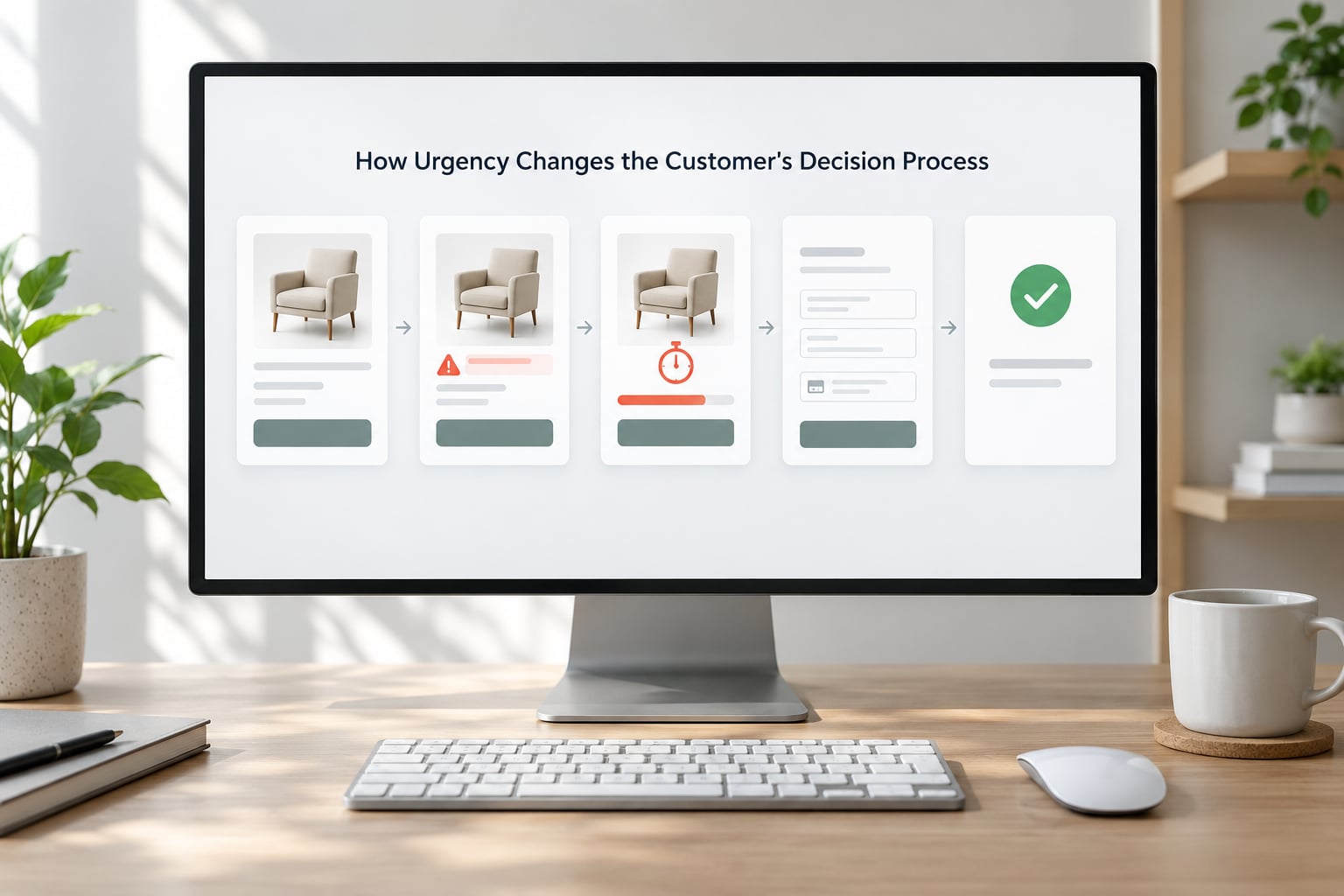
The shift happens in three stages, and each one has an observable signature in your analytics. First the shopper notices the cue. Then they re-evaluate the deal against the new constraint, usually by mentally rerunning the comparison faster and with less weight on alternatives. Finally they act, or they leave.
What gets cut in stage two is deliberation. That is the whole benefit, and it is also the risk, because deliberation is where a mismatched purchase normally gets caught. Shoppers describe the compressed state differently depending on whether the constraint was real. When it was genuine they call it helpful. When it was not, they call it pressure, and several Reddit r/ecommerce threads make the same point that refreshing to see whether a timer resets is now a normal habit.
| Urgency level | Typical shopper state | Effect on completion | Effect on satisfaction |
|---|---|---|---|
| Low | Noticed, mildly reassured | Small or neutral change | Unchanged |
| Moderate | Deliberation shortened, defaults accepted | Noticeable lift, mostly on hesitant sessions | Mixed, depends on product fit |
| High | Reaction rather than reflection | Lift plus more errors and more abandonment in some segments | Lower, with more returns |
The table is worth reading twice, because high urgency is not simply more of a good thing. It trades completion rate against purchase quality, and those two move in opposite directions once pressure outruns deliberation.
Why Urgency Can Increase or Reduce Conversions
The upside is straightforward. Urgency reduces cart hesitation, which matters because the base rate of cart abandonment across ecommerce sits around seventy percent. Almost every cue you add at checkout is working against a large leak, so even a small percentage shift lands on a meaningful number of orders.
The cost side is less discussed and more durable. Impulsive purchases driven by time pressure come back as returns and support contacts. Repeated pressure across visits produces desensitisation, where the cue stops registering at all and the store has to escalate volume to get any response. Practitioners in the Shopify Community argue that real urgency still works while fake urgency mostly trains people to ignore you, and that split shows up repeatedly in r/ecommerce threads too.
There is a timing effect as well. Pressure layered onto weak demand produces scepticism rather than sales. If traffic is already soft and you add a timer, most of the people seeing it are not interested in the product anyway, and the ones who are can tell the difference. A delivery cutoff placed on a product that nobody wants is just an insult with a timestamp.
How Urgency Affects Online Checkout Behavior
How urgency changes time spent at checkout
Shorter, measurably. When a cue lands early on the checkout page, median time on that step typically falls, and time on the payment screen falls with it. Teams that watch only conversion sometimes miss that a portion of that gain is coming from shoppers who stopped comparing and just finished.
Why add-to-cart decisions speed up
The cart step is where the decision is still soft. An inventory number or a promotion timer in the cart drawer tends to move more people across the line than the same message on the product page, because the interest is already demonstrated. The effect shows up as higher add-to-cart velocity and fewer carts sitting open for hours before purchase.
Why payment completion and error rates move together
Compressed sessions produce compressed typing. A shopper rushing to beat a timer enters incomplete card numbers, mistypes postcodes, and abandons at the point where errors become visible. On some stores urgency lifts completion and error rates at the same time, which is why error rate is a guardrail metric and not an afterthought.
How urgency behaves on mobile
Mobile sessions are shorter and more interrupted, so a timer often produces a different reaction. If the constraint is real and visible, it can finish a session the shopper abandoned to a notification. If it is only on the product page and disappears at checkout, mobile buyers read that as an attempt to squeeze them, and mobile abandonment rises rather than falls.
Payment method changes the picture too. A saved-card or wallet flow removes the slowest part of checkout, and adding pressure on top of an already fast flow tends to do nothing useful. The friction you were hoping to overcome was never the bottleneck.
What urgency does to purchase quality after the order
This is where the cost shows up later rather than at the moment of conversion. Purchases made under time pressure more often end in return requests, and the pattern holds across published work on impulsivity and ecommerce returns. A team that measures only week-one conversion will systematically overestimate urgency.
From the consumer side, the pattern is well documented too. People describe urgency messaging as encouraging purchases they do not really need, and the standard advice is unglamorous but effective: decide before you reach the payment screen, close the tab if the deadline is doing the persuading, and keep a wishlist for anything you want to think about overnight.
Which Urgency Cues Work at Checkout?
The strongest checkout cues share one property: a shopper can verify them without taking your word for it. The weakest are the ones that ask for trust first and provide evidence never.
| Cue | Verifiable? | Where it belongs | Risk |
|---|---|---|---|
| Real promotion end date | Yes, from the terms | Cart drawer and checkout header | Low, if it does not silently extend |
| Order cutoff for next-day delivery | Yes, checkable by clock | Shipping step | Low, useful for moving the shipping method choice |
| Inventory count for a variant | Yes, against your own catalog | Product page, repeated at payment | High if the number is fabricated |
| Cart reservation window | Only if it is honoured | Cart drawer | High, treated as a trap when cancelled early |
| Renewal or quote expiry | Yes, from documents | Checkout, for quote-based orders | Low, and rarely seen in ecommerce |
| Payment reminder | Not a constraint at all | Email, not on the payment page | Adds friction without adding reason |
Vendor-reported figures in this space deserve a discount. Numbers like a low-stock badge lifting reported purchase intent by roughly a quarter, or scarcity driving the majority of impulse purchases in a survey, come from tool companies selling the tactic. Treat them as a reason to test, not as an expected result.
How to Use Urgency Without Damaging Trust
Ask one question before shipping any cue: could a shopper who refreshes the page ten times still see something true? If the answer is no, the cue is not urgency, it is a decoy, and shoppers on r/Anticonsumption and r/ecommerce actively hunt for that kind of thing.
Beyond that, a few rules hold up. Tie the deadline to something that actually ends, publish the terms where the message appears, never reset a running timer, and keep a clear route back to browsing so the shopper can continue shopping without losing their cart. Put one cue at the decision point rather than three competing ones, and segment by context so a first-time buyer with a saved cart does not see the same message as someone comparing five products.
Finally, be honest about when you should not use it. Long consideration cycles and high-priced items are poor candidates, because the shopper who needs twenty minutes cannot be helped by a timer and will read it as pressure applied at the moment of maximum commitment.
How to Test Urgency in an Online Checkout
Urgency is unusually testable because the variants are simple and the metrics are clean. The risk is not difficulty, it is running the test badly and concluding something false.
State a hypothesis before you start, in numbers. Something like a five percent relative lift in checkout completion from a real promotion deadline shown in the cart drawer. Then randomise at the cart level, run both variants for full business cycles including weekends, and size the run so a realistic effect is detectable rather than merely possible.
Watch the guardrails as closely as the primary metric. An urgency test that raises completion while raising errors and refunds has not succeeded, it has moved the problem downstream.
| Measure | What it tells you | Role |
|---|---|---|
| Checkout completion rate | Whether sessions finish | Primary |
| Time from cart to order | Whether deliberation compressed | Primary |
| Payment error rate | Whether speed produced mistakes | Guardrail |
| Mobile abandonment | Whether short sessions reacted differently | Guardrail |
| Return and refund rate | Purchase quality over the following weeks | Guardrail |
| Repeat visit rate | Whether trust held | Guardrail, longer window |
Run the trust guardrails long enough to mean something. A one-week read on returns tells you almost nothing, so extend the follow-up window to cover the period where returns actually arrive before you decide the test won.
Frequently Asked Questions
Does urgency always improve ecommerce conversion rates?
No. Urgency reliably lifts completion when the constraint is real and the shopper was already close to buying. It can lower purchase quality, raise payment errors, and produce returns when pressure outruns deliberation. It also fails outright when demand is weak, because the shopper reads urgency as a sign the product is not selling. Treat completion as the primary metric and refunds, errors and repeat visits as guardrails.
What is the best urgency cue to use during checkout?
A real deadline a shopper can verify, such as the end of a promotion or the order cutoff for next-day delivery. These work because they require no trust in the store. Inventory counts can work too, but only when they match your own catalog, and shoppers who catch an inflated number tend to discount everything else on the page. Pick one cue and place it at the decision point.
How long should a checkout countdown timer last?
Long enough to be believable, short enough to be a constraint. A promotion that genuinely ends at midnight does not need a per-session timer at all, and a countdown that restarts on every visit destroys credibility the moment someone notices. Recurring deadlines, like a weekly delivery cutoff, are usually better served by stating the cutoff time plainly than by running a timer.
Are low-stock messages effective for expensive products?
They tend to be less effective. High-priced purchases involve a longer consideration cycle, and a shopper who is still comparing five options is not moved by an inventory number, since the number changes while they deliberate. Expect the cue to raise completion slightly and to cost more in returns than it gains in orders. Scarcity language fits consumables and limited releases better than it fits considered purchases.
Can urgency messaging increase cart abandonment?
Yes. It does so when the shopper perceives pressure applied at the moment of commitment, which is precisely where the checkout page sits. Shoppers describe being hurried through payment as the point where trust feels most violated. Raised payment error rates and mobile abandonment in the same test are usually the earliest signals that a cue has crossed from helpful into pushy.
How can a retailer tell whether an urgency message is believable?
Run the shopper’s audit yourself. Refresh the page repeatedly and watch whether the timer resets or the number changes. Ask whether the claim is verifiable against something outside your own store, such as a published end date or a carrier cutoff. If the only way to confirm it is to take the store’s word for it, treat that as a sign the message will not survive an attentive customer.
Conclusion
Urgency affects online checkout behavior by shortening deliberation, which raises completion in the session and can lower purchase quality afterwards. The whole trade turns on whether the constraint is true.
Start with an audit rather than a new tool. List every deadline, counter and reservation window currently live on your checkout, mark each one real or invented, and delete the invented ones. Then pick the single most credible real deadline you have and test it against a control, watching refunds and error rates as closely as completion.