
The endowment effect raises perceived value because ownership moves your reference point. Once an item is yours, giving it up registers as a loss, and a loss carries roughly twice the psychological weight of an equal-sized gain, so you end up asking more to sell it than a stranger would pay to buy it.
That gap between what an owner will accept and what a non-owner will pay is the whole mechanism, and it shows up in garage sales, in negotiations, in subscription cancellations, and in pricing meetings where nobody can quite explain why the room resists the number.
One note before we go further, because the search term is a genuinely ambiguous one. An endowment in charitable or financial contexts is money or property donated to an institution and held in perpetuity. This article is about the behavioural science sense: a cognitive bias where possession inflates what something is worth to you.
Key findings
How the bias works
- Ownership resets the reference point for value
- Losses hurt more than equal gains please
- Owners ask more; non-owners bid less
- Sustained resale markets stay thin
Real-world impacts
- Personal finance: shares, property and clutter stay held too long
- Business: trials, customisation and onboarding raise willingness to pay
Table of Contents
- How the Endowment Effect Raises Perceived Value
- Why does owning something make it seem more valuable?
- How loss aversion shifts the reference point
- How psychological ownership and identity attach
- How mental accounting changes the comparison
- How anticipated regret does the last 10 percent
- How does the ownership process change valuation?
- What is a classic endowment effect experiment?
- Where can you see the endowment effect in marketing?
- How can marketers use the effect ethically?
- How do you measure the endowment effect in research?
- Frequently Asked Questions
- What is the endowment effect in psychology?
- Is the endowment effect just loss aversion in disguise?
- Does the endowment effect apply to digital products and subscriptions?
- How can endowment effects be avoided?
- What are the criticisms of the endowment effect?
- How strong is the endowment effect in real markets?
- Conclusion: Begin With Real Value
How the Endowment Effect Raises Perceived Value
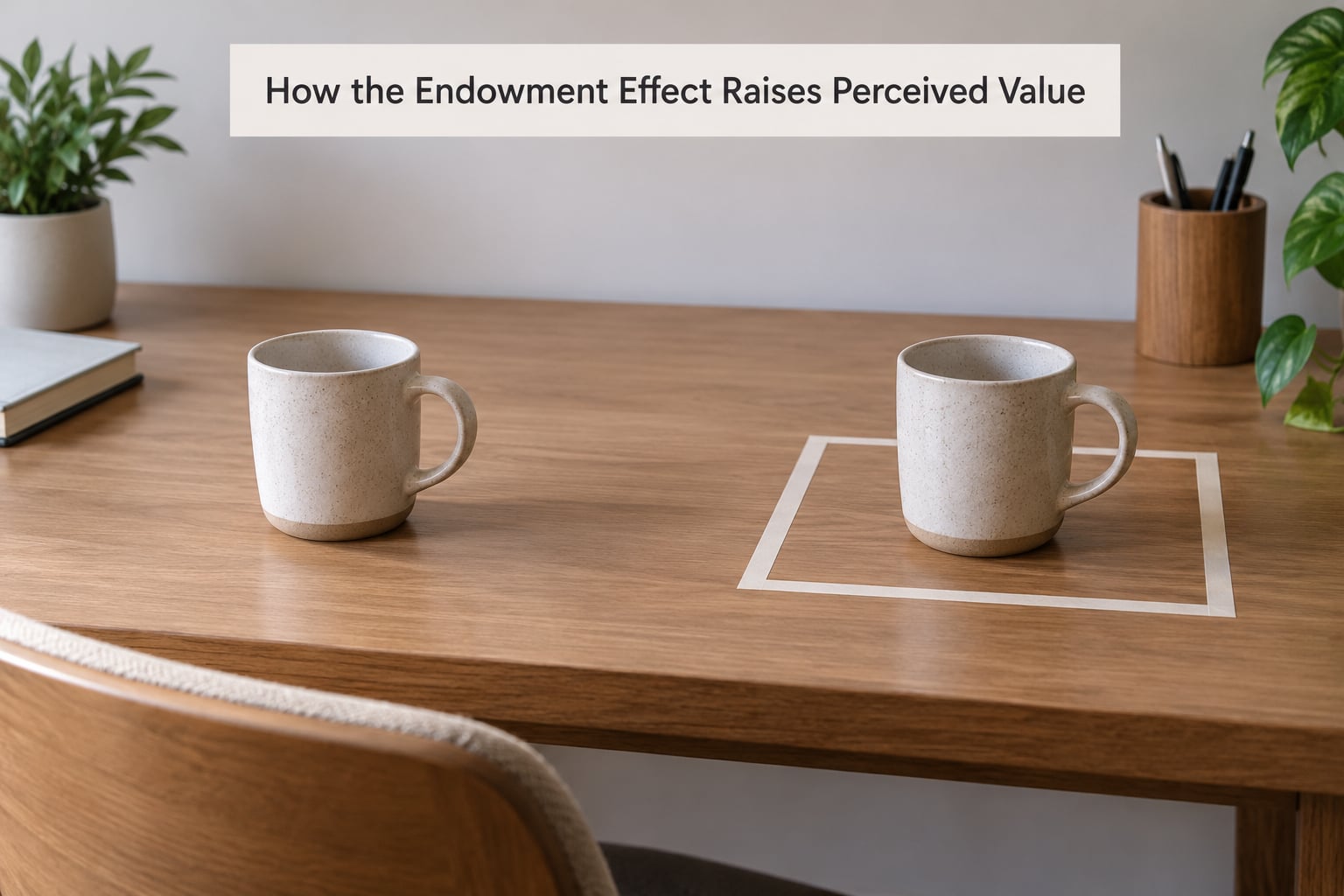
How the endowment effect raises perceived value is easiest to see as a change in asking price rather than a change in the object. The mug does not improve. The coffee does not improve. The function of the thing stays exactly where it was, and something in the owner’s head moves anyway.
Economists measure that movement as willingness to accept (what an owner will take) against willingness to pay (what a non-owner will offer). In the classic studies the owner asked roughly two to two and a half times what the non-owner bid for the same identical object. A gap that consistent, on goods nobody had any reason to value, is a bias rather than a fact about mugs.
Two things this is not. It is not ordinary preference: you can prefer a well-made pen without asking four times what someone else would pay for it, and a genuine preference gap usually shrinks when a real buyer shows up with money. It is not product quality: both halves of the experiment handled the same object, and the quality was constant by design.
The cleanest test of the effect is a swap. If a person is given an item and then offered a different item of identical market value in exchange, many will refuse the swap even though the two are worth the same. Something that nobody has ever seen before cannot carry an ownership premium, which is why the effect shows up so clearly in experiments with strangers, identical objects and no history between them.
That last detail matters for anyone trying to use this in a business setting. The endowment effect is loud when the object is unfamiliar and unattached, and quiet when it is beloved, familiar, and already spoken for. Assume a fresh item carries the strongest premium and an item with an emotional story attached carries a much smaller one.
Why does owning something make it seem more valuable?
There is no single switch. Four mechanisms stack up, and they reinforce each other, which is why the effect is stronger for some people and categories than others.
How loss aversion shifts the reference point
Prospect theory says value is judged as a gain or a loss relative to a reference point, not in absolute terms. For a non-owner the reference point is zero, so any price above it is a gain and the sensible move is to walk away from a bad deal. For an owner the reference point becomes the item itself, and giving it up is now coded as a loss, however reasonable the offer looks in cash terms. The value function is steeper on the loss side, so the same money buys less comfort against a loss than it does as a gain.
How psychological ownership and identity attach
Some ownership is legal, and some of it lives entirely in the head. People come to treat an object as theirs because they chose it, put work into it, or it fits who they are. That second route is why a plain mass-produced mug decorated with a name or a photograph beats the identical undecorated mug, and why a self-built playlist feels worth more than a curated one. Possession that carries identity is the most durable kind, and the most expensive to fake.
How mental accounting changes the comparison
Money spent is not judged against the same yardstick as money received. The cash from selling the item lands in a general-purpose account, while the item itself was sitting in a personal one. Ask an owner to compare their own price with the cash offer and they compare two currencies. Ask a non-owner to compare the same offer with zero and they compare one, which is the whole reason the two answers differ.
How anticipated regret does the last 10 percent
Owners carry an imagined future regret: the what if I sell this and see it somewhere better. Sellers carry the imagined regret of the other kind, and price defensively to compensate. In practice regret accounts for a modest share of the gap, but it is the component most likely to soften once a decision is made under pressure or with a hard deadline, because the imagined future stops being vivid.
How does the ownership process change valuation?
Valuation climbs in stages, and each stage has a marketing equivalent. Choosing an object raises value before it is even paid for. Handling it, living with it or wearing it raises it further. Customising it raises it more, because effort invested is effort defended. Simply owning it for a long time adds a slower increment that has little to do with the object’s function.
That sequence is why free trials, samples, configurators and personalisation work at all. They are not random acts of generosity; they are engineered to move a customer further along the sequence before the moment a question appears. The practical lesson for pricing is that the value gained in the trial period is not the same thing as value perceived on day one, and a discount that removes the trial removes the mechanism too.
What is a classic endowment effect experiment?
The most cited design comes from Kahneman, Knetsch and Thaler, published in the Journal of Political Economy in 1990 and revisited in their 1991 review of anomalies. Participants were randomly split into two groups. One group was simply asked what they would pay for one of several identical objects. The other group was first given the object to keep, then asked what they would sell it for. The objects were deliberately mundane: a university-branded mug, a chocolate bar, a pen.
That design is the minimum viable experiment for the effect, and it is worth copying in your own research because it isolates the only manipulated variable: possession.
| Object in the study | Average willingness to pay (non-owner) | Average willingness to accept (owner) | Ratio |
|---|---|---|---|
| University of Michigan mug | About 2.25 | About 5.81 | Roughly 2.6 times |
| Chocolate bar | About 0.63 | About 1.45 | Roughly 2.3 times |
Read the table as a ratio rather than as a price list. The absolute numbers matter less than the consistency of the ratio across objects that have no emotional significance whatsoever, because a bias strong enough to survive a chocolate bar is not being driven by attachment to the thing.
Later work has extended the same logic into unfamiliar territory. Collectors have been shown to price cards they own above the market price for identical cards they do not own, which is the mechanism economists use to explain why some markets stay thin. Controlled exchange experiments with chimpanzees have produced the same qualitative result, with owners refusing to swap a valued food item for an equal portion of a food they did not receive. Toddlers have been observed preferring a toy they were given over an identical toy held by a stranger.
None of this settles a question researchers still argue about: whether the measured gap is entirely a behavioural effect or partly an artefact of how the bids are collected. A participant asked what they would pay may be shy about naming a low number, and one asked what they would accept has little reason to give a realistic figure. Ericson and Fuster’s 2014 review in the Annual Review of Economics treats that measurement problem as central rather than incidental, and it is the strongest reason to treat a single WTA figure as a directional signal rather than a constant.
Where can you see the endowment effect in marketing?
The endowment effect in marketing shows up wherever a product is put into a customer’s hands, or into their vocabulary, before any money changes. Trials, samples, configurators, loyalty programmes, personalisation and community spaces all do some version of this, and the useful ones share a feature: they give the customer real time with the product before asking for a commitment.
Free trials are the obvious case. A customer who has run a SaaS tool for a month is not evaluating the same product as one looking at a pricing page, because the trial has made the workflow theirs. A product tour that lets someone import their own data does the same thing with more speed and less generosity required.
Possessive language is the cheapest version of the mechanism and the most overused. Dashboard, your leads, your workspace: the word does real work when the space genuinely belongs to the person using it, and it does nothing when the data is still the vendor’s and can be switched off in a click.
Customisation raises willingness to pay more reliably than a discount does, because the customer has invested effort. A configured product is defended harder, discounted less, and cancelled later, which makes customisation a retention tool as much as a pricing one.
Mock-ups, previews and saved configurations push the same switch. So do loyalty schemes and subscription onboarding, where the accumulated record of what someone owns in the programme becomes part of what they would give up. On marketplaces, seller-side listing tools that let people catalogue and photograph their own belongings create the effect in the person selling, which is a genuinely useful application for anyone trying to move stale inventory.
Two categories resist the effect more than most. Services with no repeat use generate no memory to draw on, and commodity goods a customer already owns several of produce no scarcity of identity. If a tactic shows no lift, check first whether the customer had any real use of the product before the ask.
How can marketers use the effect ethically?
The ethical test is simple and it is about sequence: did the customer get something real before they were asked to commit? Everything below follows from that.
- Create genuine value before the ask. A trial, a sample or a working configuration should let the customer judge the product on its merits. If the trial is deliberately hobbled, the mechanism is being used against the customer rather than for them.
- Set the price where a fair customer would set it. A willingness to pay inflated by ownership is not the same thing as a fair price. Test the price with people who have not yet been given the product, and treat that number as the honest baseline.
- Make leaving easy. One-click cancellation, no dark patterns, no maze of retention offers. A commitment the customer cannot exit is a takeover dressed as loyalty, and it is the point where a useful bias becomes a grievance.
- Do not manufacture scarcity or artificial deadlines. Countdown timers and fake low-stock messages borrow the machinery of loss aversion without any real loss attached.
- Separate retention from lock-in. The question to ask is whether a customer would still be glad to have this in a year if the switching cost vanished. If not, the tactic is hiding something rather than revealing something.
- Measure what happens after the purchase. Refunds, cancellations and complaint rates are the honest scoreboard. A tactic that lifts week-one conversion and also lifts week-four churn has not solved anything, and short-term revenue is the only number that will tell you otherwise.
Consumer forums show this tension clearly. Practitioners reach for the effect because it works, and buyers describe free trials and personalised configurations that turned out to be expensive to unwind. Both experiences are real, and the difference between them is usually whether the product delivered anything before the commitment was requested.
How do you measure the endowment effect in research?
The endowment effect is measured by splitting a sample between owners and non-owners of the same object and comparing what each group will pay against what each will accept. A clean version of the classic design needs a few specific choices, and each one has a habit of going wrong.
- Randomise the assignment. If you let people choose who gets the item, the owners differ from the non-owners before the experiment starts and the gap measures the difference between the groups, not the effect of ownership.
- Use identical objects for both groups. A different mug in each condition reintroduces a quality difference and the result is no longer interpretable.
- Decide between-subject and within-subject. Asking the same person both what they would pay and what they would accept is more efficient, and it invites them to reason about what answer is expected. Between-subject designs are cleaner and larger.
- Test the swap, not only the price. Offering an identical replacement for an item the participant already holds is a behavioural measure that is harder to game than a stated number, and it is the version to trust when a price result looks implausibly large.
- Keep quality, price and promotion out of the picture. Discounts, extra features and better photographs all move willingness to pay. Hold them constant or randomise them, or you will measure your pricing test and call it psychology.
- Watch for demand characteristics and social desirability. People who guess the hypothesis will produce the effect for you. Mask the purpose where you can, and treat any stated preference as weaker than revealed behaviour.
- Report a ratio and a spread, not a single number. A ratio around two is the familiar headline figure, and the honest unit of analysis is a distribution with error bars. Individual WTA figures are extremely noisy, and the median tells a different story from the mean.
- Plan for the criticism in advance. A thoughtful preregistration that anticipates the credibility and demand-effect objections is what separates a result that survives review from one that does not.
For practitioner work rather than academic work, the cheap version is a holdout test. Show one group a product configured and in use, and another the standard page, then compare conversion and refund rates rather than conversion alone. It is not a clean measurement of the bias, and it is considerably better than shipping a tactic on a colleague’s hunch.
Frequently Asked Questions
What is the endowment effect in psychology?
The endowment effect is the tendency to value an item more highly once you own it. The standard laboratory version splits participants into owners and non-owners of the same object and compares what each will sell for against what each will pay. Owners typically ask around two to two and a half times the non-owner price for the same identical object.
Is the endowment effect just loss aversion in disguise?
They are related but not identical. Loss aversion describes the general finding that losses hurt more than equivalent gains feel good. The endowment effect is the specific result you get when the reference point is a possession rather than zero. Loss aversion explains why owning raises your asking price; the endowment effect is the observable gap that produces.
Does the endowment effect apply to digital products and subscriptions?
Yes, though it usually arrives later and smaller. A digital product builds ownership through use, customisation and saved work rather than through touch, so the trial period matters more. A subscriber who has populated a workspace or built a history in a tool resists cancellation for the same reason an owner resists a lowball offer.
How can endowment effects be avoided?
Set a valuation before you own the item, and let someone who has no stake tell you what it is worth. Pre-commit to a price you will accept and refuse to revise it. Then consider the swap test: if you would take an identical replacement, the ownership premium was doing the work, not the item.
What are the criticisms of the endowment effect?
The main objection is measurement, not magnitude. Buyers asked what they would pay may name a low figure to look reasonable, and sellers asked what they would accept have no incentive to be realistic, so part of the gap may be an artefact of how bids are collected. Critics also note the effect shrinks with real market experience, is hard to separate from quality and familiarity, and has never produced a convincing economic argument for why markets stay inefficient.
How strong is the endowment effect in real markets?
Strongest for unfamiliar, low-involvement goods and weakest for familiar items that already carry an emotional story or a market price people know well. Collectors, who trade constantly, price their own cards far closer to market than novices do, which suggests experience and attention narrow the gap. Treat two-to-one as a laboratory figure rather than a constant.
Conclusion: Begin With Real Value
Ownership changes the reference point, and a changed reference point changes what the thing is worth to you. That is the whole mechanism, and it explains why the same object carries two prices depending on which side of the table you are sitting on.
So the first move is not a tactic. Find a point of genuine value in what you sell, give people real time with it, and make ownership clear and useful rather than merely claimed. Pricing that survives scrutiny, easy exits and honest scarcity are not restrictions on the strategy; they are the parts that make it work outside a lab.
Everything else, the trial length, the configurator, the possessive noun, is a way of letting that value land before the question gets asked. Get the sequence right and the bias works for the customer too.