
Social proof changes purchase behavior because buyers copy what other people already did. Robert Cialdini named the shortcut in Influence (1984): when you cannot judge a product yourself, you infer the correct choice from the behaviour of people like you. A review count, a star rating or a visible purchase turns an uncertain decision into a safe one.
That definition only covers the first thirty seconds of the decision. This piece goes further, into the mechanisms behind it, the cue types that carry real weight, the buyers who ignore the whole thing, and the situations where more proof makes a brand look worse. If you are the kind of marketer who wants the mechanism rather than another list of tactics, you are in the right place.
Table of Contents
- Key Takeaways
- What Is Social Proof and Why Does It Influence Buying?
- How Social Proof Changes Purchase Behavior
- What Kinds of Social Proof Work Best?
- Why Buyers React Differently to Social Proof
- How Social Proof Changes Purchase Behavior in High-Risk Decisions
- How Social Proof Affects Conversion, Trust, and Brand Perception
- Where Social Proof Can Backfire
- How to Use Social Proof Responsibly in Marketing
- Frequently Asked Questions
- Does social proof always increase sales?
- Are star ratings or written customer reviews more influential?
- How many reviews does a new product need to build trust?
- Does social proof work for unfamiliar or high-risk products?
- Can too many testimonials make a brand look less credible?
- How can marketers use social proof without misleading customers?
- Conclusion: How Social Proof Changes Purchase Behavior
Key Takeaways
- Social proof is an information shortcut. It substitutes third-party evidence for inspection when a buyer cannot evaluate the product directly.
- Four mechanisms carry the effect: uncertainty reduction, trust transfer, conformity and validation, and social learning. All of them weaken as the buyer’s confidence grows.
- Peer proof outperforms expert proof for unfamiliar, low-involvement purchases. Expert proof holds longer where the buyer cannot evaluate quality at all.
- Volume alone is not persuasive. Recency, credibility of the source, and how the buyer identifies with the reviewer decide whether proof lands.
- Manipulated, uniform or stale proof backfires, because audiences read patterns, not just counts.
What Is Social Proof and Why Does It Influence Buying?
Social proof is any evidence that other people have already chosen, used or approved something. Cialdini described it as a shortcut for reading ambiguous situations: rather than evaluate the object, the observer evaluates the observers. Everything that follows from that logic, the whole persuasive weight of reviews, follower counts, bestseller labels and real-time purchase notifications, is a variation on the same move.
Two distinctions from social psychology make it easier to reason about. Informational social influence is what happens when someone copies another person to learn something, and it drives the shopper who reads a review of a product they have never used. Normative social influence is what happens when someone copies to fit in or avoid standing out, and it drives the buyer who does not want to be the only one owning an unfamiliar thing.
Social norms come in two more useful forms. Descriptive norms tell you what people actually did, which is why the sentence “1,240 people bought this in the past week” is descriptive. Injunctive norms tell you what people think you should do, which is why “the recommended choice for first-time buyers” is injunctive. Descriptive norms tend to shift behaviour through information, injunctive norms through approval, and mixing the two in one sentence blurs which one is doing the work.
That is why social proof moves purchasing decisions more than it moves opinions. A buyer rarely needs to be convinced a product is good; the product page already says that. What the buyer cannot resolve is the risk, and other people’s behaviour is the cheapest available answer to it.
How Social Proof Changes Purchase Behavior
The effect runs through four mechanisms, and they stack rather than compete. Most pages that mention social proof stop at the first one, which is why the same tactic gets relabelled every year without anyone knowing whether it works.
Uncertainty reduction. Buyers face information asymmetry in almost every online purchase. They cannot touch the product, test the fit, or interrogate the seller, so they borrow someone else’s verdict. This is the base layer, and it explains why proof matters most for unfamiliar brands and unfamiliar categories.
Trust transfer. The value of a review depends less on its content than on who wrote it. A buyer who notices that a reviewer shares their own situation reads the review differently from the same words written by an unknown account. Similarity bias and authority bias do most of the work here, and they explain why verified-buyer badges and named customer details outperform generic five-star blocks.
Conformity and validation. Choosing the bestseller feels safe even when the underlying information is thin, because the alternative carries a social cost. Cialdini and Noah Goldstein’s field work on towel reuse in hotels showed that messages stating a norm (“most guests reuse towels”) shifted behaviour far more than environmental appeals, and that the descriptive, purely informational version worked best of all.
Social learning. In choices where the buyer has no prior framework, observed behaviour becomes the decision rule itself. Daniel Salganik and colleagues reproduced this in an artificial music market, where an experimental download chart created a social influence effect: songs that started popular kept their lead, and that early advantage produced both quality and bias in how listeners rated them. Without the audience, one of those songs would have been rated on its own merits.
Leon Festinger’s social comparison work adds a fifth mechanism that marketers misread as a bonus. People compare themselves to relevant others to work out where they stand, so a review from someone slightly better off than you can read as either reassurance or a warning. Same content, different effect, and the difference is entirely in the reference point the reader picks.
| Cue | How a buyer reads it | Likely behavioral effect |
|---|---|---|
| Star rating with a large review count | Many independent people survived the choice | Faster add-to-cart, less comparison shopping |
| Written reviews describing a specific outcome | Someone like me solved the same problem | Confidence in fit, suitability and results |
| Verified-buyer badge | The reviewer actually completed a purchase | Higher weight on the review content |
| Recent dated reviews | The product still performs now | Reduced fear of an outdated or discontinued item |
| Bestseller or sales-volume label | Many people chose this over the alternatives | Choice simplification, higher conversion on close options |
| Expert or professional endorsement | Someone with credentials evaluated it | Stronger effect where the buyer cannot assess quality |
| Creator or follower count | Social status transfers to the product | Aid, low-risk purchases, discovery |
| Real-time activity notices | Other people are acting while I watch | Urgency, impulse adds, checkout completion |
| Peer case study or named reference | A firm like mine solved this | Shorter committee cycles in B2B |
| Trust badges, certifications, press logos | Third parties checked the basics | Lower perceived transaction risk, especially first purchase |
What Kinds of Social Proof Work Best?
No proof type is universally strongest. What matters is the match between the cue and the uncertainty it resolves, so it helps to sort proof by the kind of doubt it answers.
Peer reviews and ratings answer “will this work for someone like me?” They are the workhorse, and industry surveys keep finding that a majority of shoppers read reviews before buying from an unfamiliar seller, with a sizeable share refusing to consider a business at all below a small threshold of review count. The same surveys show most readers weighting recent reviews heavily, which is why a five-year-old review block does less than a mix with dated entries.
Written reviews do something a star rating cannot: they describe the situation. Specific detail, including complaints, makes a reviewer more credible because real buyers are not perfectly happy. A page showing a realistic spread with visible brand responses reads as a place where feedback is handled, and a page showing only glowing five-star copy reads as something else entirely.
User-generated content is peer proof with a visual attached. Shoppable photo galleries tend to outperform brand-produced imagery on the same page because they show the product in a context the brand cannot manufacture, and e-commerce reporting over the last couple of years has put customer-created content several times more effective per piece than brand content for certain categories.
Testimonials answer “can this person be believed?” They work when the person is identifiable and connected to the outcome. Anonymous praise in a rotating carousel is weak, because the reader cannot apply the similarity check.
Expert and authority proof answers “is this technically sound?” It holds up best where the buyer has no way to judge quality, in insurance, health-adjacent products, financial products and professional services. Its weakness is that it carries no similarity, so it persuades rarely and reassures thoroughly. Position it as a permission to proceed, not as a reason to want.
Creator and influencer recommendations answer “is this normal for people my age?” They work in categories where identity matters, and the smaller the creator’s following relative to the target audience, the more useful the recommendation, since a huge generalist audience dilutes the similarity signal.
Sales-volume labels and real-time activity answer “will I miss out?” They are the weakest of the bunch for considered purchases and surprisingly effective for low-consideration ones, where the deciding question is not quality but whether the effort of continuing is worth it.
Peer case studies do for B2B what individual reviews do for retail. A named customer with a similar size, industry and problem is the closest available proxy for the buyer’s own outcome, and committee buyers lean on them to justify a decision they will have to defend internally.
Why Buyers React Differently to Social Proof
Same page, same rating, same review count, different outcome. That variance is the part most marketing advice skips, and it is predictable once you look at who is reading.
Product familiarity. A buyer who already owns a category skips proof entirely and reads reviews for edge cases only. The proof that converts them is the negative one, since the routine question is already settled. Familiar buyers also stop noticing volume, because a thousand reviews no longer change what they believe about the product.
Perceived risk. The higher the cost of being wrong, the more weight proof carries, and the more the buyer wants disconfirming evidence. A refund promise reassures more than another five-star review on a high-involvement purchase.
Expertise. Experienced buyers read proof differently, scanning it for specifics and discounting sentiment. Photographers do not convert on star averages; they convert on a comment about autofocus behaviour. Telling a knowledgeable audience to trust the crowd usually reads as an insult to their judgement.
Ambiguity in the category. Where the buyer cannot even name the criteria that matter, proof substitutes for a decision framework. Where the criteria are obvious and they know their priorities, proof just confirms what they already decided.
Culture and social identity. Norms are learned. In a culture that reads visible purchasing as status display, a bestseller label is status proof. In a culture that reads it as waste, the same label is a weak argument, and sustainability evidence does the persuasive work instead.
Prior experience with the brand. Existing customers already have social proof internally, so public reviews matter less to them and matter more to their friends. Advocacy, not display, is the useful lever at that stage.
How Social Proof Changes Purchase Behavior in High-Risk Decisions
In high-risk decisions the effect concentrates and the standard cues stop working. A first surgery, a large contract or a year-long subscription are not choices made by pattern-matching, so the buyer wants specific, verifiable, recent and independent evidence rather than volume. Volume alone performs poorly here; named case studies with comparable details, third-party certifications, published methodology and a visible response to complaints all outperform a raw review count.
The trade-off is that risk cuts both ways. In these categories the same scepticism applies to enthusiastic proof, and a single well-documented failure report from a credible source can outweigh a hundred favourable anecdotes. Brands that want the benefit of high-risk social proof have to accept the visibility of high-risk negative proof.
B2B is the clearest example. A buying committee means several people each need their own evidence, and the social proof that works is the one matching each member’s objection: a case study for the champion, an analyst or certification reference for procurement, a security document for the risk officer. Proof aimed at the committee as a whole tends to satisfy nobody, because it never addresses the specific doubt of any one member.
How Social Proof Affects Conversion, Trust, and Brand Perception
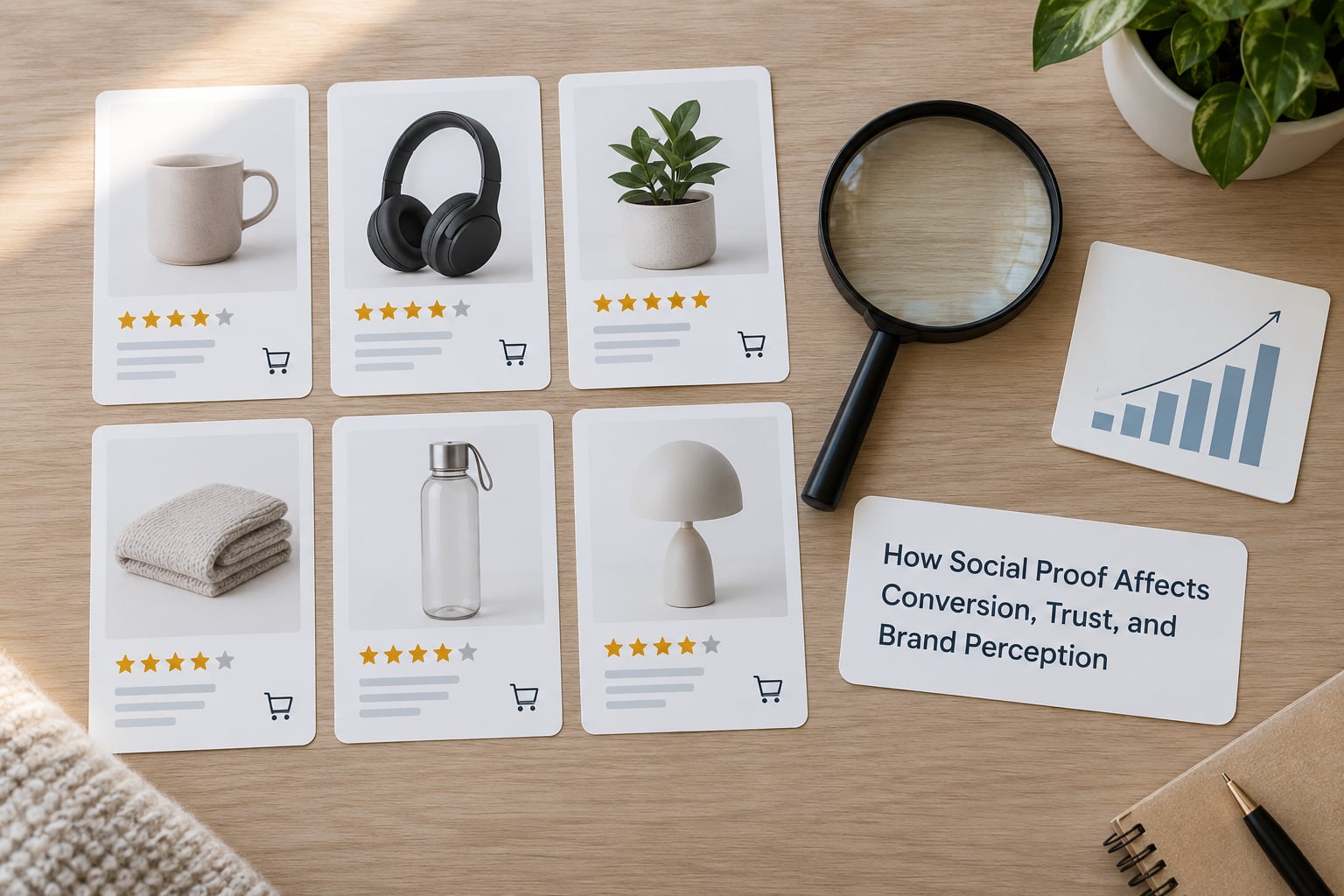
Proof changes behaviour through a chain of measurable steps, and knowing which one moved tells you where to put the next piece of evidence.
Click-through rate responds to proof that appears before the click: follower counts, review counts in ad copy, press logos, marketplace listings with high ratings. It is the weakest signal in the chain because it measures attention, not conviction.
Add-to-cart rate responds to proof on the product page, especially review count, rating distribution and detailed written reviews that address fit or results. This is usually where the largest share of the total effect shows up.
Conversion rate responds to reassurance at the decision point and, crucially, to payment, returns and security signals near checkout, where the remaining doubt is operational rather than quality-based.
Average order value moves when proof covers the upgrade or bundle, for instance reviews that mention a second product or a longer-term benefit. Reviews on a single item rarely move basket size.
Return rate is the honest check on the whole chain. Proof that pulls in buyers whose expectations were set badly raises returns, and the conversion gain was partly borrowed from future margin. High volume with a rising return rate usually means the reviews are doing targeting work they cannot support.
Revenue per visitor is the number to watch when price varies, since a proof change that lifts conversion but drops average order value can look like a win in a conversion-rate dashboard and lose money overall.
What I would refuse to claim is a universal lift. There is no dependable percentage that social proof adds to any page, because the effect size depends on how uncertain the buyer was to begin with, how relevant the proof is to their specific doubt, how much of it is visible without scrolling, and what the category norm already looks like. A page that already had strong proof has less headroom than a page starting from zero.
Measurement is straightforward if you run it as a test. Change one proof element at a time on a product page, hold the traffic source and price constant, and run long enough to cover at least one full buying cycle, which for considered goods is weeks rather than days. Watch add-to-cart, conversion and return rate together. Reading the treatment arm before the test has a pre-set end point is the most common way teams convince themselves a weak cue worked.
Where Social Proof Can Backfire
This is the section almost no competitor page covers, and it is where a lot of wasted budget sits. The failure modes are mostly signals of a manufactured pattern, because audiences read structure, not just content.
Suspiciously uniform reviews. Five reviews, all five stars, all in the same week, similar length, no detail. Volume that looks staged signals fabrication, which makes the reader discount the whole page including genuine reviews. A realistic spread, including the two-star ones, reads as authentic because real reviewing behaviour is not uniform.
Review manipulation and incentives. Incentivised reviews that are not disclosed violate consumer-review rules in several jurisdictions and, more practically, produce generic praise with no useful detail. Disclosed incentives are a different case, since buyers adjust for them, but undisclosed ones poison the source for everyone else reading the same page.
Out-of-context testimonials. A result quote lifted from a different product, region or year is a short-term gain. Readers who spot one comparison on the page generalise it to everything else on it.
Excessive proof and page overload. Badges stacked above the fold, five activity notifications firing at once, six review carousels all pulling attention turn a reassurance into noise. Attention is a scarce resource, and proof competes for it with the product.
Stale proof. Three-year-old reviews on a fast-moving category, an award from a discontinued programme, or a follower count that has not moved in two years all signal neglect. Freshness is part of credibility, and a stale asset is worse than no asset.
The ceiling effect. Past a certain volume, additional reviews stop moving anything, because nobody counts to 40,000. At that point the marginal value sits in recency, distribution and detail, not count, and effort is better spent there.
Minority signals. A minority of buyers can move a crowd, and not always in your direction. A thread of detailed criticism from plausible buyers can outweigh hundreds of short praise posts, particularly when the detail looks informed.
Social comparison running the wrong way. Proof that highlights extreme outcomes or extreme users invites readers to measure themselves against an unattainable reference, which deflates rather than persuades. Reviewers closer to the reader’s own situation do better than impressive outliers.
Overconfidence. Heavy proof reduces hesitation, and hesitation is sometimes what protects a buyer from an expensive mistake. On a page for an irreversible or high-consideration purchase, removing every doubt at once can push marginal buyers past the point where they understand the product.
The safeguard is short: keep proof that a knowledgeable reader would accept, because the audience most likely to notice a staged pattern is the one whose purchase matters most.
How to Use Social Proof Responsibly in Marketing
Ethical use here is not soft. The short version is that the evidence has to survive the reader who knows what to look for, which in practice means specific rules about selection, placement, representation and upkeep.
Match evidence to the doubt. Write down the one sentence a hesitant buyer would say, then pick the proof that answers it. Uncertainty about quality calls for detail and expertise; uncertainty about fit calls for peer reviews; uncertainty about the transaction calls for security and returns signals.
Place it at the decision point. Proof that sits three screens above the button has already done its work. Put review count and rating next to the buy action, security and returns signals next to payment, and keep the mix visible without scrolling.
Represent real variation. Show the distribution instead of the average, respond to negative reviews in public, and let specific complaints stand. A page that looks too good to be true is a page nobody converts on.
Disclose incentives and relationships. Say who paid, who received a free unit, who is an affiliate and who is an employee. Buyers adjust for disclosed bias, and an undisclosed one contaminates everything next to it.
Label ratings accurately. Match the rating shown to the reviews that produced it. A summary score detached from the underlying reviews is a claim, not evidence.
Retire stale proof. Set a review date on the asset and re-verify badges, certifications and counts on a schedule. Nothing ages credibility faster than a broken seal.
Test one element at a time. Proof is easy to over-apply. Testing additions one at a time is what tells you whether you have a working cue or just a busier page, and it prevents stacking three untested widgets at once and attributing the result to the last one.
One test I would run before anything else: remove all proof from a low-traffic product page for two weeks and compare add-to-cart and conversion against the baseline. The drop tells you what the proof on that page is actually contributing, which is frequently less than the team believes and occasionally nothing at all.
Frequently Asked Questions
Does social proof always increase sales?
No. The effect scales with how uncertain the buyer is, how relevant the proof is to their specific doubt, and how credible the source looks. When uncertainty is already low, added proof can do nothing, and if the pattern looks staged it can push buyers away. Measure it as a change to one page element and read return rate alongside conversion rate.
Are star ratings or written customer reviews more influential?
They do different jobs. A star rating answers a screening question fast and is what most buyers use on a search results page or a marketplace listing. Written reviews answer the fit and suitability question that stops the purchase. For unfamiliar categories, written reviews usually carry the decision once the buyer has arrived, because the average number tells the reader nothing about their own situation.
How many reviews does a new product need to build trust?
There is no threshold that applies across categories, but buyer behaviour clusters around small numbers. Survey reporting repeatedly finds a meaningful share of shoppers unwilling to consider a business below roughly twenty reviews, which makes that a practical floor rather than a target. Past a few hundred, count stops mattering and recency plus detail take over as the persuasive elements.
Does social proof work for unfamiliar or high-risk products?
It works harder there, not less, but the standard cues stop being enough. In high-risk decisions, volume carries less weight than named case studies with comparable details, third-party certifications, published methodology and a visible record of how complaints were handled. The same scrutiny applies to positive proof, so one well-documented failure report can outweigh a large volume of praise.
Can too many testimonials make a brand look less credible?
Yes, and it is usually a pattern problem rather than a volume problem. Repeated praise with no detail, testimonials that all arrived in the same week, or a page carrying six carousels and several activity notifications at once all read as manufactured or as noise. A realistic spread of specific experiences, including the critical ones, reads as authentic and converts better than a wall of enthusiasm.
How can marketers use social proof without misleading customers?
Keep proof that a knowledgeable reader would accept. Match evidence to the actual hesitation, disclose incentives and material relationships, show the real rating distribution instead of a detached score, respond publicly to negative reviews, and retire stale badges and outdated reviews on a schedule. Test one element at a time so you know which cue is doing the work rather than assuming the busiest page is the strongest.
Conclusion: How Social Proof Changes Purchase Behavior
Social proof changes purchase behavior by shortening a decision that would otherwise stall on missing information. A buyer who cannot evaluate a product borrows another buyer’s verdict, which lowers perceived risk, validates the choice, and makes stopping feel like the riskier option. The shortcut is strongest when the doubt is real, the source resembles the reader, and the evidence is recent and specific.
Start with the uncertainty, not the widget. Write the sentence a hesitant buyer would say out loud, then put evidence that answers it directly at the moment they would say it. Add one element, test it long enough for the category’s buying cycle, and watch return rate next to conversion rate, because proof that raises both is doing its job.