
To present qualitative findings to skeptical executives, you lead with the decision they are being asked to make, show how strong the evidence is before anyone asks, and separate what participants said from what you concluded. Most readouts fail on framing, not on evidence quality. A room that knows the stakes and can audit your reasoning will act on soft data; a room that hears a methods lecture will ask for the sample size and start looking for the door.
This is the unglamorous truth about presenting qualitative research findings to executives: the analysis is rarely the bottleneck. Studies get dismissed at the readout stage, after the fieldwork is done and the bill is paid. So the work that matters most is the ninety minutes before you speak.
Below is the method I use, built around seven steps. Each one answers a specific way a skeptical audience pushes back, and each comes with a check you can run on your own material before the meeting.
Table of Contents
- What You Need
- Step-by-Step
- How to Present Qualitative Findings to Skeptical Executives: Frame the Decision First
- Separate Findings, Interpretation, and Recommendations
- Build an Evidence Chain Executives Can Audit
- Turn Themes into a Coherent Executive Narrative
- Show Commercial and Behavioral Implications
- Pre-empt Skepticism Before the Meeting
- End with Decisions, Owners, and Next Steps
- Common Mistakes
- Frequently Asked Questions
- How do you handle a skeptical executive who says the qualitative sample is too small?
- What is the best way to present qualitative research to executives?
- How many findings should I include in an executive qualitative presentation?
- Should I combine qualitative findings with statistics in an executive readout?
- How do I know if a qualitative finding is strong enough to act on?
- Conclusion: Start With the Decision
What You Need
You need four things prepared before you design a single slide, and none of them is a deck. The first is the synthesis: your themes, ordered by commercial consequence rather than by how they emerged during analysis. The second is the evidence: the specific behaviours, contrasts and verbatims sitting behind each theme. The third is participant context: who these people were, how they were recruited, and which segments they represent. The fourth is the decision you want made in the room, written as a sentence.
Build a one-page evidence inventory before anything else. It has one row per finding and five columns: the finding stated as a bounded claim, the number of participants who supported it, one representative verbatim, one counter-example, and your confidence level. This single page does most of the hard work later, because it forces you to attach a disconfirming case to every finding instead of leaving it for an executive to find.
If a row has a thin evidence column, that finding is illustrative rather than verified, and the deck should say so. Knowing which is which before you are challenged is the whole game.
| What the method says | What you say to the room |
|---|---|
| Theoretical saturation | We stopped interviewing when the last four conversations stopped producing anything new |
| Informant saturation | We heard this from people in three different roles, not one team |
| Inductive coding | The categories came out of the conversations rather than from a framework we imposed |
| Deductive coding | We tested a specific hypothesis against what people actually said |
| Member checking | We sent the summary back to a handful of participants and they corrected us |
| Transferability | This holds for the segment we studied; whether it holds elsewhere is your call |
| Thick description | We describe the situation closely enough that you can judge whether it matches yours |
| Audit trail | Every conclusion we drew can be traced back to raw material you can inspect |
| Reflexivity | Here is where my own assumptions could have shaped the reading |
| Disconfirming case | Here is the person who disagreed, and why |
| Triangulation | The same pattern showed up in interviews, in support tickets and in session recordings |
| Participant, subject, respondent | Customer, employee, user |
Step-by-Step
How to Present Qualitative Findings to Skeptical Executives: Frame the Decision First
Open with the business decision, its urgency, and the specific choices on the table. Not the research question, not the methodology, not a warm-up anecdote about recruitment. One slide, three lines: here is the decision, here is why it cannot wait, here is what we need from you by the end of this meeting.
Translate the research question into decision language without pretending the evidence can do more than it can. You cannot size a market from twenty interviews or prove causation. You can describe how a segment behaves, explain the mechanism behind a decision they already make, and show where a proposed plan contradicts what people told you.
How do you tell this worked? By asking a colleague to watch the first slide and tell you what you want them to decide. If they cannot answer in one sentence, the framing is not finished.
Separate Findings, Interpretation, and Recommendations
Use three visibly distinct layers, and keep the same labels on every slide: evidence, meaning, implication. Evidence is what participants did and said. Meaning is your interpretation of the pattern. Implication is the recommended response. When those three blur, a skeptical executive cannot tell where your judgment begins, and the instinct is to distrust all of it.
Consistent labelling sounds clinical, and that is the point. It also makes disagreement cheap: an executive who rejects your implication is disagreeing with one layer, not throwing out the whole study.
Build an Evidence Chain Executives Can Audit
Every major finding needs a chain: the participant behaviour, the motivation behind it, a contrast with someone who behaves differently, and the practical consequence. Pick one memorable verbatim rather than five. A quote dump reads as a lack of editing, and a single well-chosen line does more work than a slide of fragments.
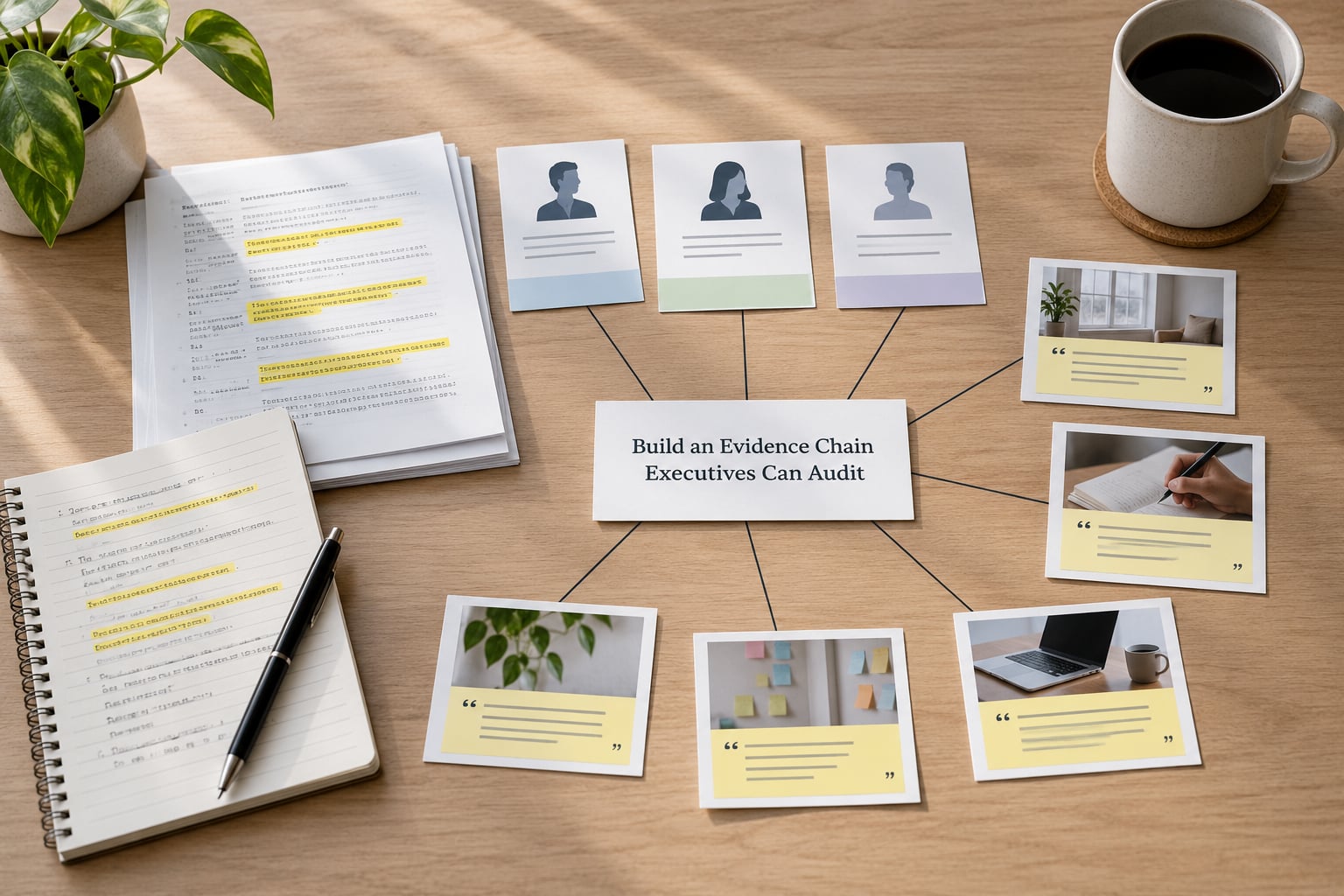
Show the case that argues against you. Lincoln and Guba’s trustworthiness criteria treat disconfirming evidence as a credibility signal rather than a liability, and in practice that is how it lands: showing the one person who disagreed tells the room you looked hard rather than confirming a hunch. State your limits out loud, including the segment you did not study and the segment you could not recruit.
On a slide, credibility fits into a small box rather than a full page: participant count, where recruitment stopped and why, one disconfirming case, and the pattern that appeared in more than one source. Triangulation, in plain terms, is your strongest answer to representativeness, because it shows the finding does not depend on one interview guide or one channel.
How do you tell this worked? Pick any finding and try to name the behaviour, the motivation and the contrast without opening your notes. If you cannot, the chain is not built yet.
Turn Themes into a Coherent Executive Narrative
Order your findings by the story they tell together, not by the order you analysed them. Executives do not need your taxonomy; they need a plot. A workable skeleton runs protagonist, challenge, intervention, outcome, and future direction, and it maps neatly onto customer stories without pretending a customer is a hero.
A related framework that shows up constantly in impact storytelling is the five C’s, from Christopher Vogt: character, context, change, consequence and call to action. It is worth borrowing because it forces the last element, which is the one researchers skip most often.
Give each theme a plain-language title an executive could repeat in a corridor. “Trust erodes at the moment of cancellation” beats “Theme 3: Deception and exit”. Connect the themes with one sentence each, so the meeting hears an argument rather than four disconnected findings.
How do you tell this worked? Read only your theme titles in order. If the sequence reads like a case with a beginning, a complication and a turn, the narrative is doing its job.
Show Commercial and Behavioral Implications
Translate what you heard into what it means for the decision: which segment it applies to, which context it holds in, and what would have to be true for it to be wrong. Mark confidence honestly. A finding carried by four of twenty participants in one segment is not a universal law, and claiming it is one is how researchers end up defending something that was never solid.
Use conditional logic for unproven outcomes rather than promises. If we change the cancellation flow, we expect retention in this segment to improve, and here is the metric and window we will check. That is a far stronger position than predicting a result, because it hands the room a test instead of a claim.
Pair qualitative with quantitative rather than competing against it. Qualitative explains the mechanism behind a number you already have; the survey tells you the size of the group. Used this way, each makes the other more useful. Used as rivals, the softer dataset loses by default.
Pre-empt Skepticism Before the Meeting
Skepticism in these rooms has a small number of repeatable shapes, and naming them in advance is what buys you a decision instead of a fight. It is also worth separating two things that look identical but need opposite responses: distrust of the method, which you answer with evidence, and distrust of the presenter, which you answer by giving the room something to check.
| What they say | What it usually means | Your response | Show this |
|---|---|---|---|
| That is just an anecdote | Categorical discount, not a request for detail | Agree with the label, change the noun: this is a pattern, not a story. Here is how many people showed it and the one who did not | Participant count behind the theme, plus the disconfirming case |
| Twelve people is not a sample | Survey frame imported into a method that does not use it | Qualitative studies stop when new interviews stop producing new themes. Show the last four, they added nothing | Where recruitment stopped and why |
| How do you know this is not just your opinion | Distrust of the presenter | Here is the audit trail. Every claim traces to raw material you can inspect this afternoon | Evidence inventory page and the coding frame |
| So what | The finding never reached a decision | Do not defend the finding. Answer with the choice and the cost of doing nothing | The implication slide with owner and date |
| Can we prove this caused the drop in renewal | Qualitative evidence asked to do a quantitative job | No, and it was not designed to. It explains the mechanism. Here is the data that would test causation | Triangulation sources and the proposed validation test |
Rehearse those answers out loud. Written language is always braver than spoken language, and the version you can say in one breath is the version that lands under pressure.
Time-box methodology to roughly a tenth of the live session. One slide of method, one slide of limits, then move. Burrowing into detail unprompted signals anxiety and turns the meeting into a seminar.
| Format | Its job | Length |
|---|---|---|
| Pre-read, sent two days ahead | Give skeptics time to find the flaw before the meeting. Better that they bring it to you than ambush it live | Two pages |
| Live session | Secure the decision. Presentation, discussion, decision ask | Thirty to forty-five minutes |
| Follow-up memo | Lock the commitment after everyone has left the room | One page |
| Appendix | Serve the deep skeptic without slowing the room down | Unlimited, never presented |
Two cautions. Never use a phrase like “bad data” in the deck; it hands the audience an interpretation you did not choose. And never sound apologetic about a small sample, because apologising for a defensible design choice tells the room you agree it is a weakness.
How do you tell this worked? If you can state each challenge and its answer in under fifteen seconds, you are ready. If any answer takes a paragraph, you have not made a decision yet.
End with Decisions, Owners, and Next Steps
Close with a short decision memo: the recommended action, the rationale in two lines, the questions that remain open, one named owner, a date, and how you will validate that it worked. The meeting should end with agreement about what happens next, not a recap of every theme you covered.
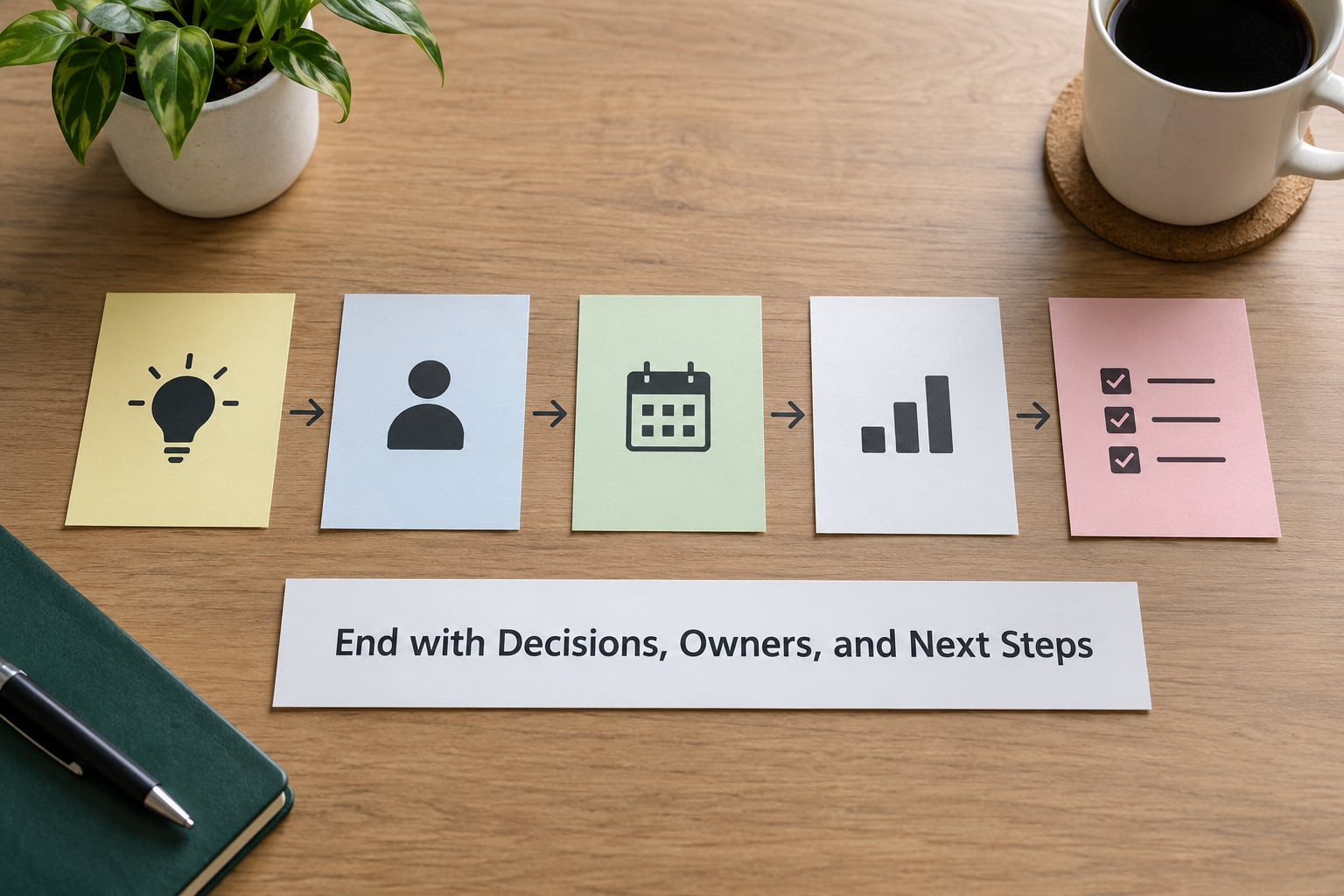
Decide what you want from the room before you walk in. One decision is realistic. Three reads as indecision and guarantees you leave with a working group instead of a commitment.
Six weeks later, check whether the decision actually changed. If the readout produced nothing, no amount of methodological polish will fix it, and the next request for research access will be much harder. Track it anyway, because a single documented case where insight changed a decision does more for your next funding conversation than any methodology slide.
How do you tell this worked? Leave the room with a name and a date, not with a promise to circulate the report.
Common Mistakes
Presenting a topic guide instead of a story. Analysis order is not argument order. Re-sequence so the findings explain a problem and its resolution. Keep the taxonomy in the appendix.
Overloading the deck with quotations. One memorable verbatim per theme. Five fragments read as an editing failure and give the room nothing to remember.
Hiding methodological limits until asked. A limitation you disclose first reads as rigour. The same limitation surfacing under questioning reads as something you hoped nobody would notice. Say it yourself, and pair every disclosed weakness with an improvement you would make next time.
Treating participant preference as market demand. People are good at explaining their own behaviour and bad at predicting it. Qualitative evidence describes mechanism and motivation. Size and forecast come from elsewhere.
Vague recommendations. “Improve the experience” is not a recommendation. “Move cancellation confirmation ahead of the retention offer, starting with the self-serve segment, measured by 90-day renewal” is.
Opening with process. Recruitment, screener design and transcription choices do not belong in the first three minutes. The decision does.
Getting visibly defensive. When a challenge lands, restate it accurately before answering. People stop challenging the moment they feel heard, and they start challenging harder the moment they feel ambushed.
Then three habits worth building. Pre-announce your main finding in the pre-read so nobody is ambushed in the room. Separate confidence levels visibly, even on a slide, because visible calibration reads as honesty. And keep the appendix genuinely deep; it is the only way to satisfy a skeptic without costing the rest of the room ten minutes.
One more situation deserves its own preparation: findings about internal colleagues. When your participants are the employees sitting two floors above you, expect the analysis to be read as an assessment of people rather than of a process. Agree with your data team on anonymisation rules before the fieldwork, and have the segment statement ready. Most of the politics in that readout is created by the reporting format, not by what participants said.
Frequently Asked Questions
How do you handle a skeptical executive who says the qualitative sample is too small?
Do not argue about the number. Agree that the study was not designed to estimate prevalence, then show the design instead: where recruitment stopped, how many consecutive interviews produced nothing new, and the pattern appearing in more than one source. If you cannot show that stop rule, you have a real gap, so say what you would add next time.
What is the best way to present qualitative research to executives?
Lead with the decision, then evidence, then implication, in that order and visibly separated. Show credibility signals early rather than under questioning, use one memorable verbatim per theme instead of a quote dump, translate method into plain words, and close with one named owner and a date. Send a two-page pre-read so skeptics arrive with their objections already formed.
How many findings should I include in an executive qualitative presentation?
Three is the practical ceiling for a forty-minute session, and four is the absolute limit. Each one needs a behaviour, a motivation, a contrast and a commercial implication, and presenting more than that usually means you are listing your taxonomy rather than building an argument. Hold the remaining themes for the appendix or a follow-up readout.
Should I combine qualitative findings with statistics in an executive readout?
Yes, and use each for what it is good at. Statistics size the group and show whether a problem is material; qualitative evidence explains the mechanism behind the number and surfaces behaviour nobody asked about. Presented as rivals, the softer dataset loses by default. Presented as complements, the statistic supplies scale and the interview supplies the reason.
How do I know if a qualitative finding is strong enough to act on?
Check three things: the pattern appeared across several participants rather than one, you can name at least one counter-case and explain why it differs, and the finding points at a decision somebody in the room actually owns. A theme with no counter-case and no owner is a hypothesis. Present it as one, and treat it as an input to the next round of research.
Conclusion: Start With the Decision
The first move in presenting qualitative findings to skeptical executives is never a slide about saturation. It is a sentence about what you want decided. Everything after that, the evidence chain, the plain-language method, the pre-empted objections and the closing memo, exists to make that decision feel safe to make.
So before you open a slide editor, draft the one-page decision and evidence summary. Fill in the finding, the count behind it, the counter-case, the implication and the owner. If any row stays blank, that is the work your next hour should go into, and it is far cheaper to fix now than in front of the room.