Steering a focus group is any moderator behaviour that changes what participants are willing or able to say: the words you pick, your face, the order you ask things in, or the way you summarise what someone just said. To moderate a focus group without steering it, you replace judgement with procedure, because neutral moderation is a set of observable behaviours, not a personality trait.
Most new moderators are not trying to lead the group. They are trying to be helpful, and helpfulness is exactly the problem. A nod after the answer you expected, a paraphrase that drops the awkward part, a probe that hands the participant a list of acceptable answers, and every one of them narrows what the next person is willing to say. Twenty minutes into a 60-minute session, the group has quietly stopped disagreeing with you and started agreeing with each other.
The practical answer has two halves. The first half is preparation: a guide built around behaviour before opinion, a probe bank that covers anything you did not predict, and a way to catch your own influence while it is happening. The second half is a small set of in-session moves that keep the floor open, plus a rule for knowing when you are allowed to step in at all.
Table of Contents
- What You Need
- What are the 6 qualities of a good moderator?
- A moderator guide built around behaviour
- A screener, consent plan and recording setup
- Prompt cards and a probe bank
- A way to log your own influence
- A pre-session self-check routine
- How to Moderate a Focus Group Without Steering It: Step-by-Step
- How to moderate a focus group without steering it in the opening
- Use open questions before evaluative prompts
- Ask one participant at a time without implying who matters
- Use neutral probes and balanced follow-ups
- Handle silence, disagreement, and dominant voices
- Check your influence before, during, and after the session
- Close without leading the final synthesis
- Common Mistakes
- Asking questions that contain their own answer
- Confirming the answer you wanted
- Paraphrasing with a lean
- Interpreting in the moment
- Rescuing a struggling participant
- Using silence as pressure
- Letting the sponsor in the room shape you
- Frequently Asked Questions
- How do I stop myself from accidentally leading a focus group?
- What is a neutral follow-up question in a focus group?
- How do I probe without putting words in a participant’s mouth?
- How should a moderator handle a dominant participant?
- What can a moderator do after asking a leading question?
- Does neutral moderation mean the moderator should never interpret?
- Conclusion
What You Need
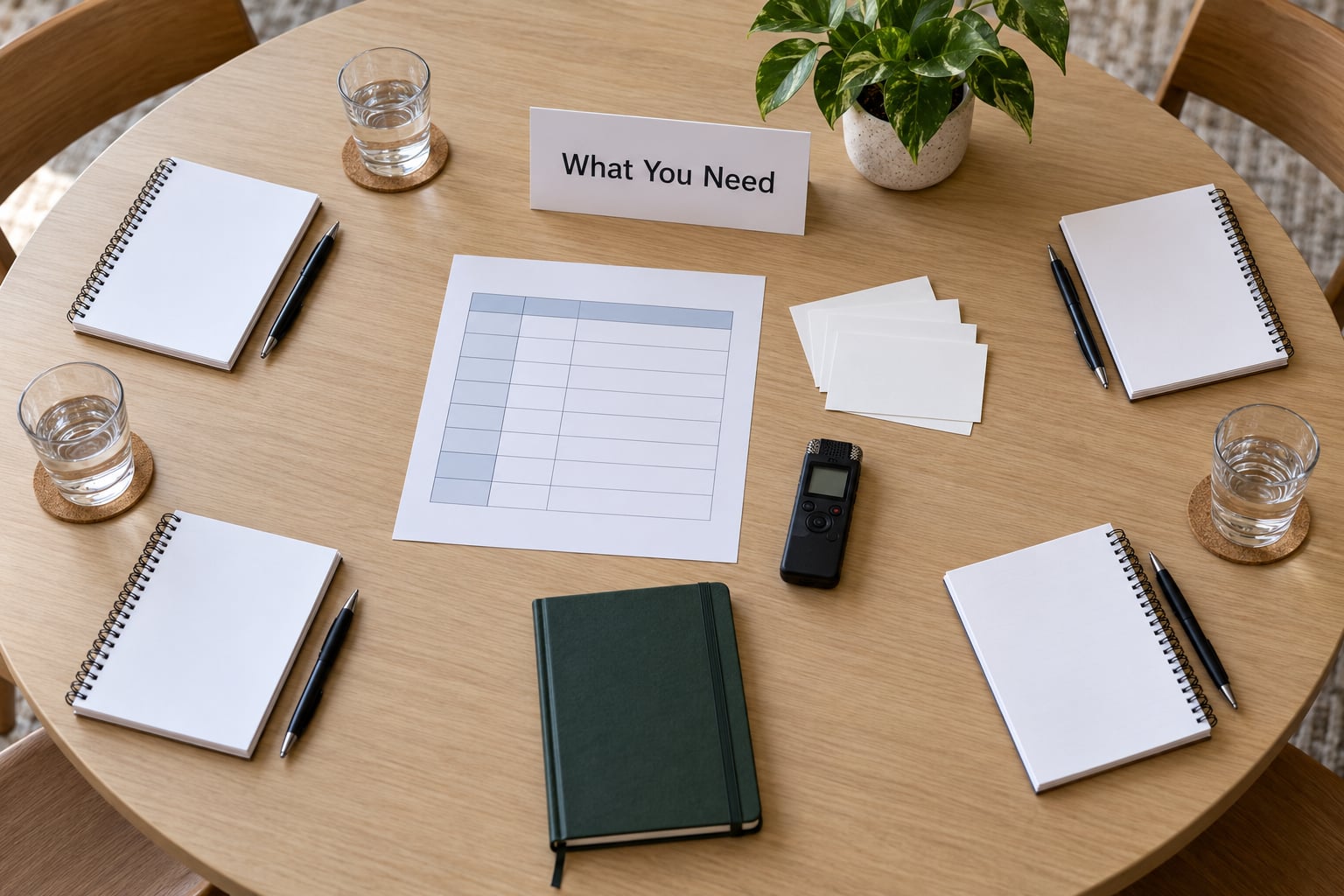
Neutrality is easier when the pressure is designed out of the session in advance. Here is the kit I would want on the table before the first participant walks in.
What are the 6 qualities of a good moderator?
- Structure. You can run a session on a timing grid and still follow a thread when something better turns up.
- Curiosity. You want the answer that contradicts you more than the answer that confirms you.
- Discipline. You leave your opinion in your pocket, including when a participant says something you disagree with.
- Patience. You let a pause run long enough for someone to change their mind.
- Attentive listening. You hear what was actually said rather than the version that fits your hypothesis.
- Consistency. You treat every participant the same way all session, not the two or three who are easiest to talk to.
A moderator guide built around behaviour
Write questions that ask for the last time something happened, not for a verdict on how it went. Split the guide into must-cover blocks and optional blocks so that a lively tangent does not cost you the objective you were hired for.
A screener, consent plan and recording setup
Bias often enters before you speak. A screener that recruits only people who already like the idea, a consent script that rambles, or a recording that failed halfway through leaves you with data you cannot defend. Confirm the recording, confirm consent language, and be honest about the limits of confidentiality. Participants assume other participants disappear once incentives are paid; when they realise their words are attributed, the honesty that follows is not the honesty you wanted.
Prompt cards and a probe bank
Print your question set and the neutral follow-ups for each one on separate cards. If you are improvising from memory under time pressure, you will drift toward whatever wording is easiest, and the easiest wording is rarely the most neutral.
A way to log your own influence
Keep a separate note beside your field notes. Every time you notice yourself reacting, prompting, translating silence into meaning, or leaning toward one side, write the timestamp and a three-word description of what you did. It takes about four seconds and it becomes the raw material for the post-session audit.
A pre-session self-check routine
Read the whole guide aloud to yourself at natural speed. Anything that makes you feel a preference is a loaded question. Then run a timed dry run with a colleague, and mark every question where you wanted to add an example of your own. Those marks are your highest-risk moments.
How to Moderate a Focus Group Without Steering It: Step-by-Step
Bias enters a group through four channels. Verbal is the obvious one, but non-verbal, structural and procedural do most of the quiet damage, and the four are easy to confuse with each other when you are running on no sleep.
| Channel | How it shows up in a live session | Counter-move |
|---|---|---|
| Verbal | Loaded wording, double-barrelled questions, a probe that offers the answer, evaluative prompts early | Ask what happened and when, not whether it was good. Keep loaded verbs like easy, annoying or obvious out of your mouth. |
| Non-verbal | Nodding, smiling, eyebrow raises, saying exactly, interesting or uh-huh, mirroring one participant | Neutral face, neutral sounds. Save reactions for the debrief, not the session. |
| Structural | Guide order, stimulus position, who you address first, group composition, session length | Randomise stimulus order, rotate who you call on, and design the group before the screener fills it. |
| Procedural | Paraphrasing selectively, summarising, translating silence, correcting a participant, rescuing a struggling one | Reflect without editorialising, count to five before filling a gap, and let the struggle stand as the finding. |
How to moderate a focus group without steering it in the opening
Your first two minutes set the norm more firmly than any rule you state later. Welcome people, confirm recording consent, and say plainly that there are no right answers in the room and that disagreement with each other is useful rather than awkward.
Say it in neutral language: There are no right answers here, and I am not here to sell you anything. If you disagree with each other, that is exactly the part I want to hear. Do not say I am interested in whether the new packaging appeals to you, because the word appeals is doing the steering for you.
Set the limits on confidentiality in one sentence and move on. Spending ninety seconds on a confidentiality caveat signals that the topic is sensitive, which changes how people speak before the first question lands.
Use open questions before evaluative prompts
Open with how, what or why about a concrete recent instance. Evaluative prompts such as How much do you like this? come after participants have described their own behaviour, never before.
| Leading version | Neutral rewrite | What the bias did |
|---|---|---|
| How much do you like the new pricing? | Tell me about the last time you looked at pricing for a similar product | Presupposes the pricing change exists and frames liking as the response |
| Was the onboarding confusing? | What happened the first time you used it? | Suggests confusion before any evidence for it |
| Would you recommend this to a friend? | What, if anything, would you say to someone considering this? | Assumes a recommendation is on the table |
| How important is speed to you? | Tell me about the last time speed mattered. | Implies importance the participant may not have felt |
| Why did the website fail you? | What were you trying to do when that happened? | Attributes failure and blames the thing under study |
| You found that difficult, right? | What was that like? | Requests agreement and tags the answer as difficult |
| Which of these two concepts do you prefer? | What is different about these two? | Forces a comparison before either is understood |
| Do you agree that the trial is too complicated? | What is your experience with the trial? | Double-barrelled and invites consensus on a claim |
Read that table left to right once before every session. Most of the bias in a transcript comes from a handful of phrasings that felt efficient when you wrote them.
Ask one participant at a time without implying who matters
Working around the table beats calling on people by name, because named calls sort participants into those who answer immediately and those who get overlooked. Leave a short pause after each answer, then open the floor: Who has had a different experience of that?
The phrase what did the rest of you think? is not neutral. It hands the floor to agreement, because the first person who answers sets the range and the rest are reacting rather than thinking. If someone agrees with what has been said, ask why rather than moving on. What makes that the right read for you? gets you the reasoning instead of the chorus.
Use neutral probes and balanced follow-ups
Keep a probe bank of three types and rotate between them so no answer gets the same treatment twice.
- Clarifying probes pull the detail back out without evaluating it: Can you say more about that? What happened next? What did you mean by that?
- Comparison probes open a contrast: Is that different from how you handled it last time? What would the opposite view say? Who would disagree with that?
- Experience probes push past the summary into the lived moment: What were you feeling at that point? What was going through your mind?
Balanced follow-ups matter as much as neutral ones. If a participant says the product is excellent, ask what would have to be true for them to describe their last experience differently. If someone criticises it, ask what part of the experience made them critical. Pursuing both directions is what stops you collecting agreeing data, and it is the single biggest difference between a productive moderator and a polite one.
Handle silence, disagreement, and dominant voices
Count to five before you fill a gap. Most answers arrive between three and seven seconds, and a moderator who speaks at two has taken the thought away from the participant who was about to have it.
For contradiction, treat the two accounts as data rather than a problem: I am hearing two different experiences of that. I would like to keep both of them on the table. Then ask each person what would have to be true for the other account to hold.
For heated debate, slow the room down and name the pattern instead of taking a side: I do not think we have to settle this. I would like each of you to say what the other side gets wrong about it. For a participant who is taking most of the airtime, aim the redirect at the group rather than the person. I want to hear from people who have used a different approach. It is less pointed than naming someone, and naming someone works only when the person is not the sponsor’s colleague.
For quiet participants, do not invite them twice. Asking someone who has stayed silent and then forgetting them is worse than never asking, because the group now reads silence as consent. Better to lower the formality of the whole room, invite written input, or move to something everyone has an opinion about.
Check your influence before, during, and after the session
Self-monitoring is the least glamorous part of the craft and the one that most changes your data. The routine that works for me has four parts.
- Before: mark every word in the guide that carries a preference. Rewriting them once is cheaper than noticing them live.
- During: keep a running note of your reactions. Anything you would not say if a journalist were recording belongs in that note.
- At the point of rescue: when a participant flounders, resist the urge to rephrase for them. The floundering is the finding, and a rewritten question gives you an answer they did not give.
- After: audit the transcript against the six most common moderator artefacts below.
The transcript audit is the part people skip. Read your own words with the participants’ words removed and ask whether the discussion is still legible. Then check for the artefacts: your paraphrase that carried a value judgement, your probe that arrived a full second before someone else spoke, your summary that consolidated three positions into one, your long silence right after your least favourite answer.
Close without leading the final synthesis
Summarise neutrally and without ranking. What I heard today is that some people preferred the earlier version, some the later one, and the reasons split along setup and habit rather than preference. Do not tell participants what the research found, and do not hint at the hypothesis you were testing.
Then ask the closing question that gives quiet people the last word: Is there anything you did not get to say, or anything we talked about that you would put differently? Handle procedural questions about time and payment separately from anything about content, then stop.
Common Mistakes
Each of these is a steering move wearing a helpful costume, and each has a specific fix.
Asking questions that contain their own answer
How frustrating was the last step? tells the group what kind of answer fits. Ask what happened at the last step instead and let the frustration arrive on its own if it is there.
Confirming the answer you wanted
Exactly, right? is a request for agreement and gets agreement. Replace it with a neutral continuation, what happened after that?, which keeps the person talking without scoring the answer.
Paraphrasing with a lean
Reflect back the substance and drop your evaluation: not so basically the process was painful but so the process took three attempts and you were still not finished. The first version turns one participant’s experience into the group’s consensus.
Interpreting in the moment
When someone says a thing was fine and their tone says otherwise, do not narrate the tone back to the room. You said fine, but you sounded like it cost you something. Can you tell me about that? Acknowledges what you noticed and hands the interpretation back to the speaker.
Rescuing a struggling participant
The instinct to rephrase is the one that costs the most data. If a participant cannot find the words, wait. If they still cannot after a full ten seconds, offer support rather than content: Would it help if I read the question again, or would you rather to come back to it later?
Using silence as pressure
Pausing is a technique and it works. Holding a three-second stare aimed at someone until they answer is not the same thing, because it applies social pressure to a specific individual in front of their peers. Keep your gaze moving, keep your face neutral, and count in your head instead.
Letting the sponsor in the room shape you
When a stakeholder is watching from the back room or sitting in with the group, both moderator and participants perform for them. Practical habits help: decide your must-cover list before you walk in so you are not visibly steering toward the items the sponsor cares about, keep eye contact with the participants rather than the observer, and after the session document the moments where you noticed yourself steering toward a watched interest.
One last habit. Keep the field note of your own influence next to your notes about the participants, and review both together. A moderator who can list the three moments they most likely shaped the group is far more useful to the research team than one who insists they were neutral throughout, because they know where the findings are soft.
Frequently Asked Questions
How do I stop myself from accidentally leading a focus group?
Steering usually happens through small reactions rather than big opinions. The fix is a routine: review the guide for loaded wording before the session, keep a running note of your own reactions during it, and hold reactions until the debrief. If you notice you would not say something in front of a journalist, it belongs in the neutral version. Practising on colleagues first also helps, because the wording habits show up there too.
What is a neutral follow-up question in a focus group?
A neutral follow-up asks for more detail without scoring what was just said. Can you say more about that, what happened next, and what did you mean by that are all neutral. Exactly, right or so that was frustrating are not, because they request agreement and attach a judgement. The test is whether the question could be asked after any answer, not only after the one that suits you.
How do I probe without putting words in a participant’s mouth?
Use a probe bank instead of a reaction. Clarifying probes pull out detail, comparison probes open a contrast, and experience probes ask about the lived moment. Keep a list and rotate, so the same follow-up does not follow every answer. Crucially, do not offer examples or a menu of reactions, because a list of options is a suggestion in disguise.
How should a moderator handle a dominant participant?
Redirect toward the group rather than the person: I want to hear from people who took a different approach. It achieves the same result without singling anyone out or embarrassing them. Track airtime rather than impression, open the floor after each answer with a short pause, and avoid calling on the same names in rotation, which quietly rewards volume.
What can a moderator do after asking a leading question?
Name it, neutralise it and move on rather than backtracking visibly. Say something like: I phrased that badly. I am asking about the process itself rather than whether it felt smooth. Then return to the open version and let the participant answer. Long apologies make the group over-read the question, so keep the correction short and businesslike.
Does neutral moderation mean the moderator should never interpret?
No. Neutrality is about not imposing your interpretation on participants, not about having none. Interpretation belongs in your field notes and in the analysis, after the session ends. In the room, your job is to get the participant’s account, clarify what you did not follow, and leave the meaning to them. The moment you tell a group what something means, the group tends to agree with you.
Conclusion
Start with the guide, not the room. Read it aloud at natural speed, mark every word that carries a preference, and write the neutral alternative next to each one so you are not composing it under time pressure. Then print your probe bank, keep a separate note for your own reactions, and build the debrief into the same hour as the session.
Strong moderation is not silent moderation. It is a structure that keeps the discussion focused and the airtime honest while leaving the participants’ meaning intact, which is the whole point of running the group in 2026 rather than for a client who already knows the answer.