
A screening question, or screener question, asks about a specific, observable behavior or verifiable fact to decide whether a respondent belongs in your study — and, just as importantly, whether they should be screened out. A good one is written so that reading it does not reveal the qualifying answer.
That last part is where most screeners fail. A veteran panelist who takes twenty studies a week has learned that “Do you work in marketing?” means yes, and that “Do you use project management software?” means yes. Learning how to write screener questions that catch professional respondents is less about adding tricks and more about removing the tells: write in observable behavior, disguise the target, order every question to eliminate cheaply, and back the whole thing with one verification item a fraudster cannot fake on autopilot.
Five screener question types do most of the work:
- Behavioral frequency — “In the last 30 days, how many times have you set up a new project in your team tool?”
- Role in the last decision — “When your team last chose a vendor for this, whose signature was on the contract?”
- Knowledge check — a category-specific detail only a real user would hold.
- Category usage verification — what you own, what version, which plan, since when.
- Open-ended verification — one short free-text box asking for something specific, with no lookup possible.
Updated for October 2026. No product recommendations here — this is a method guide, and every control below is free to build in any survey tool.
Table of Contents
- What You Need
- Step-by-Step: Build a Reliable Screener
- Define who should qualify
- Identify how professional respondents behave
- Write eligibility questions before opinion questions
- Ask for specific, verifiable details
- Add consistency and attention checks carefully
- Pilot, review, and set exclusion rules
- Common Mistakes
- Frequently Asked Questions
- How do you screen out professional respondents?
- How long should a screener be?
- Are attention checks and trap questions good in surveys?
- How do you verify someone is a real customer or genuine user?
- What disqualifies a respondent automatically?
- How do I test a screener before fielding it?
- Conclusion
What You Need
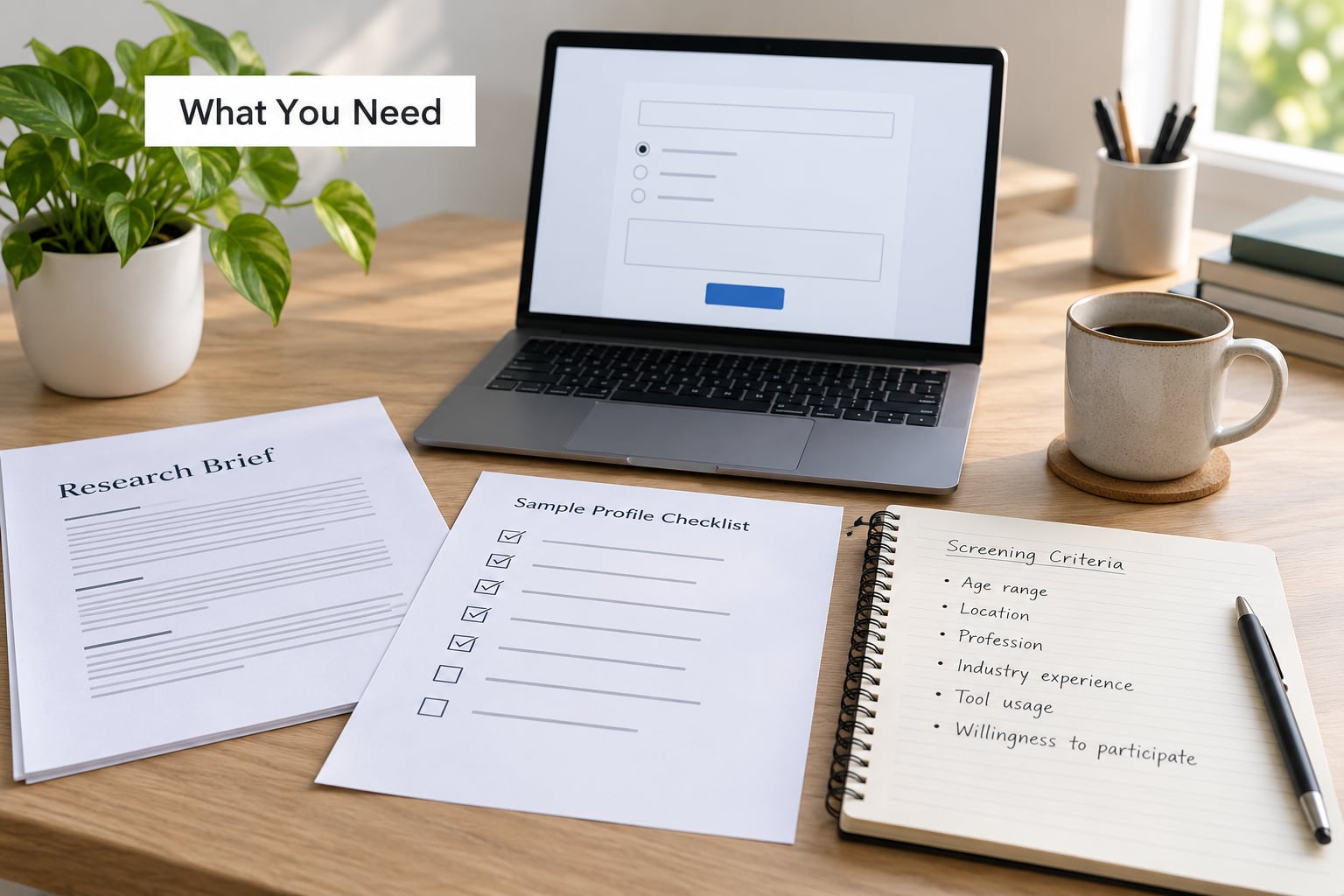
You need six things before you write a word of the screener, and most screeners fail because one or two of them were skipped.
The research objective, in one sentence. If you cannot say what decision the study informs, you cannot say who qualifies, and the screener becomes a demographic form.
The target participant profile — the firmographic or behavioral attributes a real qualifying respondent must have. “Marketing managers at companies of 200 to 1,000 employees” is a start. “Someone who personally ran a product launch in the last six months and can name the tool their team used” is closer to screenable.
Your disqualification risks. Write down who could lie their way in: a competitor’s employee, a respondent from a client you are researching, a recruiter filling their own panel, someone who has already given you an answer in a tracker. Each one becomes a specific screen, not a general worry.
Sample size and the incidence you expect. If your audience is 5% of the general panel, that arithmetic decides your screener length and your budget. Estimate incidence, then add over-recruitment, because low-incidence screeners lose completed responses to fraud checks and to plain dropout.
A screening budget. Every question you ask is paid for, including the questions asked of respondents you will later throw away. Know your per-response cost before you decide how long the screener can be.
Verification evidence. Decide now what proof of qualification looks like for this study: a receipt, a photo of the product, a SKU, a follow-up call, or a second screener at the interview stage. If you have no plan for verification, your screener is only a filter, not a check.
Step-by-Step: Build a Reliable Screener
Building a screener that catches professional respondents takes six moves: define who qualifies, learn the fraudster’s tells, order the questions by elimination power, ask for verifiable specifics, add checks you can defend, and test before you field. Here is each one.
Define who should qualify
A criterion belongs in a screener only if it passes three tests: it is observable rather than internal, it can be answered accurately, and it will still be true next week.
“Interested in the category” fails the first test, because interest is an internal state that only the respondent can report and anyone can claim. “Used a budgeting app in the last 90 days” passes all three.
“Works in technology” is answerable but leans on self-reported identity, which is the easiest field on earth to fake. Replace it with something a title alone cannot satisfy: what your team shipped in the last quarter, which system you own, what approval you had to get.
Be ruthless about the second test too. If a genuine respondent would have to guess, your screen will reject the people you want and accept anyone who guesses confidently. Professional respondents guess confidently. That is the whole problem.
Identify how professional respondents behave
Professional respondents leak in specific, learnable patterns, and every one of them can be turned into a screener feature.
Yes to everything. This is the classic tell. Take each eligibility criterion and ask yourself the question the Global Data Quality Initiative working group put in print: can I fake my way into this by answering yes to everything? If yes, your screen is not screening.
Contradictory demographics. A 22-year-old who reports 15 years of experience, or a company size of 5,000 that reports a three-person budget. Screeners rarely compare answers across fields; a scripted respondent passes each gate in isolation.
Impossible experience claims. Someone who says they ran a rebrand for a national retailer last quarter, and four other studies this week, in a field where qualification takes months.
Category jargon gaps. Real users use the vocabulary of the category, including the ugly parts. Fraudsters describe products generically. This is cheap to check and one of the most reliable signals there is.
Speed, in both directions. Practitioners working through the Global Data Quality Initiative guidance note that deviation either way matters: absurdly fast suggests a scripted or farmed response, unusually slow suggests someone looking things up. Both are worth a look.
Answers aimed at the incentive. Responses that describe the reward rather than the experience — “I would definitely participate, I love these studies” — are people negotiating rather than recalling.
Better process knowledge than genuine respondents. Fraudsters often know your process better than occasional participants. Someone who asks when the incentive is released and mentions the disqualification rules unprompted is telling you something.
Write eligibility questions before opinion questions
Order the screener so the questions that eliminate the most people, and cost the least to ask, come first. Every question asked of a respondent who eventually fails is money spent on data you discard.
Hard-to-qualify B2B audiences make this brutal. If you need managers at a particular company size in a particular industry, ask for company size and industry first, because those terminate roughly three quarters of the pool at the cheapest possible point.
Move soft preference questions to the end, or drop them. “How interested are you in this topic?” eliminates nobody. It just makes the survivors feel vetted.
Put qualification ahead of opinion for a second reason: once a respondent invests two minutes in thoughtful answers, they are committed to the study and unlikely to abandon before the incentive. Reverse the order and you pay for effort you never receive.
Ask for specific, verifiable details
Every weak screener question can be repaired by pushing the respondent toward a detail that is either right or wrong, rather than toward an opinion that anyone can share. This is where the real craft sits.
| Question type | Weak version | Why it leaks | Rewritten version |
|---|---|---|---|
| Role screen | Do you work in IT? | Yes answers everyone | Are you the person who gets called when the file server stops, or do you call that person? |
| Experience screen | Are you an experienced user? | Unfalsifiable claim | Thinking of your last difficult session with the tool, what went wrong and what did you do? |
| Recency screen | Have you used a budgeting app recently? | Teaches the answer | In the last 90 days, which of these did you open at least once? |
| Decision role | Are you a decision maker? | Self-promotion | Whose name was on the paperwork when this was last bought? |
| Category knowledge | Do you know about project tools? | Broad and vague | Which tool does your team use for dependencies, and which one has the worst search? |
| Usage verification | Do you use the product? | Pure yes-gate | What is the last thing you changed in your account settings, and why? |
Notice the pattern in the rewritten column. Each one asks for a name, a number, a reason, or a specific artifact, and each one can be wrong. That is the whole game.
Put the disqualifying options in the list rather than in a separate question. “Which of the following have you never used?” is far better than “Do you use our competitors?” because the second question hands the respondent the exclusion criteria, and the first one requires them to contradict themselves to pass.
Add consistency and attention checks carefully
Consistency checks ask about the same fact twice, separated by enough distance that a scripted respondent forgets. Attention checks sit in the main survey rather than the screener. Both work, and both cost you good people if you deploy them carelessly.
Here is the honest ledger on the main anti-fraud controls, including who they wrongly remove.
| Control | What it catches | Who it wrongly removes | How to soften it |
|---|---|---|---|
| Attention check | Pattern-based bots, straight-liners | Older respondents, second-language readers, anyone on a phone with a small screen | One check only, early, plain wording, never as a hard gate |
| Trap question | Box-checkers who never read | Careful honest readers who click too fast once | Use only where failure is unambiguous |
| Fictitious brand red herring | Respondents who claim to use a product that does not exist | Almost nobody, if worded correctly | Keep it in the screener, never in a tracked measure |
| Open-ended verification | Nearly every scripted response | Shy respondents, anyone writing on a phone | Make it specific, allow one sentence, never require an essay |
| Proof of qualification | Impostors with no access to the product | Gift buyers, account sharers, people who just cancelled | Ask for a photo within ten minutes of recruiting, not at screening |
| Response-time threshold | Straight-lining and bots | Respondents on mobile data, or with a screen reader | Flag for review rather than auto-reject |
Read the third column carefully. Trap questions punish slow, older and non-native respondents, and those groups are frequently exactly the perspective a study was trying to reach. An anti-fraud control that removes your only Spanish-speaking participant has not improved your data, it has narrowed it without telling you.
Layer controls instead of stacking one. Obfuscated format plus a knowledge check plus an open-ended verification item catches far more than any single mechanism, and each one fails on a different person, so the false positives spread out instead of piling on the same group.
Add one modern signal of your own. A fluent, perfectly structured, instantly typed answer is now suspicious, because writing assistants produce exactly that shape. If an open-ended screener response arrives in under a few seconds and reads like a brochure, check it against the category jargon test before you accept it.
Pilot, review, and set exclusion rules
Test the screener before it costs you a single completed response. Two runs matter more than any others.
The known-case run. Walk it with two or three people who genuinely qualify and two or three who do not. If an ineligible person qualifies by answering honestly, your logic has a hole. If a qualifying person is confused, your wording has a hole.
The adversarial run. Hand the screener to a colleague who has not seen it and ask them to qualify however they like, then write down which question gave it away. If they can pass in under three minutes without any real knowledge, a professional respondent can too. This ten-minute exercise catches more leakage than an hour of re-reading.
Then write the exclusion rules down before you launch, not after you look at the data. Rules written in advance get applied consistently; rules written afterwards get bent around the responses you were hoping for.
Two more things before launch. Ask your recruiting partner for unique invitation links, VPN and proxy blocking, and a rescreen at the interview stage, because a recruiter paid per completed recruitment has little reason to run deep verification. And if this is a tracker, never edit a screener without a parallel run — changing the qualification logic silently changes the population while every other number keeps looking comparable.
Common Mistakes
Leading questions that name the target. “Are you a marketing professional?” teaches the answer in the first four words. Disguise the criterion inside a list of plausible options with no visual emphasis.
Screener bloat. Every added question is asked of everyone, including the respondents you discard. Cut anything that does not change eligibility.
Vague expertise tests. “Are you an expert?” cannot be answered wrongly. Ask for the specific thing they did, when, and with what.
Unfair exclusions. Screening out everyone who does not own the product removes your prospects and your lapsed customers, who often have the sharpest memories. Decide per study whether lapsed users count.
Duplicated checks. Three attention checks in one survey reads as surveillance. One is enough.
Trap-question abuse. A trap a careless but honest reader can hit is a coin toss, and a respondent who spots a trap changes every later answer. Use them only where failure is unambiguous.
Treating fluency as truth. Perfectly worded, instantly delivered open-ended answers are a fraud signal now, not a quality signal.
Cleaning data before the rules exist. Deciding which responses look bad while you are looking at them is how good respondents disappear and nobody can tell why.
Over-filtering without tracking it. Log your exclusion reasons and counts by question. If one screen is removing a third of genuine applicants, that is a wording problem, not a fraud problem.
Frequently Asked Questions
How do you screen out professional respondents?
Layer your controls rather than relying on one. Disguise the target so the screener never names the qualifying category, add a knowledge question that only a real user could answer, require one specific open-ended detail, and flag response-time outliers for human review. Run each control against your own genuine applicants before fielding, because every mechanism that catches fraudsters also removes some honest people.
How long should a screener be?
As short as your disqualification logic allows, and no longer. Every question asked of a respondent who eventually fails is paid for and discarded, so length multiplies your cost per qualified response directly. Most B2B and specialist screeners need four to eight questions; anything past ten usually means preference questions have crept in, and those eliminate nobody.
Are attention checks and trap questions good in surveys?
Attention checks are useful in moderation; trap questions usually are not. A trap that a careful, honest, fast-clicking reader could fail turns screening into a coin toss, and a respondent who spots a trap tends to change every answer that follows. Keep attention checks plain, place one early, treat failure as a flag for review rather than an automatic rejection, and never use traps where a wrong answer is genuinely plausible.
How do you verify someone is a real customer or genuine user?
Ask for something only a real user could supply: a receipt, a photo of the product, an SKU or model number, or a specific setting they changed and why. Request it within ten minutes of recruiting, while the real experience is fresh, and rescreen briefly at the start of any interview. For specialist audiences, add a short call with follow-up questions they have no time to look up.
What disqualifies a respondent automatically?
Write your exclusion list before launch. Typical automatic disqualifiers: contradictory profile answers, implausible experience for their age or role, claiming use of a product that does not exist, failing the open-ended verification item, being a competitor or client employee, and bot signatures such as straight-lining or attention-check failure combined with a suspicious response time.
How do I test a screener before fielding it?
Run it twice. First, walk two or three genuinely qualifying people and two or three ineligible people through it, watching where they hesitate or fail. Second, hand it to a colleague who has not seen it and ask them to qualify by any means, then note the question that gave it away. If they pass in under three minutes, your professional respondents will too.
Conclusion
Start with one page today: write down your three essential eligibility criteria, phrase each one so a yes-answer cannot be given without a detail behind it, and then test the finished screener with two known-eligible and two known-ineligible cases. Fix the wording where the honest people stumble and where the ineligible people sail through.
Once it passes, write your exclusion rules down before launch so they are applied the same way to everyone. Professional respondents will keep getting faster, but a screener that asks for specifics they cannot look up will outlast them.