
A path to purchase is the full set of questions a buyer works through inside one product category before they commit, plus everything they check afterwards to decide whether they made the right call. Mapping it means writing down where those questions start, what evidence settles them, and which touchpoints actually move the answer.
Most teams already have a funnel report. What they lack is the reasoning between the steps, and that reasoning changes completely depending on the category. To learn how to map a path to purchase for a product category, you scope one decision, rebuild the route buyers really take from evidence, rank the friction, then attach a fix and an owner to each one. A focused version of this map takes a small team two to four weeks; a full multi-segment version is a quarter’s work.
Table of Contents
- What You Need
- Step-by-Step: How to Map a Path to Purchase for a Product Category
- How to Map a Path to Purchase: Set the Category Decision Boundary
- 1. Define the Category and the Decision to Make
- 2. Rebuild the Buyer’s Path from Evidence
- 3. Map Questions, Criteria, and Friction at Every Stage
- 4. Trace Context, Channels, and Key Moments
- 5. Quantify the Decision Impact of Each Step
- 6. Prioritize Friction and Choose the Right Fix
- 7. Validate the Map and Turn It into Actions
- Common Mistakes
- Frequently Asked Questions
- How often should a product category purchase path be remapped?
- Should a purchase path map differ for B2B and B2C categories?
- What research methods are best for finding missing purchase barriers?
- How do you map a purchase journey when customers use several channels?
- What should a team do first after identifying the biggest journey friction?
- Conclusion
What You Need
The quality of a purchase path map depends on the evidence underneath it, not on the template you draw it in. Five inputs carry most of the weight.
A clearly bounded product category. Not “home care” but “laundry detergent” or “refillable kitchen cleaning products”. The boundary decides which evidence counts.
Recent buyer and lost-buyer evidence. Interviews, review text, support transcripts, search queries, and win and loss notes from the last six to twelve months. Old decks invite you to map a path that no longer exists.
Sales and conversion data. Conversion by entry point, search refinement terms, comparison and basket behavior, repeat rates. This is what tells you which stages carry weight and which are decoration.
Substitute and competitor behavior. For many categories, the real decision happens against the do-nothing option or a rival category, not your own assortment.
A team that can connect findings to decisions. Someone has to own the map and act on it, or it becomes a poster that ages on a wall.
Step-by-Step: How to Map a Path to Purchase for a Product Category
Seven steps take you from a category name to a decision map with owners attached. The workflow maps decisions rather than listing channels and pages, because a channel tells you where someone clicked while a decision tells you what they were trying to settle.
By the end you should have four outputs: a visual path with stages and moments, an evidence table attached to each node, a ranked list of friction with the right response for each, and a validation plan that tests your assumptions before you spend money on them.
How to Map a Path to Purchase: Set the Category Decision Boundary
Before any diagram, write the decision in one sentence with a subject and an outcome. “A household decides which kitchen and bathroom cleaner to buy for weekly use and sticks with it.” That sentence rules a lot of arguments out of the room.
Then answer five scoping questions. Who actually buys in this category, as opposed to who uses it? What job or problem are they trying to solve? In what situations does the category come up, including the seasonal and emotional ones? What counts as a substitute, whether a different brand, a different category, or nothing at all? Where does the path start and where does it end?
Take household cleaning. The decision is not “which cleaning product” in general. It is whether to refill bottles of concentrate, switch to a ready-to-spray formula, or keep buying conventional bottles. Each option has a different comparison set, a different trigger, and a different moment of doubt. Undefined, the category swallows every cleaning conversation and the map says nothing.
1. Define the Category and the Decision to Make
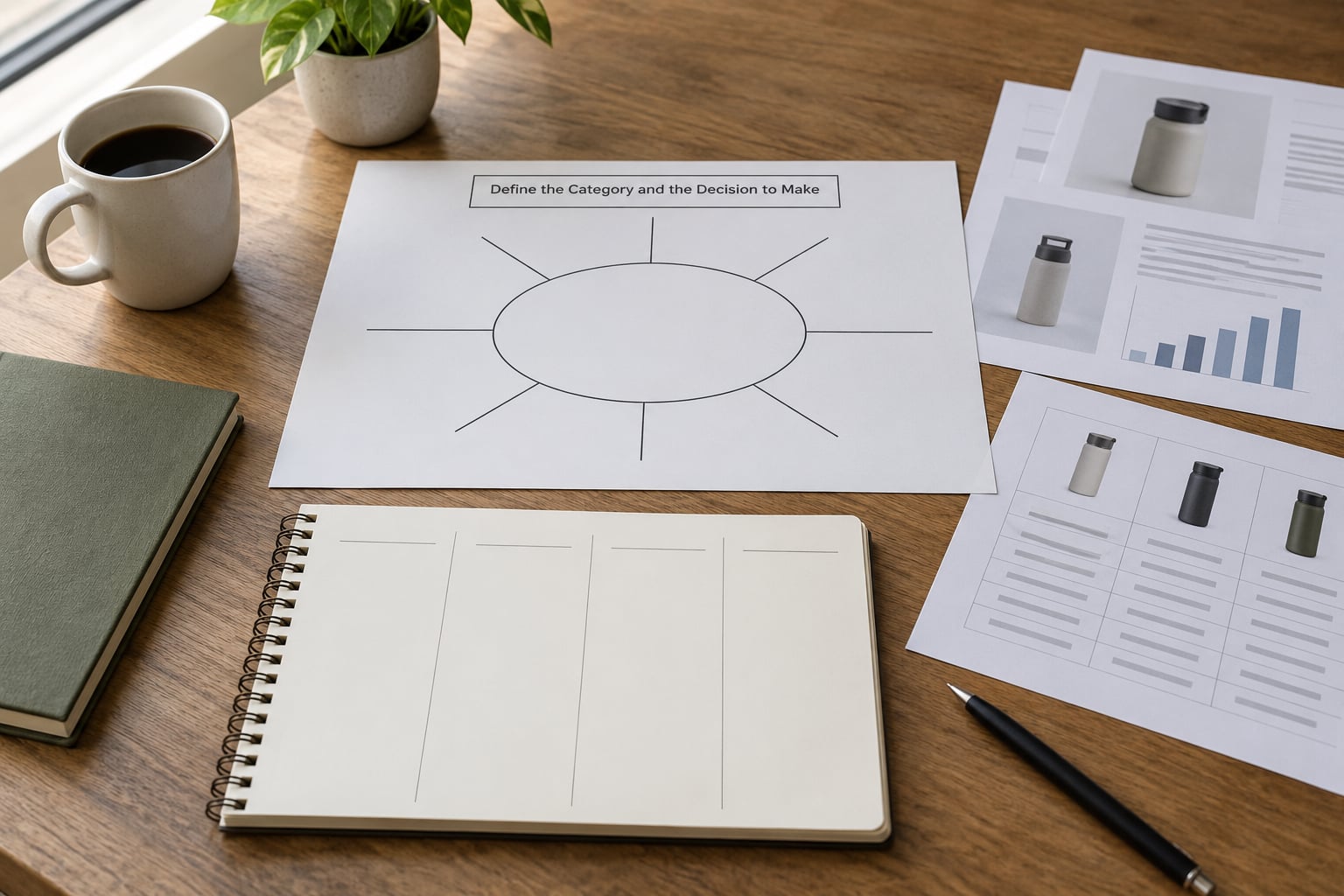
Split the decision into the stages it actually passes through instead of forcing everything into one long sequence. Most category decisions run through five: need recognition, shortlisting, final selection, purchase, and post-purchase learning.
Write what the buyer is trying to accomplish at each one. At recognition they are noticing a problem. At shortlisting they are building a comparison set of two to five options. At selection they are trading off criteria under some level of uncertainty. At purchase they are closing, which can stall on logistics rather than doubt.
That last stage is where many maps stop, and it is a mistake. What happens after the first use changes repeat behavior, review writing, and word of mouth inside the category.
When you know how to map a path to purchase for a product category, this split is the first real decision you make, because every later step attaches to one of these stages.
2. Rebuild the Buyer’s Path from Evidence
Pull behavioral and qualitative material together, because each one catches what the other misses. Analytics shows where people go; interviews show why.
Good sources for a category map include on-site search terms and refinement sequences, review and forum threads where buyers compare options out loud, support and chat logs, sales call notes, lost-deal reasons, and short intercepts at the shelf or on the product page. Practitioners report that the most useful maps come from walking the path as a customer yourself, flagging every step that felt awkward, and then checking those flags against support transcripts.
Sort everything into six buckets per decision step: the trigger that started the search, the information needed at that point, what the buyer is comparing, which criterion settles it, the barrier that stops momentum, and the resolution that unblocks them. A single row of your evidence table will look like: read reviews after a leak, needs proof the formula works on grout, comparing two eco sprays, criterion is scent versus residue, barrier is uncertain about concentrate refills, resolution is a demo.
Two cautions. Do not assume one sequence: plenty of buyers loop, starting at purchase when a second person needs convincing. And do not treat one loud interview as a pattern. Three people describing the same hesitation is a finding; one is an anecdote.
3. Map Questions, Criteria, and Friction at Every Stage
Each stage carries a different question, and criteria shift weight as buyers move along. At recognition the question is whether the problem is real enough to solve now. At shortlisting it is who is even in the running. At selection it is which difference matters most given the constraints.
Write the question at the top of each column, then list the criteria buyers use underneath it. You will usually see criteria gain and lose value: performance dominates the shortlist, while fit, habit, and disposal drop out. When a criterion is dropped, something replaced it, and finding out what is a good use of an afternoon.
Then name the friction. In B2C the barriers are usually informational and convenience-led, wrapped in some trust doubt about unfamiliar brands. In B2B or considered purchase, the barrier set shifts toward financial approval, stakeholder agreement, and switching risk, and a single map built for consumer behavior will miss all of it.
Keep six friction types separate because each needs a different response:
- Informational — the buyer cannot find the answer they need.
- Emotional — doubt about whether this will work for them.
- Social — they need someone else’s experience before committing.
- Financial — the outlay, or the cost of being wrong, feels too large.
- Convenience — effort, availability, or timing stops momentum.
- Trust — they doubt claims, privacy, or after-sales support.
4. Trace Context, Channels, and Key Moments
Now place the purchase path in the situations where it actually happens. Personal decisions at home on a Sunday morning behave nothing like professional ones at a desk on a Tuesday afternoon, and the same buyer moves between both.
Map the environments too. Physical space constrains what can be compared side by side; digital space allows ten options open at once. The same category therefore produces a different purchase path in a store aisle than on a phone screen, and it changes again when the buyer starts in a forum thread or asks an assistant a direct question instead of typing keywords.
Mark the key moments: the point where a recommendation, a demonstration, a trial, or one conversation with a knowledgeable person changes confidence enough to move forward. In consumable categories these moments are small and frequent. In durable or high-ticket ones they are scarce, and each one carries disproportionate weight.
Practitioners increasingly report that buyers start research inside AI assistants and community forums before they reach a retailer, which is a node the classic five-stage model has no slot for. If your map does not include that first touch, it starts in the wrong place.
5. Quantify the Decision Impact of Each Step
Score each step with a measure that suits its job rather than one metric applied everywhere. Entry rates and search refinement terms describe recognition. Comparison behavior and the composition of the shortlist describe consideration. Selection shows up in conversion, basket changes, and switching between options. Purchase stage reveals abandonment, and support contacts after buying expose problems nobody saw coming.
Then draw a line you cannot cross. Analytics show what people did, never why. When you write “price deterred them” on the basis of a bounce rate, that is a hypothesis, and it belongs in the map as an assumption to test rather than a finding.
Where numbers are missing, say so explicitly and mark the confidence low. A gap you have named is a research task; a gap you have filled with an assumption is a plan built on sand.
6. Prioritize Friction and Choose the Right Fix
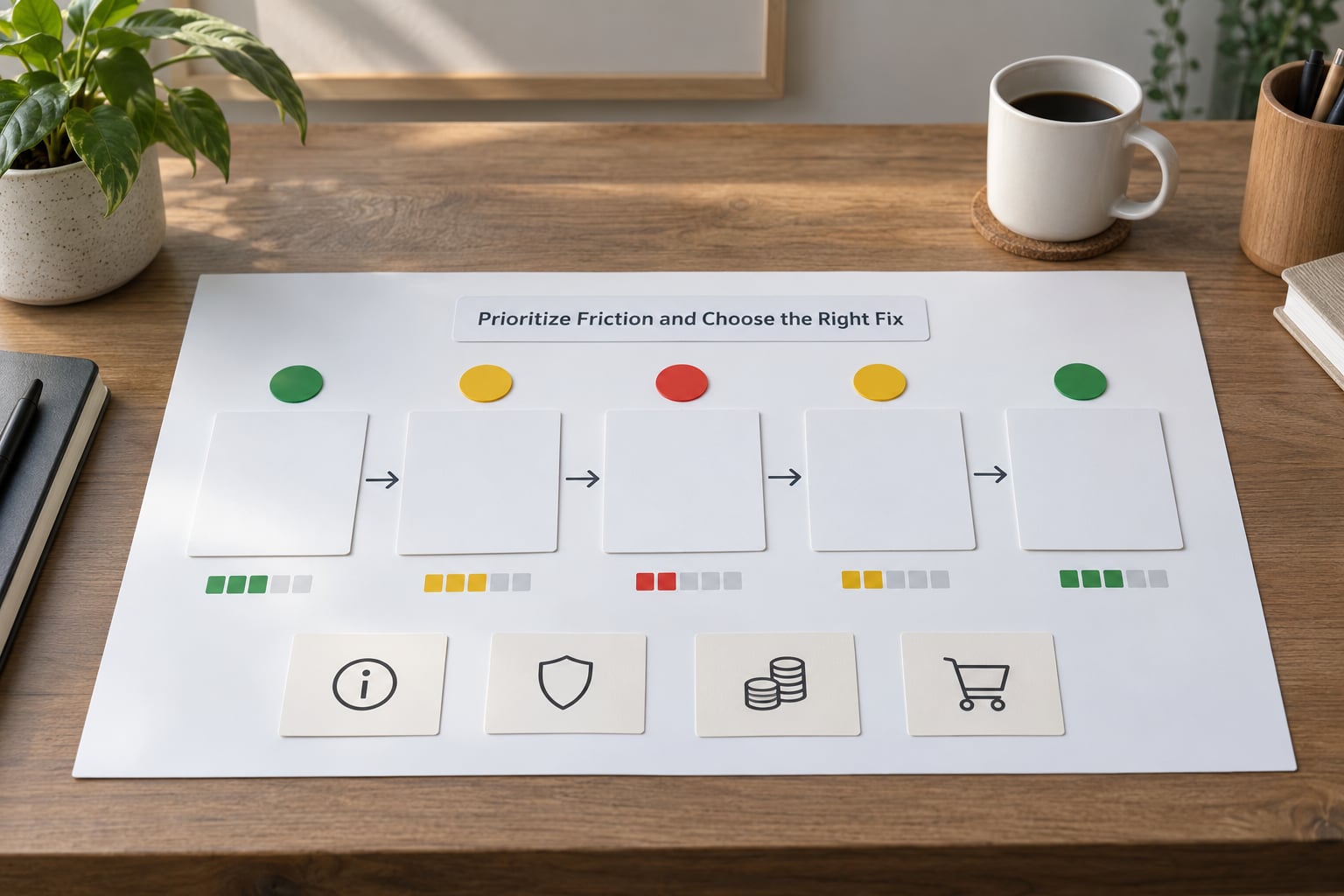
Rank every friction on six factors: severity, how often it appears, which segment it hits, the commercial effect if it stays, how confident you are in the evidence, and how hard it is to change. Severity times frequency times affected audience gives you the size of the prize; confidence and ease tell you what to do first.
Match the response to the barrier type, not to whatever is easiest to ship.
- Information gap — answer it directly with clearer detail, comparison content, or specification.
- Choice overload — narrow the set with a comparison tool, a recommendation, or a shortlist.
- Perceived risk — show a demonstration, a trial, or a clear returns position.
- Trust doubt — supply proof: reviews, third-party testing, transparent claims, human support.
- Operational friction — simplify the step itself, or add a reminder, bundle, or reorder.
Resist the urge to list recommendations before you have named the mechanism behind the friction. Fixes aimed at the wrong barrier feel productive and change nothing.
7. Validate the Map and Turn It into Actions
Test the map with four groups, and do not skip the uncomfortable ones: current buyers, people who bought recently, people who considered the category and walked away, and people in the segment you ignored. Non-buyers show you where momentum dies, and their reasons usually contradict what sales assumed.
Put competing interpretations in front of them rather than defending yours. If two explanations for the same drop-off survive, keep both and design a test that separates them.
Document the evidence behind every node, mark weak links, and revise them rather than quietly keeping them. Then convert what survives into a backlog where each item has an owner, a success measure, and a review date.
Knowing how to map a path to purchase for a product category is only half the work; the second half is keeping the map honest once real buying data starts disagreeing with it.
Common Mistakes
Treating the map as one universal funnel. Real buying loops back. Show loops as arrows that return, and record how often they occur rather than hiding them behind a straight line.
Using channel labels instead of buyer questions. A box that says “email” tells nobody what the buyer needed. Write “can I still return this after the trial ends” and attach the channel underneath.
Confusing weak evidence with low importance. No data on a stage usually means nobody instrumented it. Treat absence as a question to answer, not proof the step does not matter.
Designing for an average buyer. Average behavior is a person nobody is. Segment by need state, which is why two people shopping the same category in the same week may need completely different proof.
Ignoring substitutes and what happens after the purchase. The do-nothing option often wins, and the post-purchase stage decides whether buyers come back or warn others.
Listing recommendations before identifying the friction mechanism. Fixes chosen for convenience rather than cause produce movement that disappears in the next quarter.
Building a map with no owner. Give one person the map, a quarterly refresh slot, and the authority to retire touchpoints that stopped earning their place. Put the evidence log beside it so the next person can see why a line exists.
Frequently Asked Questions
How often should a product category purchase path be remapped?
Refresh the full map when buying behavior shifts materially: a new entrant arrives, a rival changes its offer, a channel expands, or your own conversion drops without an obvious cause. In a stable category, a quarterly check of drop-off points and a full rebuild every year or two is enough. Keep the evidence log current in between, since most maps fail from stale inputs rather than a wrong structure.
Should a purchase path map differ for B2B and B2C categories?
Yes, and combining them produces a map that fits neither. B2C buying is usually shorter, more emotional, and decided by one person, with barriers around trust and convenience. B2B decisions involve several stakeholders, longer cycles, formal budgets, and friction around approval and switching risk. Map them separately, then merge only where the evidence genuinely overlaps.
What research methods are best for finding missing purchase barriers?
Interviews and intercepts reveal barriers people do not think to report, while review mining and support transcripts catch friction that already cost you sales. Session recordings and search-term analysis show where people hesitate even when they never complain. Combine at least one behavioral source with one qualitative source, and recruit deliberately for people who dropped out, not only people who bought.
How do you map a purchase journey when customers use several channels?
Map by decision stage rather than by channel, and attach every touchpoint to the question it answers. Buyers move between search, forums, assistants, stores, and messaging, so a single-channel view hides the handoffs where momentum breaks. Track how often shoppers switch mid-decision and where the switch happens, then make sure the handoff points are consistent across every channel involved.
What should a team do first after identifying the biggest journey friction?
Confirm the mechanism before you design anything. Pick up ten recent examples of buyers who stalled at that point, compare their reasons with the ones who moved through, and check whether the stated cause matches what the data shows. Then choose the smallest fix that addresses the confirmed barrier, give it an owner and a measure, and set a review date so the result is visible.
Conclusion
A useful purchase path map does one job: it tracks how the buyer’s questions, the evidence they need, and the barriers they hit change around one category decision. Drawing a funnel with your logo on it is quick and tells you almost nothing.
Start with two actions this week. Write the category decision as one sentence with a subject and an outcome, then collect ten recent buyer accounts and ten recent lost ones and mark where each stalled. Those twenty conversations will tell you more than any template, and they give you the spine of a map you can defend in front of a skeptical room.