
A customer case story persuades when one identifiable customer, with a problem you can name and a result you can measure, becomes the protagonist of the piece. That is the whole method: pick the right customer, make the customer the hero, name the real pain, structure it as situation, solution and results, then back every claim with a number or a verbatim quote.
The teams producing weak case stories usually fail in the same three places. They open with their own company, they describe a problem so generic that any reader nods along, and they close with results that could have been invented. Fix those three things and the piece starts doing persuasive work on its own.
Below is how to write customer case stories that persuade, step by step: the interview question bank I take into customer calls, the script for getting permission to publish, and what to do when a customer refuses to hand over their numbers.
Table of Contents
- What You Need
- Step-by-Step
- How to choose a customer with a persuasive story
- How to frame the customer’s challenge
- How to build a customer story arc
- How to add proof without sounding salesy
- How to write the result and takeaway
- How to adapt the case story for different channels
- Common Mistakes
- Frequently Asked Questions
- How do you write a case study step by step?
- How long should a customer case story be?
- What is the difference between a case study and a testimonial?
- What if the customer will not share metrics?
- Should a case study be gated behind a form?
- What makes a case study persuasive?
- Conclusion
What You Need

Gather these before you write a single sentence. A persuasive case story needs four kinds of evidence: what the customer said, what changed in their numbers, what you actually did, and written permission to tell it publicly.
- One customer interview, recorded or transcribed, ideally with the person who owns the result rather than a gatekeeper.
- Project details: industry, company size, team, timeline, what was tried before, budget range if they will say it.
- Before and after metrics, with the measurement window and source named. A number without a timeframe is a decoration.
- Two or three verbatim quotes, including at least one with a number in it.
- Visual assets: logo, team photo, screenshots of a dashboard or product in use, a chart of the trend line.
- Approval in writing, covering the name, the logo, the quotes and any figures you plan to publish.
Knowing which format you are writing also stops a lot of wasted effort, because the three are not interchangeable.
| Format | What it is | Length | Approval |
|---|---|---|---|
| Testimonial | A short quote, usually with a name, title and logo. No story around it. | 25 to 60 words | One line approval |
| Case study | One customer, one problem, one approach, one measured outcome, told as a narrative. | 700 to 1,400 words | Full written sign-off on name, quotes and figures |
| Use case | A scenario your product fits, with no real customer attached. | 200 to 500 words | None needed |
Candidates rarely come to you. Ask the people closest to the customer for them with these eight questions: which account had the messiest problem before us, which one had the clearest turnaround, which customer says nice things about us unprompted, which deal took longest to close, which one expanded, which one is easy to reach, which industry do we want more of, and which account would be comfortable in print.
An account that took nine months to close and landed anyway is usually a better story than the smooth reference customer, because resistance is what your next buyer is worried about.
Step-by-Step
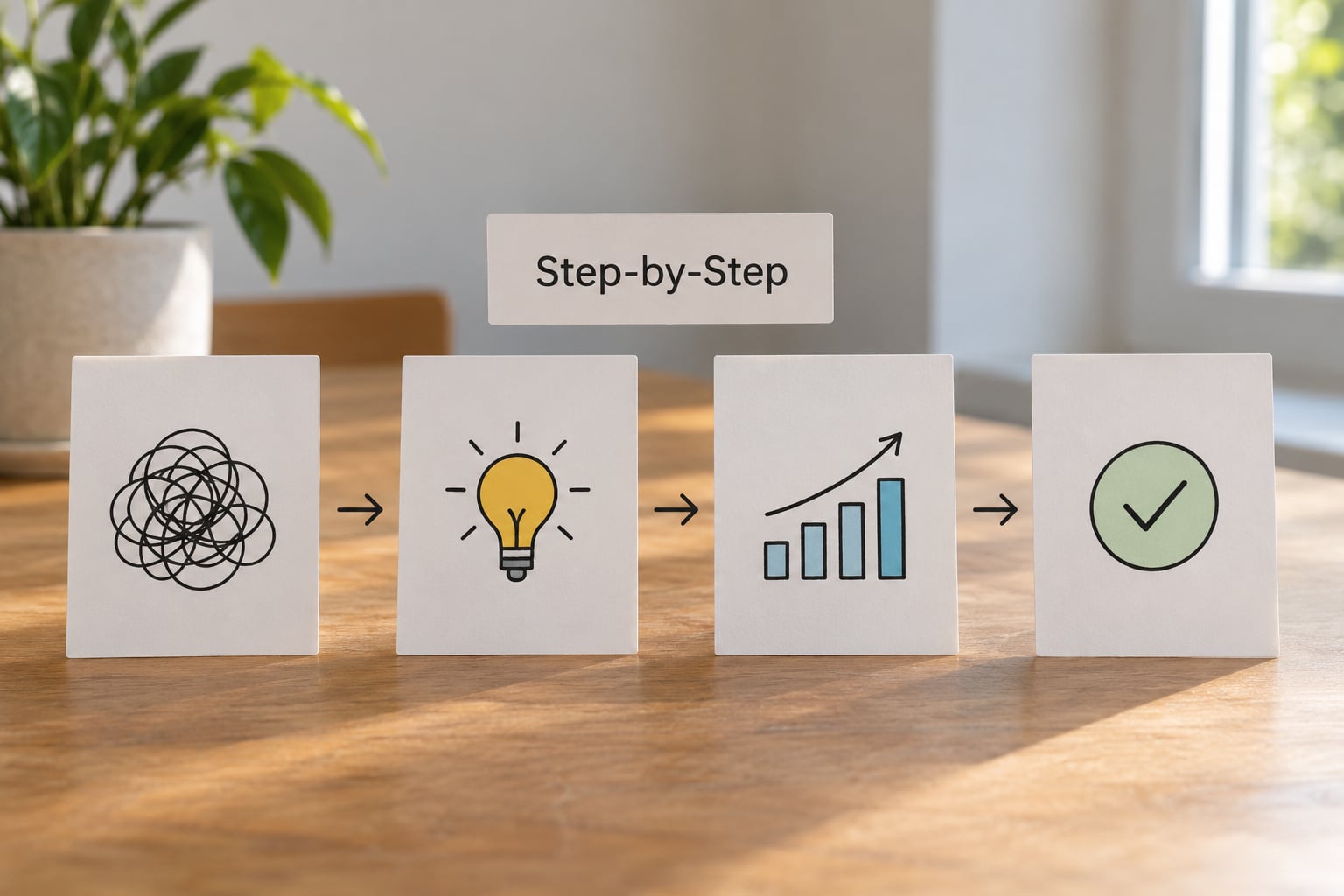
Here is the sequence. Follow it in order and the draft almost writes itself, because the hard thinking happens in the interview rather than at the keyboard.
- Choose a customer with a visible before-and-after change.
- Ask eight sourcing questions of your sales and customer success teams.
- Run a 30-minute interview using the question bank below.
- Name the real pain, with the constraint that made it expensive.
- Draft the arc: situation, challenge, approach, turning point, results, lesson.
- Attach proof to every claim, or cut the claim.
- Write the takeaway and the call to action last.
- Get written approval, then adapt the story to each channel.
How to choose a customer with a persuasive story
Pick the customer whose problem a stranger would recognise instantly. Four tests decide it: a pain point your buyer already feels, a decision with real stakes, a change that can be measured in some direction, and a person willing to be named.
Timing matters as much as fit. Interview inside the first 90 days after a milestone, while the customer is still telling colleagues about the win. At month two the achievement is fresh and the team is generous with detail. At month fourteen you get a polite interview full of half-answers.
Then ask for permission in plain language. Here is the script I use:
“We would like to write up your results as a case study: the problem you were dealing with, what we did, and the numbers you reached. It would include your company name, your logo and two or three quotes from your team, published on our site and used by our sales team. You will see the full draft and can cut anything you want before it goes live. Does that work?”
If they cannot be named, anonymise rather than abandon. Describe the company by industry and size instead: a 400-employee specialty distributor, a regional bank serving 12 branches, a 60-person software team. Anonymity costs you social proof detail but keeps the substance intact.
How to frame the customer’s challenge
The challenge section answers three things: what was happening, why it mattered, and why the usual fixes had not worked. Vague pain reads as filler because the reader cannot picture it. Stakes are what make it real.
Customer pain usually falls into a handful of recognisable shapes: work piling up faster than the team grows, a manual process eating hours nobody can account for, a system that silences problems until they escalate, compliance pressure outpacing the current process, onboarding that takes months, or a number nobody trusts.
Ask the questions below in the call. The first four open the story, the middle four produce detail and tension, and the last four generate quotable lines.
- What changed in the business that made this a priority now?
- What were you doing about it before we arrived?
- What did that attempt cost you, in money, time or people?
- Who else felt the problem day to day?
- What had already been ruled out, and why?
- What was the moment you knew the current approach was finished?
- What were the three requirements your solution had to meet?
- Who needed to sign off, and what were they worried about?
- What was the first measurable change, and how soon?
- What surprised you about how it went?
- What would you tell a peer in the same position?
- What do the numbers look like now compared with before?
- What is still not solved?
- What would you do differently if you started over?
Question six is the one people skip and the one that creates the tension every story needs. Ask what finally broke, and you get a scene instead of a summary.
How to build a customer story arc
Structure the case study in six beats and give each one a job. This is the part where most teams lose the plot, and it is where the discipline behind how to write customer case stories that persuade mostly lives.
- Situation: who they are, size, industry, the system or team involved.
- Challenge: the pain, the stakes, what had already failed.
- Approach: what you did, in plain language, without product jargon.
- Turning point: the moment the change became visible.
- Results: the numbers, the before-and-after, the quote that carries them.
- Lesson: what other buyers in the same position can take from it.
Keep each beat short and give the reader a reason to keep going. Fact-bearing subheadings outperform generic ones: Results: invoice disputes down 38 percent in two quarters tells a reader what they will learn before they read it.
| Section | What goes in it | Target words |
|---|---|---|
| Opening summary | Customer, problem, result in two sentences. Written so it survives being read alone. | 40 to 60 |
| Situation and challenge | Size, industry, constraints, what had been tried and failed. | 180 to 300 |
| Approach | What changed in their week. Two or three concrete changes, not the whole method. | 200 to 300 |
| Results | Metric table or bullets, before and after, with the measurement window named. | 150 to 250 |
| Quotes | Two or three verbatim lines from different roles. | 60 to 100 |
| Takeaway and CTA | One transferable lesson, then a single next step. | 60 to 100 |
Two or three people quoted beats five quotes from the same sponsor. A line from the person who pushed back during the project carries more weight than a line from the person who signed the contract, because it shows the decision was not easy.
How to add proof without sounding salesy
Proof persuades when the reader can check it. Three kinds work: a specific number with its timeframe, a verbatim sentence that sounds like a person rather than a company, and a stated method that explains where the number came from.
Vagueness is what turns evidence into advertising. Compare the two versions below. The left column is the sentence most teams publish.
| Weak version | Persuasive version |
|---|---|
| We helped a leading retailer dramatically improve its inventory accuracy and streamline operations across every location. | A 240-store home goods retailer cut stock discrepancies from 9.1 percent to 3.4 percent in five months, measured on the same weekly cycle count both before and after. |
| After partnering with us, the client saw a significant boost in efficiency and satisfaction across the board. | Support response time fell from 19 hours to 4, and the team handled a 40 percent rise in ticket volume without adding headcount. |
The differences are mechanical. Add the number, name the timeframe, name the customer type, and drop every word that could be true of any company on earth.
When a customer will not share figures, do not retreat to adjectives. Use proxies in this order of strength:
- A directional change with a baseline, such as going from about forty manual entries a week to none.
- A counted event instead of a percentage: number of escalations, approvals or handoffs removed.
- Time returned: hours per week saved on a named task, multiplied only if the customer confirmed it.
- Rank-order evidence: from third-highest complaint category to last in the queue.
- Verbatim description of the change in their own words, presented as a quote rather than a metric.
Say what you did to get the number. A figure described as pulled from the customer’s own quarterly review carries more credibility than the same figure with no source at all.
One quote does most of the work, so choose it deliberately. Look for a line with a concrete detail, a slight hesitation or a mild criticism, and a first-person verb. Those are the marks of something actually said.
How to write the result and takeaway
The results section ties a number to something the reader cares about: cost, time to decision, risk, revenue, staff hours. Then say what is still unresolved. A limitation sentence increases trust because it signals that the rest of the piece is accurate.
The takeaway converts one customer’s story into a rule your reader can apply. It should read as advice, not as a slogan. “Measure cycle count accuracy before you change the counting method, or you will never know whether the change helped” is useful. “The future of retail efficiency starts with data” is not.
Close with one call to action that matches the buyer’s position in the journey. Someone reading a case study is usually comparing options, so send them to a proof step rather than a purchase step: a similar case in their industry, a walkthrough with their scenario, or a short call.
How to adapt the case story for different channels
Reshape the same evidence instead of rewriting it from scratch. The facts stay identical; only the length, the framing and the call to action change.
- Website page: the full arc, 700 to 1,400 words, the summary written so it can be quoted on its own.
- Sales deck: situation, three numbers, one quote. Five slides, no method detail.
- Proposal or RFP response: the challenge mirrors the buyer’s stated problem in their own language, then the results mirror their metric.
- Landing page: one customer, one problem, one outcome, one form. Long stories lose the form.
- Email or newsletter: 90 words opening on the single most surprising number, with a link.
- Social post: the headline number and the customer type, no setup.
- Video: a four-minute interview with one question per beat, cut into 30-second clips.
- Sales enablement one-pager: leave-behind with the arc condensed and the full link attached.
For video, ask one question per beat rather than a running commentary. B-roll of someone doing the work they described is usually more persuasive than the customer talking to camera about results.
Build the video cutdowns from the interview transcript rather than filming again. Most case study footage gets watched once and reused for a year.
Common Mistakes
Almost every weak case study fails in a way that has a specific fix. These are the ones I see most often.
Starting with your company. The first paragraph should contain no mention of your product at all. Fix: delete the opening paragraph’s brand references and start at the customer’s problem instead.
Vague praise. Words like dramatic, sweeping and transformational cannot be checked, so readers discount the whole piece. Fix: replace each adjective with a number, a name and a time window.
Feature-heavy copy. A paragraph of capabilities reads as a brochure and tells the reader nothing about their own situation. Fix: describe what changed in the customer’s week, then let one capability appear as the reason.
Unsupported claims. Improvement stated without a baseline makes the comparison impossible. Fix: capture the before figure, or state clearly that the baseline was measured after go-live and say what it included.
No context. A 40 percent improvement means nothing without knowing the starting point or the size of the operation. Fix: give company size, industry, team and the measurement window in the summary.
Writing without approval. Publishing a quote the customer has not seen is how you lose a reference, and in some industries it is a legal problem. Fix: send the finished draft with a written sign-off request naming the exact figures and quotes included.
One story, one format. A 1,400-word page reused as an email gets deleted. Fix: keep a source document and cut it per channel as described above.
Letting AI write the customer voice. Machine-written case studies read smooth and dead: the specifics thin out, filler phrases appear, and the customer’s own idiom disappears. Use a draft tool for structure, then have a person interview and a person write the voice. The evidence has to come from a conversation either way.
Gating by default. Hiding your best proof behind a form costs you the search traffic and the sharing that a public case study generates. Fix: publish the best stories openly, and gate only the material that bundles several of them for a sales conversation.
Writing once and never updating. A case study with a stale number quietly costs you credibility when a prospect checks it. Fix: put a review date in your calendar and refresh the figures every six to twelve months.
Frequently Asked Questions
How do you write a case study step by step?
Choose a customer with a visible before-and-after change, interview them for 30 minutes with a prepared question bank, name the real pain and its stakes, then draft in six beats: situation, challenge, approach, turning point, results and lesson. Attach a number or a verbatim quote to every claim, write the takeaway and call to action last, get written approval on name, quotes and figures, and only then adapt the story to each channel.
How long should a customer case story be?
Most readable case studies run 700 to 1,400 words on a web page, with a 40 to 60 word summary that works when read alone. Front-loaded pages for cold visitors can be shorter, and PDFs for sales conversations can run longer. Length matters far less than structure: if each section earns its place, readers finish it, and if it does not, no word count saves it.
What is the difference between a case study and a testimonial?
A testimonial is a short quote with a name and title, usually 25 to 60 words, offering opinion without evidence. A case study is a structured account of one customer moving from a specific problem to a measured outcome, roughly 700 to 1,400 words, with context, method, figures and approval. Testimonials build comfort, case studies build belief, and buyers at the comparison stage need the second one.
What if the customer will not share metrics?
Do not fall back on adjectives like significant or dramatic. Use proxies in order of strength: a directional change with a baseline, a counted event such as escalations removed, hours returned on a named task, a rank-order change in complaints, or a verbatim description of the change presented as a quote. Say how you gathered the figure, and keep the customer unnamed if they prefer, using industry and size instead.
Should a case study be gated behind a form?
Publish your strongest customer stories openly, because public proof earns links, shares and search traffic, and gated pages collect fewer reads than teams expect. Gate only bundles that combine several stories plus material a buyer would want in a sales meeting. If you do gate, give a useful preview first: the customer type, the problem and the headline result, so search engines and buyers can judge it.
What makes a case study persuasive?
Three things. The reader identifies with a protagonist who has a problem they recognise, so the story is read as a forecast of their own situation rather than an advertisement. Specific figures are believed more than adjectives, so claims survive scrutiny. And the evidence comes from someone with nothing to gain from praising you, which is why a quote from a sceptical stakeholder outweighs one from the contract signer.
Conclusion
How to write customer case stories that persuade comes down to one customer this week. Ask your sales team the eight sourcing questions, pick the account with the clearest before and after, and send the interview request with a date attached rather than an open invitation.
While you are in that call, ask what finally broke. That one answer supplies the tension the rest of the story hangs on, and it is the hardest thing to invent later at a desk.