Sound influences brand perception because the auditory system delivers audio straight into the brain’s memory and emotion systems, so a sonic cue binds feelings and contexts to a brand faster and more durably than a logo does. That is why a two-second chime can pull someone back to a shop floor they visited once, years ago.
The mechanism is not mysterious, but it is rarely explained well. Most writing on sonic branding is agency copy that promises “connection” without saying which part of the brain does the connecting. This guide walks through the actual psychology, the acoustic properties that shape impressions, the situations where a sound works and where it backfires, and a practical way to choose and test your own.
It is written for brand strategists, brand managers and marketing leads who own an identity system but have never specified an auditory one. You do not need an audio background to follow it.
Table of Contents
- What Is Sonic Branding?
- How Does Sound Influence Brand Perception?
- The Psychology Behind Auditory Branding
- What Sound Qualities Shape Brand Impressions?
- How sound influences brand perception through timbre and tempo
- Brand names are sounds too: phonetic symbolism
- How Do Emotion and Context Change Sound Responses?
- How Can Brands Use Sound Strategically?
- How Do You Test Whether a Brand Sound Works?
- When Can Sound Damage Brand Perception?
- Frequently Asked Questions
- Does sound affect brand perception more than visual identity?
- Are audio logos more effective than musical jingles?
- Why do some brand sounds become memorable while others do not?
- How many times does a listener need to hear a brand sound before recalling it?
- Should a brand use a sound logo, a jingle or a sonic atmosphere?
- How can marketers measure the emotional effect of brand audio?
- Conclusion: What Should a Brand Do First?
What Is Sonic Branding?
Brand perception is the set of associations a person forms about a brand from everything they encounter: the name, the packaging, the colours, the price, the staff, the reviews and now the sounds. Brand identity is what the company intends those associations to be. Sonic branding, also called audio branding, is the deliberate use of sound to shape perception toward that identity.
It is not the same as hiring a musician for a campaign. A campaign track borrows emotion for a fortnight. Sonic branding is a repeatable system, applied the same way a colour or a typeface is applied.
Five components do most of the work in practice:
- Audio logo. A short sound at the front of a film, a podcast intro or a product boot. The Intel chime is the classic case.
- Brand mnemonic. A longer musical idea people can hum: a jingle, a theme tune, a signature instrumental bed.
- Sound palette. The wider family of sonic materials a brand is allowed to use, including instrument choices, texture and mix character.
- Voice. How the brand sounds when it speaks: vocal tone, pace, vocal fry level, whether it reads as a person or an institution.
- Environmental and product sound. Store ambience, interface clicks, a camera shutter, a start-up chime, the sound a package makes when it opens.
The vocabulary varies by industry, which causes endless confusion in pitch meetings. Radio people say audio imaging, television people say a theme tune, agencies say sonic identity, and product teams usually just say notification.
| Term | Where it comes from | What it means |
|---|---|---|
| Sonic branding | Agency and design world | The whole discipline: strategy plus audio assets |
| Audio branding | Marketing and broadcast | Same thing, more common in media buying |
| Sonic identity | Brand strategy | The system and rules, comparable to a brand guideline |
| Audio logo | Broadcast and digital product | The single short sound, usually under five seconds |
| Jingle or theme tune | Radio, television, retail | A musical idea built to be remembered and sung |
How Does Sound Influence Brand Perception?
Sound shapes perception in four steps that happen almost automatically: the auditory system encodes the sound and tags it with meaning, memory and emotion systems bind that meaning to the brand, a familiar cue triggers recall on its own, and the listener then judges the brand using whatever came back up.
Nobody has to decide to think about this. That is the practical difference between a sound and a poster. A poster waits for attention; a sound arrives whether or not the listener is ready.
- Attention is captured before evaluation. Auditory processing is fast and largely automatic, so a sound registers while a listener is still mid-task.
- The sound is tagged with meaning. Pitch, tempo, timbre and accent carry associations that people read as size, energy, warmth or reliability.
- The cue is bound to the brand. Repeated exposure links the sound and the brand in memory, so hearing one brings the other along.
- The cue works alone. After enough pairings, the sound alone triggers brand recall and the feeling attached to it.
Here is how common acoustic properties translate into impressions. Treat it as a starting hypothesis, not a rule, and test it.
| Sound property | Tends to be read as | Typical brand territory |
|---|---|---|
| High pitch | Light, sharp, small, fast, youthful | Beverages, tech, sports, digital services |
| Low pitch | Heavy, solid, calm, authoritative | Automotive, finance, premium goods |
| Fast tempo | Energetic, urgent, exciting | Quick service, gaming, youth categories |
| Slow tempo | Calm, considered, premium | Luxury, wellness, professional services |
| Bright timbre, bell or glass | Clean, precise, modern | Technology, healthcare, fintech |
| Warm timbre, strings or wood | Human, craft, care | Food, family, heritage brands |
| Wide stereo or reverb | Cinematic, spacious, enveloping | Entertainment, travel, telecoms |
| Dry, close, single source | Intimate, direct, honest | Craft brands, independent publishers |
The Psychology Behind Auditory Branding
Five processes decide whether a sound becomes a brand asset or vanishes after two exposures.
Distinctiveness. A sound that resembles something already in memory gets filed under that old thing. The Nielsen-type problem is obvious in podcasting, where creators keep discovering that their intro music is also a skincare ad or another channel’s bumper.
Processing fluency. Fluent stimuli feel safe and pleasant. That is the logic behind simple motifs repeated in a narrow range, with one clear contour rather than a chord stack that changes every time.
Affective conditioning. Feeling and cue pair up through repetition, in the same way a dog associates a sound with a walk. This is ordinary classical conditioning and it explains a lot: pair the motif with a moment people already like, and the motif carries the feeling afterwards.
Associative memory. Sound is tightly bound to time. A tune is a sequence, which maps unusually well onto the sequence of an event: a walk to school, a match going extra time, a shop you visited on holiday.
Multisensory congruence. When a sound fits the visual identity, both are recalled together and the brand linkage gets stronger. When they clash, listeners notice the clash, and the brand reads as confused rather than memorable.
What Sound Qualities Shape Brand Impressions?
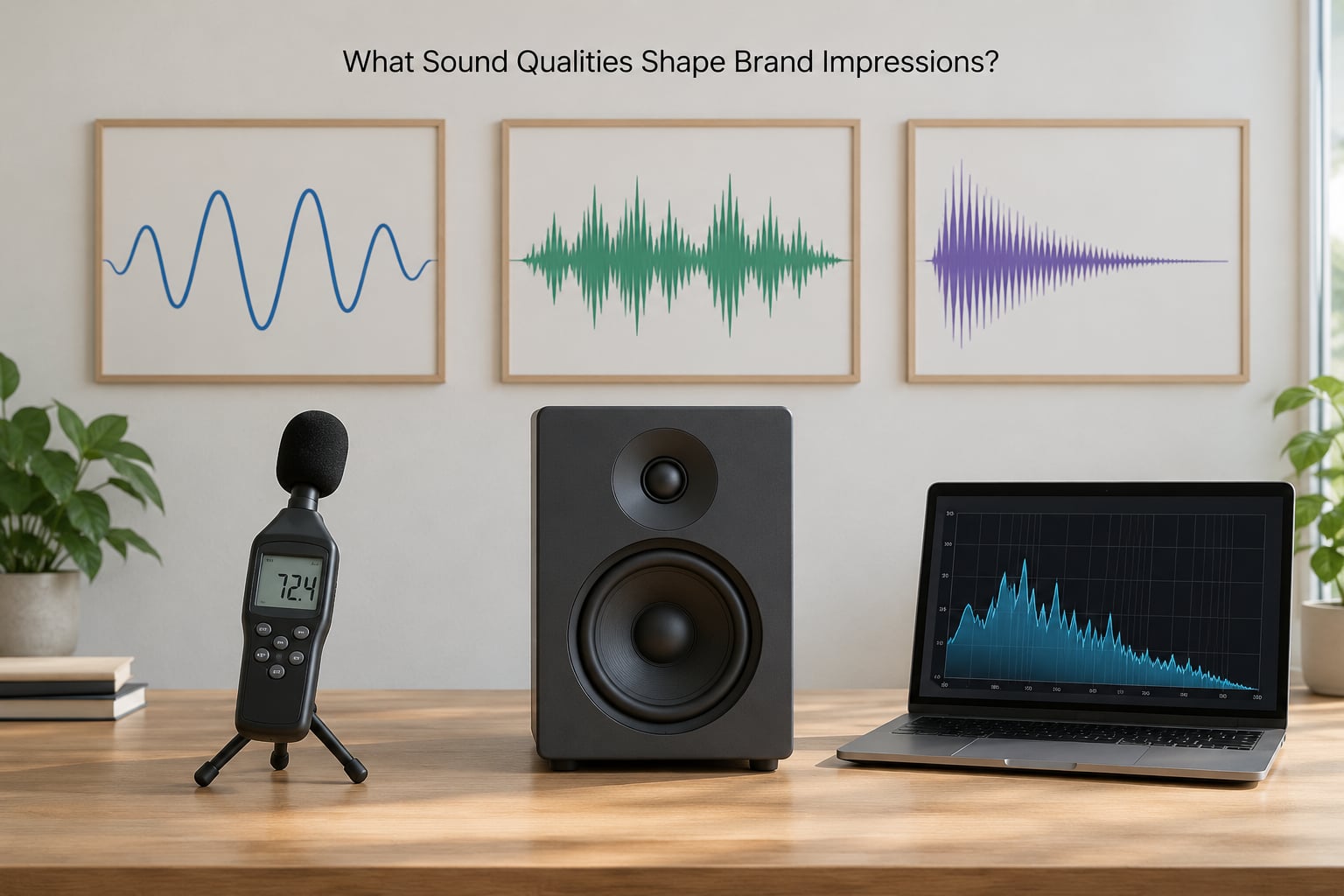
Acoustics give a strategist more dials than most people use. The useful ones are timbre, pitch, rhythm, tempo, dynamics, vocal delivery, spatial qualities and the acoustic space itself.
How sound influences brand perception through timbre and tempo
Timbre is the character of a sound: brass against strings, a marimba against a synth, a human voice against a machine. It is the hardest parameter to describe in words and the one listeners pick up fastest, which is why timbre carries so much of the positioning load.
Tempo sets the implied pace of the brand. A 70 beats-per-minute bed under a checkout flow makes waiting feel normal. The same transaction at 130 beats per minute feels like an operation.
Dynamics, the difference between loud and soft passages, control perceived confidence. Constantly loud audio reads as anxious, because real confidence rarely needs to shout.
Spatial qualities matter more than brand teams expect. A sound with wide stereo or long reverb feels big and cinematic. A dry, close, single-source sound feels like a person talking to you at a table. That is a very large perceived difference for one mixing decision.
Vocal delivery is the sound most people meet first, because a support line, an advert or a store assistant talks before anything plays. Rate of speech, pitch range and vocal placement all read as personality. A clipped, low, unhurried voice reads as authority and possibly as coldness; a bright, quick voice reads as warmth and possibly as low seriousness.
Acoustic context changes everything too. The same five-note motif over a stadium crowd and the same motif in an empty lift are different assets. Decide where your sound will actually live before you design it.
Brand names are sounds too: phonetic symbolism
Vowels carry impressions before a name is even read. Tina Lowrey and L. J. Shrum, in the Journal of Consumer Research in 2007, tested fictitious brand names that differed by a single vowel and found a consistent pattern: names with front vowels such as i and e were judged smaller, sharper and faster, and names with back vowels such as a, o and u were judged larger, rounder and slower.
Preference followed the description. When the fitting described a product as small, fast or crisp, the front-vowel name won by roughly two to one. When the description favoured something large or slow, the back-vowel name won by a similar margin. The worst performer across categories was the sound written as “yoo”, read as a putrid or unpleasant vowel, and it lost regardless of the product.
Two practical rules follow. If the name should signal speed, precision or lightness, lean on front vowels; if it should signal solidity, tradition or calm, lean on back vowels. And test the name aloud, at speed, in a crowded room, on a bad phone connection. Names that work only on paper fail immediately in voice assistants and radio reads.
How Do Emotion and Context Change Sound Responses?
The same four notes produce different reactions in different categories. Funeral music played at a fast tempo and in a bright timbre does not read as celebratory; it reads as wrong. A rising interval signals growth in a fitness app and threat in a security alert. Category conventions set the range of acceptable sound, and stepping outside that range reads as confusion rather than originality.
Situation changes the response too. A soundtrack that works as a two-second audio logo may become irritating after the fortieth notification of the day. Repetition is what builds the association, and repetition is also what wears the cue out, so brands tend to develop a short signature for frequent use and reserve their longer musical material for occasional moments.
Culture and language matter as well. A phonetic joke that lands in one market can be a slur-adjacent sound in another, and a rising or falling intonation pattern carries different emotional meaning across languages. Any brand operating across more than a handful of markets should re-test the sonic assets locally rather than translating a jingle and assuming it survives.
Listener state adds a final variable. Sound is more persuasive when attention is already turned toward the brand, which is why an audio logo at the start of a film works better than one at the end of a long podcast episode.
There is also a genuine cross-modal effect here, documented extensively by Charles Spence at Oxford: high-pitched, fast sounds raise perceived spiciness, and low-pitched, slow sounds reduce it. The 7UP campaign built on this idea for its Spotify “SpiceIt Playlist” paired, which used audio to change how a flavour was experienced rather than describing it. Sound can alter judgement of taste, texture, crispness and even perceived quality of a product you cannot hear.
How Can Brands Use Sound Strategically?
The order of operations matters more than the budget. Brands that commission audio first and define the strategy afterwards end up with a nice asset attached to no attribute.
- Name two or three brand attributes. Pick the words a colleague would use unprompted. Warm, precise, urgent, dependable, playful. You cannot design sound for a word you have not settled on.
- Map each attribute to acoustic choices. Use the parameter table below as a starting point, then check that the choices do not contradict each other. Playful and solemn do not share a sound.
- Decide what the system needs. A one-shot audio logo, a mnemonic, an ambience palette, product sounds and a voice specification are different projects with different costs.
- Build a short list and test it blind. Unbranded, against competitors, with people outside the project. If the only people who can identify it work on the brand, the asset is not doing its job.
- Write it into the brand guideline. The reason most sonic systems decay is that audio was appended at the end of a project and never documented. A system nobody can apply correctly is not a system.
| Brand attribute | Sonic choice | Watch out for |
|---|---|---|
| Warm | Mid pitch, moderate tempo, strings or acoustic instruments, close recording | Warmth read as sentimental if tempo drops too far |
| Energetic | Fast tempo, bright timbre, percussion-forward, rising contour | Exhausting if used at full length repeatedly |
| Sophisticated | Low-to-mid pitch, slow tempo, sparse arrangement, wide space | Reading as cold or unaffordable |
| Playful | Unexpected interval or rhythm, bright timbre, short form | Undercuts seriousness in high-stakes categories |
| Dependable | Stable pitch, even dynamics, simple rhythm, consonant-heavy motif | Bland if there is no tension and release |
| Innovative | Unusual timbre, synthetic textures, unexpected resolution | Distinctiveness must survive low-fidelity playback |
Two deployment rules I would not relax. One motif should appear across every channel rather than a different sound per platform, because the whole value is in cross-channel association. And each use needs a defined length, a defined frequency and a defined context, otherwise the audio drifts toward becoming wallpaper.
How Do You Test Whether a Brand Sound Works?
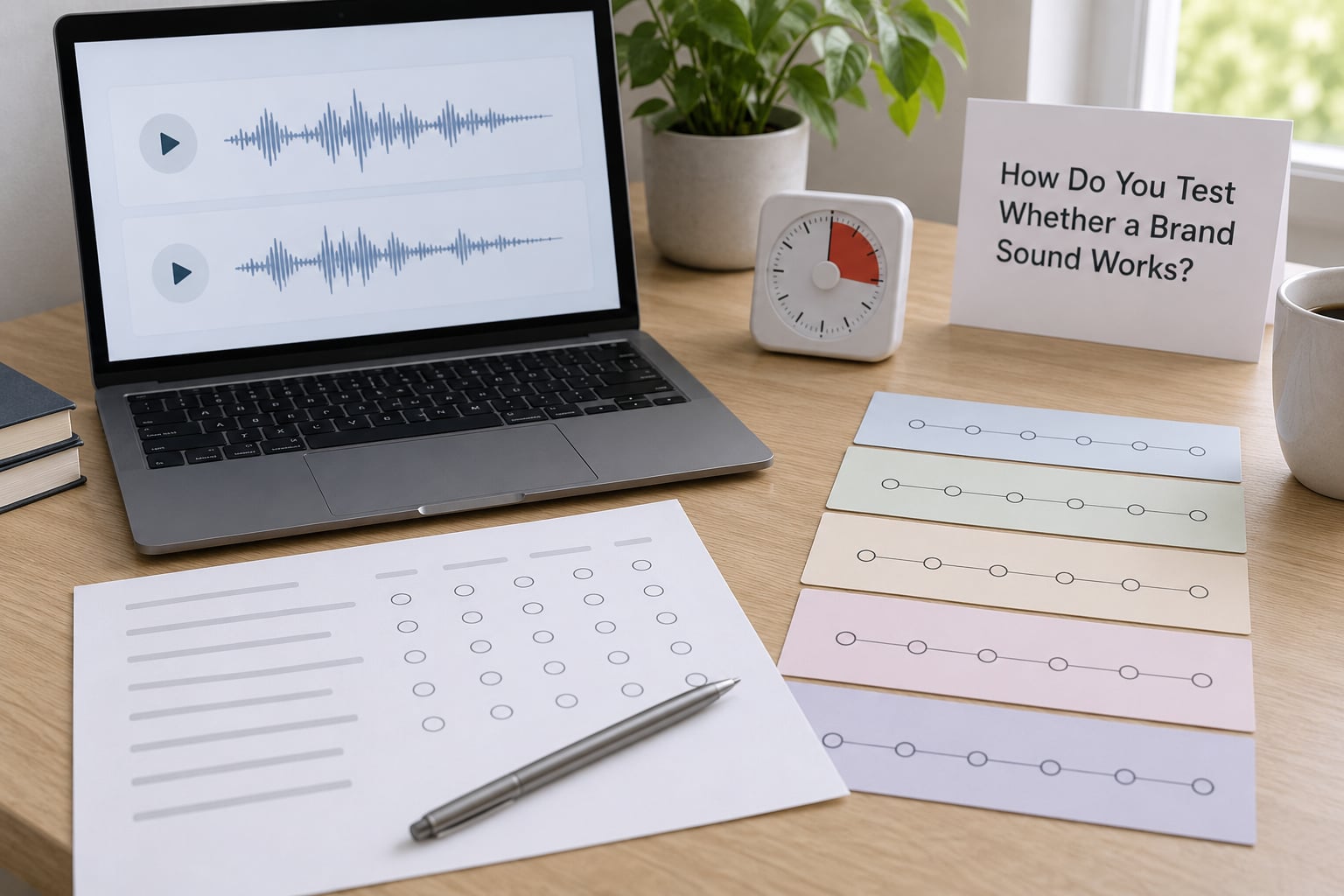
Recall numbers alone will mislead you. People remember a tune and have no idea what it belongs to, which is exactly the failure brands should care about. Meaning has to be measured alongside memory.
Attribution test. Play the asset with no branding attached and ask what brand or organisation it belongs to, with an open answer box and a no idea option. This is the hardest test and the most informative one. Aim for correct attribution on second exposure from people who do not work on the brand.
Unaided and aided recall. Unaided means you ask what they remember about the brand first, including sounds. Aided means you play a list of sounds, including competitors’, and ask which belongs to which. Unaided numbers are always lower, and the gap between them tells you how much the sound is doing without help.
Semantic differential rating. Ask listeners to place the brand on bipolar scales such as calm to energetic, cheap to premium, traditional to modern. Compare the ratings before and after exposure to the sound. This is the clearest way to see whether the asset moved the attribute it was meant to move.
Emotional valence and arousal. Separate pleasantness from intensity. A sound can be pleasant and low energy, which suits a bank and fails a sports brand. Measuring only like/dislike hides that difference.
Blind competitive comparison. Put your asset next to two or three competitor assets with no labels. If listeners cannot rank it out of the set, it is a weak asset even if your team loves it.
Exposure frequency. Test after one, two, three and more exposures to find where recall and attribution actually climb. That curve tells you how much repetition the strategy needs and where the wear-out point sits.
One caution about the evidence itself. Much of the published work in audio-visual advertising uses small student samples, and isolating audio from a full commercial is methodologically awkward. Treat effect sizes as directional, and be sceptical of any headline statistic without a traceable publication. A figure about brands being dramatically more memorable with music circulates widely in vendor content with no source anyone can locate.
When Can Sound Damage Brand Perception?
Audio can make things worse, and it usually fails in the same ways.
Intrusion. Autoplay, repeated notification stings and in-store music played too loud all shift perception of the brand that emits them. Users describe these sounds as irritants, and irritation transfers to the source.
Weak distinctiveness. Music drawn from shared subscription libraries is used by competitors, other podcasts and unrelated advertising. Once a bed is widely recognised as a library bed, it signals nothing about you.
Sounds that date the brand. A jingle written in the idiom of its decade quietly caps how modern the brand can seem. Repositioning usually means replacing the audio, and replacing audio means consumers have to learn the association again.
Category and cultural mismatch. Sonic conventions that feel off in the category read as inauthenticity, and vowel sounds or intonation that read differently across languages create real risk in international markets.
Inconsistent execution. Different audio per agency, per platform and per campaign dissolves the association the system exists to build. Worse than having no sound at all, in most cases.
Association with someone else’s brand. Licensing a track from a famous artist attaches the brand to that artist’s reputation, including the parts the brand cannot control. This has cost brands relationships and headlines.
Audio-visual incongruence. A warm, rounded sound against sharp, cold visuals reads as a mistake to listeners, even when neither element is wrong on its own.
Accessibility. Audio that carries essential information and cannot be adjusted for hearing differences, or sudden loud stings, exclude people and generate complaints.
Overproduction. Dense arrangements buried under dialogue do not travel well on phone speakers, and complexity is the fastest route to being forgotten.
There is also a legitimate case for doing nothing. A small business whose customers meet it in person rarely needs an audio logo, and a brand with a single product and no advertising budget can spend the same money on the thing customers actually touch. The return shows up where the sound repeats.
Frequently Asked Questions
Does sound affect brand perception more than visual identity?
No, and treating it as a contest wastes budget. Visual identity builds recognition and structure; sound adds emotion, memory and a cue that keeps working when the screen is not visible. The stronger claim to make is that sound travels further per second of exposure, because a listener cannot look away from a sound the way they can from a billboard.
Are audio logos more effective than musical jingles?
They do different jobs. An audio logo is a marker, useful at the start of a video, a film or an app, and it works after one or two exposures. A jingle is a mnemonic that takes longer to build but can be hummed, licensed and used across years. Many brands end up needing both: a short marker for frequent moments and a musical idea for campaigns.
Why do some brand sounds become memorable while others do not?
Three things separate them: distinctiveness from existing sounds, simplicity so the ear can hold it, and repetition paired with meaning. James Kellaris’s research on earworms, sometimes called Stuck Song Syndrome, shows that people report involuntary replay of short, repetitive pieces far more often than long or complex ones. Memorable assets are short, simple and repeated in the same form.
How many times does a listener need to hear a brand sound before recalling it?
There is no single number, and anyone who gives you one is guessing. Research and practice point to two exposures as a minimum for recognition and somewhere in the region of five or more for reliable attribution, and the rate depends entirely on the asset, the channel and how often the listener is exposed. Test your own curve at one, two, three and higher exposures rather than trusting a generic figure.
Should a brand use a sound logo, a jingle or a sonic atmosphere?
Start from where the sound will appear. Frequent, short moments such as an app open or a product start want an audio logo. Brand campaigns and long-form audio want a musical mnemonic. Physical and retail spaces want an ambience palette. Brands that operate across several of these usually need a family of sounds rather than one asset, built from a single motif.
How can marketers measure the emotional effect of brand audio?
Use bipolar rating scales on the brand attributes you care about, measured before and after exposure, and separate pleasantness from energy. Then add an emotional valence and arousal measure, since a sound can score as pleasant but calm, which suits one category and fails another. Pair it with an unaided attribution test so you learn whether the feeling arrives attached to the brand.
Conclusion: What Should a Brand Do First?
How sound influences brand perception comes down to association: a sound that is distinctive, repeated and paired with meaning becomes a cue that carries the brand on its own. Do not start with a composer. Start by writing down the two or three attributes your sound should communicate, then design and test against them. Everything else is production.