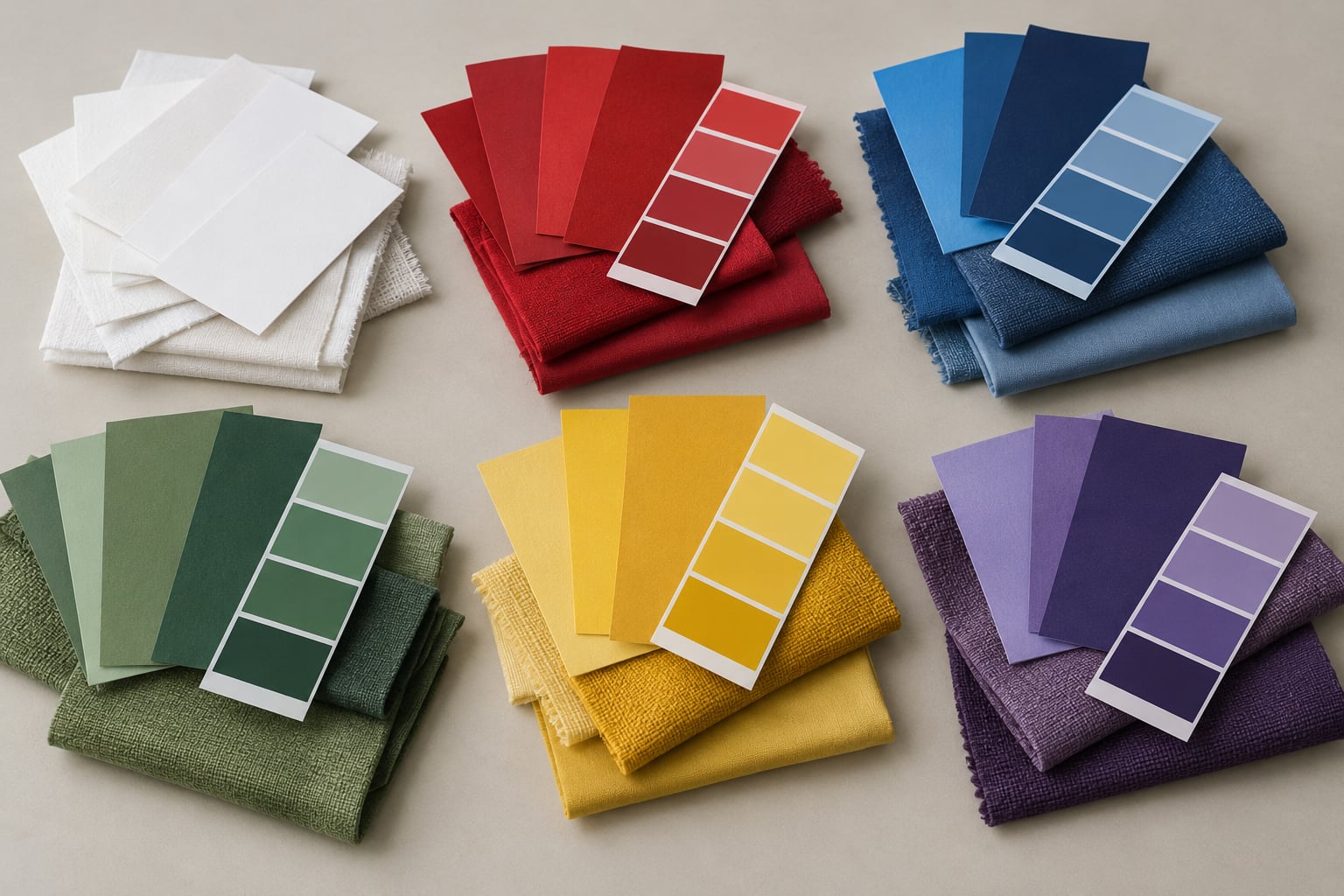
Color meanings differ across cultures because a hue carries no built-in meaning of its own. What red, white or black signals is produced by biology, religious ritual, the words a language uses for colors, and the material history of dyes and pigments. Where those forces line up, meaning reinforces itself. Where they diverge, the same color carries opposite readings in different places.
That last part is the practical problem. A packaging palette that reads as trustworthy at home can read as funerary two markets over, and a color a team picked for calm energy can land somewhere as a warning. I have watched teams argue from intuition, and intuition is exactly the thing that does not travel.
Most of what circulates on this topic online is a list. This is the mechanism underneath the list, plus a way to check your work before anything ships. I flag where a claim rests on solid cross-national research and where it rests on thinner ethnographic material, because the two wear the same clothes online.
Table of Contents
- What Does Color Mean?
- Why Do Color Meanings Differ Across Cultures?
- How Does Culture Shape Color Associations?
- Which Color Meanings Change Most Across Cultures?
- Why Can the Same Color Create Different Reactions?
- How Do Religion and History Influence Color Meanings?
- How Do Color Meanings Change Within a Culture?
- What Should Brands and Designers Do?
- What Are Common Mistakes When Using Colors Across Cultures?
- Frequently Asked Questions
- Are color meanings universal or learned?
- Why is white associated with death in China and Japan?
- Why do colors mean different things in different countries?
- Is pink a feminine color everywhere?
- What colors are safe to use across multiple markets?
- How do I validate a color-meaning claim before using it in a brief?
- Conclusion
What Does Color Mean?
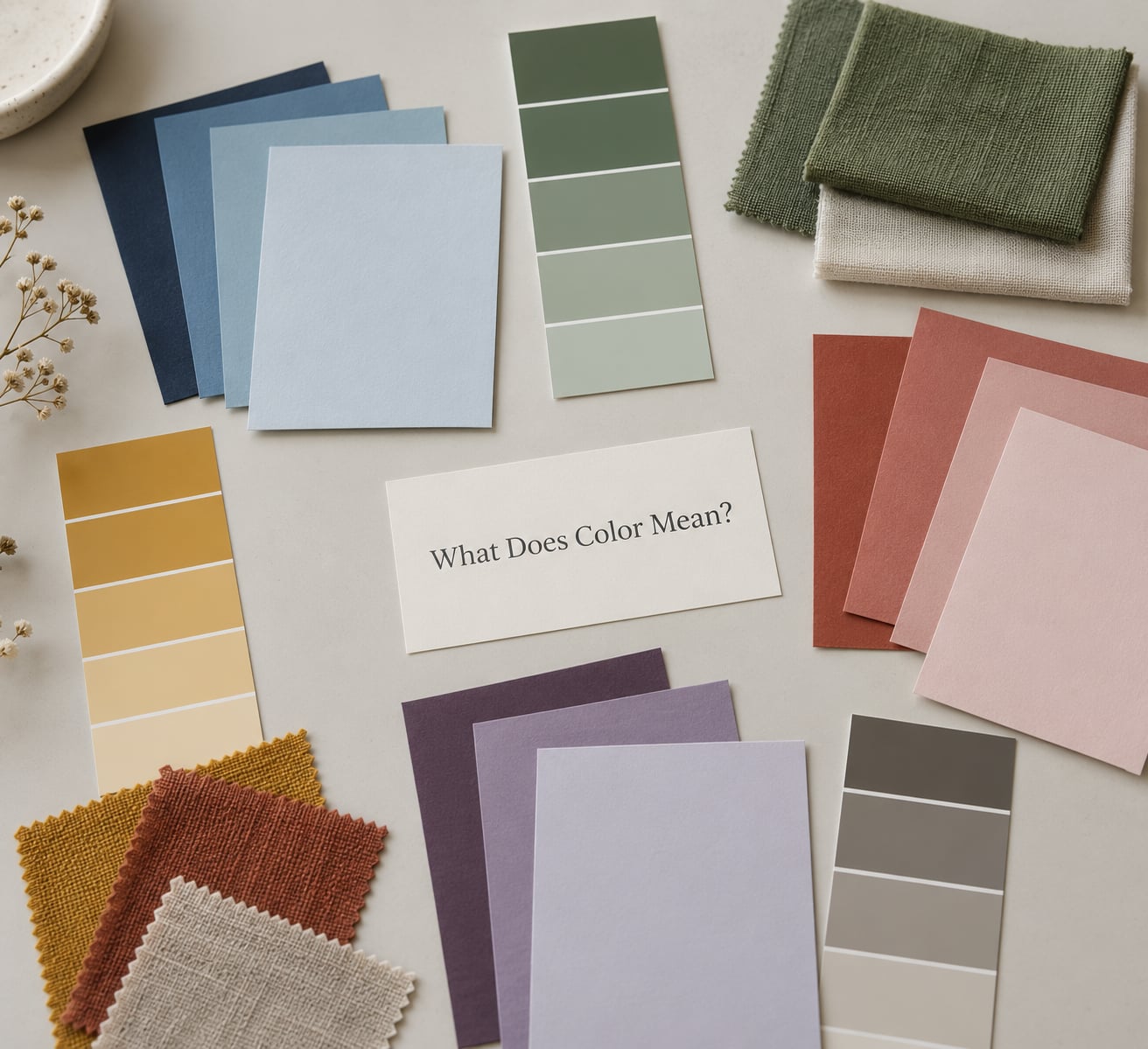
When researchers talk about the meaning of a color, they mean everything a viewer brings to it: how they perceive it, what their language calls it, what it has been used for, and what the people around them read into it.
Color itself supplies none of that. A wavelength does not carry a wedding, a funeral or a bank balance. Meaning lives in the gap between a physical stimulus and a person looking at it, which is why two people can see the same swatch and reach for entirely different words.
It also explains a term people mix up constantly. Color psychology points to measurable responses: arousal, attention, the way a hue shifts perceived temperature of a space. Color symbolism points to what a group has agreed a hue signifies through use and repetition. You can have a color that reliably feels energizing in laboratory conditions and still mean something quite different once it appears on a coffin.
Why Do Color Meanings Differ Across Cultures?
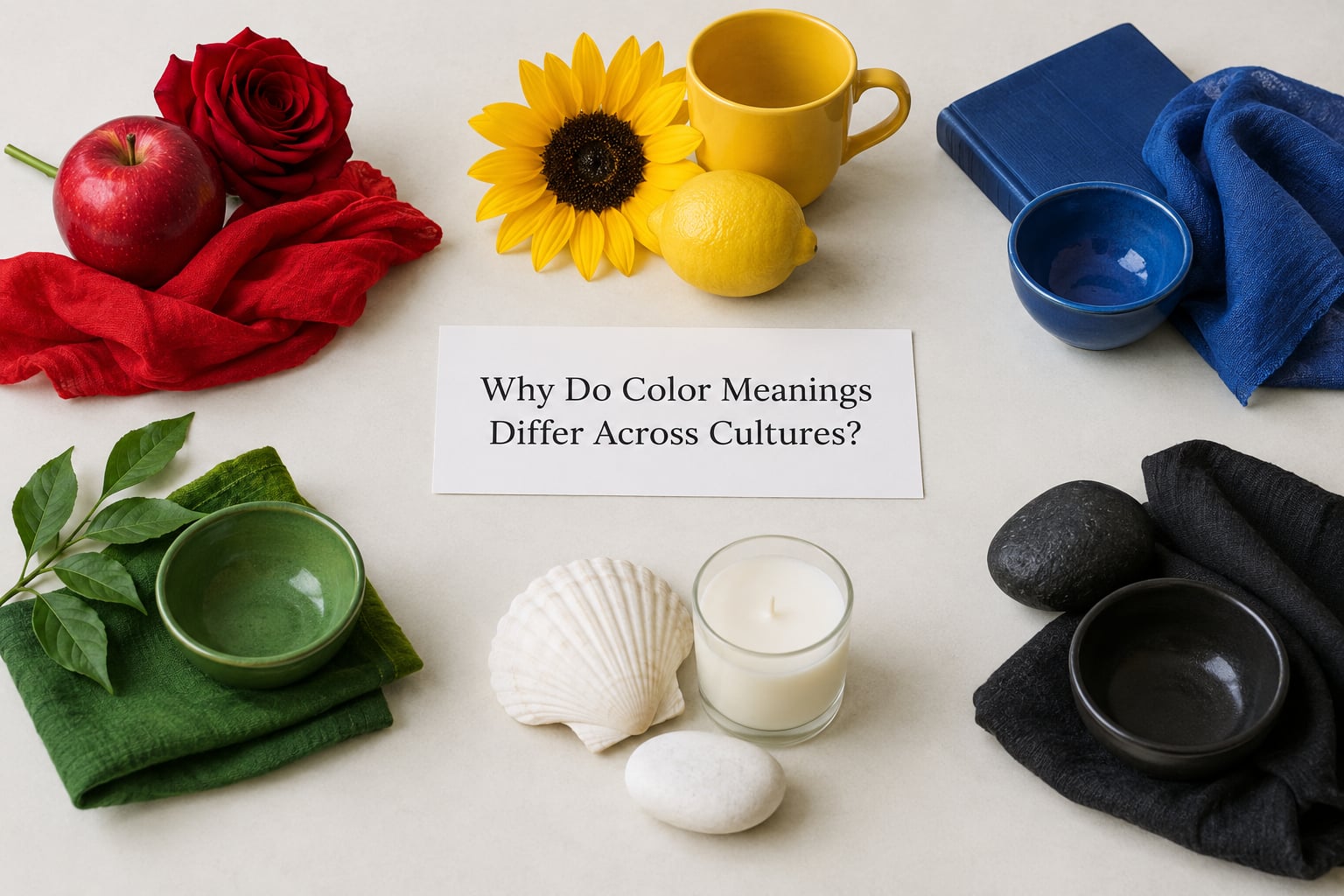
Seven things push color meanings apart between cultures, and most real cases combine several of them.
- History. A hue takes on the reputation of what it was used for, and the association sticks long after the use stops. Purple dye was brutally expensive, so the people who wore it were people nobody else could afford to be.
- Religion and myth. Repeated ceremonial use converts a color into a symbol. Once enough people have seen saffron robes on a monk a thousand times, saffron means devotion, not a garment color.
- Ecology. The colors a people see constantly become emotionally loaded. Where white dominates the landscape year-round, white reads very differently than it does in a culture where it is a scarce event color.
- Social status and law. Sumptuary rules and class history attach meaning to who is allowed to wear or display a hue. That is a large part of why a specific color reads as expensive or as forbidden.
- Political association. Recent events attach colors to parties, movements and regimes. These meanings are young, which is exactly why they feel intense.
- Language. The words a language has for colors decide which distinctions people are equipped to make in the first place.
- Lived experience. Family, religion, neighborhood and generation produce personal readings that no national average will capture.
Notice what is missing. Not one of these is taste in the aesthetic sense. Meaning accrues from circumstance, and circumstances differ.
How Does Culture Shape Color Associations?
Associations form by repetition at a specific scale, and the scale matters more than the culture name. Ritual is the cleanest example: a color enters a ceremony, appears at every performance, is worn by every participant, and stays linked to that event for generations.
Environment does similar work more quietly. People build expectations from the colors they see constantly and find colors they never encounter strange or unsettling. The American expectation that green is a backdrop rather than the main event has little to do with green itself and everything to do with where green shows up across a countryside.
Language is the layer most lists skip. The research here runs through two positions. One holds that languages carve color into named categories in a similar way wherever you look, which suggests a shared perceptual floor under all the cultural variation. The other holds that color lexicons vary substantially and that the lexicon shapes what a speaker can name and therefore notice. The Current Biology paper on hunter-gatherer color naming pushed on exactly this, arguing that categorization can drift with local need rather than sitting still.
Nobody has settled it cleanly, and for your purposes the practical reading is that a shared floor exists without a shared ceiling. Your audience will agree with you about the basic categories and still disagree entirely about what a color stands for.
Exposure completes the loop. Once a meaning exists, every repetition reinforces it, and the more often it repeats the more invisible it becomes to the people who inherited it. That invisibility is why insiders find claims like white means mourning in China confusing. It is obvious from inside, and strange from outside.
Which Color Meanings Change Most Across Cultures?
Some colors travel better than others. The table below covers commonly researched ones, and every cell describes a dominant reading rather than a uniform one. Read across a row, not down a column.
| Color | Western contexts | East Asian contexts | South Asian contexts | Middle Eastern and North African | Latin American |
|---|---|---|---|---|---|
| White | Purity, weddings, mourning in some Protestant traditions | Mourning and death in China, Japan and Korea | Mourning in many Hindu communities | Purity, peace | Religiosity and mourning in Catholic contexts |
| Black | Elegance, formality, mourning | Authority, formality, water in some feng shui practice | Protection against the evil eye in some traditions | Widely associated with mourning and death | Mourning in Catholic contexts |
| Red | Passion, danger, urgency, Christmas | Luck, prosperity and celebration, red envelopes for new year | Purity, marriage, power, also anger | Strength and sometimes danger | Blood of Christ, also danger and political passion |
| Green | Nature, growth, go signal | Youth, growth, purity of jade | Associated with Islam, also fertility in parts of India | Islam and paradise | Independence in Mexico, national colors elsewhere |
| Blue | Trust, calm, corporate stability | Healing, immortality, also the cold and the scholarly | Krishna’s skin, linked to divinity and also to unfairness | Safeguard against the evil eye | Hope, spirituality, and mourning in some indigenous communities |
| Yellow | Caution, warmth, optimism | Royalty in Japan and historically in China, honor | Learning and commerce, also mourning in some regions | Color of the dead and of mourning in Egypt | Mourning in parts of Latin America |
| Purple | Royalty and luxury | Nobility, also linked to the spiritual in some traditions | Spiritual association through saffron-adjacent tones | Some contexts attach negative associations | Catholic mourning associations in some areas |
| Pink | Feminine, romance, youth | Youth in some contexts, spring, celebration | Hospitality and celebration, notably in Jaipur traditions | Varied, with contemporary fashion influence | Widely associated with girls |
Two honest caveats. The pink-and-femininity link is recent and historically thin. It turns up strongly in modern, market-mediated, urban contexts and is weak or absent in small-scale societies, which is one of the clearest cases of a meaning being manufactured rather than inherited.
And regional labels hide contradictions. Green reads as independence in Mexico, infidelity in one Chinese context and as a symbol of Islam in others, all of which appear in the same blog posts without comment. Red is prohibited for women in some sub-Saharan communities and used for mourning in others. Anyone who tells you a continent reads a color one specific way has not done the work.
Why Can the Same Color Create Different Reactions?
Three different things get collapsed into one when people talk about color reactions, and separating them clears up most disagreements.
Preference is personal and soft. Someone likes or dislikes a shade for reasons they cannot fully explain, and that reaction changes with mood and lighting.
Social symbolism is shared and load-bearing. It shows up in what people wear for a wedding, what a family buries a loved one in, and what a bank shows on a screen.
Context decides which reading wins. The same hue carries a different charge depending on where it appears, what surrounds it, and what is happening. This is where practical errors concentrate. On East Asian financial displays, red marks gains and green marks losses, which is the reverse of Western markets. A finance brand localizing an interface by translating only the words will quietly invert the most important signal on the screen.
Here is how far that context dependence goes: one hue has to mean celebration in one setting and death in another for both meanings to make sense. That is not a contradiction. It is evidence that meaning attaches to situations, not to hues.
How Do Religion and History Influence Color Meanings?
Religious traditions are the most efficient meaning-making machines cultures have, because the behavior repeats on a schedule and involves the whole community.
Saffron and orange robes mark Buddhist monastic orders across much of Asia. Green is associated with Islam in many Muslim-majority contexts. Blue appears in the robes of Marian figures across Catholic iconography, and blue skin marks Krishna in Hindu visual culture. The careful version of that statement is that practices differ by school and region. Not every Muslim context reads green the same way, and Catholic mourning in parts of Latin America runs alongside the same church’s use of white for weddings.
History supplies the other half, and it is often material rather than spiritual. The purple dye story is really an economics story. Tyrian purple was extraordinarily hard and expensive to produce, laws restricted who could wear it, and royal association followed scarcity. Replicate those conditions anywhere and royalty associations tend to reappear.
Material history explains darker turns. Nineteenth-century arsenic-based green dyes were genuinely toxic and killed people who wore or used them, which left green carrying a poison association in parts of Europe long after the dye disappeared.
Political color is the fastest-moving layer. Colors attach to regimes, parties and movements, often very recently, and that is why they feel so charged. A color that reads as ordinary to you can be actively political two borders away.
How Do Color Meanings Change Within a Culture?
This is where most published lists break down, because they treat nations as units and nations are not units of meaning.
Generation is the biggest divider. A convention that feels deeply inherited to someone over 60 may be a dated marketing convention to someone under 25, who has never met it outside advertising. That gap is doing a lot of work in any global brand launch right now.
Religion, region, class, language and industry all cut across national lines. Within a single country, a religious community can read a color as sacred while a secular audience reads it as decoration, and both are correct about their own context.
Subculture does the same thing with borrowed meaning. Colors migrate between communities and change what they carry when they arrive.
Practically, this means the market, not the country, is usually the right unit for a decision. A coastal trading city and an inland rural region can read the same color differently, and a diaspora audience may read it according to their old country or their new one. National averages smooth away exactly the variation you need to see.
What Should Brands and Designers Do?
Six steps cover most of the decisions that actually go wrong. They take a day for a single market and a week for a launch touching several.
- Write down the association you are trying to produce. One sentence, in plain language: trustworthy, energetic, calm, celebratory, premium. If you cannot write it, you cannot test it.
- Set the unit at market level, not continent level. Name specific cities and regions you are actually reaching. Regional averages hide more than they reveal.
- Check the function the color performs. Is it on packaging, a wedding product, a financial display, a UI state, a hospital sign, a sports team? Function changes reading far more than hue does.
- Ask local readers, not translators. Translators move words. You are moving meaning. Ask people who grew up with the category what the colors in your palette make them think, and ask what it makes them think of the competitors’ colors too.
- Test interpretations with open questions. Show the artwork without naming the color and ask what feeling or association it produces. Leading questions produce the answer you hoped for.
- Document regional variants and set a review date. Keep a core palette with recorded, justified departures per market, and revisit them when you enter a new region or when the target audience shifts age.
Keep a record of what each color was tested for and in which market. When a client says a color is wrong, the disagreement is often about the association being asserted, not the hue being seen, and a documented test ends the conversation faster than opinion can.
One more practical note: treat any list you find, including this one, as a starting prompt for research rather than a verdict. The Global Color Meaning Database grades claims by evidence strength, which is a better model than an undated blog table with no sources.
What Are Common Mistakes When Using Colors Across Cultures?
Treating a color dictionary as a rule. Dictionaries describe patterns; they do not license decisions. Correction: use the list to form a hypothesis, then test it in the market you care about.
Relying only on an online survey in English. An English-language poll run on a Western panel measures what English-speaking panellists think about a hue, which is not the population you are shipping to. Correction: run it locally, in the local language, with people who use the product category.
Ignoring the occasion. A color approved for a product line can be entirely wrong for a wedding range or an in-memorandum campaign. Correction: audit by function and by season of the year, not just by asset.
Equating lightness or saturation with meaning. A pale version of a color does not carry a pale share of its symbolism automatically, and a vivid one does not read as more intense meaning. Correction: test each variant you plan to use.
Assuming one global palette will travel everywhere. Keeping a single palette is a legitimate decision, but it should be made knowing what you are accepting rather than by default. Correction: decide deliberately whether the cost of local variants is worth the fit.
Trusting a confident claim with no source. If a color-meaning claim cites no study, no region and no date, it is a story. Correction: ask what the evidence is. A heuristic that works: a claim naming a country, a practice and a date is usually real; one naming a whole continent is usually an average pretending to be a fact.
Frequently Asked Questions
Are color meanings universal or learned?
Both, partly. Cross-national research finds that broad emotion-color pairings recur across many populations, which suggests a shared perceptual floor. But the specific things a color signifies are learned, reinforced through ritual, language and repeated use. A hue can feel reliably energizing everywhere while meaning celebration in one country and danger in another.
Why is white associated with death in China and Japan?
White is the dominant color of the landscape in much of East Asia, which weakens any emotional charge attached to it as an event color. Over centuries, white also became the standard of funeral and mourning dress, and that repeated ceremonial use fixed the association. Where black is the dominant seasonal color, as in much of the West, the same role went to black.
Why do colors mean different things in different countries?
Because meaning is attached to circumstance rather than to wavelength. History, religion, ecology, class rules, politics, language and personal experience all push in different directions, and each culture lands in its own configuration. So when you ask why color meanings differ across cultures, the useful question is rarely what the color is. It is what this culture has repeatedly used that color to signal.
Is pink a feminine color everywhere?
No, and the assumption is recent. The strong pink-for-girls convention appears mainly in modern, market-mediated, urban societies and is weak or absent in many small-scale ones. Color historians also trace the practice to the early twentieth century, when pastel dyes made pink commercially available and retailers began pitching it to parents. Treat it as a marketing convention, not an ancient one.
What colors are safe to use across multiple markets?
There is no list of universally safe colors, but low-contrast, low-salience hues carry the least cultural baggage in practice. Colors with fixed ceremonial meaning are riskiest: white for mourning in East Asia, yellow in Egypt, purple in some Catholic European contexts. The practical answer is that safety depends on function, so test the specific palette in the specific market rather than trusting any general ranking.
How do I validate a color-meaning claim before using it in a brief?
Ask four questions. Which country and which community is the claim about? What is the source, and is it research or a listicle? What is the date, since political and retail meanings move fast? And does the claim name a practice you can verify? If it cannot answer all four, treat it as a hypothesis and test it with people in the target market before the work ships.
Conclusion
Color meanings differ across cultures because they are made, not given. Biology sets a floor, and ritual, language, economics and politics decide what gets built on top of it. The useful move for any team is to start from the audience in a specific market, form a hypothesis about what a color will signal there, and test it with local readers before you scale the design or campaign.
Sources and further reading: the Global Color Meaning Database, which grades claims by evidence strength; Berlin and Kay on basic color terms; Griffin and Verheyden on the optimality of basic color categories; and the Current Biology paper on hunter-gatherer color naming.