
An authority cue is any signal — a job title, a credential, a third-party endorsement, a published result — that lets people judge whether a source is worth deferring to before they have evaluated the message itself. Authority cues increase persuasion by replacing an expensive evaluation of every claim with a cheap one: people use the cue as a shortcut, feel less uncertain, and transfer trust from the source to the message.
That shortcut is not a flaw to be engineered. It is how people make decisions faster than they can verify everything, and understanding it changes how you signal expertise honestly.
Table of Contents
- Key Takeaways
- What Are Authority Cues and Why Do They Influence Us?
- How Authority Cues Increase Persuasion
- Expertise Cues: What Makes a Source Look Knowledgeable
- Credibility Cues: Why Trust Changes the Message
- Status and Prestige Cues: When Being Seen Matters
- Why Compliance and Recommendation Cues Amplify Authority
- How to Use Authority Cues Ethically in Marketing
- Authority Cues in High-Risk and Low-Risk Decisions
- When Authority Cues Backfire
- How to Measure Whether Authority Cues Are Working
- Frequently Asked Questions
- Can you provide an example of the authority principle of persuasion?
- What are Robert Cialdini’s 7 principles of persuasion?
- How can a person improve persuasion skills?
- What is the golden rule of persuasion?
- Is authority the same as expertise?
- Can authority cues backfire?
- Conclusion: Start With Credible Evidence
Key Takeaways
- Authority cues work by collapsing an expensive evaluation into a cheap one. The audience stops auditing the claim and starts auditing the source.
- Two separate mechanisms sit behind the effect: expertise (this person knows things I do not) and legitimacy (this person has the right to decide).
- Specificity beats seniority. Naming a narrow domain reads as credible; a general claim to be knowledgeable reads as sales copy.
- Evidence is the strongest cue and the slowest to build. Titles are fast, cheap, and only work when they come from outside your own organisation.
- Cues can backfire. Overclaiming, credential inflation, and conspicuous status all trigger scepticism instead of deference.
What Are Authority Cues and Why Do They Influence Us?
Authority is not the same thing as being right, and it is not the same thing as holding power. In social psychology it means something narrower: the right to be believed, granted by the people who hear you rather than claimed by you. The cue is the visible evidence of that grant — a hospital badge, a peer-reviewed paper, a case study with a named client, twenty years in the same specialism.
Social scientists tend to separate authority into two strands. Max Weber’s classic treatment is about legitimate domination: power people accept because they recognise it as rightful. French and Raven’s bases of social power split it further into legitimate power, expert power, referent power and information power. Tom Tyler’s work on procedural justice adds a third idea that matters for persuasion: people grant authority more freely when they believe the process that produced the decision was fair.
So an authority cue does two different jobs at once. It says, this person knows something, and it says, this person has a standing to decide. The second job is the one most applied marketing writing misses.
Here is how authority cues increase persuasion in one sentence: they let an audience accept a claim on borrowed confidence rather than earned evidence, and that borrowed confidence is what cuts through uncertainty.
Because the constructs get mixed up constantly in applied writing, it helps to keep five of them apart:
| Construct | What it is | Who grants it |
|---|---|---|
| Power | Ability to impose an outcome regardless of agreement | Position or coercion |
| Authority | Accepted right to be believed and to decide | The audience, based on legitimacy |
| Prestige | Admiration conferred by standing outside the task | Social ranking |
| Status | Rank within a specific group or hierarchy | Peers in that group |
| Dominance | Coercive or controlling capacity, sometimes feared | Fear, physical or social |
Of these, only authority and prestige usually help a persuasive argument. Power produces compliance without agreement, and dominance tends to produce avoidance. A message delivered by someone the audience finds dominant can persuade precisely by triggering resistance.
Consider the everyday case. Somebody needs a dentist, and there is no time to evaluate three practices on the merits. A framed diploma on the waiting room wall, a recommendation from a neighbour, and a review score all do the same job at different speeds. None of them tell you anything about this particular dentist. They tell you that other people have already done the evaluating, which is cheaper.
How Authority Cues Increase Persuasion
Persuasion increases through four linked steps, and it helps to name them because each one can fail independently.
- Uncertainty reduction. People dislike not knowing. A cue supplies an answer to the question they are already asking — is this person qualified? — before they have read the content.
- Easier processing. Information attributed to a credible source is remembered better and processed with less effort. The halo effect does part of this work: a single positive impression, such as a published book, bleeds into unrelated judgements like honesty and competence.
- Source monitoring. Audiences tag claims by origin. When the origin carries weight, they attribute the claim to the source rather than to themselves, which makes it feel like information rather than like being sold to.
- Trust transfer. Existing trust moves from the source to the message. Someone you already regard as credible makes your claim borrowable.
This is why Robert Cialdini’s authority principle in Influence works as a shortcut to good decisions rather than as blind obedience. And it is worth being careful about the canonical list: the 1984 first edition set out six principles — reciprocity, commitment and consistency, social proof, liking, authority and scarcity. The “seven principles” version circulates widely and differs across editions and secondary sources. If you plan to quote it, check which edition you are quoting.
Ranked by how much persuasive work they actually do, the cue types look like this. Strength here means how reliably the cue raises acceptance on its own, not how impressive it looks.
| Cue type | Strength | Cost to signal | Backfire risk |
|---|---|---|---|
| Demonstrable track record | High | Slow; requires real outcomes | Low, unless the numbers are vague or unverifiable |
| Published work and thought leadership | High | High; takes months to years | Low, but decays if the field moves on |
| Third-party endorsement | High | Moderate; needs relationships | Moderate if the endorser is inside your own group |
| Specific domain claim | Medium to high | Almost free | Low; over-broad phrasing is the only way it fails |
| Institutional affiliation | Medium | Moderate to high | Moderate; perceived elitism in some groups |
| Titles and credentials | Medium | Low if earned, high if bought | High when read outside their specialism |
| Trappings of the trade | Low to medium | Low | High; often read as compensation for thin evidence |
The pattern is clear: the cues that do the most work are the expensive ones, and the cheap ones are the ones that get audited. That is why a visible diploma converts a stranger faster than it converts anyone who knows you.
The laboratory evidence behind the effect is old and solid. Stanley Milgram’s obedience studies in the early 1960s showed that participants delivered what they believed were severe shocks to a learner when instructed by an authority figure, and that proximity to the authority sharply raised compliance. Solomon Asch’s 1951 conformity experiments showed something adjacent: a single dissenting voice in a group cut the error rate by roughly three quarters, because it supplied social counter-evidence. Hovland and the Yale group on source credibility separated the construct into expertise and trustworthiness, which is still the standard split today.
Expertise Cues: What Makes a Source Look Knowledgeable
Expertise cues signal information you do not have. The strongest ones are specific and verifiable.
- Track record — outcomes with names and dates attached. “Cut onboarding time from six weeks to nine days at a 400-bed hospital” carries more weight than “helped many organisations”.
- Published work — papers, books, long-form analysis that predates the current sales conversation.
- Institutional affiliation — a university, a standards body, a regulator. Strongest when it is verifiable outside the pitch.
- Peer recognition — awards, licences, editorial roles, invited talks. Useful mostly as third-party corroboration of the first two.
- Narrow domain claim — the plainest signal there is. Naming the exact specialism is what separates a practitioner from someone who read a blog post.
Haloes explain why expertise cues spread further than they should. Once someone forms a favourable impression, they tend to fill in the rest, so a single strong cue can carry an audience through unrelated parts of your argument. That is also why expertise inflation backfires badly: the halo is only as good as the specific claim attached to it.
Lin’s 2016 work on social media credibility indicators, in Computers in Human Behavior, found that authority cues matter most where the stakes are highest — health, finance, safety. That result holds up in applied work too. In a low-stakes decision, a well-written page wins. In a high-stakes one, the source wins.
Credibility Cues: Why Trust Changes the Message
Credibility is a separate question from competence. Someone can be a genuine expert and still not be believed, because credibility is about how they handle the parts of the message that threaten their own position.
- Transparency about limits. Saying where your expertise ends reads as more credible than claiming it covers everything.
- Evidence shown, not asserted. Method, sample, timeframe, and the caveat that weakens the finding.
- Consistency over time. A body of work that holds a position for years is hard to dismiss as opportunistic.
- Disclosure. Saying who paid for the research, and who did not, removes the main reason a reader would discount it.
- Relevant experience. Not seniority in general, but experience in the situation the reader is actually in.
Hovland and Weiss found that a source seen as trustworthy could hold attention and produce more agreement even when the audience could tell the position was taken deliberately. Trustworthiness buys you the benefit of the doubt; expertise buys you the argument.
Status and Prestige Cues: When Being Seen Matters
Prestige cues signal standing rather than knowledge. They are weaker at changing minds and stronger at opening doors, and applied marketers frequently overestimate them.
- Titles — a doctorate, “professor”, “director”. Effective mainly when the audience is outside your field and cannot otherwise evaluate you.
- Presentation and environment — offices, sites, documentation, the visible state of your operation.
- Recognition and association — awards, media appearances, the company you are known for.
Titles have an asymmetry worth remembering. Your own job title barely persuades your own team, because insiders already know the context. The same title on an outside expert lands much harder, which is why third-party recommendation outperforms self-description almost every time. That is the same reason the dentist on the toothpaste packet works and your own About page does not.
Why Compliance and Recommendation Cues Amplify Authority
Social proof and authority are the two most confused principles in this area, and they are not the same thing.
| Dimension | Authority cue | Social proof |
|---|---|---|
| What it signals | Qualification and standing | What others already did |
| Core question answered | Is this person qualified? | Are people like me doing this? |
| Fails when | The audience rejects the source as out of group or illegitimate | The count is small, irrelevant, or obviously manufactured |
| Weakens under | Credential inflation and fake titles | Volume without specificity |
They stack. Testimonials that name a result and a reviewer with standing do two jobs at once, which is why third-party validation outperforms self-asserted credentials in nearly every applied setting. Two rules keep the stack honest: the endorser must be independent enough to be believable, and the recommendation must say what the person actually endorsed.
How to Use Authority Cues Ethically in Marketing
Marketing practitioners report one problem repeatedly: audiences do not notice competence unless it is signalled, but audiences punish the moment a signal overreaches. The line is not “use authority cues” versus “do not”. It is whether the claim is narrower than the evidence.
- Name the domain precisely. “Pricing research for B2B SaaS between 20 and 200 employees” persuades; “a pricing expert” does not. Narrow claims read as knowledge because nobody claims narrow domains lightly.
- Lead with evidence, not identity. The result, the method, the timeframe. Identity cues support evidence; they do not substitute for it.
- Get validation from outside the group. People discount self-asserted credentials and accept out-of-group corroboration. A customer name, a published talk, an independent reviewer all count as outside.
- Disclose the interest. Who funded it, who reviewed it, what it does not cover. Disclosure costs a little persuasive force and buys a lot of durability.
- Match the cue to the decision. In a high-stakes domain, credibility evidence outranks prestige. In a low-stakes one, clarity usually beats credentials.
If you have no formal title, that is not a dead end. Specificity, published work, and a documented track record are all authority cues, and none of them require a degree. The only thing they require is evidence you can point to.
Authority Cues in High-Risk and Low-Risk Decisions
The same cue does different amounts of work depending on what the audience is deciding, which is why one brand’s credibility signals feel reassuring and another’s feel like a sales push.
| Dimension | Low-stakes decision | High-stakes decision |
|---|---|---|
| Typical examples | A blog topic, a software tool, a routine purchase | Health, legal, financial or safety advice |
| What wins | Clarity and relevance | Verified credentials and transparent method |
| Prestige effect | Mild positive lift | Often distrusted on its own |
| Testimonials | Helpful if specific | Ignored unless the reviewer is identifiable and qualified |
| Audience tolerance for uncertainty | High | Low, which is why cues get leaned on harder |
The pattern holds in published work too. Lin’s study found authority cues mattered most on health and risk topics. The more consequential the decision, the more an audience wants a reason to defer, and the less a bare title will do.
When Authority Cues Backfire
Every cue carries a risk that grows as it gets louder.
| Failure | What happens | The fix |
|---|---|---|
| Overclaiming | The claim exceeds the evidence; audiences read it as a sales tactic | Cut the claim to what you can evidence, then say what it does not cover |
| Credential inflation | A senior title read outside its specialism invites scepticism | State the domain of the credential next to the claim it supports |
| Conspicuous status | Prizes and trappings read as compensation for thin evidence | Move prestige below the evidence in your copy order |
| In-group rejection | An in-group member judges the cue as performative and discounts the message | Use specificity and evidence instead of rank when speaking to peers |
| Legitimacy withdrawal | Procedural unfairness causes people to revoke an authority’s standing | Show the method; let people check the process |
There is also an uncomfortable finding in the recent literature. A 2026 study in Proceedings of the National Academy of Sciences reported that attaching scientific authority cues to claims increased how widely those claims spread, including false ones. The cue did not make people believe the claim was true; it made them more willing to pass it on. That is a fair description of a large share of authority cues in circulation right now.
Machine systems are not immune either. Research on large language models reports that responses shift when authority markers appear in the prompt or the source material, which means a synthetic testimonial or a fake affiliation can propagate as easily as a real one. Scepticism toward authority cues is rising for the same reason: content volume has made unsupported claims cheap, so people now check for corroboration before they defer.
Finally, credibility decays. An authority claim made in 2026 was earned at some earlier point, and fields move. A re-signal every couple of years keeps a cue current: updated results, a new case, a fresh citation.
How to Measure Whether Authority Cues Are Working
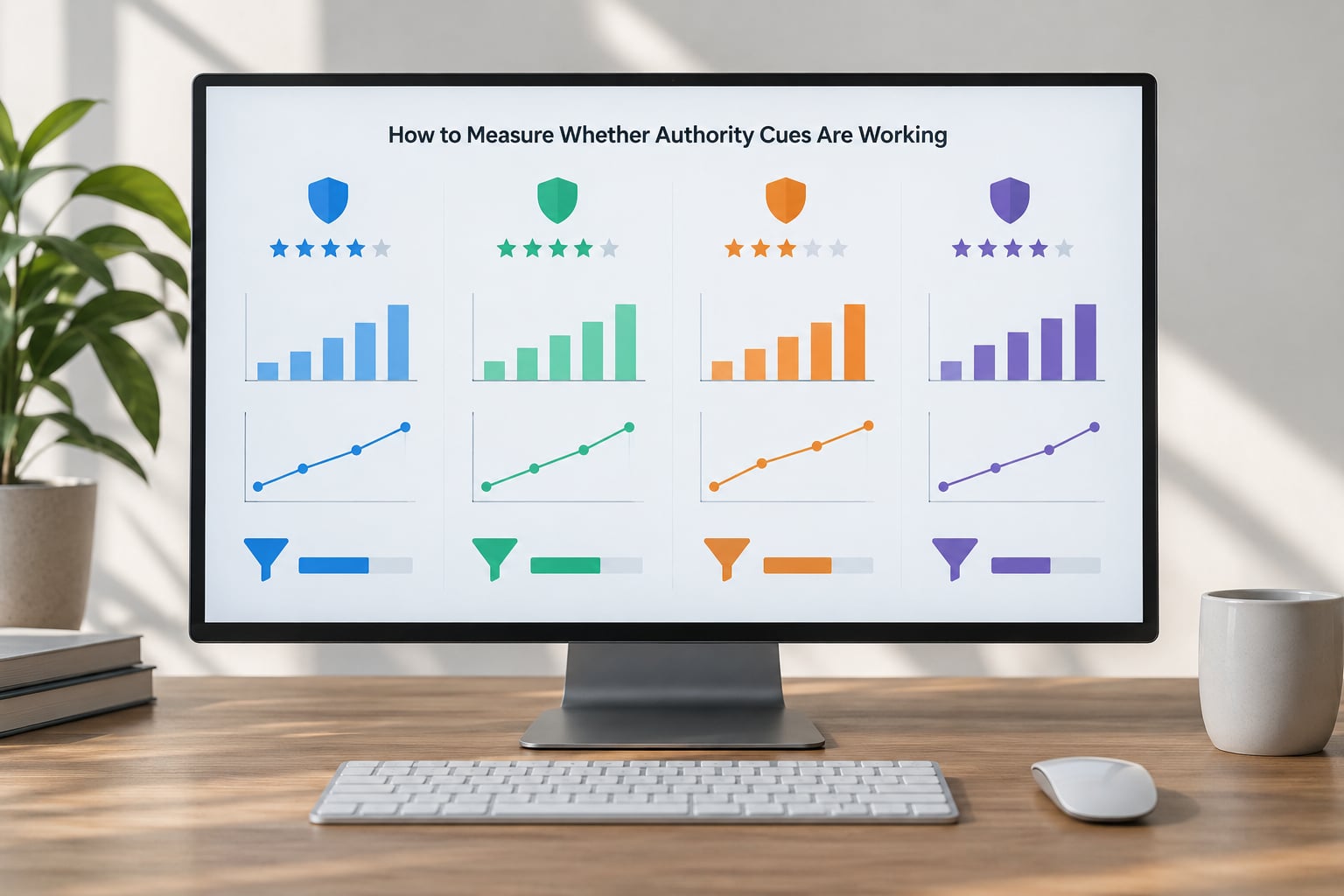
Most teams guess. You do not have to. Run the test as an A/B, keep everything but the cue constant, and measure three things separately: attention, belief, and behaviour.
Attention and recall. Which version gets read and remembered? Blunt, but useful for catching cues that add nothing.
Credibility ratings. Ask readers directly how credible and how expert the source seemed, on a short scale, immediately after exposure. This is the measure closest to the mechanism itself, and it usually moves before conversion does.
Behaviour. Clicks, sign-ups, qualified replies, sales-cycle length. Useful, slower, and easy to confuse with other page changes.
Then check the trade that matters most: short-term persuasion against long-term trust. Run a returning-audience check three to six months out. If credibility ratings held but conversions stalled, the cue probably was too thin. If conversions rose while credibility ratings fell, you may have bought a one-off with a signal that will cost you later.
A short audit you can run on your own material before publishing:
- Is the domain of authority named in specific terms?
- Is there evidence in the message, not just a claim about the source?
- Does at least one cue come from outside my own organisation?
- Are interests disclosed?
- Does the cue match the stakes of the decision?
- Could a sceptic check my strongest claim and find it holds?
Frequently Asked Questions
Can you provide an example of the authority principle of persuasion?
A doctor recommending a medication is the clearest case. The prescription does the medical work, but the physician’s status tells a reader which details to weight and how much uncertainty to tolerate. The toothpaste packet carrying a four-out-of-five-dentists recommendation works the same way at a lower stakes level: the number of professionals matters less than the fact that they sit outside the seller’s own field. In both, the cue is doing the persuasion while the product does the justifying.
What are Robert Cialdini’s 7 principles of persuasion?
The 1984 first edition of Influence set out six: reciprocity, commitment and consistency, social proof, liking, authority and scarcity. A seven-item version circulates widely and differs between editions and secondary sources, so there is no single canonical list. If you plan to quote the number, check the edition you are reading. Authority usually appears fifth, right after liking and before scarcity.
How can a person improve persuasion skills?
On the authority dimension specifically, four moves help. Publish evidence someone can check. Name the exact domain of your expertise instead of claiming to be knowledgeable. Get corroboration from outside your own group, since people discount self-asserted credentials. And match every cue to the decision at hand, using credibility evidence where stakes are high and clarity where they are low. Reuse those four as an audit before you publish.
What is the golden rule of persuasion?
The phrase is loosely attributed to Confucius and has no settled original wording, so treat it as a folk saying rather than a sourced principle. The version the evidence does support is narrower: persuasion works when the audience perceives a genuine benefit in doing what you propose. Authority cues raise persuasive power because they raise perceived competence and legitimacy, but they cannot supply a benefit that is not there.
Is authority the same as expertise?
No. Expertise is a factual property: this person knows things others do not. Authority is a granted status: an audience decides this person should be believed. A top surgeon may have expertise in surgery and no authority on nutrition, which is why credential inflation backfires. Legitimacy is a third thing again: the standing to decide, which Tyler links to whether people see the process as fair.
Can authority cues backfire?
They can, and they fail in predictable ways. Overclaiming invites scepticism, credential inflation invites scope questions, conspicuous status reads as compensation for thin evidence, and an in-group audience discounts a cue it reads as performative. A 2026 PNAS study also found that scientific authority cues increased how far claims spread, including false ones, which is a reminder that a cue can raise sharing without raising belief.
Conclusion: Start With Credible Evidence
The mechanism behind authority cues is simple enough to state in one line: a cue lets an audience defer the hard work of evaluation, and deference transfers trust from the source to the message. That is why they work, why they can be faked, and why the newest evidence on misinformation and machine deference is worth taking seriously.
So start in this order. Identify the one thing your audience is genuinely unsure about. Find the single most honest cue you can attach to it, which is usually a specific result rather than a title. Check the claim against the evidence yourself, disclose the interest, and only then consider adding prestige or a recommendation layer.
Everything above that layer is decoration, and decoration is the first thing an audience learns to discount.