Music tempo changes shopper pace in stores mainly by setting a rhythm people match without noticing: slower tracks, roughly 60-80 BPM, tend to slow walking speed and extend dwell time, while faster tracks around 120-140 BPM push aisle movement and decisions along. The effect is real but modest, and it depends just as much on genre, volume, layout and what the shopper came in to do.
That last clause is where most retail music advice falls apart. A single tempo number cannot tell you whether a shop should feel calm or quick, because a convenience counter and a fitting-room corridor have opposite jobs. What follows is the evidence, the parts that do not hold up, and a way to test tempo in a real store.
Table of Contents
- How Music Tempo Changes Shopper Pace in Stores
- What Does Music Tempo Do to Shopper Behavior?
- How Does Tempo Affect Browsing, Dwell Time and Purchases?
- What BPM Means for Store Music
- Why Does Genre Matter as Much as Tempo?
- When Should Stores Use Faster or Slower Music?
- How Can Retailers Test the Effect of Music Tempo?
- What Are the Common Measurement Mistakes?
- Frequently Asked Questions
- What BPM is best for speeding up shoppers in a store?
- Does faster store music always make shoppers buy more?
- Is slow music better for encouraging browsing and dwell time?
- Should grocery stores and clothing stores use different tempos?
- How can a retailer test music tempo without losing sales?
- Does volume or genre matter more than BPM?
- Conclusion
How Music Tempo Changes Shopper Pace in Stores
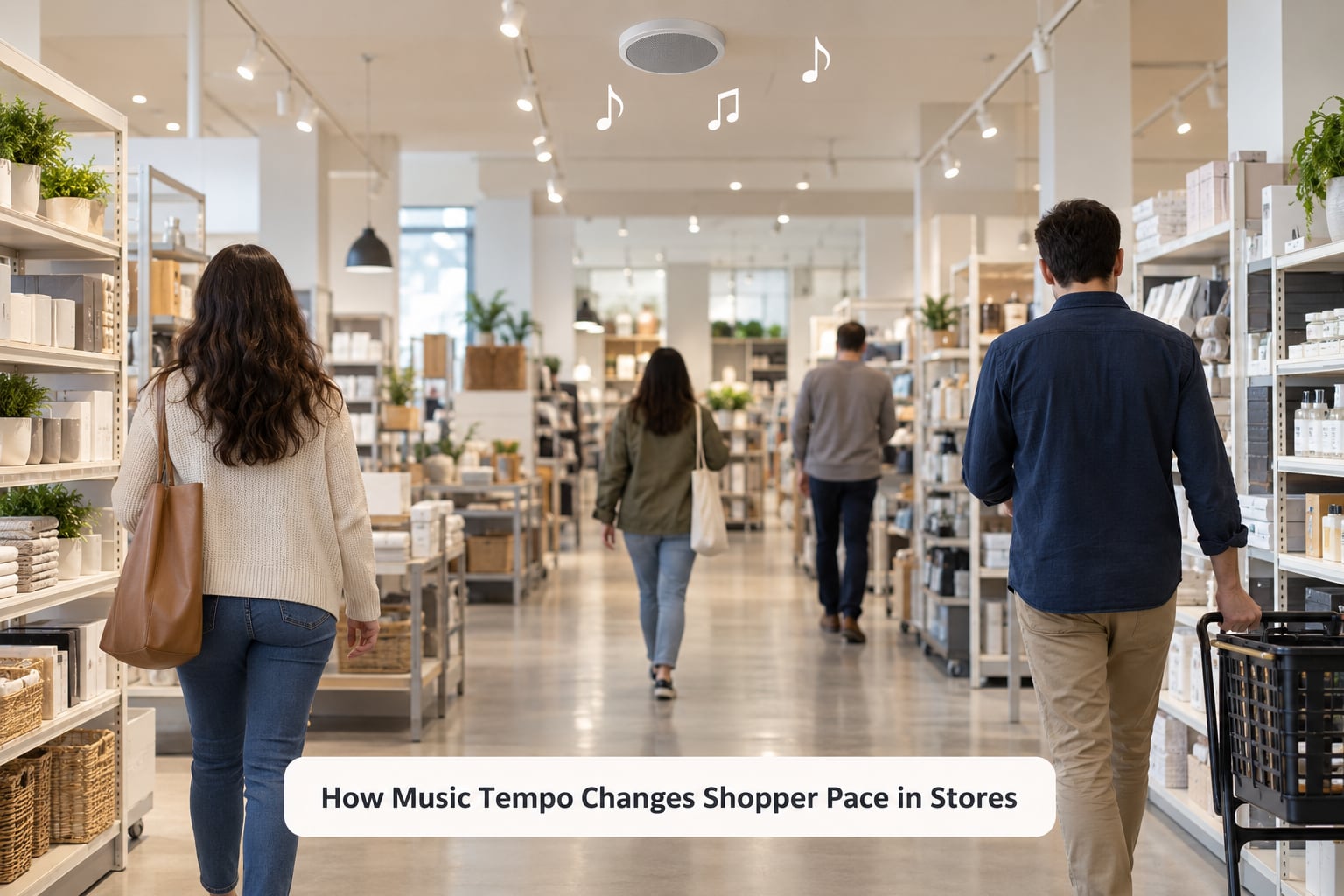
Shopper pace is three things at once: walking speed, how often a person stops, and how long the visit lasts before they leave. Those three can move in opposite directions. Someone walking quickly down an aisle can still spend twelve minutes in the store, and someone browsing slowly can leave in four.
Tempo acts on that set through arousal and time perception. A faster beat nudges the body toward movement and speeds up the felt sense of time passing, so a trip that takes ten minutes feels like seven. A slower beat does the reverse, and shoppers tend to walk more, stop more often, and read the visit as longer.
Speed is not the same as revenue, and it is not the same as satisfaction either. Shoppers who feel hurried report the store as more crowded and are quicker to abandon a line; shoppers who feel unhurried browse wider. If a retailer treats pace as a proxy for sales, the measure quietly stops meaning what the dashboard says it means.
The measurable language of store music is small: tempo (BPM), rhythm and texture, mode (major or minor), pitch, volume and how familiar the track is. A track moving from one speed to another mid-playlist is a tempo change, sometimes marked with a gradual transition rather than an abrupt switch.
Here is what the foundational work actually measured. Read the reported direction column as a summary of each study’s conclusion, not as a guaranteed result.
| Researcher | Year | Setting | What changed | What was measured | Reported direction |
|---|---|---|---|---|---|
| Milliman | 1982 | Supermarket | Slow vs fast in-store music | Time in store, spending | Slower music: more time, higher spending per shopper |
| Milliman | 1986 | Restaurant | Slow vs fast background music | Time at table, spending | Slower music: longer stays, higher spend |
| Sommer | 1999 | Supermarket | Ambient music tempo | Variety of items purchased | Slower music linked to wider item variety |
| Knoferle and colleagues | 2012 | Laboratory retail simulation | Tempo crossed with major vs minor mode | Estimated time in store, spending estimates | Slow tempo raised estimates in major mode; the pattern reversed in minor mode |
| Yalch and Spangenberg | 1990s | Store environment studies | Background music conditions | Perceived time and pace | Music shifts how long a shopping trip feels |
Two caveats belong next to that table rather than buried in a footnote. Most of this work is quasi-experimental: one store, one playlist pair, one period, with shoppers who did not know they were in an experiment. And the restaurant findings have been harder to reproduce than the supermarket ones, which is why smart retailers treat tempo as a dial to test rather than a rule.
You will also see precise sales-lift numbers attached to the 1982 supermarket work online. One retelling claims roughly 32 percent, another claims about 39.2 percent. Both cannot describe the same sample, and neither comes with a method you can audit from a blog post. Use them as a sign that the effect is large enough to write about, not as a forecast for your store.
What Does Music Tempo Do to Shopper Behavior?
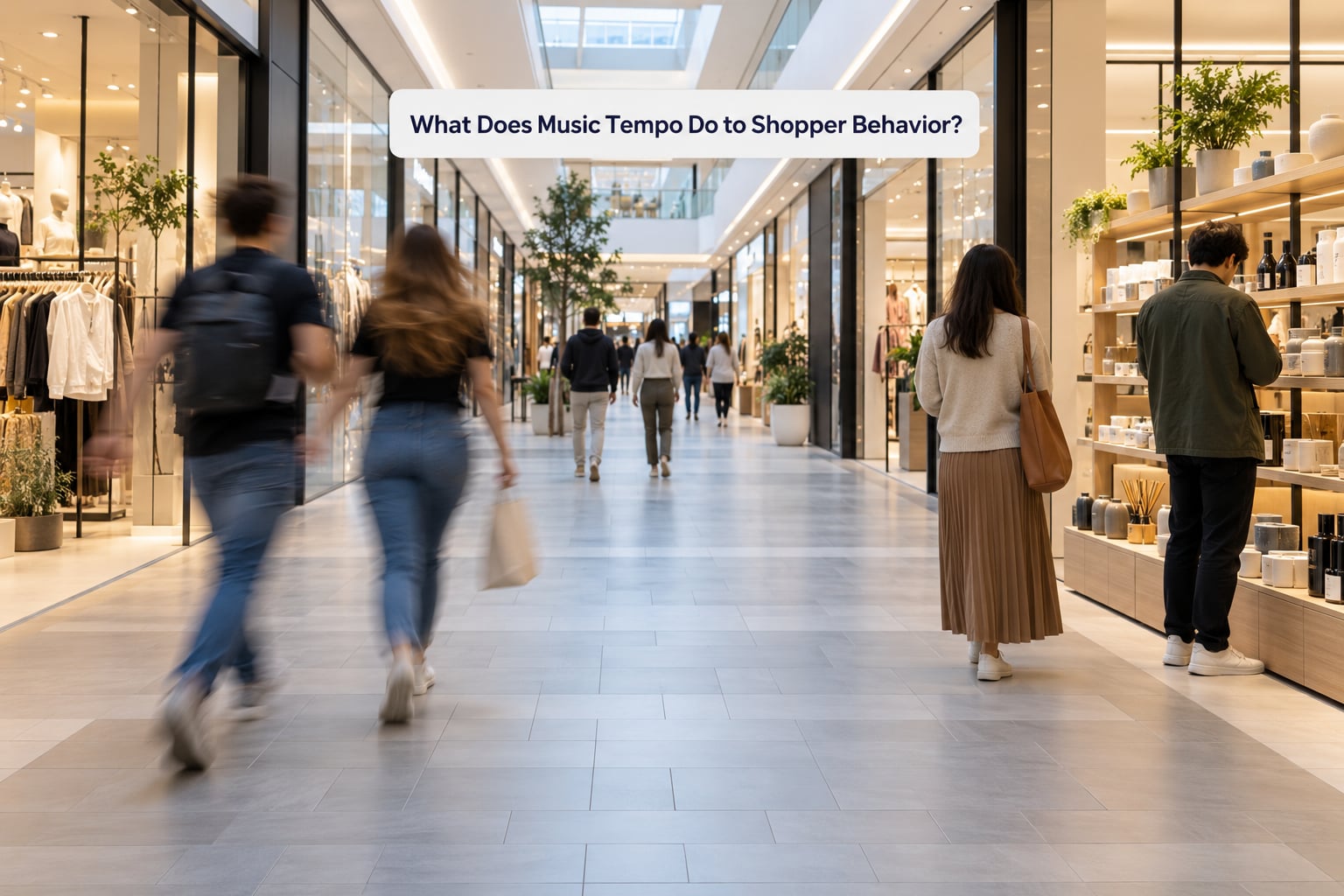
Tempo influences shoppers through a handful of pathways, and they are much better documented individually than together. The practical value for a retailer is knowing which pathway the store is trying to move.
- Movement speed. Faster beats are associated with faster walking and a shorter route through the floor. This is the most consistent of the effects.
- Time perception. Music changes how long a trip feels. Faster play compresses the felt duration, which matters most in queues and waiting rooms.
- Attentional narrowing. A driving beat pulls attention toward rhythm and away from incidental detail. In a store full of signage, that can reduce scanning.
- Choice comfort. People who feel hurried take fewer, safer options. People who feel relaxed take longer over a decision.
- Arousal. Tempo is one input among several into a general state of activation, alongside volume, mode and genre. On its own it is a weak lever.
The distinction between the first item and the rest matters. Movement speed shows up reliably in observation; purchase outcomes show up unreliably, because spending depends on price, promotion, stock and footfall far more than on a playlist.
How Does Tempo Affect Browsing, Dwell Time and Purchases?
Trace it in order and the chain is fairly clean. Tempo shifts walking speed. Walking speed changes how many displays a shopper passes within reach. That changes stopping points. More stopping points means more dwell time. More dwell time means more items examined, and examined items are more likely to end up in a basket.
It also runs the other way in queues. When perceived waiting time is compressed, tolerance for a line goes up, and a shop that is close to its throughput limit gets through more of its peak footfall without the aisles seizing up.
Conversion is the step most likely to disappoint. Nothing in the research suggests that slower music makes people want to buy more of what they came for. It tends to widen exploration, which helps categories where browsing is the point and does very little for a shop where someone is buying one specific item on a list.
So if the goal is throughput, fast and functional. If the goal is discovery in a category that rewards it, slow and warm. If you cannot name which one you are optimizing for, the playlist will keep arguing with itself.
What BPM Means for Store Music
Tempo is the speed of the beat, counted in beats per minute. That is the whole definition, and it is the least useful part of choosing store music on its own. A 70 BPM ballad and a 70 BPM drum-and-bass track carry the same number and completely different energy.
| Tempo range | What it sounds like | Typical effect on shopper pace |
|---|---|---|
| Under 70 BPM | Ballads, ambient, sparse piano | Slower walking, longer dwell, can read as inactive if nothing else supports it |
| 70-100 BPM | Soft pop, acoustic covers, downtempo | Comfortable browsing pace; the safest general-purpose band for browsing stores |
| 100-120 BPM | Upbeat pop, light funk | Neutral to slightly brisker; rarely unpopular in general retail |
| 120-140 BPM | Dance-pop, energetic pop | Faster walking and faster decisions; suited to queues, food service and convenience |
| Above 140 BPM | Hard dance, high-energy club edits | Effective at moving a line, rarely right for a floor where people browse |
Treat these ranges as starting points for a test, not as rules. A slow track in a bright, open, wide-aisle store reads as calmer than the same number in a cramped, crowded aisle, because the shopper’s own pace and the physical space are part of the message.
The most useful way to set a target is to start from the shopper’s task rather than from the genre. Someone on a lunch break has a clock in their head. Someone browsing a gift wall does not. Those two people should not hear the same program, even in the same store, an hour apart.
Why Does Genre Matter as Much as Tempo?
Tempo is the number you can log. Genre, mode, instrumentation, vocals and familiarity are the variables shoppers actually respond to, and they move the outcome further than a 10 BPM change.
Mode is the clearest case. Knoferle and colleagues found that the effect of tempo depended on whether the music was major or minor, with the direction flipping between the two. In other words, the same slow beat in a major key and the same slow beat in a minor key did not produce the same behavior. Anyone who programs by BPM alone is optimizing one variable out of five.
Volume is the other one shoppers notice directly. People complain about loudness far more often than tempo, and the folk explanation is that loud music masks staff interaction and announcements, which makes a visit feel harder to navigate. If you raise volume to create energy, you are trading attention for noise.
Familiarity cuts both ways. A track people know gets processed on autopilot, so it barely registers as music. Something unfamiliar gets attention, and attention spent on the soundtrack is attention not spent on the shelf.
Culture and season matter as much as genre. The holiday complaints that show up in staff and shopper threads start weeks before December, which tells you a familiar seasonal loop is doing something to people well before they can name it.
When Should Stores Use Faster or Slower Music?
Match tempo to the job the shopper is doing in that part of the store. The table below is a starting grid for a test, not a finished program.
| Environment | Shopper task | Suggested BPM range | What to watch |
|---|---|---|---|
| Supermarket aisles | List shopping plus browsing | 70-100 | Whether slower music slows shoppers on a mission; A/B it before assuming |
| Fresh and prepared food | Slow browsing, appetite mood | 70-90 | Dwell time in the zone, not just spend per basket |
| Fashion and apparel | Long browsing, trying on | 80-110 | Fitting-room queue length; music carries into the queue |
| Electronics and mobile | Comparison, advice, list | 90-110 | Staff conversation audibility; drop volume before tempo |
| Beauty and cosmetics | Consultation and trial | 70-100 | Whether the floor feels calm rather than abandoned |
| Convenience and checkout | Fast, transactional, impulse | 115-140 | Impulse attachment rate at the till, not queue length alone |
| Food service and queue areas | Waiting, throughput | 115-140 | Perceived wait tolerance and line abandonment |
| Morning daypart | Getting in and out, coffee run | 100-120 | Energy on entry without pushing people past the produce |
| Evening daypart | Leisure browsing, longer dwell | 75-100 | Whether slower play slows the last-hour spend as well as the walk |
Two rules keep a program sane. Change tempo by daypart rather than by track, so shoppers hear a shift that matches their own day. And keep the loudness constant while you test tempo, or you will never know which one did the work.
How Can Retailers Test the Effect of Music Tempo?
Testing tempo in a live store is less expensive than most retailers assume. The hard part is discipline, not budget.
- Name the outcome first. Aisle walking speed, minutes in zone, time to first item, queue abandonment, or units per transaction. Pick one primary measure and one commercial measure.
- Hold everything else still. Same volume, same genre family, same signage, same staffing pattern, same weather if you have any control over the calendar.
- Alternate rather than switch. Run slow and fast in alternating blocks across comparable days, not a calm week followed by a loud week. Weekends and rainy Saturdays will bury the result.
- Measure pace as well as sales. Counters or simple timed observation give you walking speed and dwell; point-of-sale data gives you basket size and conversion. You need both, because they can move in opposite directions.
- Ask the staff. The people on the floor feel a tempo change before shoppers do, and they will tell you which version of the day felt worse.
- Watch for repetition fatigue. A one-hour loop is a fixture in retail, and workers on r/retail describe playing the same short set for an entire shift as tedious. Fatigue distorts both staff behavior and how shoppers read the space.
Worth knowing: individual staff have almost no influence over what plays. A thread on r/HEB makes that plain, with workers describing the soundtrack as something decided elsewhere and simply arriving in their store. If you test tempo, keep the staff informed and give someone a channel to report problems.
On the licensing question shops actually ask: most stores do not own the music. It comes through an in-store media provider, an agency, a mall-wide feed, or a national brand playlist, so changing tempo usually means changing what you request rather than what you buy.
What Are the Common Measurement Mistakes?
Most failed music tests fail for boring reasons.
- Judging from the busy period. Saturday footfall will look like a tempo win whatever you play.
- Changing two things. A new playlist plus a new promo layout tells you nothing about either.
- Ignoring volume. The most common audio change in retail is loudness, and it is the one most often folded into a “tempo” claim.
- Mixing shopper types. A quick mission shopper and a stroller family produce different pace readings in the same aisle at the same BPM.
- Trusting observation alone. Manual counts describe behavior but miss spend; point-of-sale data shows outcome but cannot tell you why.
- Forgetting season and weather. A holiday playlist in early October is a confound, not a tempo.
If you can only fix one thing, pair timed walking-speed observation with a point-of-sale comparison across matched days. Two data sources agreeing is the difference between a finding and a coincidence.
Frequently Asked Questions
What BPM is best for speeding up shoppers in a store?
Most retailers start a speed test in the 110-130 BPM range, which is energetic without turning the floor into a nightclub. Above 140 BPM works well for queues, convenience counters and food service, where the goal is moving a line rather than relaxing anyone. Below 100 BPM rarely speeds anybody up. Start at the middle of your band, keep volume constant, and let the measurement tell you whether the number helped.
Does faster store music always make shoppers buy more?
No. Faster tempo is fairly reliable at increasing walking speed and shortening perceived wait time, but the link to revenue is weak and inconsistent. Spending depends far more on price, promotion, stock and footfall. Some retailers report faster music in food service lifting turnover simply because tables turned sooner. Treat any sales-lift figure, including the 32 percent and 39.2 percent numbers repeated online, as something to test rather than to expect.
Is slow music better for encouraging browsing and dwell time?
Slower music is the better bet when the goal is exploration, which is why it shows up in apparel, fresh food and gift retail. Shoppers tend to walk more slowly, stop more often and report the visit as longer. It is a poor choice for anyone on a clock, and a very slow program in a bright, open store can read as a place where nothing is happening. Around 70 to 100 BPM is the usual browsing band.
Should grocery stores and clothing stores use different tempos?
They should. Grocery shoppers arrive with a list, a clock and a trolley, so faster programming suits the mission even when a slower track sits in the ambient bed. Clothing browsing is closer to browsing for its own sake, where slower play supports exploration and trial. That is also why daypart matters inside one store: the lunch run and the evening browse are different tasks sharing the same floor.
How can a retailer test music tempo without losing sales?
Alternate slow and fast blocks across comparable days instead of switching one whole week to another, and keep volume, genre family, signage and staffing as steady as you can. Measure walking speed and dwell time alongside basket size so a pace gain that costs conversion does not hide. Weeks with promotions, holidays or unusual weather should be excluded from the comparison rather than explained away afterward.
Does volume or genre matter more than BPM?
In practice, both of them matter more than the tempo number, which is the part most retailers can actually log. Genre and mode shape how a track is read emotionally, and the tempo effect has been shown to flip depending on major or minor mode. Volume is what shoppers complain about most, because loud music masks staff conversation and announcements. Change one variable at a time.
Conclusion
Start with an audit, not a playlist. Listen to what plays in your store at three times of day and write down the BPM range, the volume and the genre mix. Then decide which pace you actually want: throughput, comfort or exploration.
Once that is written down, run one controlled test with volume and genre held constant, and read the behavioral and commercial numbers together rather than picking whichever one flatters you. Everything else in store music follows from that discipline.