A research debrief presentation works when it is built backwards from the decision, not forwards from the report. You open with the choice the audience faces, state your answer with its confidence level in the first three slides, then build the evidence one idea at a time so nobody has to guess where the argument is going. The rest of the session follows the same logic: findings, limits, recommendations, decisions with owners.
Most debriefs fail in a predictable way. Someone takes the written report, cuts it into pages, and reads it aloud. That deck is too heavy to present live and too thin to forward afterwards, so it does neither job well. Knowing how to structure a research debrief presentation is what separates the two.
Here is the short version before the detail:
- Start with the decision at stake. Name the choice, the person who owns it and the date it has to be made.
- Give the answer by slide three. The headline finding and its confidence level appear before any methodology.
- Sequence slides as a chain of questions. Each slide answers one question the previous one raised.
- Show what the research could not establish. One slide, in the main flow, never a footnote.
- End on decisions, owners and dates. A readout with no decision taken was a status update.
- Move everything else to the appendix. Full tables, instrument, quotas and code frames live there.
Those six lines are the spine. The rest of this guide fills in the mechanics: what to prepare, how to write each slide, how many slides the session can actually hold, and what to do when a stakeholder challenges a finding in the room.
Table of Contents
- What You Need
- The decision at stake, in one sentence
- The audience list, with a role against each name
- The questions the deck has to answer
- An agreed evidence standard
- A send-ahead pack and an appendix folder
- A time budget, a facilitator and a note taker
- Step-by-Step: How to Structure a Research Debrief Presentation
- 1. Start with the decision, not the methodology
- 2. Give the audience a short executive storyline
- 3. Establish the research context and approach
- 4. Present findings in a consistent evidence pattern
- 5. Connect findings to audience needs and tensions
- 6. Translate insight into implications
- 7. Make recommendations specific and testable
- 8. Close with decisions, owners and next steps
- Common Mistakes
- Opening on objectives
- Reporting every chart
- Dense slides that get read aloud
- Confusing insight with implication
- Hiding the conclusion and the limitations
- Ending without a decision
- Running long because discussion was never reserved
- Letting pushback arrive unprepared
- The cut order for an overlong deck
- Frequently Asked Questions
- How do you structure a debrief?
- What are the five key points of debriefing?
- What four questions should be asked during a debrief?
- How do you present research findings to an executive audience?
- How long should a research debrief be?
- What do you do when the research was inconclusive?
- Conclusion
What You Need

Most of what makes a debrief feel focused was decided days before the room, in preparation, not in the room itself.
The decision at stake, in one sentence
If you cannot write the decision in a single sentence, you are not ready to build the deck. Something like “should we move the trial packaging from the current 500g format to two 250g packs for the second half of the year” tells you what evidence matters. “Findings from the packaging study” does not.
Write it, then name the person who owns that decision and the date by which it must be made. If nobody in the room can own the decision, you are presenting an update, not running a debrief, and the structure changes accordingly.
The audience list, with a role against each name
Sort everyone into three groups: decision-makers who need to act, contributors who supply context or expertise, and observers who need awareness only. Mixed audiences are where decks go wrong, because a designer and a finance lead need different evidence from the same study.
For a mixed room, put the commercial and behavioural evidence in the main flow and push the technical detail to the appendix. If someone in the second group cannot follow the main story without help, the story is pitched wrong, not the person.
The questions the deck has to answer
Write down three to five questions in the words your stakeholders actually use, not the words the report uses. “Will people pay more for less packaging” is a real question. “Do respondents associate refill with sustainability” is a research objective, and it belongs on the method slide rather than the argument.
Every slide you keep should trace back to one of those questions. Every slide that does not is a candidate for the appendix.
An agreed evidence standard
Decide in advance what the study can support and what it cannot. For quantitative work that means the base size for each cut, the confidence level you are prepared to stand behind and the minimum subgroup size you will quote. For qualitative work it means how many participants said something before you will call it a theme.
Write these thresholds down before you read your own charts. Once you are deep in the data, it is easy to quietly relax a rule because an interesting cut appears.
A send-ahead pack and an appendix folder
Send the deck, or at least the executive summary and the agenda, 48 hours ahead. People who walk into a readout cold spend the first fifteen minutes forming an opinion about the study, and they rarely revise it.
Prepare a separate appendix folder with full tables, the instrument or interview guide, quotas, the coding frame and any wave-over-wave detail. Number the findings (F1, F2, F3) and the recommendations (R1, R2, R3) so that people can reference them in the discussion and in the follow-up email.
A time budget, a facilitator and a note taker
Reserve a third of the session for discussion and protect it. The most common failure in the room is not a hostile question, it is the presenter running eleven minutes past the point where the decision needed to be made.
Use a facilitator who is not the researcher when the findings are contested or the stakes are high. The person presenting the evidence cannot also police the conversation, and the second role usually wins over the first.
Step-by-Step: How to Structure a Research Debrief Presentation
Structure a research debrief presentation in eight moves: frame the decision, give the audience a three-part storyline, establish enough method to build confidence, present findings in a repeating evidence pattern, synthesise them into themes and tensions, translate those into implications, turn the implications into testable recommendations, then close on decisions, owners and next steps. Each move has a clear output and a simple check that it worked.
1. Start with the decision, not the methodology
The first slide is not “objectives” and it is not a logo. It states the decision the room faces, the person who owns it, the date and the cost of getting it wrong in either direction.
Slide one, roughly: the decision, the owner, the date. Slide two: the answer in one sentence, with the confidence level attached. Slide three: the three-part storyline for the session, so people know how long it runs and where their questions belong.
The test: read only the first three slides to someone who was not in the room. If they can describe both the decision and your recommendation, the opening works. If they cannot, you are still writing background.
2. Give the audience a short executive storyline
Most decks fail because nobody in the room knows how many findings there are or how the pieces connect. A three-part storyline fixes that in about fifteen seconds.
- Where we are. One slide of context: the market, the customer question, the business problem. No history.
- What we found. The central discovery, usually three to five supporting findings that each explain part of it.
- What it means for us. The implication and the recommendation, including what you would not do.
Give each part a plain signpost and one sentence that sums it up. “Three things we were wrong about” is a better signpost than “Section 2: Findings”, because it tells a sceptical executive exactly what kind of slide is coming.
Here is the whole deck on one page. The example headlines come from a fictional packaging study, but the structure transfers to any project:
| Slide | Purpose | Headline says | Evidence on the slide | Time |
|---|---|---|---|---|
| 1 | The decision at stake | The choice, its owner and the date | None. Context only | 1 min |
| 2 | The answer | What we recommend, with confidence | None | 1 min |
| 3 | Storyline | Three parts, with time per part | None | 1 min |
| 4 | Context | What the business is trying to solve | One chart or one image | 2 min |
| 5 | Method, in brief | Sample, recruitment, fieldwork dates | Base sizes and quotas | 2 min |
| 6 | Central finding | The discovery in one sentence | One dominant chart | 3 min |
| 7 | Finding F1 | The finding as an assertion | Chart plus two quotes | 3 min |
| 8 | Finding F2 | The finding as an assertion | Chart or concept map | 3 min |
| 9 | Finding F3 | The finding as an assertion | Chart plus segment split | 3 min |
| 10 | Tensions | Where the evidence contradicts itself | Two columns side by side | 2 min |
| 11 | Limits | What this research could not establish | List of gaps | 2 min |
| 12 | Implications | What we should consider doing | Three boxes | 2 min |
| 13 | Recommendations | R1, R2, R3 with confidence and owner | Table with owner and date | 3 min |
| 14 | Decisions and next steps | What is decided, by whom, by when | Action list | 3 min |
Notice what is missing: an agenda slide, a thank-you slide, a team credits slide inside the main flow, and every individual chart. That is the point. Credits belong on a closing frame or in the appendix, and the individual charts are already inside the findings.
3. Establish the research context and approach
The method slide is not an apology and it is not a lecture. It exists so the audience can calibrate how much weight the findings can take, which means four things and nothing else: the objective in one line, who was included and how many, when fieldwork ran, and the limitations that matter for the decision at hand.
Put base sizes on the slide, not in the appendix. A percentage without its base is a decoration. “62% of pack buyers said they would try refill” means something quite different from “62% of 18 to 34s in urban households said they would try refill”, and the audience cannot tell which one they are looking at unless you say so.
Skip anything that does not change how much someone should believe you. Recruitment channel matters when it affects who answered. Screening criteria matter when a subgroup is central. A list of every question in the questionnaire does not.
The check: a sceptic should be able to tell from this slide alone where your evidence is strong and where it is thin. If they cannot, add the missing detail here rather than waiting for the appendix.
4. Present findings in a consistent evidence pattern
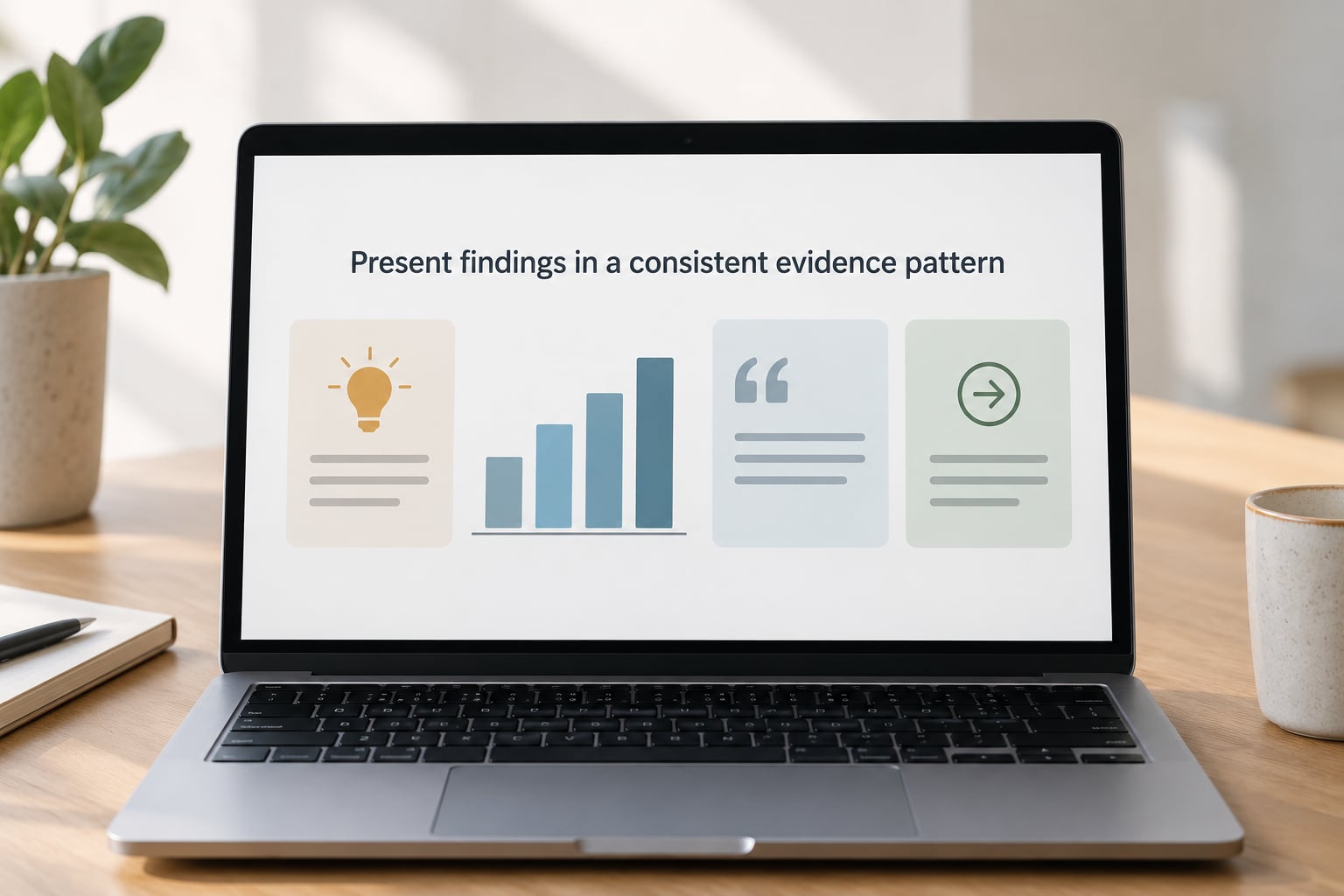
Every finding slide should follow the same four-part pattern, so the audience learns the shape once and stops spending attention on your slide design.
- The finding, stated as a full sentence headline.
- The evidence: one dominant chart, or one chart and two supporting quotes.
- What it means, in one line.
- What we should consider doing about it.
That last line is what most decks omit, and it is what turns a finding into something a stakeholder can act on. “Refill interest is highest in the 25 to 34 group” is an observation. “Refill is worth testing as a subscription mechanic for that group rather than a one-off purchase” is an implication.
Write headlines as assertions, not labels. “Segment results” tells the audience nothing. “Older buyers are not interested in refill at any price point” tells them the finding before the chart loads, and if the chart contradicts the headline they can stop you immediately, which is exactly what you want.
Keep one dominant element per slide. Two charts side by side produce a conversation about the charts rather than about the finding, and the finding is the thing you are there to deliver.
For qualitative evidence, treat quotes as evidence rather than decoration. Anonymise them, mark the base they come from and keep them short. A single quote illustrating a theme you established across a coded set is fine; a quote standing in for that evidence is not.
5. Connect findings to audience needs and tensions
Individual findings are not a synthesis. The synthesis slide is where you group them into themes, needs, barriers and segments, and where you show the contradictions.
Three patterns recur in most studies and each needs a decision. Unanimity means the finding is solid and the argument is about execution, which is the easy case. Segmentation means the finding is real for one group and absent for another, and the debate is about priority. Tension means two findings point in opposite directions, and you need to explain why before anyone will act on either.
Show tensions explicitly rather than hoping the sharper slide wins. Two columns, the contradictory finding on each side, and your read of what is driving it. Practitioners who have run these sessions report that raising the contradiction first is what keeps a sceptical stakeholder from spending the meeting trying to find it.
The check: after this slide, the central finding should look inevitable rather than merely stated. If your synthesis is a list of themes with no hierarchy, you have not synthesised yet.
6. Translate insight into implications
Implications are the bridge between what the research says and what the organisation might do, and they are where most decks jump straight to recommendations and lose credibility.
Split them into three columns on one slide: opportunities, risks, and open questions that need more work. The third column is not padding. It tells the audience which parts of the story you are not claiming, and it converts “you have not thought about X” from an attack into something you already flagged.
Keep implications conditional where they are conditional. “If refill interest survives contact with shelf prices” is a better line than “adopt refill”, because it tells the room exactly which assumption the recommendation rests on, and you can point back to it when that assumption is challenged.
The check: for each implication, can you name the finding it came from? If an implication has no finding behind it, it is an opinion wearing a research finding’s clothes, and someone will take it apart.
7. Make recommendations specific and testable
A recommendation is only finished when someone could act on it without asking a follow-up question. For each one, name the audience or behaviour it targets, the rationale that connects it to a numbered finding, a confidence marker, a named owner and a next step.
“Explore refill further” fails on every count. “Test refill packs as a subscription option with urban 25 to 34s, based on F1 and F3, medium confidence, owner Sam in Category, next step is a concept test in six weeks” passes.
Confidence markers are worth the effort even when they are uncomfortable. High for something the data supports directly, medium for a supported inference, low for a hypothesis worth testing. Marking a recommendation low confidence tells the room it is a proposed experiment rather than a conclusion, and that framing changes how people respond to it.
Rank by decision value, not by certainty. The lowest-confidence recommendation might still be the most important one to fund this quarter, and the deck should say so out loud.
8. Close with decisions, owners and next steps
The final slide is an action list, not a summary. Each row: the decision, who owns it, the date, and the sign-off status. If nothing was decided in the room, write that down as well, because “no decision, revisit on 14 November” is a legitimate and far more useful outcome than leaving the room with an agreement in the hallway.
Hold the discussion to four questions, and put them on the agenda slide so nobody has to invent them:
- What has to be true for us to act on this?
- Which finding are we least comfortable with, and why?
- What would change the recommendation?
- Who owns each next step, and by when?
Answer the first two before you reach the appendix. The rest can run as long as the room wants, but keep the evidence behind you available on screen rather than behind a hidden folder.
Now the timing. The rule of thumb from experienced facilitators is two to three minutes per substantive slide, with a third of the session reserved for discussion. That arithmetic is worth writing on a sticky note before you build the deck, because it decides how many slides you can afford.
| Session length | Presentation time | Discussion time | Slide budget |
|---|---|---|---|
| 30 minutes | 18 minutes | 12 minutes | 8 to 10 slides |
| 45 minutes | 30 minutes | 15 minutes | 13 to 15 slides |
| 60 minutes | 38 minutes | 22 minutes | 16 to 18 slides |
| 90 minutes | 55 minutes | 35 minutes | 22 to 25 slides |
If a forwarded deck also has to work read-alone, you have a second artefact to think about. The live deck carries the argument in its slide order; the read-along deck carries it in speaker notes and captions, because a person reading it alone cannot hear your caveats. The practical fix is to add short captions under each chart that state the finding and its base, and to write speaker notes as if the reader is a sceptic who missed the meeting.
Common Mistakes
Each of these has a direct fix, and the fix is usually structural rather than cosmetic.
Opening on objectives
The audience does not need to know how the study was framed before they know what it found. Move objectives into the method slide at slide five and use the opening for the decision and the answer.
Reporting every chart
A deck that contains every exhibit in the report is a report with page breaks. Choose one dominant chart per finding and move the rest to the appendix, ordered by the question someone is most likely to ask.
Dense slides that get read aloud
If a slide needs a paragraph of explanation, it is carrying two ideas or the wrong idea. Cut it, split it, or move the text into speaker notes. Whitespace is not wasted space when the reader has to absorb an argument at speed.
Confusing insight with implication
An insight describes what you learned. An implication describes what follows for the organisation. Label them differently on the slide, because the second is what people will argue about and it needs to be visibly distinct from the evidence.
Hiding the conclusion and the limitations
If the answer sits on slide twenty and the gaps sit in a footnote, nobody has the full picture when they start challenging. Put the limits in the main flow, on their own slide, with a headline that states them as a finding about the evidence rather than a caveat.
Ending without a decision
A readout that ends with “we will circulate the full report” has produced nothing. Build the closing action list backwards: for each open decision, name the owner and the date before the session and ask for a signature in the room.
Running long because discussion was never reserved
Reserve a third of the session in the invitation, not just in your own plan. If the room overruns, cut the deck rather than the discussion block, and use the order below to decide what goes.
Letting pushback arrive unprepared
Assume three to five questions: how strong is the evidence, how representative was the sample, why does this contradict the last study, why are we not doing nothing, and who is accountable for the next step. Each answer already exists somewhere in the deck. Put the support in the appendix in the order you expect the questions, so the answer is one click away rather than improvised.
The cut order for an overlong deck
Cut whole slides before you cut inside a slide, and never cut base sizes or confidence markers to save space. Then drop supporting findings that do not change the recommendation, then detail that belongs in the appendix anyway. Anything you cannot defend in one sentence as part of the argument does not survive the cut.
Frequently Asked Questions
How do you structure a debrief?
A debrief is a decision conversation, so structure it as a chain of questions rather than as report sections. Open with the decision and its owner, give your answer with a confidence level by slide three, then move through findings, tensions, limits, implications and recommendations, and close with decisions, owners and dates. Method detail and full tables go in the appendix.
What are the five key points of debriefing?
Five things carry most debriefs: the decision at stake, stated first; the answer with its confidence level, early; findings presented as assertion plus evidence plus implication, one per slide; an honest statement of what the research could not establish; and decisions with named owners and dates at the end. Miss any one of them and the session drifts toward a status update.
What four questions should be asked during a debrief?
Ask what has to be true for the team to act, which finding people are least comfortable with and why, what new evidence would change the recommendation, and who owns each next step and by when. Put these on the agenda slide so the discussion has a shape, and answer the first two from the evidence before anyone reaches for the appendix.
How do you present research findings to an executive audience?
Executives need the answer, the strength behind it and the cost of being wrong. Keep each finding to one dominant chart, write the headline as the finding rather than a label, show base sizes on the slide, and translate each finding into a specific implication. Two or three minutes per slide and a reserved third of the session for discussion is a workable rhythm.
How long should a research debrief be?
Budget two to three minutes per substantive slide and reserve a third of the session for discussion. That gives roughly 8 to 10 slides for a 30-minute session, 13 to 15 for 45 minutes, 16 to 18 for 60 minutes and 22 to 25 for 90 minutes. Put the longer version in the appendix rather than speeding up the presentation.
What do you do when the research was inconclusive?
Say so early and make it the headline of a slide rather than a caveat at the end. Inconclusive usually means one of three things: the effect is too small to matter, the segments disagree, or the instrument was wrong. Name which one applies, state what you can and cannot say, and convert the gap into a proposed next study with a decision attached to it.
Conclusion
Start with the first action, not the software: before you open a slide template, write one sentence for the decision at stake, one for the answer with its confidence level, and one for the outcome you want from the session. Everything after that is sequence, and sequence you can edit in an afternoon.
Build the deck backwards from the closing action list, keep one idea per slide with the finding written in the headline, and give the limitations their own slide. When the deck is forwarded a week later to someone who missed the meeting, those three habits are the reason it still makes sense.