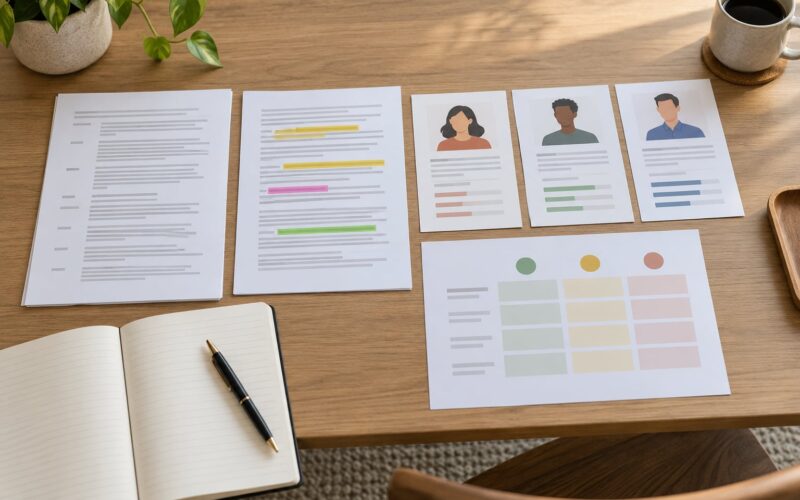
A research roadmap is a year-long plan that lists, in priority order, the research questions your organisation has committed to answering, showing the method, timing, owner, budget and the business decision each piece of research will inform. Building one takes roughly two weeks of focused work plus a sign-off meeting, and it is the difference between an insights team that answers the questions the business actually needs answered and one that runs whatever study was emailed in last Tuesday.
The method below is built for marketing and consumer insights leads, research directors and CMOs, from a solo in-house researcher to a team covering three business units. It works because it starts with decisions rather than methods. Nothing gets commissioned until someone has named the decision it will support.
Table of Contents
- What You Need
- How to Build a Research Roadmap for the Year
- Step 1: Start with the decisions the research must inform
- Step 2: Turn decisions into research objectives
- Step 3: Map the evidence gaps and choose the right methods
- Step 4: Sequence the work across the year
- Step 5: Assign owners, timing, budgets, and deliverables
- How to prioritize research when everything is a priority
- What fields a research roadmap template needs
- Budget allocation across the year
- Step 6: Build in quality checks and decision gates
- Step 7: Review and refresh the roadmap
- Common Mistakes
- Frequently Asked Questions
- What is a research roadmap?
- Can ChatGPT create a research roadmap?
- Is there a free way to create a research roadmap?
- Can you create a roadmap in Excel?
- How do you prioritise research when everything is a priority?
- How often should a research roadmap be reviewed?
- Conclusion
What You Need

Gather these six inputs before you open a blank document. Without them, the roadmap becomes a wishlist.
- Business objectives for the coming year. Three to six objectives, written by the people who own them, not paraphrased by research.
- Stakeholder questions. Everyone who will commission or consume research in the next twelve months, plus the questions they arrive with.
- Prior-year evidence. Every study, tracker wave, readout and unanswered question from the last twelve months.
- Customer and market context. Competitive moves, category shifts, whatever the sales team keeps hearing on calls.
- Budget and capacity reality. The actual number for the year, and how many researcher-weeks sit behind it once you subtract analysis and reporting time.
- Decision calendar. Dates the business has already committed to: a launch, a repositioning, a pricing change, a board meeting.
Add a decision log from last year if you have one. Which studies actually changed a plan, and which were read once and filed away? That ratio is the most honest input you will collect all quarter, and it tells you what to cut before anyone asks.
How to Build a Research Roadmap for the Year
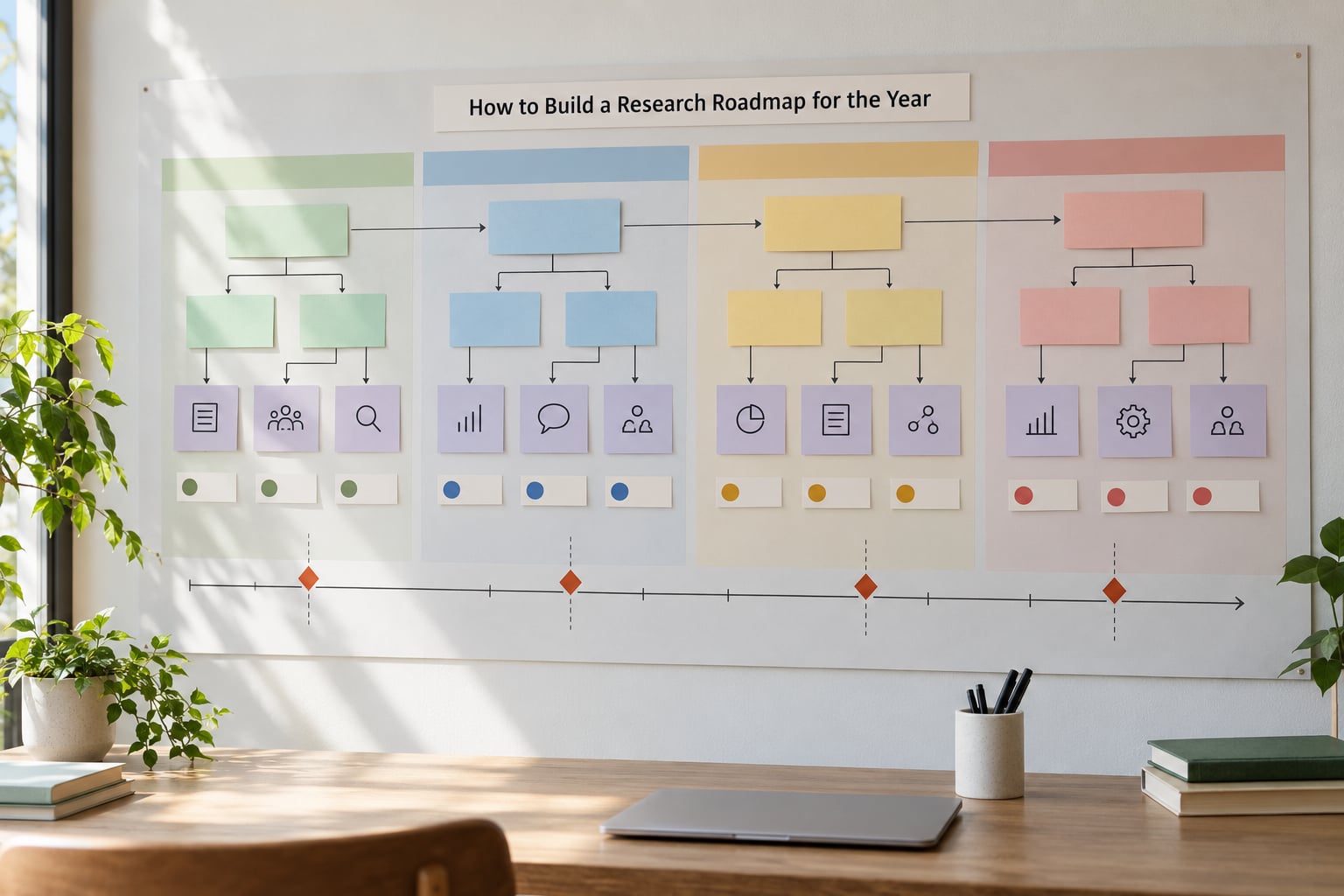
The process runs in seven steps. Each one produces something the next step consumes, so resist the urge to jump to the calendar and start scheduling surveys.
Step 1: Start with the decisions the research must inform
Write down every decision the business will make in the next twelve months that depends on evidence: which segment to target, whether to launch, what to charge, which channel to fund, whether the brand promise still lands. For each one, name the person who makes the call and the date they need it.
If you cannot name the decision, you do not have a research question yet. That single test removes more wasted fieldwork than any budgeting technique I know.
Step 2: Turn decisions into research objectives
Each decision becomes one or more objectives written as what you need to learn, not what you will do. “Understand why churn rises after month three” beats “run a churn survey”, because the second one assumes the method before you know what will move the decision.
Cover the ground your business actually lives in: customers and segments, competitors and category, channels, product and portfolio, communications and messaging, and the barriers that stop people choosing you. A roadmap that only studies attitudes is a mood ring for the leadership team.
Step 3: Map the evidence gaps and choose the right methods
Now check what you already know. Researchers on r/UXResearch describe the same move from the other side: start with the top four or five business problems, map what data already exists against them, and only then plan new fieldwork. It stops you paying to answer a question the tracker answered in March.
Match the gap to the method. Attitudes and reactions to new ideas are one problem, and behaviour in the aisle is another. The table below is the shortcut most teams use.
| Gap you need to close | Method that fits | Typical fieldwork |
|---|---|---|
| Why people behave this way | Depth interviews, ethnography | 2 to 4 weeks |
| How big a group holds this view | Online survey with quotas | 3 to 5 weeks |
| Whether a concept earns a second look | Concept testing, monadic cells | 3 to 4 weeks |
| Whether messaging persuades | Message testing, copy testing | 2 to 3 weeks |
| Whether it moved over time | Brand tracker, re-test with controls | Rolling waves |
| What actually happens in market | Behavioural data, retail audit, A/B tests | Continuous |
| Who is buying and switching | Segmentation, panel or purchase data | 4 to 6 weeks |
Two rules keep a roadmap honest here. One qualitative round before the big survey tells you whether your question is the right one. And every quant study earns its place only if you have already decided what result would change the decision, because a survey with no possible outcome is expensive reading.
Step 4: Sequence the work across the year
Split the year into quarters and place work around the decisions, not around your convenience. Foundational and exploratory research goes early because later studies depend on it. Testing and tracking clusters around launch and campaign windows. Reviews land two to three weeks before a decision, not the week of it.
A workable split looks like this for a consumer brand with one launch and one repositioning in the year:
| Quarter | Focus | Typical commitment |
|---|---|---|
| Q1 | Diagnose. Harvest prior-year questions, run foundational work | About 30% of budget |
| Q2 | Explore the biggest unresolved question, screen early concepts | About 25% |
| Q3 | Test and optimise ahead of the launch window, tracker wave | About 30% |
| Q4 | Read out, re-plan, prep next year’s objectives | About 15% |
Then subtract. Count the fieldwork weeks, the analysis weeks and the write-up weeks each study really consumes, and compare that to what your team can absorb. Most over-committed roadmaps are built from fieldwork time alone and forget that synthesis takes as long as fieldwork.
Step 5: Assign owners, timing, budgets, and deliverables
Every row needs a named owner, not a team name, a budget line, a fieldwork window and a deliverable with a date attached. The deliverable is the sentence “the brand team will know whether to pursue segment B by 14 March”, not “insights report”.
Write dependencies down too. A concept test that needs the positioning result from Q2 cannot start in May, and everyone learns that faster when it is written on the roadmap than when the fieldwork is already booked.
How to prioritize research when everything is a priority
Every team hits the same wall: four business units, each with requests that all sound equally urgent, and capacity for a fraction of them. Score instead of argue. Give each question a 1 to 5 rating on impact (what changes if we know), urgency (when the decision lands), confidence gap (how wrong we might be today) and effort (cost and weeks), then total it.
Weighted scoring is the most useful version because you control the weights: double urgency if your business has a hard launch date, or drop effort to a token value if you already know which studies are expensive. Simple impact-effort grids are faster in a meeting but hide the tradeoffs. RICE and ICE, which multiply reach, impact, confidence and effort, work well when you can estimate reach numerically and badly when you cannot. Run the scores in the room, not in advance, so the arguments happen about the weights rather than about who shouted loudest.
Then publish the ranking to everyone who asked, including the requests you declined and the one that pushed them over the edge. That single act does more for trust than any methodology talk, and it ends the monthly re-negotiation.
What fields a research roadmap template needs
One row per study, and these columns. It looks unglamorous, which is the point, because every later conversation is easier when the answer is already in a row.
| Field | What goes in it |
|---|---|
| Quarter and fieldwork window | When the study runs, set backwards from the decision date |
| Business objective | The objective this study serves, in the owner’s words |
| Learning question | The specific thing you need to learn |
| Method and sample | Method, target sample or participant count, recruitment source |
| Budget | Line cost including incentives and contingency |
| Owner | A named person, not a team |
| Decision informed | The specific call, its owner and its date |
| Status | Planned, briefed, in field, read out, decision logged |
The last column is the one teams skip and the one that makes the roadmap defensible. A roadmap with a status column behaves like a project plan; without it, it is a wishlist with dates on it.
Budget allocation across the year
Roughly 30% up front for foundational and diagnostic work, about 25% in the exploratory middle, around 30% around the decision-heavy window where testing and tracking cluster, and the remaining 15% for read-outs and re-planning. This is a starting shape, not a rule. If you inherited an unresolved positioning question, that budget moves to Q1 and something smaller gets pushed out.
Hold back roughly 10% as contingency for recruitment overruns and fieldwork that runs long. A roadmap with zero slack is a roadmap that breaks in week six, and a broken one teaches stakeholders to distrust every date on the sheet.
Step 6: Build in quality checks and decision gates
Before fieldwork starts, gate the study: is the screener right, is the sample frame the audience we mean, is the questionnaire doing something other than confirming the brief. After it lands, gate the interpretation: does the read hold against behavioural data and sales reality, or does it only match what marketing wanted to hear.
The final gate is the decision itself, recorded in one line. Which way did it go, what evidence moved it, and would the same study have been run six months earlier with half the cost. That log becomes next year’s step one.
Step 7: Review and refresh the roadmap
Book the re-plan before you need it, usually a half-day at the end of each quarter. Bring the decision log, the new requests that arrived, and what changed in the business. Then add, drop or re-sequence.
Treating the roadmap as a living document is the habit that separates teams whose plans survive contact with the business from teams that abandon them by March, a complaint that comes up constantly in planning forums. Fixed-date roadmaps die the first time a priority shifts.
Common Mistakes
Starting with methods. “Let’s do a tracker and some interviews” is not a plan. It picks tools before anyone has said which decision needs evidence, and the study then goes looking for a question that fits it.
Promising an answer to every stakeholder. Demand overload is the most common failure. Serving several business units, everyone wants research, and a roadmap that says yes to all of it delivers nothing on time. Score the requests, publish the ranking, and let the arithmetic do the declining for you.
Scheduling research before business milestones. A readout that lands after the decision meeting is a wasted study. Work backwards from the decision date, then check that recruitment and fieldwork fit in front of it.
Underestimating recruitment and analysis. Hard-to-reach audiences, screeners, quotas and incentive budgets add weeks that were never in the plan. Publish a convention for padding estimates, even something as blunt as a flat 25% on fieldwork, so dates stay credible instead of quietly wrong.
Forgetting the last-step cost. Planning stops at the readout. The follow-up session where marketing rewrites the plan, and the activation work in the field, rarely get a slot on the calendar.
Building a document nobody maintains. A roadmap in a shared drive with no owner and no re-plan date becomes a static PDF by February. One named person, one place, one quarterly ritual.
Two smaller habits pay off. Write down what you deliberately chose not to research and why, so next year’s plan does not restart the same argument. And test your scoring in the room with executives present, because scores make tradeoffs visible in a way narrative justification never does.
Frequently Asked Questions
What is a research roadmap?
A research roadmap is a year-long plan listing the research questions an organisation has committed to answer, in priority order, with the method, timing, owner, budget and the business decision each study informs. It replaces a queue of ad hoc requests with a plan where every study traces back to a decision someone will actually make, and where tradeoffs are visible before fieldwork starts.
Can ChatGPT create a research roadmap?
It can help you draft one. Ask for a skeleton of objectives, learning questions, methods and quarterly sequencing, and you will get a usable starting structure in a few minutes. It cannot know your budget, your team’s capacity, what you already learned last year or which decisions are genuinely contested, so treat its output as a draft for your first working session, not a finished plan.
Is there a free way to create a research roadmap?
Yes. A spreadsheet with columns for quarter, business objective, learning question, method, sample, budget, owner and the decision informed will do most of the work, and a whiteboard or Miro board handles the sequencing view. Paid platforms add collaboration, version history and request intake, which matter as soon as several business units are involved, but they are not what makes the roadmap good.
Can you create a roadmap in Excel?
Excel is fine for the plan itself. One row per study, one column per field, and a quarter-by-quarter timeline view built from conditional formatting gives most small teams everything they need. Its weak point is intake: stakeholders will not log requests in a shared workbook, so keep a simple request form beside it and port requests in during the quarterly re-plan.
How do you prioritise research when everything is a priority?
Score every request on impact, urgency, confidence gap and effort, then publish the ranking to everyone who asked. The visible score does the declining for you, because the request that ranks last loses to arithmetic rather than to a personality in the room. Review the scores at each quarterly re-plan, since urgency changes faster than most teams assume.
How often should a research roadmap be reviewed?
Quarterly, for about half a day. Add new requests, drop work whose decision slipped, re-sequence anything blocked by a dependency, and log which findings changed a decision. Annual roadmaps that skip this ritual are accurate in January and fiction by June, which is the fastest way to lose a stakeholder’s trust in the plan.
Conclusion
Start with the next three important business decisions your team will face in the coming year. Name the person who makes each call and the date they need it, write the evidence each one requires, then place the highest-priority work on the annual calendar against the capacity and budget you actually have.
Only after that do you choose methods, brief vendors or talk to stakeholders about what you will research. A roadmap earns its keep by making the tradeoffs visible early, and every hour spent on decisions first is an hour you will not spend explaining in March why the study finished after the meeting it was meant to shape.