Negative reviews can increase sales when a balanced mix makes the praise on the same page believable. Buyers read a flawless 5.0 profile as curated or fabricated and discount it, while a realistic 4.0 to 4.4 average with specific criticism reads as authentic. The important part: it is credibility that lifts revenue, not the number of complaints.
I have watched two very different review pages produce opposite results in the same week. One was a 5.0 average with nine reviews, all glowing, and prospects simply did not convert. The other sat at 4.2 across a few hundred reviews, and the two- and three-star entries were the most-quoted part of the profile in sales calls.
That is the whole argument, and the rest of this piece is the evidence behind it, the cases where it reverses, and a way to test it in your own business. The flip side matters just as much: negative reviews are also the number one reason people decide not to contact a business, so the effect has a floor and a ceiling.
Table of Contents
- Why Can Negative Reviews Increase Sales?
- How Negative Reviews Can Increase Sales: The Consumer Psychology
- The authenticity test is the strongest mechanism
- Diagnostic value shortens the sales cycle
- Social proof needs a comparable customer
- What Kinds of Negative Reviews Work Best?
- The credible rating band runs from about 4.0 to 4.4
- Volume and valence are different levers
- When Does the Effect Disappear?
- How to Encourage Honest Reviews Without Creating More Problems
- Ask every buyer the same question
- Reply to criticism in public, and quickly
- Close the loop before the buyer leaves
- Show the work, not just the score
- How to Measure the Sales Effect
- Set up a before-and-after comparison
- Frequently Asked Questions
- Do negative reviews really increase sales?
- What is the best average rating for a product that has negative reviews?
- How many negative reviews are normal for a product or business?
- Should a business respond to negative reviews?
- Can too many negative reviews reduce sales?
- Is it ethical to use negative reviews in marketing?
- Conclusion
Why Can Negative Reviews Increase Sales?
Negative reviews increase sales by functioning as an authenticity test. A buyer cannot verify your claims directly, so they use criticism as evidence that the praise was not written by you. When a profile shows a realistic spread with detailed complaints, the positives carry more weight and the decision gets shorter. It only works while the underlying product and service are sound.
Two conditions have to hold at once. The criticism must be specific enough to look like a real experience, and it must be resolved or visibly taken seriously. A one-star review that gets a vague corporate reply is worse for you than no review at all, because now you have demonstrated that you do not listen.
The buyers I have talked to about this are not sentimental about reviews. They read them the way they read a car service log: looking for the failure point. That is why the article that only ever talks about how to respond to negative reviews misses the commercial question, which is why they convert at all.
How Negative Reviews Can Increase Sales: The Consumer Psychology
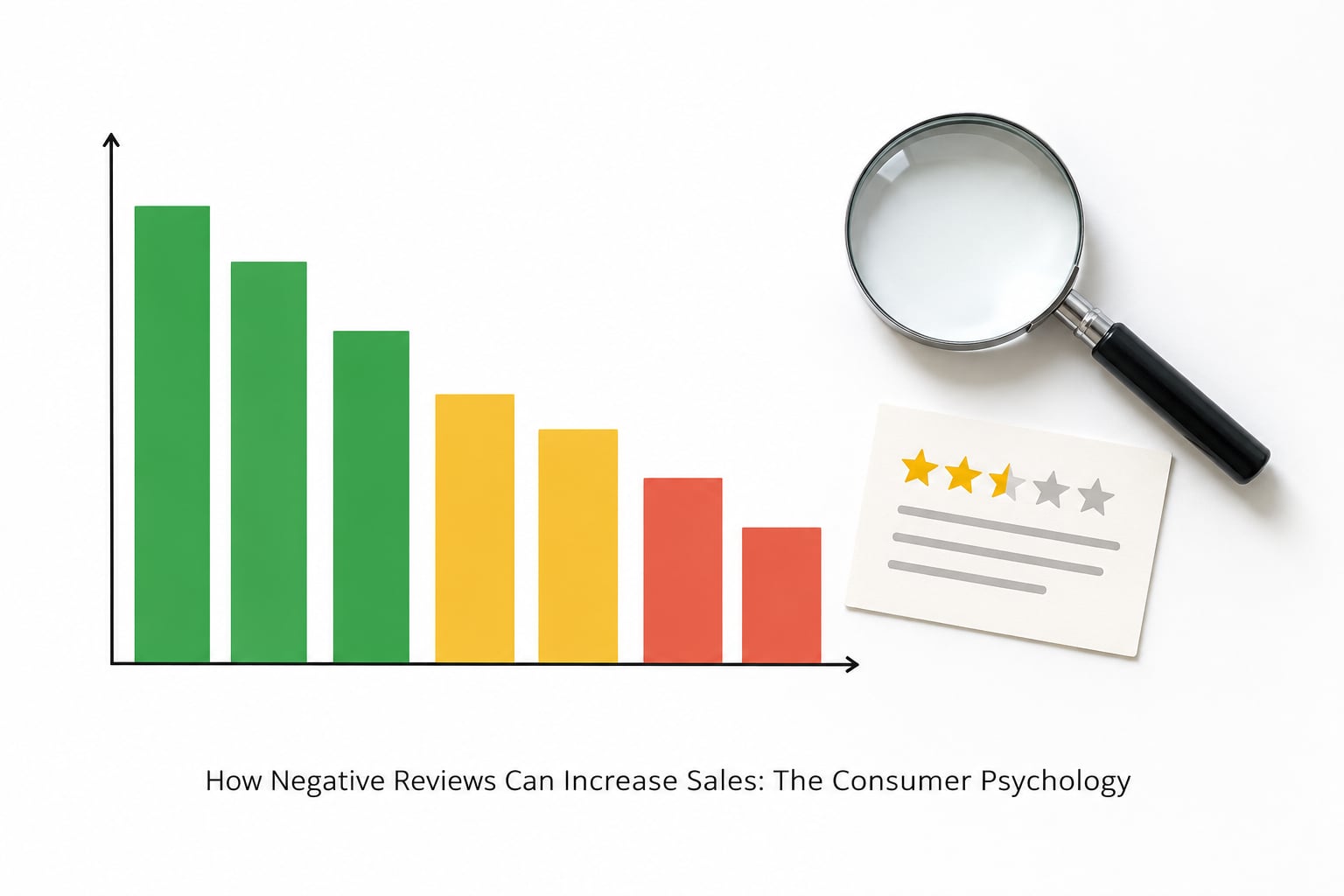
Six mechanisms explain most of the lift, and they are worth separating because each one calls for a different fix when it breaks down.
| Mechanism | What the buyer does with it | Typical effect on conversion |
|---|---|---|
| Authenticity test | Uses the presence of criticism to decide whether the praise is real | Higher trust in every positive review on the page |
| Diagnostic value | Learns the failure mode, then checks whether it applies to them | Shorter research stage, fewer follow-up calls |
| Uncertainty reduction | Replaces an unknown risk with a known, bounded one | Fewer abandoned carts and stalled deals |
| Social proof | Sees other people describing a comparable problem and outcome | Less perceived personal risk |
| Perceived seller control | Reads a public reply as evidence the seller handles problems | Lower perceived support risk |
| Credibility transfer | Attributes the specific criticism to honesty, not to failure | Higher willingness to start a conversation |
The authenticity test is the strongest mechanism
TrustRadius asked B2B software buyers what they do with the cons listed on a review page. The top answer was not to avoid the product. It was to decide whether the pros could be believed. That is a different job than the one most marketers assume.
The same research found that 88% of those buyers look for negative feedback alongside positive insights, and that only 16% read a positive-only profile as a sign the product is good. About a third distrust all the feedback on the page when it skews positive-only.
Practitioners describe the same test in plainer language. On a widely-shared thread about reading competitors’ bad reviews, one operator wrote that they look at the reviews and, if they are all five stars, they assume they are fake. Another described competitors’ one-star threads as a substitute for sales calls, because the complaints tell you exactly which objection to raise before a prospect does.
Diagnostic value shortens the sales cycle
A specific negative review answers a question the buyer would otherwise have to ask you. Reviews that mention a forty-minute setup with no advance call give your prospects the language of their own hesitation, and the deal moves to whether the product fits rather than whether they trust you.
Vague criticism does the opposite. Nobody can act on “it wasn’t what I expected”, so it adds suspicion without adding information. The diagnostic mechanism needs detail, which is why specificity is the practical target when you ask customers for feedback.
Social proof needs a comparable customer
One two-star review from a buyer in the same industry and roughly the same size carries more weight than forty five-star reviews from people with no visible overlap. Buyers look for someone like themselves, and mixed feedback gives them a way to find that person without the page reading as curated.
What Kinds of Negative Reviews Work Best?
Useful negative feedback names a limitation you can state plainly and fix, or at least acknowledge. Harmful feedback raises a safety, quality, fraud, or unresolved-service concern that no reply can talk away.
| Type of criticism | What the buyer concludes | Usable for growth? |
|---|---|---|
| Feature limitation (“no bulk export on the lower tier”) | The reviewer knows the product well enough to be specific | Yes, if you state it plainly yourself |
| Onboarding or setup friction | Service quality is variable and someone is fixing it | Yes, especially with a visible reply |
| Balanced experience (“great support, price crept up”) | A real person weighed it, not a promoter | Yes, often the most persuasive type |
| Repeated safety or quality failure | The core promise is not being met | No. Fix the product first |
| Accusation of fraud or bait-and-switch | Nothing else on the page can be believed | No, and it spreads further |
| Unresolved service failure still open | Problems go unanswered here | No, not while it stays unresolved |
The credible rating band runs from about 4.0 to 4.4
Roughly 4.0 to 4.4 is the band where a profile looks honest and still reads as competent. Below 4.0 the average starts carrying real information about your operation, and above about 4.5 with almost no critical reviews you are back in the territory buyers distrust.
The band is a heuristic, not a rule, and it moves with your sector. A law firm, a restaurant and a security vendor all have different tolerance for visible criticism because their buyers read reviews differently.
Volume and valence are different levers
Review volume answers “is this business real”, and review valence answers “how good is it”. BrightLocal research on 1,227 US consumers searching for a local business puts proximity at 44 percent, star rating at 38 percent and review count at 37 percent as research factors, with only 6 percent of consumers simply clicking the top result.
For a new business, volume is the first job. For an established one, valence is what prospects interrogate, and a critical review is part of what they read to judge whether the rating is earned.
When Does the Effect Disappear?
The effect disappears when the profile stops looking like a real business’s real week. It is a narrow window, and most businesses that assume they are inside it are not.
The clearest reversal comes from BrightLocal: negative reviews were the number one reason consumers chose not to contact a business, at 33 percent, with unclear pricing at 32 percent and a low star rating at 30 percent. Sixty-five percent of those consumers were put off by at least one review-related reason.
| Review pattern | What the buyer infers | Likely sales effect |
|---|---|---|
| Mostly five stars, a handful of critical | A genuine profile with known limits | Positive, often fastest decision-making |
| Almost all five stars, low volume | Too small a sample to judge, possibly curated | Mixed, some buyers move on to a larger competitor |
| Spike of one-star reviews on one issue | Something genuinely broke | Negative until the fix is public |
| One-star share above roughly 20 percent | Your operation is the problem | Strongly negative |
| Reviews that all mention the same unresolved problem | Support does not answer | Strongly negative, and it repeats in word of mouth |
| Reviews for a product that is not the one sold | Confusion, or a listing problem | Negative until the listing is fixed |
| Reviews written in identical language or on the same day | Incentivised or fabricated | Negative, and it can spread further than the original damage |
Fabricated reviews are a separate category with its own tail. The UK Competition and Markets Authority has estimated that a large share of online reviews are suspected of being fake or generated without genuine customer experience. Once a buyer works that out, the credibility loss applies to everything else you have said.
How to Encourage Honest Reviews Without Creating More Problems
Collecting a mixed profile on purpose is fine. Engineering one is not. The difference sits in whether anyone is ever asked to change what they wrote, and whether access to feedback is a genuine invitation or a campaign.
Ask every buyer the same question
Send one neutral request to the whole sample, not just the satisfied customers. Sampling only happy buyers and calling the result a profile is the single clearest way to fabricate a 5.0 average, and buyers have learned to notice the pattern.
Keep the request identical and the channel open. No incentives tied to the rating, no preview of the text before it posts, no requirement that it be positive.
Reply to criticism in public, and quickly
A reply does three jobs at once. It answers the specific person reading, it shows prospects what your support culture is like, and it creates a public record of the fix. Acknowledge, apologise, explain what changed, and offer the resolution. Naming the reviewer works better than a templated paragraph.
Owning a mistake plainly reads as accountability. Forum practice consistently points the same way: specific, named, non-templated replies are described as producing better outcomes than canned responses.
Close the loop before the buyer leaves
Unresolved complaints are the expensive kind. Once a problem is fixed, the reviewer is often willing to update their own text, and that update is the most persuasive single sentence you can own. Moving the argument to a private channel is fine for the specifics, as long as the public reply still exists.
Show the work, not just the score
Where you have fixed something that appeared in reviews, say so publicly and date it. This converts criticism into evidence of responsiveness rather than a lingering warning, and it does the same for the buyers who read the profile two years from now.
How to Measure the Sales Effect
If you want to know whether balance is moving revenue in your business, you have to design for it. Review metrics and sales metrics live in different systems, and the causal path is short and easy to break with any other change you run at the same time.
Set up a before-and-after comparison
Pick a period, record the profile, make a deliberate change to how you present and collect feedback, then compare conversion rate and enquiry volume across the same window in the prior year. Seasonality will hand you a false positive unless you control for it, which is the main reason this test fails in practice.
Where you can, split by surface instead. A product page, a quote form and a paid landing page with different review presentation gives you a cleaner read than one site-wide change.
| Metric | What it tells you | What it does not prove |
|---|---|---|
| Conversion rate from review page views | Whether the profile is producing inquiries | That reviews caused the change |
| Average order value | Whether balanced proof reassures higher-spend buyers | That rating band moved it |
| Refund rate | Whether expectations matched reality | Anything about trust |
| Return requests | Same question, in the other direction | Anything about trust |
| Support tickets | Where your real operational gaps are | That the review profile caused them |
| Time to first contact in a deal | Whether the diagnostic value is shortening your cycle | That it shortened revenue time overall |
Do not attribute every sales swing to reviews. Traffic mix, pricing, seasonality and competitor activity all move the same numbers, and most teams that claim a review-driven lift have not separated them.
One more caution on volume. Review count, rating and sales are all moving at once in most businesses, so a month where sales rose and reviews rose proves nothing on its own. If you want a real read, change one thing and hold everything else steady.
Frequently Asked Questions
Do negative reviews really increase sales?
They increase sales indirectly, by making the positive reviews beside them more believable. Buyers use criticism as an authenticity test: TrustRadius found 88% of B2B buyers search for negative feedback, and only 16% read a positive-only profile as a good signal. The lift depends on the criticism being specific and handled, not on the volume of complaints itself.
What is the best average rating for a product that has negative reviews?
Roughly 4.0 to 4.4 is the credible band. It reads as honest while still signalling competence, and it is far enough from 5.0 that the profile does not look curated. Below 4.0 the average starts telling buyers something real about your operation, and above about 4.5 with no critical reviews you are back in the range buyers distrust.
How many negative reviews are normal for a product or business?
There is no fixed number, because expectations differ by sector. The useful measures are the share of one-star reviews and whether complaints repeat on the same issue. A handful of varied critical reviews is normal and healthy. A cluster of near-identical complaints is an operational signal, and a one-star share above roughly 20 percent is a problem regardless of total count.
Should a business respond to negative reviews?
Yes, and quickly. A public reply answers the reviewer, shows prospects how your support culture works, and creates a record of the fix. Acknowledge the issue, apologise, explain what changed, and offer a resolution. Forum practice consistently favours specific, named replies over templated ones. Leaving criticism unanswered costs more than the criticism itself.
Can too many negative reviews reduce sales?
Yes, and this is the same evidence seen from the other side. BrightLocal found negative reviews were the number one reason consumers chose not to contact a business, at 33 percent, with 65 percent put off by at least one review-related reason. The damaging variable is volume and severity, not the existence of criticism. Balance helps, neglect hurts.
Is it ethical to use negative reviews in marketing?
Quoting real criticism accurately is honest, and buyers often read it as a sign you are not running a PR operation. It becomes unethical when you incentive positive reviews, ask only satisfied buyers for feedback, offer to remove anything, or edit what a customer wrote. Those practices produced an estimated large share of fake reviews, according to the UK Competition and Markets Authority.
Conclusion
Negative reviews increase sales for one reason: they make the positive ones trustworthy. A realistic profile with specific criticism and visible, fast responses lowers perceived risk, and lower risk is what shortens a sales cycle.
Start by auditing what you already have, not by asking for more reviews. Look at the one-star share, at whether the same complaint keeps recurring, and at how quickly each one was answered. If the balance is fine but the replies are slow, you already know your first move.